Couscous bel Khodra.
Seven-Vegetable Couscous
كسكس بالخضرة · Kouskous bel khodra · say it: koos-KOOS bell KHOD-rah
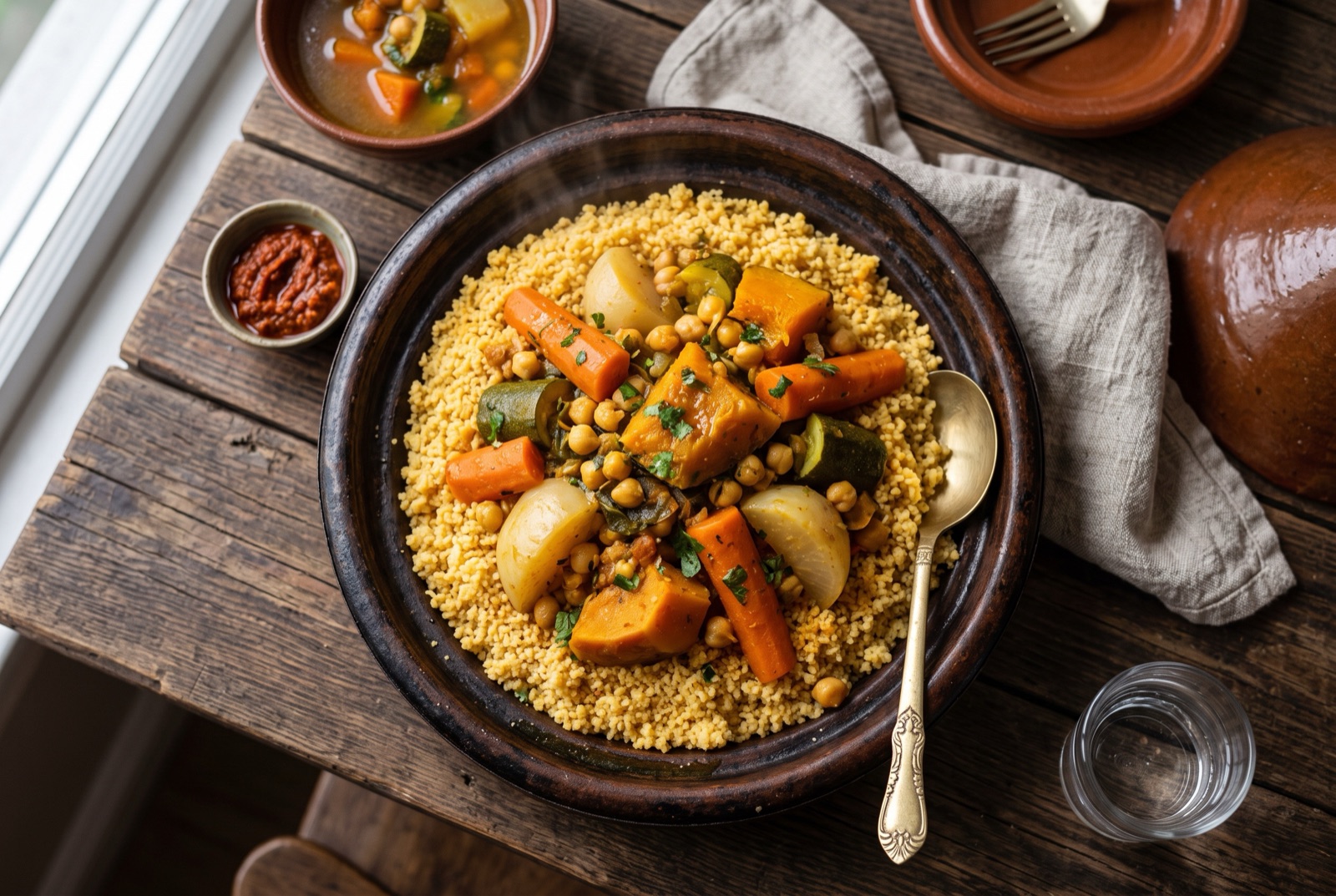
Couscous bel khodra is a mountain of steamed semolina crowned with vegetables that have simmered slowly in a spiced broth — carrot, turnip, pumpkin, zucchini, cabbage and chickpeas, all softened until a spoon goes through them without resistance. The grain itself is the point: steamed over the broth rather than boiled in it, raked and rested between steamings until every granule is separate, swollen and light enough to collapse under a fork. The broth is fragrant rather than fiery, built on saffron, ginger, turmeric and black pepper, and it is ladled over the mound at the table so the grain drinks it up. This is the dish Moroccan families eat after Friday prayers, and it is designed to feed a crowd from one pot.

- Gate
- MoroccoNationwide
- Prep
- 40 min
- Cook
- 1 hr 45 min
- Total time
- 2 hr 25 min
- Serves
- 6
- Status
- Medium
- Nutrition / serving · estimated
- Calories 520 kcal
- Protein 15 g
- Carbs 86 g
- Fat 13 g
- Fiber 11 g
- Sugar 9 g
Why this recipe works.
- Three-steaming method spelled out step by step, including the raking and resting that keeps the grain separate.
- Vegetables added in two waves so the pumpkin does not dissolve while the turnip is still raw.
- Honest workaround for cooks without a couscoussier — a steamer basket over a stockpot does the same job.
- The broth is seasoned to be ladled over the grain, not eaten alone, so it is deliberately fuller than a soup.
Ingredients.
23 itemsFor the grain
For the broth
For the vegetables
Equipment
- Couscoussier, or a stockpot with a steamer basket that sits above the liquid
- Wide shallow dish for raking the grain
- Damp tea towel or strip of dough for sealing
Instructions.
Start the broth
Warm the olive oil in the base of the couscoussier and soften the sliced onions for 8 minutes without colouring them. Stir in the grated tomato, ginger, turmeric, black pepper and crushed saffron and cook for 2 minutes, until the spices smell toasted rather than dusty.
Add chickpeas and liquid
Tip in the drained soaked chickpeas, the tied herb bundle, the salt and 2 litres of water. Bring to a boil, then drop to a steady simmer. The broth should stay well below the level where the steamer basket will sit.
Hydrate the grain
Spread the couscous in a wide dish, rub it with 2 tablespoons of the olive oil until every granule is coated, then sprinkle over 250 ml of warm water mixed with the salt. Rake it through with your fingers and leave for 10 minutes, until the grain has drunk the water and feels damp but loose.
Tip Oil first, then water. Oiled granules resist sticking to each other later.
First steaming
Set the steamer basket over the simmering broth and seal the join with a damp twisted tea towel. Add the couscous loosely — never pack it — and steam uncovered for 15 minutes from the moment steam rises freely through the surface of the grain.
Rake and rest
Tip the hot grain back into the wide dish and break up every lump with a fork, working from the edges inwards. Sprinkle over 150 ml of warm water, rake again, and leave for 10 minutes so the moisture travels to the centre of each granule.
Tip It will feel wetter than seems right. It steams off.
Add the firm vegetables
Slide the carrots, turnips and cabbage wedges into the broth below and return the raked couscous to the basket for a second 15-minute steaming. Reseal the join each time — this is where most of the steam is lost.
Add the soft vegetables
Rake the grain once more with the last of the warm water. Add the pumpkin and zucchini to the broth, tucking them under the surface, and steam the couscous a third and final time for 15 minutes, until it tastes tender all the way through with no chalky core.
Check and finish the vegetables
Fish out the herb bundle. The vegetables are ready when a knife slides into the turnip without resistance and the pumpkin is soft enough to dent with a spoon but still in one piece. Stir the smen or extra butter into the broth and correct the salt — it should taste assertive, since the grain will mute it.
Mound and serve
Fork the butter through the hot grain in a wide shallow dish and build it into a mound with a well in the centre. Lift the vegetables out with a slotted spoon and arrange them over and around the mound, then moisten the whole thing with two ladles of broth. Serve the rest of the broth in bowls for people to add their own.
Tip Add broth gradually at the table. Couscous keeps absorbing, and a drowned mound cannot be rescued.
Tips from our kitchen.
- Use medium-grain dry couscous, not instant. Instant is pre-steamed and turns to paste under this treatment.
- Seal the gap between pot and basket with a damp cloth twisted into a rope, or a strip of flour-and-water dough. Steam that escapes sideways never reaches the grain.
- Rake the grain with your fingers or a fork between steamings while it is still warm — once it cools, the lumps set hard.
- The vegetables should be cut large: quarters and thick batons, not dice. They cook for a long time and small pieces disintegrate into the broth.
- Taste the broth before the second wave of vegetables goes in. It should be slightly saltier and more strongly spiced than you would drink, because the grain absorbs and mutes it.
- If the couscous still tastes hard at the centre after the third steaming, sprinkle over a little more hot water, cover, and give it five minutes off the heat.
Substitutions.
- Smen (aged fermented butter) → Plain unsalted butter, or ghee
- Smen has a pungent, cheese-like funk that is genuinely divisive even in Morocco. Butter gives richness without the tang, and most home cooks abroad will prefer it.
- Turnip → Parsnip, or extra carrot
- Turnip brings a faint bitterness that balances the pumpkin. Parsnip is sweeter, so if you swap it, hold back on the pumpkin slightly.
- Saffron → A generous pinch of turmeric plus a few strands of safflower
- You lose the perfume but keep the colour. Turmeric alone is fine — Moroccan home cooking uses far more turmeric than saffron anyway.
Variations.
- Couscous with lamb
- Brown 700 g of lamb shoulder in the broth pot before the onions and simmer it from the start. The vegetables go in on the same schedule; the broth becomes considerably richer.
- Couscous tfaya
- Topped with tfaya — onions and raisins slow-cooked with cinnamon, honey and a little saffron until jammy and dark. Sweet against the savoury broth, and a Fez favourite for guests.
- Barley couscous (seksu belboula)
- Made with barley grain instead of semolina, common in the Atlas and the countryside. Nuttier, greyer, and slightly chewier — worth seeking out if you find it.
Storage & reheating.
Leftover couscous keeps 3 days refrigerated, ideally with the grain and vegetables stored separately from the broth so nothing turns to mush. To reheat, sprinkle the grain with water, cover and steam for 10 minutes — microwaving works but gives a drier, chewier result. The broth and vegetables reheat happily in a pan and taste better on day two. Cooked couscous grain freezes well for a month; the vegetables do not, as they collapse on thawing.
Serve with
A small bowl of the hot broth per person for ladling, and a dish of harissa loosened with broth for anyone who wants heat. Buttermilk (lben) is the classic Friday drink alongside it.
The story behind Couscous bel Khodra.
Couscous belongs to the whole Maghreb, and Morocco makes no claim to inventing it — the grain is Amazigh (Berber) in origin, rolled by hand from semolina and water long before national borders existed, and Algeria, Tunisia, Libya and Morocco each make versions that locals will defend at length. In 2020 the four countries jointly filed the dish for UNESCO recognition rather than fight over it, which tells you something about how deeply shared it is. What is distinctly Moroccan is the rhythm: couscous is Friday food, cooked for the family meal after the midday prayer, and in many households the week is quietly organised around it.
The seven-vegetable version has a slightly mythical reputation. Seven is a number that recurs in Moroccan life and the count is treated loosely — cooks add what the market offered, and nobody is disqualified for using six or eight. What matters is the mix of textures: something sweet and collapsing like pumpkin, something firm and earthy like turnip, something that holds its shape like carrot, and chickpeas for body. In the Atlas and the south the broth leans plainer and more vegetable-forward; on the Atlantic plains it often carries lamb or beef simmered alongside.
The traditional vessel is the couscoussier, a two-part pot where the broth bubbles below and the perforated basket sits above, sealed at the join with a strip of dough or damp cloth so the steam has nowhere to escape but up through the grain. Three steamings sound fussy and are not: each one takes fifteen minutes of unattended work, and the raking in between is what turns a dense clump into the loose, cloud-like grain that separates real couscous from the boxed instant version. Serving is a ritual of its own — the mound is built in a wide shallow dish, the vegetables arranged in a fan on top, the broth passed separately, and everyone eats from the section of the dish directly in front of them.
Questions, answered.
Can I make couscous without a couscoussier?
Yes. Set a metal steamer basket or a fine colander over a stockpot of simmering broth, making sure the base of the basket sits above the liquid rather than in it. Seal the gap where the two meet with a damp twisted tea towel so steam is forced up through the grain instead of escaping around the sides. The result is very close to the real thing.
Why does my couscous come out clumpy?
Almost always because it was not raked between steamings. Semolina granules swell and stick to each other as they take on moisture, and if you leave them alone they set into one mass. After each steaming, tip the grain into a wide dish, sprinkle it with water and a little oil, and break it apart with your fingers or a fork until it flows loosely again.
Is instant couscous acceptable here?
It will feed you, but it is a different dish. Instant couscous is already steamed and dried, so the three-steaming method turns it soft and pasty. If instant is all you have, hydrate it separately with hot broth according to its packet, fluff it with butter, and use the vegetables and broth from this recipe as the topping.
Does it really need seven vegetables?
No. Seven is a traditional number treated loosely, and Moroccan cooks use whatever the market has. Aim instead for a range of textures — one sweet and soft such as pumpkin, one firm and earthy such as turnip, one that holds its shape such as carrot, plus chickpeas. Five good vegetables beat seven tired ones.
Can I prepare any of it in advance?
The broth and vegetables can be cooked a day ahead and refrigerated, which improves the flavour. The grain is best steamed fresh, but you can complete the first two steamings in advance, keep the grain covered at room temperature, and do the final steaming just before serving.
You might also like.
All recipes →
Keep exploring Morocco.
Morocco has 9 more dishes in the atlas — Atay bi Na'na and Bastilla, and 7 more.
All Morocco recipes Carrot recipes Chickpeas recipes Onion recipes mainvegetarianhalal friendlynut freeRecipe by The DishRoute Kitchen · published August 19, 2026 · updated August 19, 2026