Sfenj.
Moroccan Yeast Doughnuts
سفنج · Sfinj · say it: SFENJ
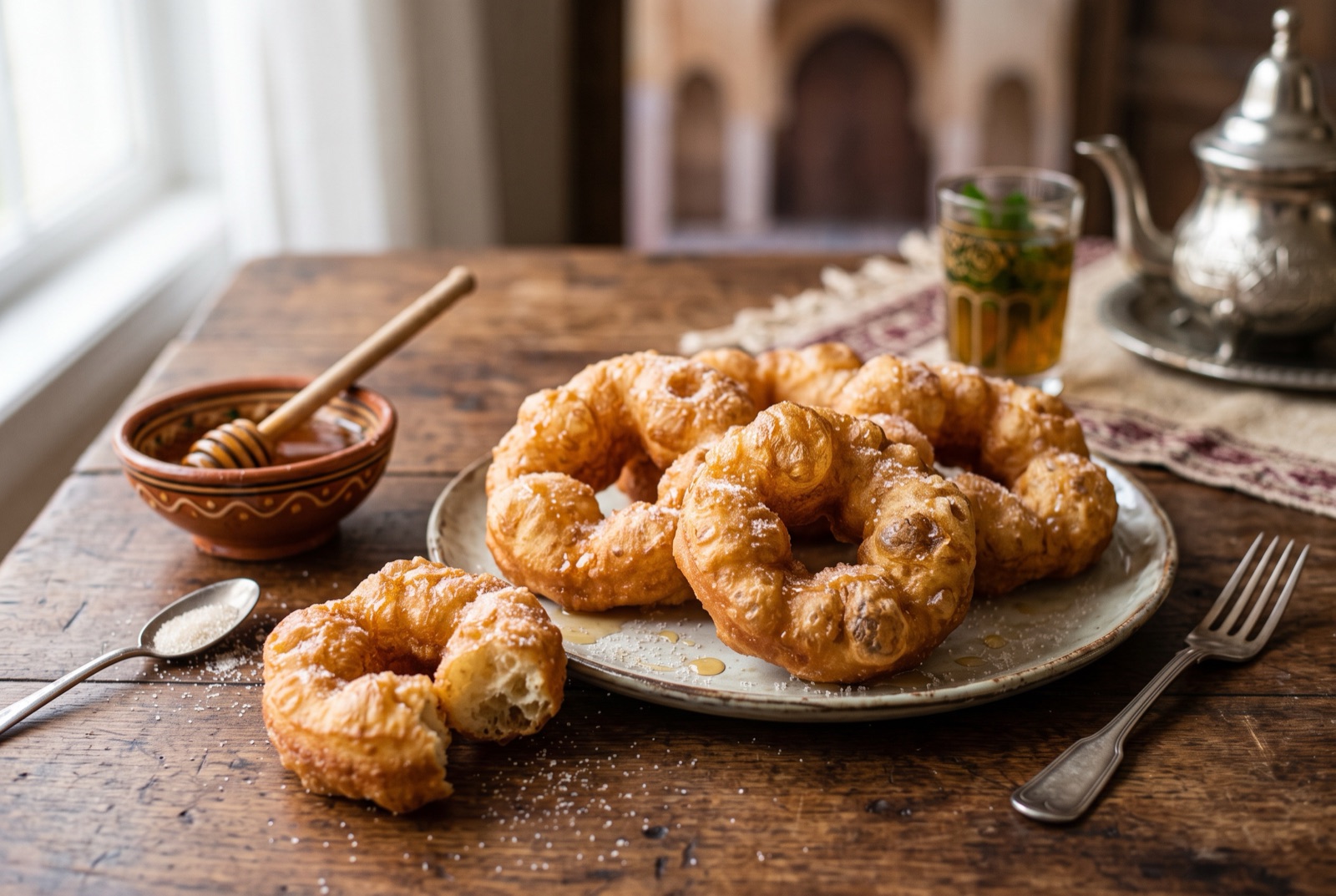
Sfenj is a doughnut with almost no sugar in it. The dough is a wet, sticky mass of flour, water, yeast and salt, beaten rather than kneaded, left to rise until it is full of air, then torn into pieces, pierced with a wet thumb and stretched into an uneven ring straight into hot oil. What comes out is glossy and blistered on the outside and stretchy, almost bready, inside — chewier than a Western doughnut and far less sweet, which is why it is finished with sugar, honey or simply eaten plain with tea. It is a breakfast food, sold from dedicated stalls in the early morning and carried home on a loop of palm leaf or string.

- Gate
- MoroccoNationwide
- Prep
- 20 min
- Cook
- 20 min
- Total time
- 2 hr 10 min incl. 1 hr 30 min rest
- Serves
- 6
- Status
- Easy
- Nutrition / serving · estimated
- Calories 340 kcal
- Protein 7 g
- Carbs 54 g
- Fat 11 g
- Fiber 2 g
- Sugar 4 g
Why this recipe works.
- Hydration kept deliberately high, which is what gives sfenj its open, chewy interior rather than a cakey crumb.
- Shaping done with wet hands straight over the pan, the way stalls do it, with no rolling pin involved.
- Oil temperature spelled out, since sfenj fails more often from wrong heat than from wrong dough.
- No sugar in the dough, so it fries the right colour and stays true to what sfenj actually is.
Ingredients.
7 itemsFor the dough
For frying
To serve
Equipment
- Deep heavy pan or wok for frying
- Cooking thermometer
- Slotted spoon
- Bowl of water for wetting hands
Instructions.
Beat a very wet dough
Whisk the flour, yeast, salt and sugar together, then pour in the warm water all at once. Beat hard with your hand or a stand mixer on medium for 8 minutes, until the mass turns from shaggy to smooth, glossy and elastic enough to stretch between your fingers without snapping.
Tip It will look wrong — closer to thick batter than dough. That is correct.
Rise until bubbly
Oil the surface of the dough lightly, cover the bowl and leave it somewhere warm for about 90 minutes, until it has doubled, domed and filled with visible bubbles. It should collapse with a sigh when you press a wet finger into it.
Heat the oil
Pour oil into a deep heavy pan to a depth of at least 6 cm and bring it to 170–175°C. Test with a scrap of dough: it should sink briefly, then rise and start bubbling steadily within three seconds.
Tip Have a plate lined with paper and your sugar or honey ready before the first ring goes in.
Shape the rings wet
Wet both hands thoroughly. Pinch off a piece of dough about the size of a small lemon, push a wet thumb through the centre, and stretch the hole to roughly 4 cm by turning the ring between your fingers. Work directly over the pan — the dough will not survive being carried.
Fry until blistered
Lower two or three rings into the oil and fry for 2 minutes, until the underside is deep golden and the surface blisters, then flip and give them another 90 seconds. They should puff noticeably and float high in the oil.
Tip If a ring stays pale and sinks, the oil has dropped — wait for it to recover before the next batch.
Drain and finish
Lift the sfenj out with a slotted spoon and drain briefly on paper. While the surface is still glossy, toss in granulated sugar or dip in warm honey, and eat straight away with tea — they are at their best within minutes.
Tips from our kitchen.
- Do not add flour to make the dough easier to handle. It is meant to be almost pourable — keep a bowl of water beside you and wet your hands instead.
- Beat the dough with your hand or a stand mixer for a full 8 minutes. It should go from shaggy to smooth and elastic enough to stretch without tearing.
- Let it rise until it is visibly bubbly and domed, then collapses when you touch it. Under-risen dough fries dense.
- Oil at 170–175°C. Too cool and the rings soak up fat and turn greasy; too hot and the outside darkens while the middle is still raw dough.
- Make the hole bigger than seems right — around 4 cm. It closes considerably as the ring hits the oil and puffs.
- Fry no more than three at a time. Crowding drops the oil temperature and the whole batch turns heavy.
Substitutions.
- Instant yeast → Fresh yeast, 15 g, crumbled into the warm water
- Fresh yeast is what most Moroccan stalls use. Give the dough a slightly longer first rise and watch the dough rather than the clock.
- Neutral frying oil → Sunflower or peanut oil
- Any oil with a high smoke point works. Avoid olive oil, which burns at this temperature and gives a bitter edge.
- Plain white flour → Bread flour
- Bread flour gives a chewier, stretchier ring closer to what a good stall produces. Add an extra 20 ml of water, as it absorbs more.
Variations.
- Sfenj with honey
- Dip each hot ring in warm honey loosened with a spoonful of water so it coats without clogging. Sticky, and the version children campaign for.
- Sugared sfenj
- Toss straight from the oil in granulated sugar while the surface is still glossy. The simplest finish and the one you see most often on the street.
- Sfenj with egg
- A stall speciality: an egg is cracked into the centre of a ring as it fries so it sets in the hole. Served savoury with salt and cumin.
Storage & reheating.
Sfenj is a same-hour food and there is no honest way around it — within a couple of hours the chew turns tough and the surface goes leathery. If you have leftovers, keep them uncovered at room temperature and revive them in a 180°C oven for 4 minutes, which restores some crispness but not the original texture. The raw dough is more useful: after the first rise, refrigerate it for up to 24 hours, then bring it back to room temperature for an hour before frying. Do not freeze fried sfenj.
Serve with
Mint tea or strong coffee, first thing in the morning. A bowl of granulated sugar and a jug of warm honey so people can finish their own.
The story behind Sfenj.
Sfenj belongs to the morning street. In Moroccan cities the sfenjs stalls open early, and the sfenndji works standing over a wide cauldron of oil, hands wet, shaping and dropping rings continuously into the fat while a queue forms. The doughnuts are threaded onto a length of palm frond or twine so a customer can carry a dozen home swinging from one finger — a detail that has survived plastic bags entirely intact. They are eaten hot, usually before nine, with mint tea or coffee.
The dish is shared across the Maghreb: Algeria and Tunisia have their own close equivalents, and among Moroccan and Algerian Jewish communities sfenj is the traditional Hanukkah fried food, taken along when those communities emigrated and now common in Israel, where it is eaten dusted with sugar during the festival. That parallel history is one of the clearer traces of how intertwined Jewish and Muslim kitchens were across North Africa for centuries.
What separates sfenj from a doughnut is the sugar, or rather its absence. The dough is essentially bread dough taken to a very high hydration, so it fries into something with real chew and a savoury-leaning base, and any sweetness arrives afterwards from a dip in sugar or a drizzle of honey. Some households eat them plain with tea and consider sugar an indulgence for children. The hydration is what frightens home cooks and what makes the dish: this is not a dough you can roll out, and any attempt to make it manageable with extra flour produces a heavy, cakey ring. Wet hands, a bowl of water beside the pan, and acceptance that the shapes will be irregular are the whole trick.
Questions, answered.
Why is my sfenj greasy and heavy?
The oil was too cool. Below about 165°C the dough absorbs fat instead of instantly sealing, and you end up with a soggy, oil-logged ring. Use a thermometer, aim for 170–175°C, and fry only two or three at a time so the temperature does not crash when the cold dough goes in.
The dough is far too sticky to shape. Did I do something wrong?
Almost certainly not — sfenj dough is supposed to be barely manageable. The fix is not more flour but wet hands. Keep a bowl of water next to the pan, wet your fingers before touching the dough each time, and pinch off pieces rather than trying to lift and shape them on a board.
Are sfenj the same as beignets or Spanish churros?
No. Beignets use an enriched dough with egg, milk and sugar, and churros use a cooked flour-and-water paste piped through a star nozzle. Sfenj is high-hydration yeast bread dough with no sugar and no fat in it, shaped by hand into irregular rings — chewier and much less sweet than either.
Can I make the dough the night before?
Yes. Let it complete its first rise at room temperature, then cover and refrigerate for up to 24 hours. The cold ferment improves the flavour. Take it out about an hour before frying so it warms and loosens, otherwise cold dough shapes badly and fries unevenly.
Can I bake sfenj instead of frying?
Baked rings will be pleasant bread, but they are not sfenj. The blistered, glossy skin and the contrast between crisp outside and stretchy inside come specifically from hot oil hitting a very wet dough. If frying is not an option, use the dough for small flatbreads on a griddle instead.
You might also like.
All recipes →
Keep exploring Morocco.
Morocco has 9 more dishes in the atlas — Atay bi Na'na and Bastilla, and 7 more.
Recipe by The DishRoute Kitchen · published August 19, 2026 · updated August 19, 2026