Msemen.
Moroccan Square Laminated Flatbread
مسمن · Msemmen · say it: mm-SEM-men
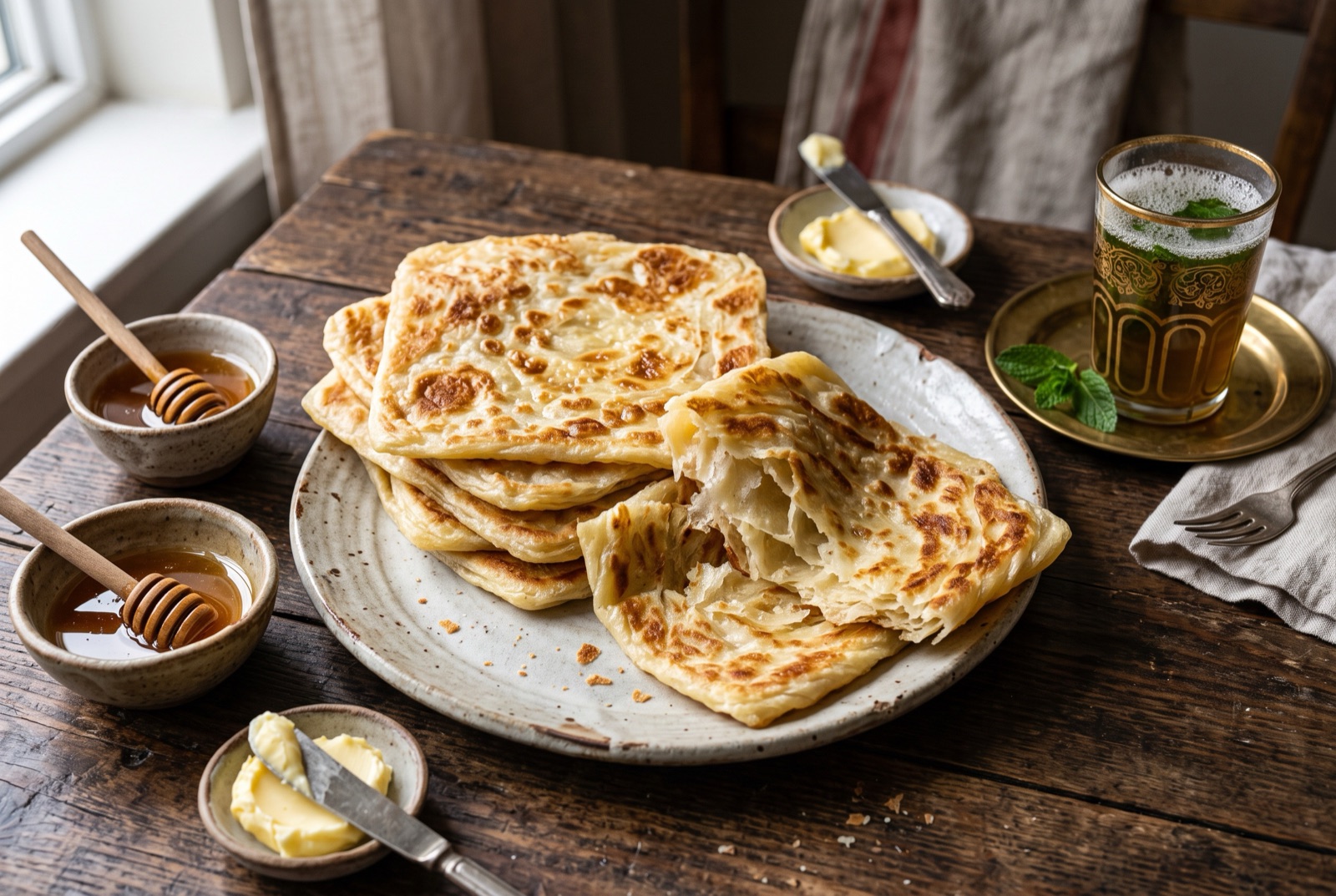
Msemen is a square, pan-cooked flatbread built from dozens of thin layers. A soft dough of flour and fine semolina is rested until slack, then each ball is stretched by hand on an oiled surface until you can almost read through it, smeared with oil and a little semolina, and folded into a square parcel. On a hot dry griddle those folds separate into leaves that are chewy at the centre and crisp at the corners. Eaten hot with honey and melting butter, or with amlou, it is the standard companion to afternoon mint tea across Morocco. The dough is forgiving; the stretching is the skill, and it takes about three attempts to get right.

- Gate
- MoroccoNationwide
- Prep
- 30 min
- Cook
- 25 min
- Total time
- 1 hr 35 min incl. 40 min rest
- Serves
- 4
- Status
- Medium
- Nutrition / serving · estimated
- Calories 390 kcal
- Protein 8 g
- Carbs 58 g
- Fat 14 g
- Fiber 3 g
- Sugar 2 g
Why this recipe works.
- Hydration set high on purpose — a slack, sticky dough is what allows the paper-thin stretch that makes the layers.
- Oil and fine semolina between the folds, not butter alone, so the leaves actually separate instead of fusing.
- Cooked on a dry pan rather than a greased one, which crisps the exterior instead of frying it heavy.
- Includes the stuffed savoury version, which uses the same dough and turns the bread into a meal.
Ingredients.
10 itemsFor the dough
For folding
To serve
Equipment
- Heavy frying pan or flat griddle
- A smooth work surface you can oil freely
- Small bowl of oil for hands and dough
Instructions.
Mix a slack dough
Combine the flour, fine semolina, salt, sugar and yeast in a bowl and add the warm water in stages, mixing with your hand. Work it for 8–10 minutes until you have a very soft, tacky dough that stretches when pulled and clings lightly to your fingers.
Tip It should feel wetter than a bread dough. Resist adding flour to make it manageable.
Portion and rest under oil
Oil your hands and divide the dough into 8 equal balls, rolling each smooth. Set them well apart on an oiled tray, coat each with more oil, cover with cling film and rest for 40 minutes at room temperature until they feel slack and spread slightly under their own weight.
Stretch one thin
Slick your work surface with oil. Place one ball down, press it flat with oiled palms, then push outward from the centre in all directions until you have a sheet so thin you can see the colour of the counter through it. Small holes at the edges are fine.
Tip Push and slide rather than pull. Pulling from the rim is what causes tears.
Oil, scatter and fold
Brush the sheet with the melted butter and oil mixture and scatter over a tablespoon of fine semolina. Fold the left and right thirds into the centre to make a long band, scatter more semolina, then fold the top and bottom thirds in to form a square parcel roughly 10 cm across.
Rest the squares
Set the folded squares on the oiled tray, seam side down, and leave them for 10 minutes while you shape the rest. This short rest lets the dough relax so the square can be pressed wider without the layers tearing.
Flatten and griddle
Heat a heavy pan over medium heat with no oil. Press each square out on the oiled surface until it is about 15 cm across and 5 mm thick, then lay it in the dry pan. Cook for 2–3 minutes per side, pressing down with a spatula, until golden blistered patches form and the edges look dry and layered.
Tip If it browns in under a minute the pan is too hot — the inner layers will still be raw.
Stack and serve hot
Stack the cooked msemen on a plate under a clean cloth so they stay soft while you finish the batch. Tear one open at the seam to check the layers have separated, then serve straight away with honey and butter, or with amlou.
Tips from our kitchen.
- The dough should be tacky enough to cling to your fingers when mixed. If it feels like bread dough you can knead comfortably, it is too dry to stretch thin.
- Rest the balls under oil for at least 20 minutes. Gluten that has relaxed stretches; gluten that has not will spring back and tear.
- Work on a smooth oiled counter, not a floured board. Flour makes the dough grip and rip — oil lets it slide out to a transparent sheet.
- Fold in thirds twice, always with a scatter of fine semolina in between. Skipping the semolina is the reason msemen sometimes comes out as one solid slab.
- Cook on medium, not high. Too hot and the outside browns before the inner layers set, leaving a raw doughy core.
- Press the square down with a folded cloth or spatula while it cooks so every part touches the pan and puffs evenly.
Substitutions.
- Fine semolina (smida) → Fine cornmeal, or extra plain flour
- Cornmeal separates the layers well but tastes different. Extra flour works at a push, though the bread loses some of its characteristic slight grit.
- Vegetable oil for stretching → Melted butter, or half oil and half melted butter
- Butter gives a richer flavour but burns faster on the griddle and firms up as it cools, making the bread less pliable when cold.
- Plain white flour → Half white and half fine wholemeal
- Nuttier and slightly less stretchy. Add a little extra water and expect a few more tears while stretching.
Variations.
- Msemen mâamar (stuffed)
- Before the final fold, spread a cooled mixture of fried onion, tomato, paprika and parsley across the square. Cooked the same way, it becomes lunch rather than tea bread.
- Rghaif with khlii
- Filled with khlii, the preserved spiced beef stored in its own fat, and often cooked with an egg cracked over the top in the pan. Rich, salty and very traditional in the north.
- Sweet msemen with amlou
- Served with amlou — toasted almonds ground with argan oil and honey into a loose spread from the Souss region. The nuttiest way to eat it, and hard to stop at one.
Storage & reheating.
Msemen is best within an hour of cooking. Cooled squares keep 2 days in an airtight box at room temperature, but they stiffen — revive them for 40 seconds per side in a dry pan, which restores most of the flakiness. Stack cooled msemen between sheets of baking paper and freeze for up to 2 months; reheat straight from frozen in a covered dry pan over low heat for 3 minutes per side. Uncooked folded squares can also be frozen flat and griddled from frozen, which is the better option if you want fresh bread on demand.
Serve with
Mint tea, honey warmed with butter until it pours, and amlou if you can find argan oil. Harira during Ramadan, torn and used to scoop.
The story behind Msemen.
Msemen sits in the everyday layer of Moroccan cooking rather than the ceremonial one. It is street and household food — sold from small griddle stalls in the morning, folded in paper and eaten walking, or made at home in a stack for the late-afternoon tea that structures the Moroccan day. In many families it is a weekend project, with someone stretching while someone else cooks and the pile disappearing about as fast as it grows.
The technique is shared across North Africa with local names and variations: the Algerian mhajeb is a close cousin, often stuffed with a cooked onion and tomato filling, and Tunisia has its own related breads. What ties them together is lamination by hand rather than by rolling pin — no butter block, no chilling, no folding schedule, just oiled fingers and gravity doing the work that a pastry chef would do with a laminator. The fine semolina scattered between the folds is what keeps the layers from welding shut; it acts as a physical separator that oil alone cannot manage.
The savoury version, msemen mâamar, is stuffed before folding with khlii or with a fried onion, tomato and pepper mixture, which turns tea bread into a full meal. There is also a sweeter tradition of eating msemen with honey warmed with butter until the two pour together, or with amlou, the argan oil, almond and honey spread from the Souss region in the southwest. In Ramadan the plain version appears on the iftar table beside harira, where its job is to be torn and dipped. None of this requires special equipment: a heavy frying pan, a flat surface you can oil freely, and a willingness to have oily hands for twenty minutes.
Questions, answered.
Why did my msemen come out solid instead of layered?
The folds fused together, which happens for two reasons: not enough oil between the layers, or no fine semolina scattered with it. Oil alone can be absorbed by the dough during cooking, while semolina grains sit physically between the leaves and keep them apart. Be generous with both, and fold in thirds twice rather than rolling the dough up.
My dough tears when I stretch it. What went wrong?
Usually it has not rested long enough, or the surface is floured instead of oiled. Give the oiled dough balls at least 20 minutes, and up to an hour, so the gluten relaxes. Then stretch on a smooth surface slicked with oil, pushing outward from the centre with flat palms rather than pulling at the edges.
Can I make the dough the night before?
Yes. Portion the dough into oiled balls, cover them tightly and refrigerate overnight. Bring them back to room temperature for about 30 minutes before stretching, since cold dough is stiff and resists. The overnight rest actually improves the stretch.
Do I need semolina, or can I use only flour?
You can make it with flour alone and it will still work, but the texture changes. Fine semolina gives msemen its faint grit and helps the layers stay separate during cooking. If you skip it in the dough, at least use a little between the folds — fine cornmeal is a workable stand-in.
What is the difference between msemen and baghrir?
They are completely different breads that often appear on the same tea tray. Msemen is a folded, laminated dough griddled into flaky squares. Baghrir is a thin semolina batter poured onto a pan and cooked on one side only until its surface fills with hundreds of small holes, which is why it is called the thousand-hole pancake.
You might also like.
All recipes →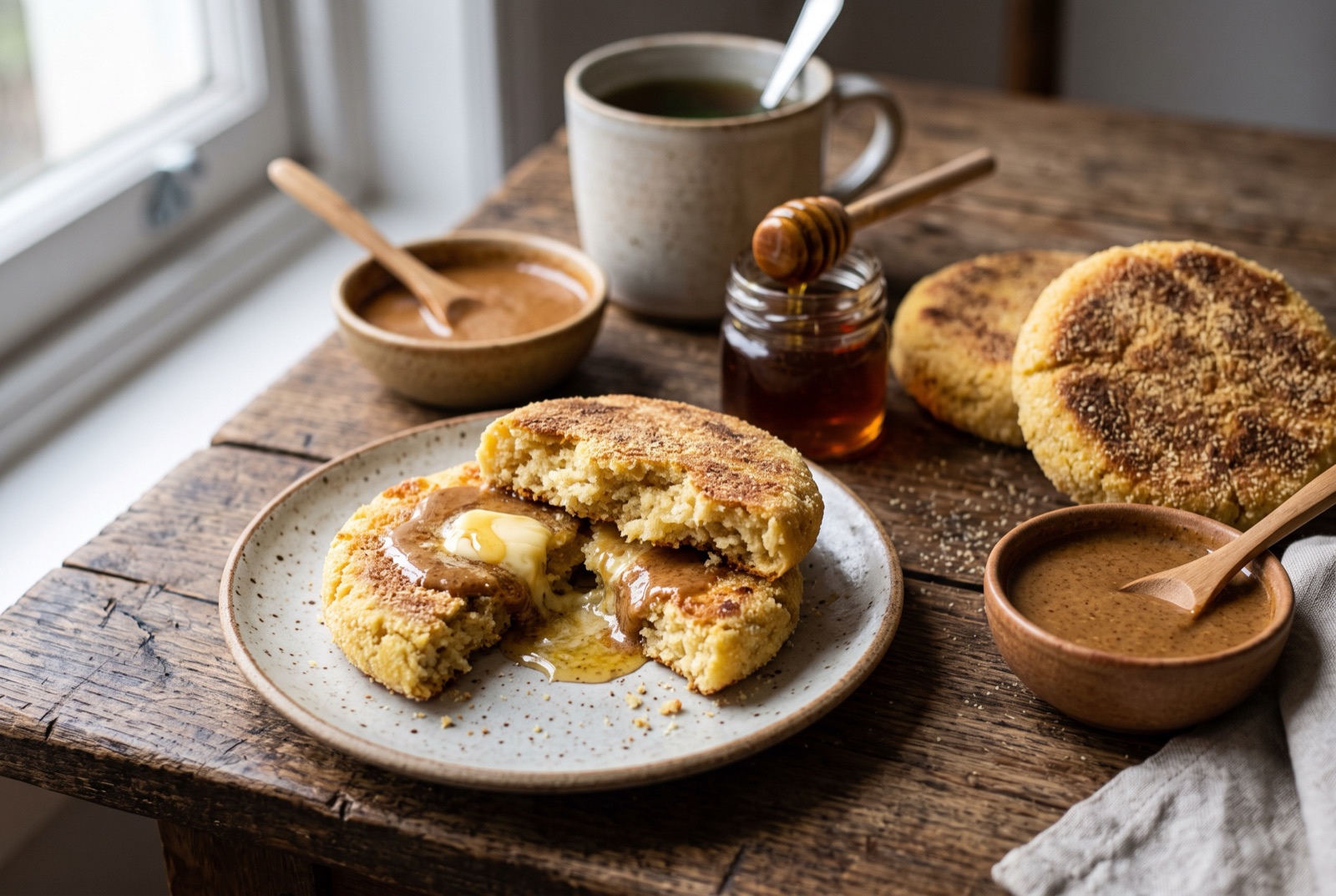
Keep exploring Morocco.
Morocco has 9 more dishes in the atlas — Atay bi Na'na and Bastilla, and 7 more.
Recipe by The DishRoute Kitchen · published August 19, 2026 · updated August 19, 2026