Harcha.
Moroccan Semolina Pan Bread
حرشة · Harsha · say it: HAR-shah
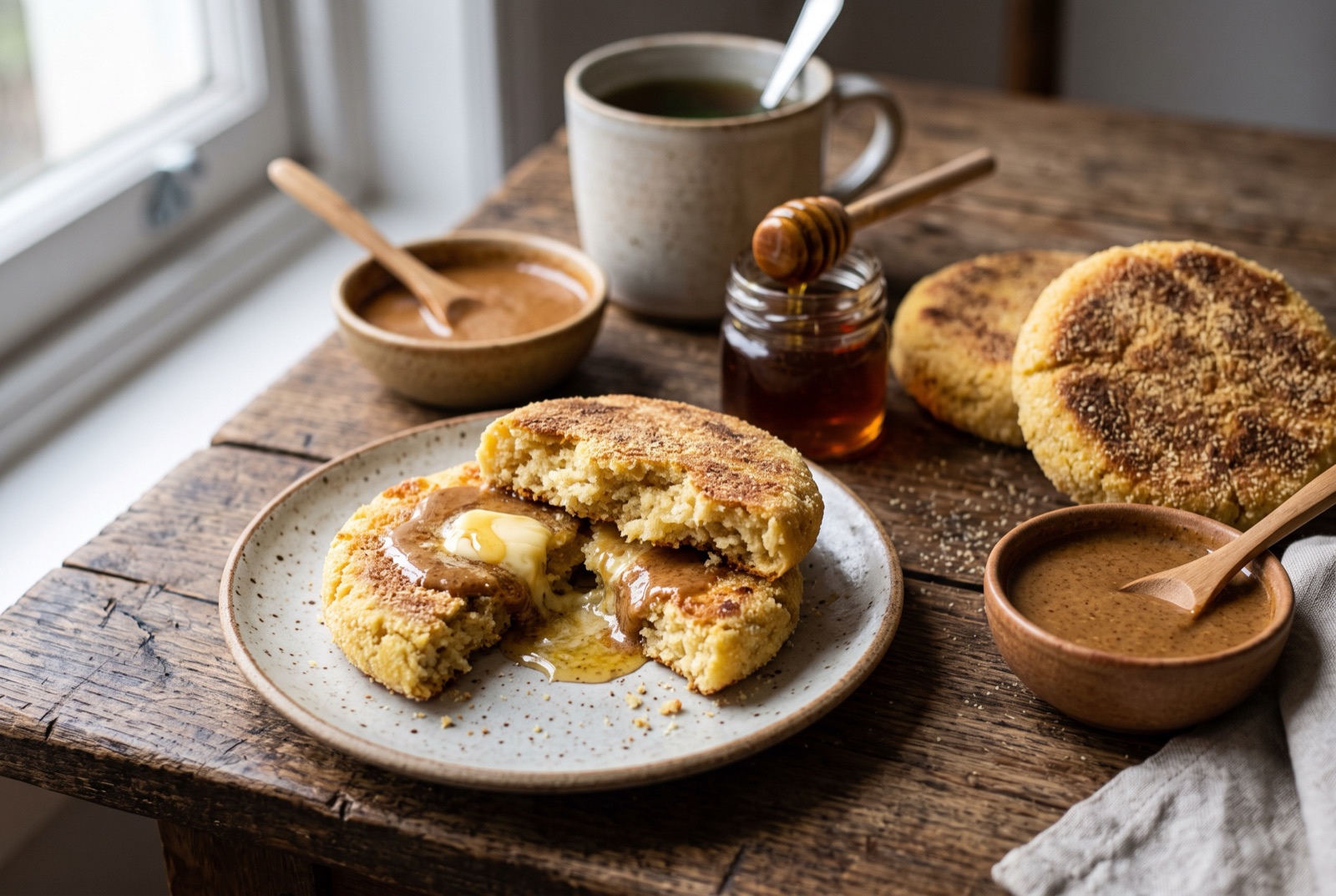
Harcha is a thick, pale disc of coarse semolina rubbed with butter, bound with just enough milk to hold, and cooked in a dry pan until both faces are freckled and crisp. It is not a bread in the yeasted sense: there is no rising, no kneading and no proving, and the texture is closer to a very short, crumbly cake than to a loaf. That crumb is the whole appeal — it drinks up melted butter and honey the moment you split a hot one open, which is exactly how it is eaten at breakfast and again at teatime. From bowl to plate is about half an hour, and the only technique that matters is not overworking the mixture.

- Gate
- MoroccoNationwide
- Prep
- 10 min
- Cook
- 16 min
- Total time
- 36 min incl. 10 min rest
- Serves
- 4
- Status
- Easy
- Nutrition / serving · estimated
- Calories 330 kcal
- Protein 7 g
- Carbs 48 g
- Fat 12 g
- Fiber 2 g
- Sugar 8 g
Why this recipe works.
- Butter rubbed into the semolina like pastry, which is what produces the short, sandy crumb instead of a rubbery disc.
- Rest built into the method so the semolina hydrates properly and the rounds stop falling apart in the pan.
- Cooked dry, not fried, so the outside crisps and the inside stays tender.
- Thirty minutes start to finish, with no yeast, no proving and no oven.
Ingredients.
8 itemsFor the dough
For shaping
To serve
Equipment
- Heavy frying pan or flat griddle
- Mixing bowl
- Round cutter or a glass, about 8 cm
Instructions.
Rub the butter through
Put the semolina, sugar, baking powder and salt in a wide bowl and add the softened butter. Rub it through with your fingertips for 2–3 minutes until no lumps of butter remain and the mixture looks and feels like damp sand.
Tip This is the step that makes harcha short and crumbly. Do not shortcut it with a spoon.
Add the milk, barely mix
Pour in most of the warm milk and turn the mixture over with a fork just until it clumps together. Add the remaining milk only if a handful will not hold its shape when squeezed. Stop the moment it comes together — it should look rough, not smooth.
Rest to hydrate
Cover the bowl and leave it for 10 minutes. The semolina will absorb the milk and the mixture will change from wet and sloppy to firm enough to shape without sticking to your hands.
Shape the rounds
Scatter the extra semolina on a tray. Press the mixture out to a 1.5 cm thick slab, cut 8 rounds with a cutter or glass, and coat both faces in the loose semolina. Re-press the offcuts and cut again rather than kneading them.
Tip Press the edges gently inwards as you lift each round so it does not fracture.
Cook dry and slow
Heat a heavy pan over low-medium heat with no fat at all. Lay in the rounds and cook for 6–8 minutes per side, until the surface is dry, freckled with golden-brown patches and sandy to the touch, and the edge looks set rather than damp.
Tip If they colour in under three minutes, take the heat down. The centre needs time.
Split and fill hot
Lift the harcha onto a plate and split each one horizontally while it is still too hot to hold comfortably. Push in a knob of butter and a spoon of honey so they melt into the crumb, and eat immediately with mint tea.
Tips from our kitchen.
- Use medium or coarse semolina, not fine. Fine semolina makes a dense, pasty round with none of the characteristic grain.
- Rub the butter in with your fingertips until the mixture looks like damp sand, before any liquid goes in.
- Add the milk gradually and stop as soon as the mixture holds together when squeezed. It should look barely combined, never smooth.
- Let the mixture sit for 10 minutes before shaping — the semolina needs time to drink, and rounds shaped too early crack and crumble apart.
- Cook on low to medium heat. High heat gives you a dark crust over a raw, gritty centre every time.
- Shape the rounds about 1.5 cm thick. Thinner and they dry out; thicker and the middle never cooks through.
Substitutions.
- Milk → Water, or orange juice for a sweeter version
- Water works fine and makes the harcha dairy-free if you also swap the butter. Orange juice is a common home variation and gives a faint sweetness.
- Butter → Olive oil, or a neutral oil
- Oil gives a slightly heavier, less short crumb. Rub it through the semolina the same way; you will need about 20 percent less by volume.
- Coarse semolina → Half fine semolina and half polenta
- A workable stand-in if coarse smida is not available. Polenta brings back the grain that fine semolina alone would lose.
Variations.
- Savoury harcha
- Fold grated cheese, chopped parsley and a pinch of cumin through the mixture before shaping. Modern rather than traditional, and very good with mint tea.
- Harcha with amlou
- Split hot and filled with amlou, the Souss region spread of toasted almonds ground with argan oil and honey. Nutty, rich, and the version most worth going out of your way for.
- Stuffed harcha
- Shape the rounds around a spoon of soft cheese or khlii before cooking, sealing the edges well. Slower to cook through, so drop the heat and give it a few extra minutes per side.
Storage & reheating.
Harcha keeps 2 days in an airtight container at room temperature, though it firms up noticeably by the second day. Refresh it in a dry pan over low heat for 2 minutes per side, or briefly in a toaster, which brings back the crisp surface. It freezes well cooked — stack with baking paper between the rounds and freeze for up to 2 months, then reheat straight from frozen in a covered pan for 4 minutes per side. Do not refrigerate: the fridge dries the crumb out faster than the counter does.
Serve with
Mint tea, and a dish of butter with honey warmed together until they pour as one. Apricot jam or soft cheese for a breakfast spread.
The story behind Harcha.
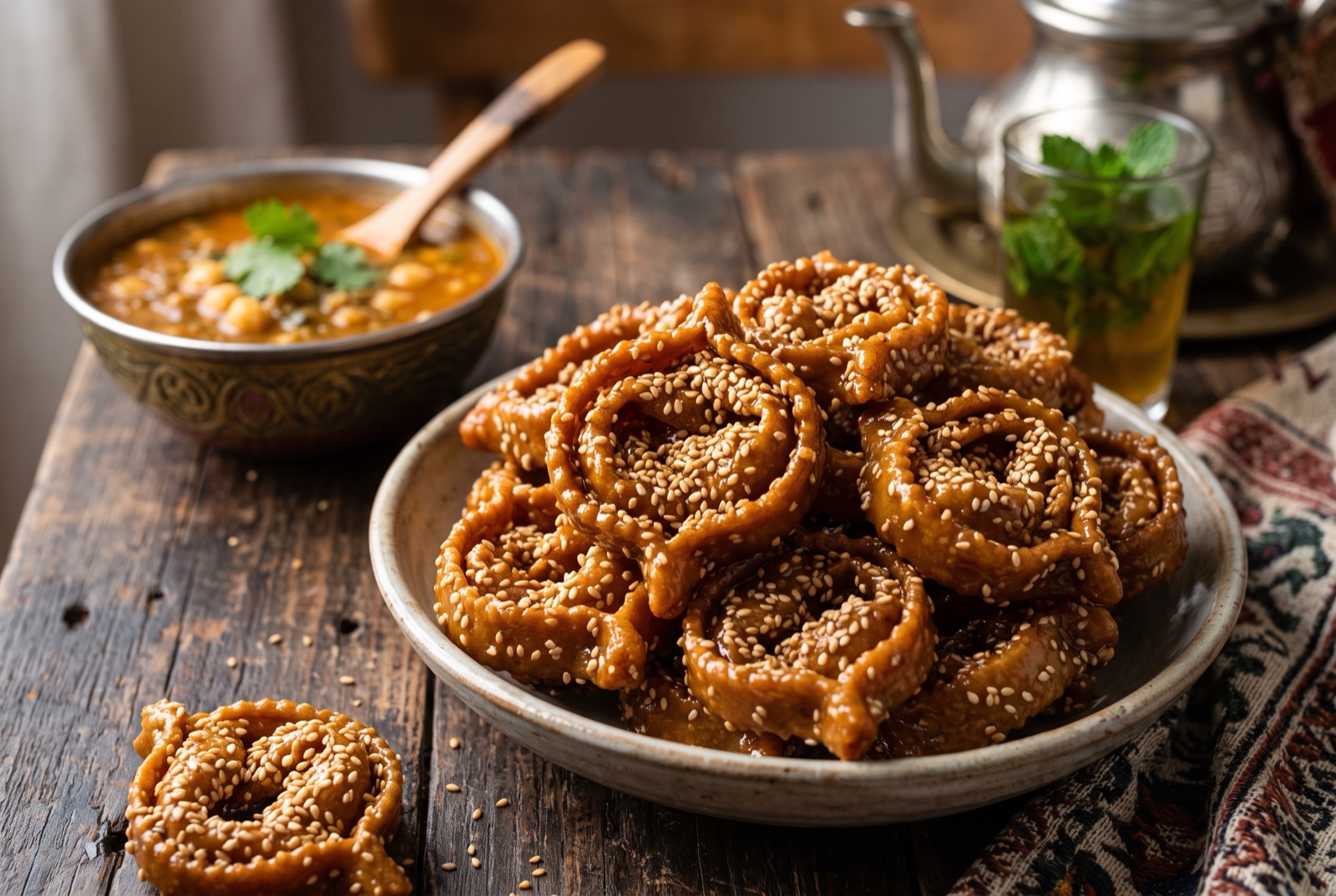
Harcha is Moroccan home baking at its plainest and most reliable. It requires no oven, which matters in a country where many households historically sent bread to a communal wood-fired oven rather than baking at home, and where a pan on a gas ring has always been the fastest route to something hot. That practicality is why it turns up so often: for breakfast with mint tea, in the late afternoon when children come home, and on the iftar table during Ramadan next to harira and chebakia.
The name relates to roughness, which describes both the coarse semolina and the sandy surface the finished bread develops. Everything hinges on the semolina grade — medium or coarse smida gives harcha its grain and slight crunch, while fine semolina produces something denser and more uniform that Moroccans would recognise as a different bread. The butter is rubbed into the dry semolina first, the way you would rub fat into flour for pastry, and then liquid is added last and barely mixed. Working the mixture develops structure, and structure is precisely what harcha should not have.
Street vendors and neighbourhood bakeries sell it stacked and still warm, sometimes already split and filled with soft cheese or jam. At home it is usually made plain and filled at the table, which lets everyone choose: butter and honey for the traditionalists, amlou for those near enough to argan country to have a jar, apricot jam for children, and in the north a slice of laughing-cow style processed cheese that has become a genuine, if unglamorous, part of the modern Moroccan breakfast. Savoury versions studded with cheese and herbs exist too, and are considered a modern liberty rather than heresy.
Questions, answered.
Why does my harcha fall apart in the pan?
Either the mixture was too dry or it did not rest. Semolina takes several minutes to absorb liquid, so a mixture that looks correct straight after mixing can dry out as it sits. Let it rest 10 minutes, then check: it should hold its shape when pressed into a round and not crack heavily around the edges. If it still crumbles, work in another tablespoon of milk.
Can I bake harcha in the oven instead?
You can, at around 190°C for 20 minutes, and it will be edible — but it will not be harcha. The dry pan is what forms the sandy, crisp crust on both faces, and an oven produces something drier and more uniform. If you have a pan and a hob, use them.
What is the difference between harcha and msemen?
They share a tea tray but nothing else. Harcha is an unleavened semolina round with butter rubbed through it, cooked dry until crumbly and short. Msemen is a soft wheat dough stretched paper-thin, oiled, folded into squares and griddled so it separates into flaky layers. Harcha is quick and crumbly, msemen is fiddly and flaky.
Is harcha sweet or savoury?
The bread itself is barely sweet — usually only a spoon or two of sugar in the whole batch, mostly for browning. It is neutral by design, so the filling decides. Honey and butter make it a sweet breakfast; cheese, olives or khlii make it savoury. Both are entirely normal in Morocco.
Can I make the mixture in advance?
Yes, up to a day. Cover it tightly and refrigerate, then let it come back to room temperature and check the texture before shaping, as it will have stiffened. You may need a splash more milk to bring it back to the point where it holds together without cracking.
You might also like.
All recipes →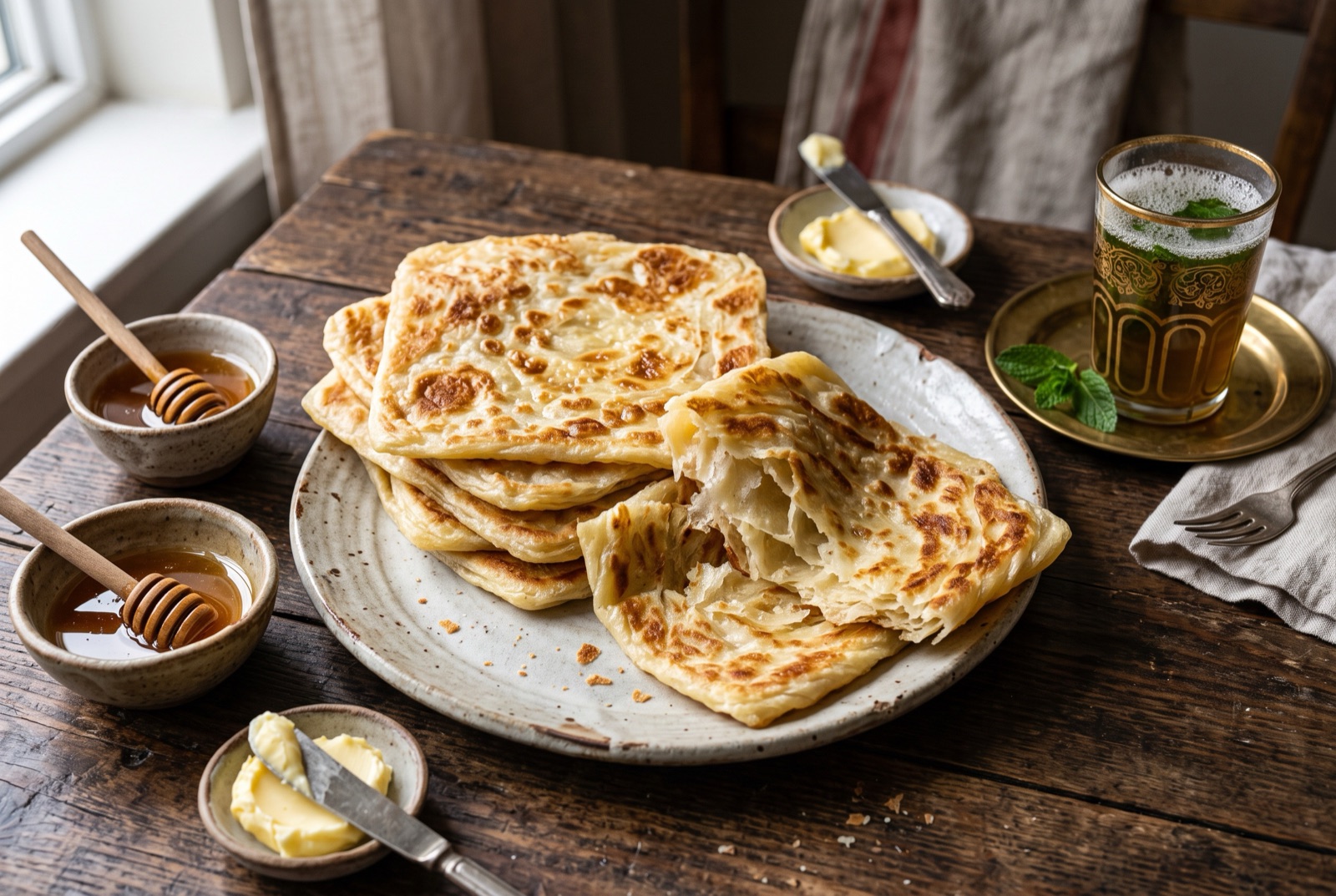
Keep exploring Morocco.
Morocco has 9 more dishes in the atlas — Atay bi Na'na and Bastilla, and 7 more.
Recipe by The DishRoute Kitchen · published August 19, 2026 · updated August 19, 2026