Ossobuco alla Milanese.
Braised Veal Shanks with Gremolata
Ossobuco alla milanese · say it: OSS-oh-BOO-koh AH-lah mee-lah-NEH-zeh
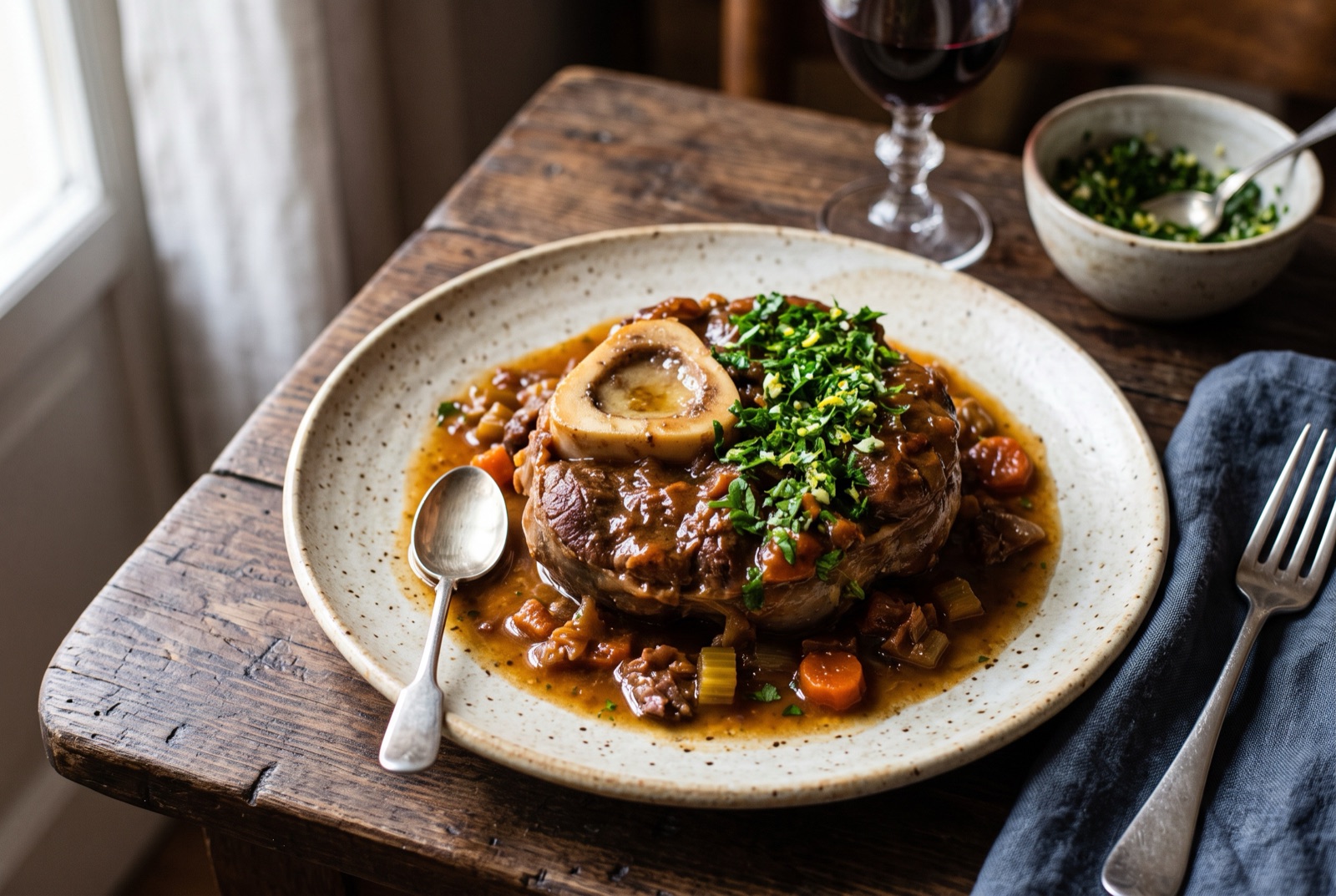
Ossobuco means "bone with a hole", and that hole — the marrow at the centre of a cross-cut veal shank — is the point of the dish. The shanks are dusted in flour, browned, then braised for a couple of hours with wine, broth and a soft vegetable base until the collagen in this hard-working muscle turns to gelatin and the sauce thickens on its own. What arrives at the table is deeply savoury and slightly sticky on the lips, with soft marrow to spoon out. Gremolata, a raw mince of lemon zest, garlic and parsley scattered on at the last second, cuts straight through all that richness.

- Gate
- ItalyLombardy
- Prep
- 25 min
- Cook
- 2 hr 15 min
- Total time
- 2 hr 50 min incl. 10 min rest
- Serves
- 4
- Status
- Medium
- Nutrition / serving · estimated
- Calories 520 kcal
- Protein 48 g
- Carbs 14 g
- Fat 26 g
- Fiber 2 g
- Sodium 780 mg
Why this recipe works.
- Shanks are tied around the middle before browning, so they hold their round shape instead of unravelling into shreds in the pot.
- Braising temperature is kept low deliberately — a bare surface tremble, never a boil, which is what keeps veal moist rather than stringy.
- Gremolata is chopped fresh and added at the end, with the reason explained rather than just instructed.
- Covers both the tomato version and the older ossobuco in bianco, so you can choose which Milan you are cooking.
Ingredients.
15 itemsFor the braise
For the gremolata
Equipment
- Heavy lidded casserole or Dutch oven wide enough to hold the shanks in one layer
- Butcher's twine
- Tongs
- Fine grater or zester
Instructions.
Prepare the shanks
Pat the shanks dry and make three or four shallow cuts through the membrane running around the edge of each one. Tie a loop of twine around the circumference of every shank and season both faces generously with salt and pepper.
Tip The cuts stop the membrane shrinking and buckling the meat into a bowl shape as it heats.
Flour and brown
Dust the shanks in flour and shake off the excess. Heat the butter and oil in a heavy casserole over medium-high heat and brown the shanks in batches, about 4 minutes per side, until the crust is deep chestnut brown and releases from the pan without sticking. Set them aside on a plate.
Tip Crowding the pan drops the temperature and steams the meat grey instead of browning it.
Soften the vegetables
Lower the heat to medium, add the onion, carrot and celery to the same pan and cook for 8–10 minutes, scraping up the browned bits, until the vegetables are soft and sweet-smelling and the onion has just started to turn golden at the edges.
Deglaze with wine
Pour in the white wine and let it bubble for 3–4 minutes, stirring, until the raw alcohol smell has burned off and the liquid has reduced by about half.
Build the braise
Add the crushed tomatoes, hot broth and bay leaf, and stir to combine. Return the shanks and any juices to the pan in a single flat layer — the liquid should reach about two-thirds of the way up the meat, so top up with broth or water if needed.
Braise low and slow
Bring to the barest simmer, cover, and transfer to a 150 °C oven for 2 hours, turning the shanks once at the halfway mark. They are done when a fork slides into the meat with no resistance and the marrow is soft and glossy in the bone.
Tip If the surface is boiling rather than trembling when you check, drop the oven to 140 °C.
Reduce the sauce
Lift the shanks onto a warm dish and cover. If the sauce is thin, boil it uncovered for 5–10 minutes until it coats the back of a spoon and leaves a clear trail when you draw a finger through it. Taste and correct the salt.
Chop the gremolata and serve
Chop the lemon zest, garlic and parsley together on a board until fine and fragrant. Snip the twine off the shanks, spoon the sauce over, and scatter the gremolata across the top just as the plates go to the table.
Tips from our kitchen.
- Ask the butcher for hind shank cut 4 cm thick, with the bone in the middle of each slice. Thin slices dry out long before the connective tissue softens.
- Score the membrane around the edge of each shank in three or four places, or it contracts in the heat and curls the meat into a cup.
- Brown the flour-dusted shanks properly, in batches, until the crust is deep chestnut. Pale meat gives a pale, thin-tasting sauce.
- Keep the braising liquid at roughly two-thirds the height of the meat, not covering it, so the exposed top glazes rather than poaches.
- Chop the gremolata just before serving; lemon zest loses its perfume within about half an hour of being cut.
- Serve a small spoon or a marrow pick with each portion — leaving the marrow in the bone is the one genuine mistake at the table.
Substitutions.
- Veal shank → Beef shank cut the same way
- Beef is cheaper and widely available but has a stronger, more mineral flavour and needs about an extra 45 minutes. Lamb shank also braises beautifully, though it is a different dish at that point.
- Dry white wine → Dry vermouth, or an extra 200 ml broth with 1 tbsp white wine vinegar
- You need the acidity to balance the gelatin. Skipping it entirely leaves the sauce tasting heavy and slightly flabby.
- Canned tomatoes → Omit them for ossobuco in bianco
- The older Milanese version. Increase the broth by 150 ml, add a small knob of butter at the end, and expect a paler, more elegant sauce.
Variations.
- Ossobuco in bianco
- The pre-tomato Milanese original: wine, broth, butter and aromatics only, finished with a little anchovy melted into the sauce for depth in some households.
- Ossobuco with polenta
- The version common across the rest of northern Italy, where soft wet polenta replaces the saffron risotto and takes up the sauce just as well.
- Orange gremolata
- A modern Lombard restaurant touch: half orange zest, half lemon, which softens the sharpness and plays against the sweetness of long-cooked carrot and onion.
Storage & reheating.
Ossobuco improves overnight. Cool the shanks in their sauce, refrigerate up to 3 days, and reheat covered at 150 °C for 25–30 minutes with a splash of broth. The sauce will have set to a firm jelly in the fridge, which is a sign you extracted the gelatin properly. It freezes well for 3 months in the sauce — freeze the meat and liquid together so the shanks do not dry out. Always make the gremolata fresh on the day you serve; frozen or day-old gremolata tastes of nothing.
Serve with
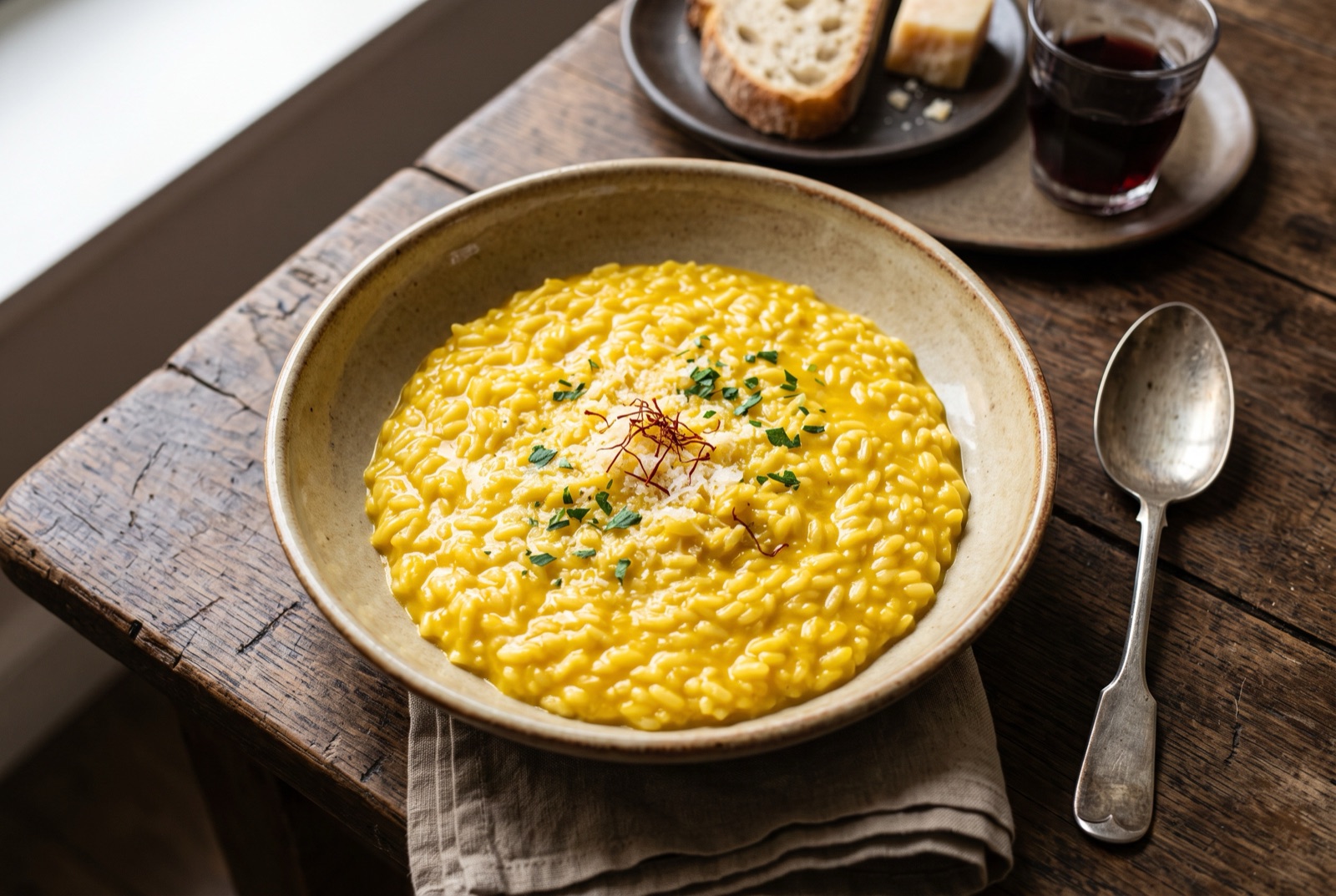
Risotto alla Milanese on the same plate, Milanese-style — or soft polenta if you want the sauce to have somewhere else to go.
The story behind Ossobuco alla Milanese.
Ossobuco belongs to Milan and to a very Lombard way of thinking about meat: take an inexpensive, sinewy cut, give it time, and let gelatin do the work that a tender cut would not need. Cross-cutting the veal shank through the bone is the whole trick, because it exposes the marrow to the braising liquid, where it melts and enriches the sauce from the inside. The dish predates the tomato in northern Italian cooking, and the older Milanese version — sometimes called ossobuco in bianco — uses no tomato at all, only wine, broth and butter. The tomato-tinted version most people now cook is a later addition and is entirely accepted, but the white version is worth knowing about; it tastes cleaner and lets the veal and lemon dominate.
Gremolata is not a garnish in the decorative sense. It is a corrective. Two hours of braising rounds every flavour off, and a plate of ossobuco without gremolata tastes flat in a way that is hard to identify until you add it. Raw garlic, lemon zest and parsley chopped together provide a sharp, aromatic top note that resets the palate between bites. It goes on off the heat, seconds before serving, because cooking it destroys precisely the volatility that makes it work. Some Milanese cooks stir half into the pot for the final two minutes and scatter the rest raw.
In Milan the classic partner is risotto alla Milanese, and the two are served together as a single plate rather than in courses — an arrangement locals treat as a rule rather than a suggestion. The saffron rice absorbs the braising juices, and the pairing is one of the few in Italian cooking where a primo and a secondo are deliberately combined. Outside Lombardy you will just as often see it with soft polenta or mashed potato, both of which do the same job of soaking up sauce.
Questions, answered.
Why did my veal shanks come out tough after two hours?
Tough after long braising almost always means the heat was too high, not too low. If the liquid boils, the muscle fibres tighten and squeeze out moisture faster than the collagen can turn to gelatin, and the meat goes stringy. The surface should barely tremble — an oven at 150 °C is easier to control than a stovetop. If it is still firm, it is usually not overcooked but undercooked; give it another 30–40 minutes.
What exactly is gremolata and can I leave it out?
Gremolata is a raw chopped mixture of lemon zest, garlic and flat-leaf parsley, added to the finished dish at the last moment. You can leave it out, but the braise will taste noticeably flat and one-note, because nothing else in the pot is fresh or acidic after two hours of cooking. If raw garlic is too aggressive for you, use half a clove or rub the cut clove around the serving dish instead.
Do I have to tie the shanks with kitchen string?
It is not strictly required but it makes a real difference to how the finished plate looks. The connective tissue that holds a shank together dissolves during braising, and untied shanks tend to fall open in the pot, with the marrow slipping out. A single loop of butcher's twine around the circumference of each slice holds everything in place; snip it off before serving.
Can I make ossobuco in a slow cooker or pressure cooker?
Yes to both, with one caveat: brown the shanks in a pan first regardless, because neither appliance can build a proper crust and the sauce will taste washed out without it. In a slow cooker, allow about 6 hours on low. In a pressure cooker, 40 minutes at high pressure with a natural release, then reduce the sauce uncovered afterwards since pressure cooking dilutes rather than concentrates it.
How do I know when the marrow is ready?
Properly cooked marrow is soft enough to scoop with a narrow spoon and looks glossy and slightly translucent rather than firm and pink. If it has completely liquefied and run into the sauce, the shanks were cut too thin or cooked too hard — the sauce will be delicious but you lose the best mouthful. Standing the shanks flat in a single layer, never stacked, helps the marrow stay in place.
You might also like.
All recipes →
Keep exploring Italy.
Italy has 9 more dishes in the atlas — Arancini and Classic Tiramisu, and 7 more.
Recipe by The DishRoute Kitchen · published August 19, 2026 · updated August 19, 2026