Soupe aux Pois.
Québécois Yellow Split Pea Soup
Soupe aux pois jaunes · say it: soop oh PWAH
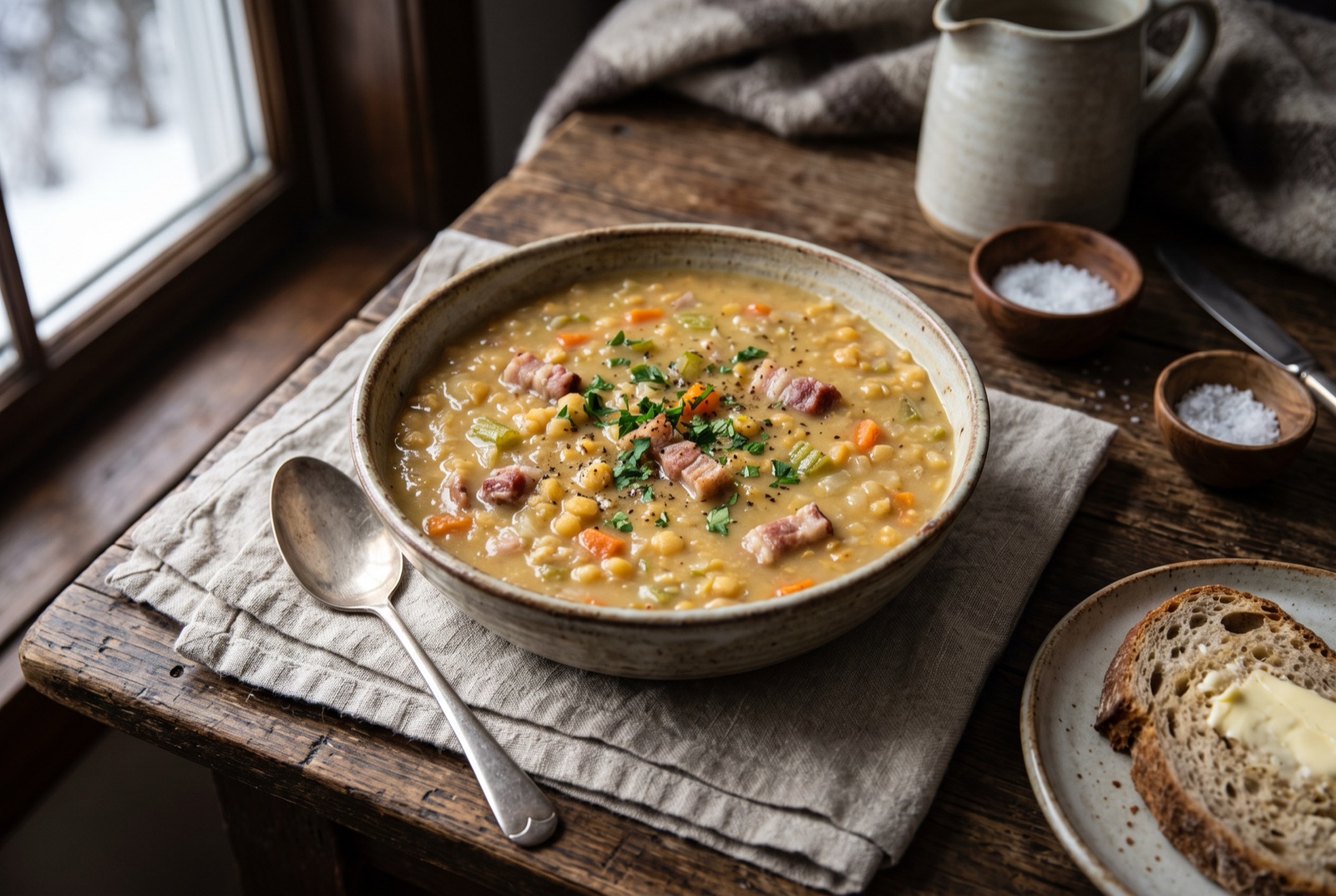
Soupe aux pois is a thick yellow soup of dried peas cooked slowly with salt pork, onion, carrot and celery until the peas break down and thicken the broth on their own. It tastes deeply savoury and faintly sweet, with smoke and salt from the pork and a distinct peppery note from savory, the herb Québec puts in almost everything. There is no cream, no flour and no blender involved — the texture comes entirely from peas that have given up. It is a one-pot soup that costs very little, improves overnight, and was built for a climate where you needed something hot and filling in the middle of the day. Serve it with bread and butter and you have a full meal.

- Gate
- CanadaQuébec
- Prep
- 15 min
- Cook
- 2 hr 15 min
- Total time
- 2 hr 30 min
- Serves
- 6
- Status
- Easy
- Nutrition / serving · estimated
- Calories 420 kcal
- Protein 24 g
- Carbs 48 g
- Fat 14 g
- Fiber 18 g
- Sodium 890 mg
Why this recipe works.
- Whole yellow peas, cooked without soaking, break down into the traditional thick body — no blending, no flour, no cream.
- Salt pork is rendered first so its fat seasons the entire pot rather than sitting on top as a slick.
- Uses savory the way Québec kitchens actually do, with a note on herbes salées for cooks who want the real thing.
- A genuine vegetarian route is written into the recipe rather than tacked on as an afterthought.
Ingredients.
13 itemsFor the soup
To finish
Equipment
- Large heavy pot or Dutch oven with a lid
- Wooden spoon
- Ladle
Instructions.
Render the pork
Cook the diced salt pork in a dry heavy pot over medium heat for 8 to 10 minutes, until the pieces are golden at the edges and a good pool of clear fat has rendered out. Lift out half the pork with a slotted spoon and set it aside for the top of the soup.
Tip Start in a cold pan so the fat renders before the outside browns.
Sweat the vegetables
Add the onion, carrot and celery to the rendered fat and cook for 10 minutes over medium heat, stirring, until the onion is soft and translucent and the pot smells sweet rather than sharp. Stir in the garlic and cook one minute more.
Add peas and simmer
Tip in the rinsed peas, the water, bay leaves, half the savory, the thyme and the black pepper. Bring to a boil, skim off any foam, then reduce to a bare simmer, cover partly, and cook for 1½ to 2 hours. Stir every 20 minutes and scrape the bottom of the pot as you go.
Tip No salt yet. Salted peas can stay gritty no matter how long they cook.
Judge the thickness
The soup is ready when the peas have collapsed and a spoon dragged across the bottom leaves a channel that closes slowly behind it. If it is still watery, uncover and simmer harder for 15 to 20 minutes; if it is claggy, loosen it with hot water.
Season and finish
Fish out the bay leaves, stir in the remaining savory, and only now taste and add salt — the pork will have contributed a great deal, so go slowly. Adjust the pepper and let it sit off the heat for 10 minutes so the seasoning settles.
Serve
Ladle into deep bowls, scatter the reserved crisp pork and the parsley over each, and serve very hot with bread and butter. If you have made it a day ahead, reheat gently with a splash of water and expect it to taste better.
Tips from our kitchen.
- Do not add salt until the peas are fully soft. Salt early and the skins stay tough — the peas can simmer for two hours and still be gritty.
- Skip the overnight soak. Whole yellow peas cook to collapse in about 2 hours anyway, and unsoaked peas give a thicker, more flavourful soup because the starch stays in the pot.
- The soup is done when a spoon dragged across the bottom leaves a channel that closes slowly. If it still looks like peas floating in water, keep simmering with the lid off.
- Old peas never soften. If a bag has been in the cupboard for two years, no amount of cooking will fix it — buy fresh stock and store it away from heat.
- Savory (sarriette) is the herb that makes it taste Québécois rather than generically European. Add half at the start and half in the last ten minutes, so you get both depth and aroma.
- It thickens dramatically as it cools and again in the fridge. Keep it slightly looser than you want, and thin leftovers with hot water or stock when reheating.
Substitutions.
- Salt pork → A smoked ham hock, a leftover ham bone, or 150 g of thick-cut bacon
- A ham bone is arguably the more traditional Québec option when one is available after a holiday. Bacon brings more smoke and less pure pork fat, so use slightly more.
- Whole yellow peas → Yellow split peas
- They cook faster — around 60 to 75 minutes — and break down more completely, giving a smoother soup. Green split peas work but produce a different, grassier soup that is no longer soupe aux pois.
- Herbes salées → 1 tbsp chopped parsley, 1 tsp chopped chives and an extra ½ tsp savory, stirred in at the end
- The salt-cured jar has a briny depth that fresh herbs cannot copy, but this keeps the herbal profile in roughly the right place.
Variations.
- Soupe aux pois maigre (meatless)
- The Lent version: skip the pork, start with butter or oil, and add 1 tsp smoked paprika and a splash of soy sauce for the savoury depth the pork would have given. Vegan if you use oil.
- With a ham bone
- The classic post-holiday pot. Simmer the bone with the peas, then pull the meat off, shred it and return it to the soup before serving.
- Cabane à sucre style
- Served at sugar shacks alongside baked beans and ham, with a spoonful of maple syrup stirred into the pot to sharpen the sweetness of the peas.
Storage & reheating.
Refrigerated it keeps 5 days and is better on day two than day one. It sets almost solid when cold — that is a sign you cooked it correctly, not that something went wrong. Reheat gently with a good splash of hot water or stock, stirring often, because the thick base catches and scorches easily over high heat. It freezes for 3 months; freeze it slightly loose, since it thickens further on thawing. Do not freeze it with the pork still in large pieces, which turn stringy.
Serve with
Crusty bread and cold salted butter, or the full sugar-shack plate: baked beans, ham, and pickled beets.
The story behind Soupe aux Pois.
Pea soup is the oldest continuously cooked dish in French Canada. Dried peas travelled well on ships and kept indefinitely in a barrel, which made them a staple ration for early French settlers along the St. Lawrence, and the soup they made from them became so identified with the habitants — the farming families of New France — that "pea soup" was used for generations as an ethnic slur against French Canadians by their English-speaking neighbours. The dish absorbed the insult and outlived it; today it is on the menu of every casse-croûte and cabane à sucre in Québec.
Two things distinguish the Québec version from its European cousins. The first is the pea itself: Québec uses whole or split yellow peas, not the green peas of Dutch snert or the split greens common in Britain, giving a paler, sweeter, less grassy soup. The second is herbes salées — a jar of finely chopped herbs and vegetables layered with coarse salt and left to cure, kept in the cellar or the fridge and spooned into soups all winter. Before greenhouses and imported produce, that jar was how a Québec kitchen had parsley, chives, savory and celery leaf in February. Households still make it, and a spoonful is what gives an authentic soupe aux pois its particular herbal, briny lift.
The traditional pot uses salt pork or a leftover ham bone, cooked long enough that the meat shreds into the soup, and it is a Lent-and-winter dish rather than a summer one. It is also one of the easiest traditional dishes to make meatless without insulting it: peas, root vegetables, savory and time are doing most of the work, and Québec kitchens have always made a meatless version during Lent. Whichever route you take, the soup must be made ahead if possible — a night in the fridge is not optional so much as customary, because the flavour genuinely settles and the body thickens.
Questions, answered.
Do I need to soak the peas overnight?
No. Whole or split yellow peas cook to softness without soaking, and skipping the soak actually improves the soup because the starch that would otherwise be poured away stays in the pot and thickens it. Soaking cuts perhaps 20 to 30 minutes from the cooking time, which is rarely worth the planning. What does matter is buying peas that have not been sitting in a cupboard for years.
Why are my peas still hard after two hours?
Either the peas are old, or salt or acid went in too early. Dried legumes that have been stored a long time develop skins that will not soften no matter how long you cook them. Salt added at the start firms the skins, and acidic ingredients like tomato or vinegar do the same, so both should wait until the peas have collapsed. Very hard water can also slow things down; a pinch of baking soda helps.
What are herbes salées and can I skip them?
Herbes salées are a Québec preserve of finely chopped herbs and vegetables — typically savory, chives, parsley, celery leaf, carrot and green onion — packed in layers with coarse salt and left to cure. A spoonful seasons a whole pot of soup. You can skip them and use fresh herbs plus salt, but the jar contributes a briny, fermented depth that is one of the quiet signatures of Québécois cooking.
How do I make this vegetarian without it tasting flat?
Leave out the pork, cook the vegetables in butter or oil until they properly soften, and rebuild the missing savoury depth with a teaspoon of smoked paprika, a tablespoon of soy sauce or miso, and a bay leaf. Finish with a small knob of butter or a spoon of olive oil off the heat for the richness the pork fat would have given. This is a version Québec kitchens have always made during Lent, not a modern compromise.
Should the soup be blended?
Not traditionally. Properly cooked whole or split peas dissolve on their own into a thick, slightly rustic soup with some texture remaining, and that is what soupe aux pois is supposed to look like. If yours stayed stubbornly loose, blending a couple of ladlefuls and stirring them back in is a reasonable rescue — but blending the whole pot gives you a smooth purée that reads more like a modern restaurant soup than a habitant one.
You might also like.
All recipes →
Keep exploring Canada.
Canada has 9 more dishes in the atlas — Bannock and Bloody Caesar, and 7 more.
Recipe by The DishRoute Kitchen · published August 20, 2026 · updated August 20, 2026