Tourtière.
Québec Spiced Meat Pie
Tourtière · say it: toor-tee-YAIR
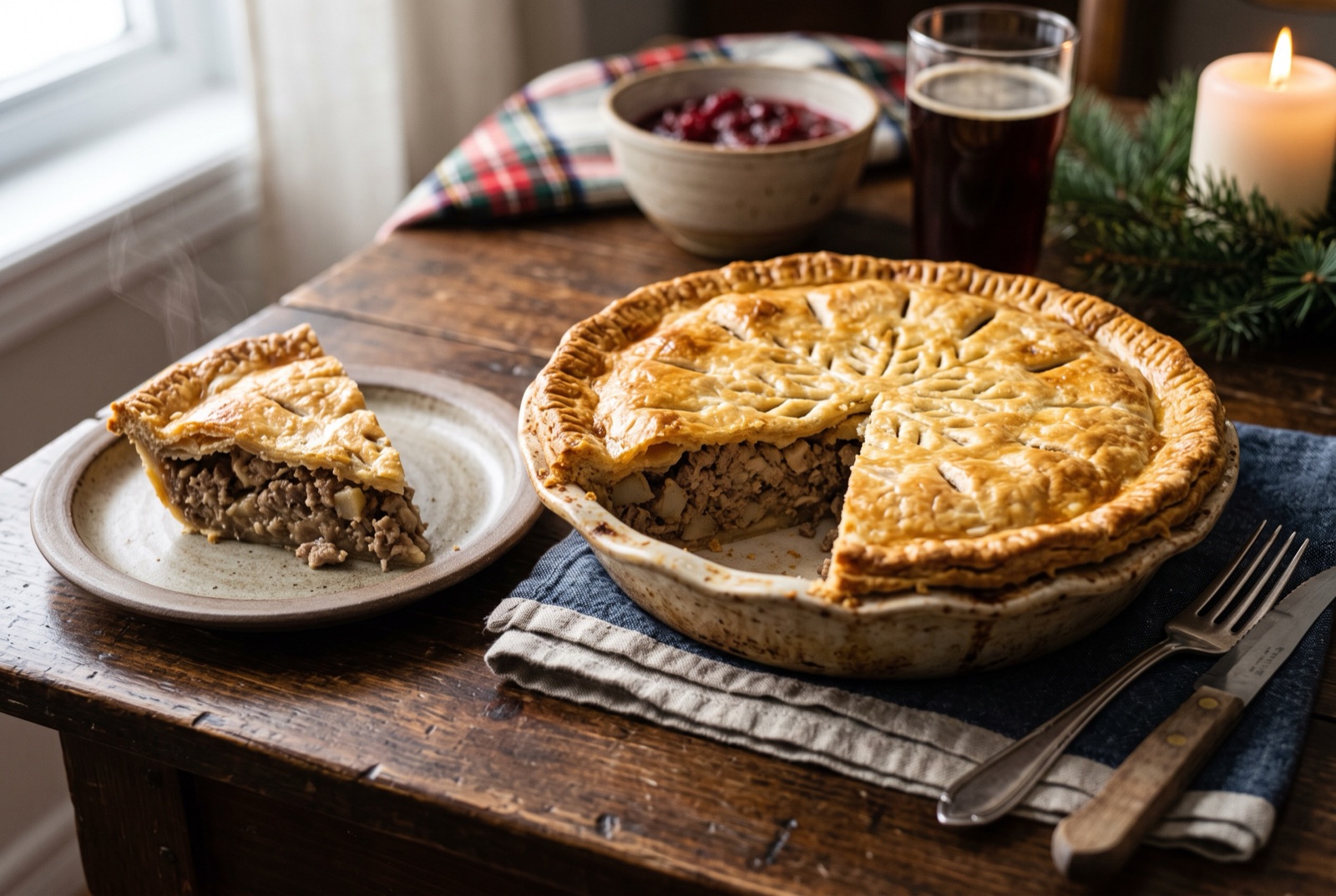
Tourtière is a double-crust pie filled with finely minced pork — often with some beef — simmered with onion, garlic and a very particular set of warm spices: cloves, cinnamon, allspice and dried savory. The filling is moist rather than saucy, thickened by grated potato that dissolves into it, and the flavour is savoury first with a sweet-spice perfume underneath that most people cannot immediately name. It is served in wedges, hot or barely warm, with something sharp on the side — ketchup, pickled beets, green tomato relish — because the pie itself is rich and needs a jolt of acid. In Québec it belongs to réveillon, the meal eaten after midnight mass on Christmas Eve, and to New Year, which is why the smell of cloves in pork is tied to winter for a whole province.

- Gate
- CanadaQuébec
- Prep
- 40 min
- Cook
- 1 hr 35 min
- Total time
- 3 hr 15 min incl. 1 hr rest
- Serves
- 6
- Status
- Medium
- Nutrition / serving · estimated
- Calories 690 kcal
- Protein 30 g
- Carbs 45 g
- Fat 44 g
- Fiber 3 g
- Sodium 820 mg
Why this recipe works.
- Grated potato dissolved into the filling gives the traditional moist, sliceable texture without a floury gravy taste.
- The filling is cooked and fully cooled before the pie is built, which is the only reliable way to keep the bottom crust crisp.
- Spicing is written as a range with an explanation, so you can tune cloves and cinnamon to the level your table actually wants.
- Covers both the everyday flat tourtière and how the Saguenay deep-dish version differs, rather than pretending there is one recipe.
Ingredients.
18 itemsFor the pastry
For the filling
To finish
Equipment
- 23 cm metal or ceramic pie plate
- Large heavy skillet or sauté pan
- Box grater
- Baking sheet
Instructions.
Make the pastry
Rub the cold butter into the flour and salt with your fingertips until the mixture looks like coarse gravel with visible flakes of butter still in it. Add the ice water a spoonful at a time and press the dough together — stop the moment it holds when squeezed. Divide into two discs, one slightly larger, wrap and chill for at least an hour.
Tip Visible butter flakes are what make the crust flaky. If the dough looks smooth and uniform, you have gone too far.
Sweat the aromatics
Cook the onion, garlic and celery in a large skillet over medium heat with a knob of butter for 8 minutes, until the onion is translucent and slumped but not coloured. You want sweetness, not browning.
Cook the meat
Add the pork and beef and break them up with a wooden spoon, cooking until no pink remains, about 8 minutes. Stir in the cloves, cinnamon, allspice, savory, pepper and salt and cook for another minute, until the pan smells warmly spiced rather than dusty.
Tip Do not brown the meat hard. Tourtière filling is pale and moist, not crusty and caramelised.
Simmer with grated potato
Pour in the stock and stir in the grated potato. Simmer uncovered over low heat for 35 to 40 minutes, stirring now and then, until the potato has disappeared into the meat and the mixture is glossy and just moist — a spoon dragged across the pan should leave a track that fills in slowly.
Tip If liquid still pools, keep going. Wet filling equals soggy pastry.
Cool the filling completely
Spread the filling on a tray and cool to room temperature, then refrigerate until cold — at least an hour, or overnight. Taste it cold and correct the salt and cloves now, because chilled filling tastes noticeably milder than hot.
Build the pie
Heat the oven to 220°C with a baking sheet inside. Roll the larger disc to line a 23 cm pie plate, letting it overhang. Pack in the cold filling and level it, roll out the second disc for the lid, seal and crimp the edges, and cut four generous steam vents in the top. Brush all over with the egg wash.
Bake in two stages
Set the pie on the hot baking sheet and bake at 220°C for 15 minutes, until the crust is set and starting to colour, then reduce to 190°C and bake a further 35 to 40 minutes, until the top is deep golden and you can see steam coming steadily from the vents. Rest at least 20 minutes before cutting.
Tip If the rim darkens too fast, cover it with a ring of foil and carry on.
Tips from our kitchen.
- Ask the butcher for coarse-ground pork if you can, or pulse pork shoulder in a food processor — supermarket fine mince turns pasty when it simmers for 40 minutes.
- Cloves are the spice that goes wrong. A quarter teaspoon of ground cloves in a kilo of meat is already assertive; start low, taste the cooled filling, and add more before it goes into the crust.
- The filling must be completely cold — ideally made a day ahead. Warm filling melts the butter in the bottom crust before the oven can set it, and you get a grey, soggy base.
- Dried savory (sarriette) is the signature herb and is worth ordering. Thyme is the closest substitute but is greener and less peppery.
- Cut generous steam vents in the top crust. Trapped steam lifts the lid off the filling and leaves a hollow dome that collapses when you slice it.
- Rest the baked pie at least 20 minutes before cutting so the filling sets — cut it straight from the oven and the first slice falls apart.
Substitutions.
- Dried savory (sarriette) → Dried thyme, or a mix of thyme and a pinch of dried marjoram
- Not identical — savory has a peppery bite that thyme lacks — but it keeps the pie in the right family rather than sending it somewhere else.
- Homemade pastry → Two sheets of good all-butter shortcrust or puff pastry
- Shortcrust is the traditional texture. Puff makes a lighter, flakier pie that many Québec bakeries actually use, so it is not a cheat so much as a different house style.
- Pork and beef mix → All pork, or pork with veal
- All-pork is arguably more traditional in rural Québec. Avoid using only beef — the pie loses the fat and sweetness that carry the spice.
Variations.
- Tourtière du Lac-Saint-Jean
- The Saguenay deep-dish version: cubed pork, beef and sometimes game with diced potato and stock, baked covered at low heat for five to six hours until the filling is meltingly soft.
- Cipaille (cipâte)
- A layered relative from the Bas-Saint-Laurent and Gaspésie: alternating layers of meat, potato and pastry stacked in a deep pot and baked for hours.
- Wild game tourtière
- Venison, moose or hare replacing part of the pork, common in hunting families. Because game is lean, keep at least a third fatty pork in the mix or the filling turns dry.
Storage & reheating.
Baked tourtière keeps 4 days refrigerated and reheats well: 25 minutes at 180°C, loosely covered with foil for the first 15 minutes so the crust does not darken further. It also freezes better than almost any other pie, which is why Québec families make several in December — freeze it unbaked, wrapped tightly, for up to 3 months, and bake it from frozen at 190°C for about 70 minutes. The cooked filling on its own can be refrigerated 3 days or frozen 3 months.
Serve with
Green tomato relish (ketchup aux fruits), pickled beets, or plain tomato ketchup — Québec households will defend all three.
The story behind Tourtière.
The name comes from the tourte, a French earthenware pie dish, and the dish arrived with settlers in the St. Lawrence valley as part of a broader European tradition of spiced meat pies — the same family that produced English mince pies, which in earlier centuries also contained real meat alongside dried fruit and warm spice. In Québec the meat stayed and the fruit left, but the spicing did not: cinnamon, cloves and allspice in a savoury pork pie is a survival of medieval European cooking that mostly died out elsewhere.
There is no single tourtière, and Québécois families are protective of their versions. In most of the province it means a pie of minced pork, sometimes with veal or beef, in a flat pie plate, seasoned with cloves and savory and bound with grated potato or breadcrumbs. In the Saguenay–Lac-Saint-Jean region, tourtière means something quite different: a deep pie filled with cubed — not minced — meat and diced potato in stock, baked slowly for several hours until the top crust caramelises and the filling turns almost confit. Historically that version used game, and it is closer to a pot pie than to what the rest of Québec calls tourtière. Both are traditional, and telling a Saguenay cook that theirs is not the real one is a bad idea.
The pie belongs to the réveillon table, the long meal that follows midnight mass on Christmas Eve, alongside ragoût de pattes de cochon, meat pies, pickles and sweets. Families still make batches in December and freeze them, and the dish carries the specific weight of food that is made once a year by the same hands from the same handwritten card. The spice ratio is where the arguments live — some households use only cloves, some add cinnamon, some insist on dried savory (sarriette) as the non-negotiable herb — and the differences between two neighbouring families can be a source of genuine, cheerful suspicion.
Questions, answered.
Why does tourtière have cinnamon and cloves in a meat pie?
It is a survival of medieval and early modern European cooking, where warm spices were used freely in savoury meat dishes rather than reserved for sweets. The same tradition produced English mince pies, which once contained real meat. In most of Europe the habit faded; in Québec it stayed, so a pork pie perfumed with cloves and cinnamon reads as completely normal there and surprising almost everywhere else.
What is the difference between tourtière and tourtière du Lac-Saint-Jean?
They are different dishes with the same name. The common tourtière is a shallow double-crust pie of finely minced pork baked in about 50 minutes. The Lac-Saint-Jean version is a deep dish of cubed meat and diced potato covered in stock and pastry, baked slowly for five to six hours until the meat is falling apart. Both are traditional in their own regions, and each region considers its own the original.
How do I stop the bottom crust from going soggy?
Three things together: cool the filling completely before it touches the pastry, bake on a preheated baking sheet on the lowest oven rack so the base gets direct heat, and start hot at 220°C for the first 15 minutes before dropping the temperature. A metal or ceramic pie plate conducts heat far better than glass or disposable foil.
Can I make tourtière ahead?
Yes, and it is normally made ahead. The filling improves after a night in the fridge because the spices settle and stop tasting raw. Assembled unbaked pies freeze for up to three months and go into the oven straight from the freezer with about 20 extra minutes. A fully baked pie also reheats cleanly, which is why it works as a make-in-advance holiday dish.
What do you serve with tourtière?
Something acidic to cut the fat. In Québec that usually means ketchup aux fruits — a chunky green tomato and apple relish — or pickled beets, mustard pickles, or plain tomato ketchup, which is far more common on Québec tables than food writers like to admit. A simple green salad with a sharp vinaigrette is the other standard, and boiled or mashed potatoes turn it into a full winter dinner.
You might also like.
All recipes →
Keep exploring Canada.
Canada has 9 more dishes in the atlas — Bannock and Bloody Caesar, and 7 more.
Recipe by The DishRoute Kitchen · published August 20, 2026 · updated August 20, 2026