Stegt Flæsk med Persillesovs.
Crisp Pork Belly with Parsley Sauce
Stegt flæsk med persillesovs · say it: stekt FLESK meth pehr-SILL-eh-sohs
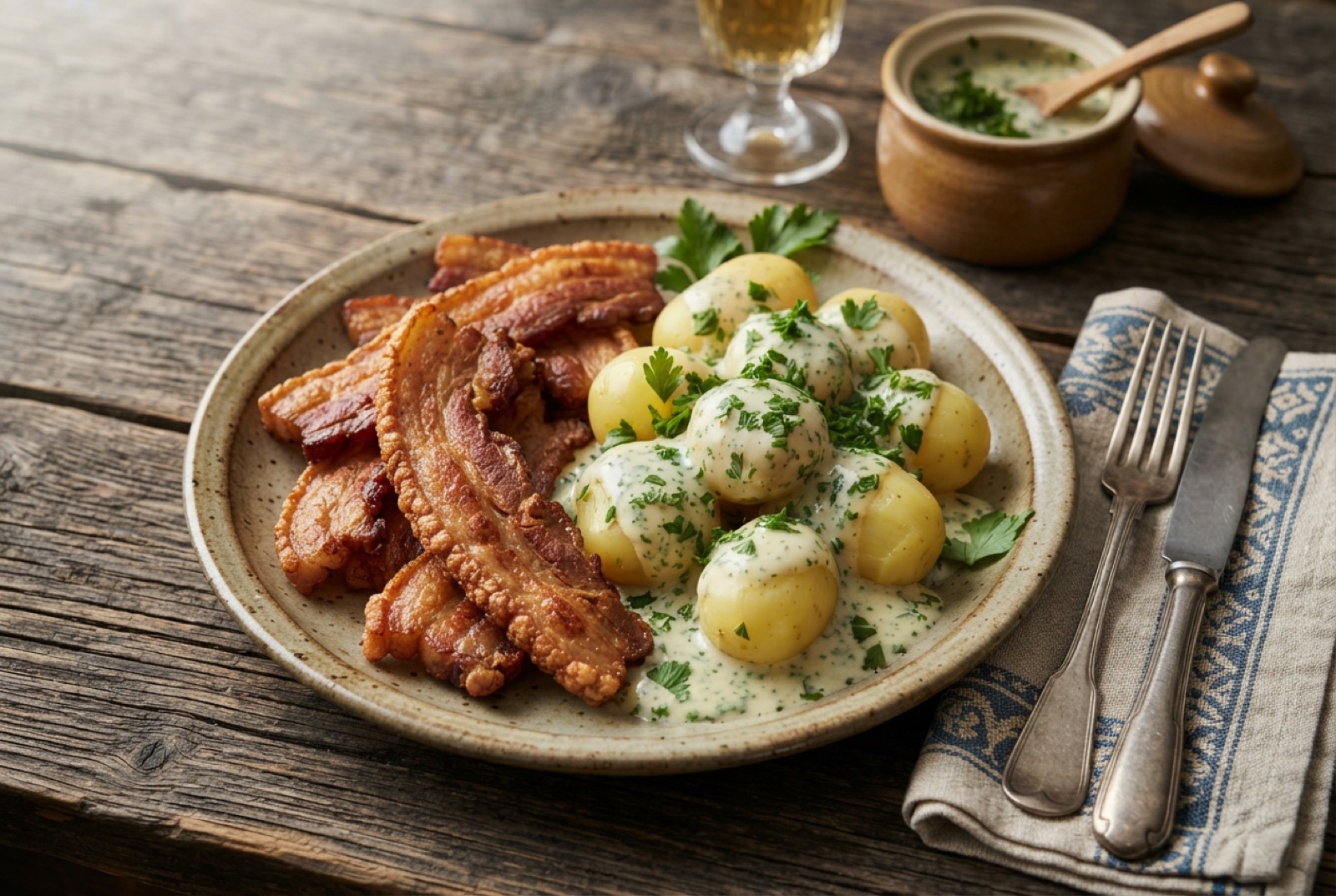
Stegt flæsk is thick-cut pork belly fried or oven-roasted until the fat renders out and the slices snap like crackling, served over plain boiled potatoes with a white parsley sauce poured generously across the whole plate. The eating is a study in three textures: brittle salty pork, soft floury potato, and a warm sauce that is barely seasoned beyond salt, pepper and an enormous quantity of parsley. It won a national vote in 2014 to be named Denmark's national dish, beating the roast pork and the meatballs, and it is served in Danish inns as unlimited refills — you keep eating until you stop.

- Gate
- Denmark
- Prep
- 15 min
- Cook
- 40 min
- Total time
- 55 min
- Serves
- 4
- Status
- Medium
- Nutrition / serving · estimated
- Calories 780 kcal
- Protein 30 g
- Carbs 52 g
- Fat 51 g
- Fiber 5 g
- Sodium 900 mg
Why this recipe works.
- Oven method with a pan finish, which renders the fat evenly and avoids the spitting mess of frying half a kilo of belly on the hob.
- A parsley sauce built on the classic roux ratio that stays pourable instead of setting into wallpaper paste as it cools.
- Says clearly how thick to cut the belly and what the crisp slice should look and sound like, which is where this dish is usually lost.
- Four cheap ingredients, no special equipment, and it feeds four people generously.
Ingredients.
9 itemsThe pork
The potatoes
Parsley sauce
Equipment
- Large roasting tray or cast-iron pan
- Saucepan
- Balloon whisk
- Pot for boiling potatoes
Instructions.
Heat the oven and lay out the pork
Heat the oven to 220°C. Arrange 800 g of pork belly slices in a single layer on a large roasting tray, without overlapping, and salt them lightly on both sides. Any overlap steams the slices soft where they touch.
Roast until crisp
Roast for 20 minutes, then pour off the rendered fat, turn each slice and roast another 15–20 minutes. They are ready when they are deep golden, shrunken and rigid enough to click against the tray — a slice that still flops is not done.
Tip Keep the poured-off fat. Danes fry potatoes and onions in it for days afterwards.
Boil the potatoes
While the pork roasts, boil the peeled potatoes in well-salted water for 18–20 minutes, until a knife slides in with no resistance but the potatoes are still holding together. Drain and keep them warm in the covered pot.
Make the roux
Melt the butter in a saucepan over medium heat, whisk in the flour and cook for a full minute, stirring constantly. It should turn pale sandy and smell of toasted biscuit — do not let it colour, and do not shortcut this step or the sauce tastes of raw flour.
Build the sauce
Pour in the warm milk a splash at a time, whisking each addition smooth before adding the next. Once it is all in, simmer gently for 5 minutes, whisking often, until the sauce coats a spoon and holds a line when you draw a finger through it.
Tip If lumps appear, take it off the heat and blitz with a stick blender. Nobody will ever know.
Finish with parsley
Take the pan off the heat and stir in all the chopped parsley, plus nutmeg, salt and white pepper. The sauce should turn distinctly green rather than flecked — if it still looks white, add more parsley.
Plate it
Put the hot potatoes on each plate, break them open with a fork and ladle the parsley sauce over until they are flooded. Lean the crisp pork slices against the side and serve at once, while they still crackle.
Tips from our kitchen.
- Ask the butcher for rindless pork belly cut into 5 mm slices. Too thin and the slices shatter into bacon crisps; too thick and the fat never renders through.
- Salt the slices lightly on both sides before cooking and do not add more later — the rendered fat concentrates whatever you put on.
- Pour the fat off the tray halfway through roasting. Slices sitting in a pool of their own fat deep-fry soft instead of crisping.
- Cook the roux for a full minute before the milk goes in, until it smells like toasted biscuit rather than raw flour, or the sauce will taste chalky.
- Chop the parsley at the last moment and stir it in off the heat. Boiled parsley turns khaki and loses the fresh grassy note that carries the sauce.
- Use waxy or all-purpose potatoes and boil them whole in their skins if they are small — they should hold together under a flood of sauce.
Substitutions.
- Pork belly slices → Thick-cut unsmoked streaky bacon
- The closest easy substitute, but bacon is cured and salted, so leave out the extra salt entirely. Smoked bacon changes the dish noticeably — the original is fresh pork, not smoked.
- Whole milk for the sauce → Half milk, half single cream
- Richer and more forgiving if you are nervous about the sauce splitting or thinning. Skimmed milk makes a thin, watery sauce and is not worth it here.
- Flat-leaf parsley → Curly parsley
- Curly is what most Danish kitchens actually use for persillesovs and holds its colour slightly better. Use it stalks and all if the stalks are tender — they carry a lot of flavour.
Variations.
- Stegt flæsk with beetroot
- Many inns add a spoon of pickled beetroot on the side. The vinegar cuts straight through the fat and is the standard Danish answer to a rich plate.
- Pan-fried version
- The older method: fry the slices in a dry cast-iron pan in batches over medium heat, pouring off fat as it collects. More attention, slightly better crisp on the edges.
- Persillesovs on its own
- The same parsley sauce is served over boiled potatoes with poached eggs or boiled salted fish, which is how Danish households used it on meat-free days.
Storage & reheating.
This is a dish to eat immediately: crisp pork softens within twenty minutes of coming out of the oven. If you do have leftovers, keep the pork and sauce in separate containers in the fridge for up to 2 days. Re-crisp the slices in a hot dry pan or a 220°C oven for 5 minutes rather than a microwave, which turns them leathery. Reheat the parsley sauce gently with a splash of milk, whisking as it warms, and stir in a little fresh parsley to bring the colour back. Neither component freezes well.
Serve with
Pickled beetroot or a sharp cucumber salad, and a cold pilsner — the vinegar and the bitterness both work against the fat.
The story behind Stegt Flæsk med Persillesovs.
This is peasant food that never got dressed up. Pork belly, potatoes, milk and parsley are exactly the four things a Danish smallholding produced, and the dish existed in some form long before it had a famous name — cooked over an open fire, then in cast iron on a wood stove, and today mostly in the oven. What is unusual is that Denmark never let it drift downmarket. The kro, the traditional roadside inn, still serves stegt flæsk med persillesovs as its signature plate, and serving it "ad libitum" — as much as you can eat — is a fixture of the format.
In 2014 the Danish Ministry of Food ran a public vote for a national dish and stegt flæsk med persillesovs won it, which surprised nobody at home and slightly baffled visitors expecting something more elaborate. The result made a real point: the food Danes actually identify with is not the fine-dining Nordic cooking that made Copenhagen famous, but a plate of fried pork with white sauce that costs almost nothing and takes four ingredients.
The technique arguments are narrow and passionately held. Pan or oven — the oven is easier and more even, the pan gives a better edge. Thickness of the slice: around 5 mm is the consensus, thin enough to crisp all the way through, thick enough that there is still meat to chew. And the sauce should be thick enough to coat the potatoes without setting into paste, with so much parsley that the sauce is more green than white. Danes will tell you a persillesovs with a modest amount of parsley in it is not persillesovs, and they are right.
Questions, answered.
Is stegt flæsk really the Danish national dish?
Yes — it won a public vote organised by the Danish Ministry of Food in 2014, beating other classics including roast pork and frikadeller. The result is a fair reflection of what Danes actually eat and feel sentimental about, rather than a historical designation.
Oven or frying pan — which is better?
The oven is more reliable at home: the slices crisp evenly without constant turning and the kitchen stays clean. A cast-iron pan gives slightly crisper edges and more control, but you must work in batches and pour off the fat regularly, and half a kilo of belly spits considerably.
Why is my parsley sauce lumpy?
The milk went in too fast or too cold. Add it a splash at a time to the hot roux, whisking each addition until it is completely smooth before adding more. If it does go lumpy, a stick blender or a pass through a sieve fixes it entirely, and no one will know.
How thick should I cut the pork belly?
About 5 mm, and evenly. Thinner slices crisp fast but shrivel into something closer to bacon crisps with no meat left to bite; thicker slices stay chewy in the middle because the fat has not had time to render. Most Danish supermarkets sell belly pre-cut at exactly this thickness for the dish.
Can I make the sauce ahead?
Make the white sauce base up to a day ahead and refrigerate it, but add the parsley only when you reheat. Parsley stirred in early goes dull green and tastes stewed. Reheat gently with a splash of milk, whisking, then fold in the freshly chopped parsley off the heat.
You might also like.
All recipes →
Keep exploring Denmark.
Denmark has 9 more dishes in the atlas — Æbleskiver and Flæskesteg, and 7 more.
Recipe by The DishRoute Kitchen · published August 19, 2026 · updated August 19, 2026