Tempe Orek.
Javanese Sweet Crisp Fried Tempeh
Tempe orek · say it: TEM-peh OH-rek
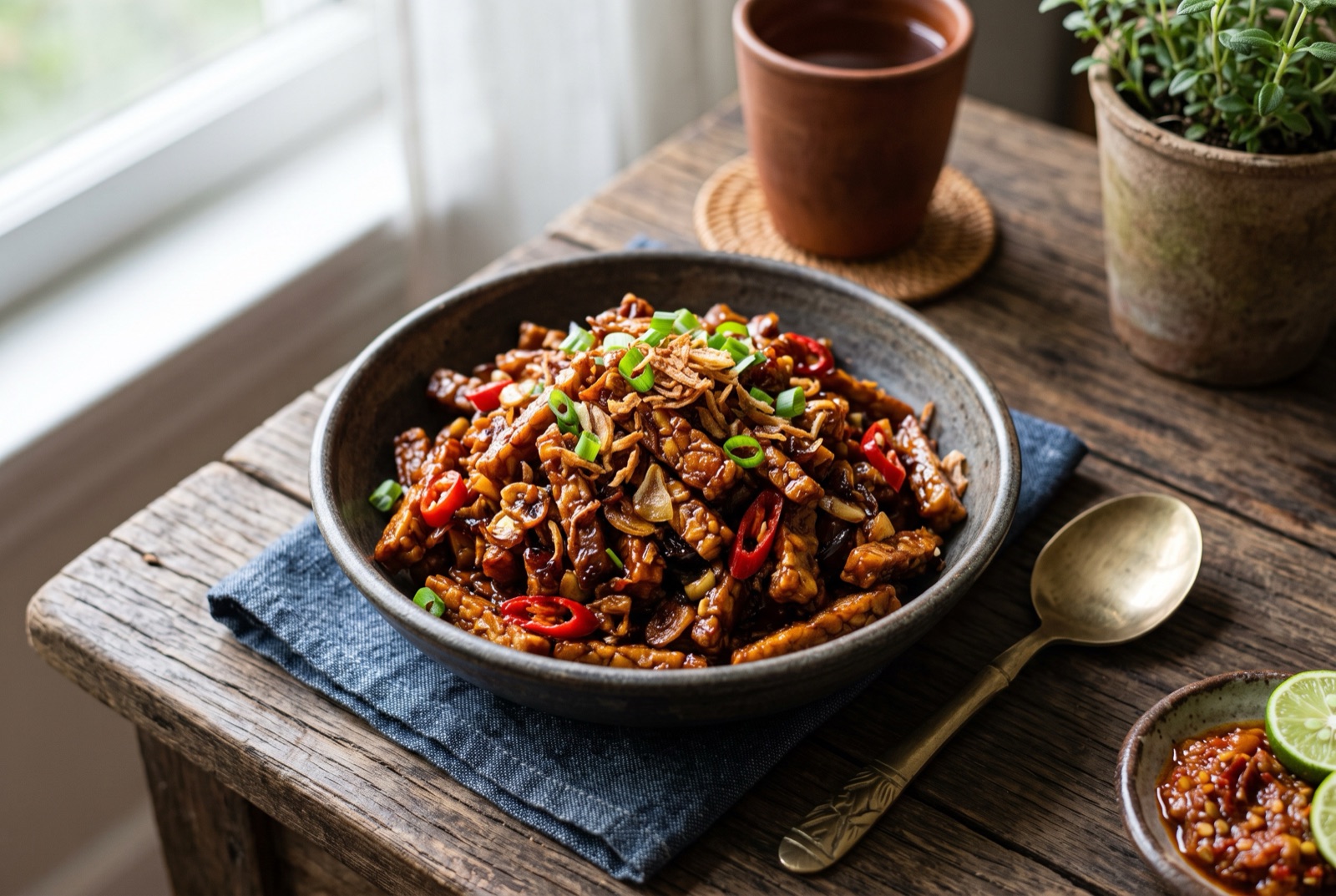
Tempe orek is the small brown side dish that turns up next to rice in half the lunch boxes in Java. Tempeh is cut into matchsticks, fried until genuinely crisp, and then thrown into a pan with garlic, shallots, chili and kecap manis — the thick, molasses-dark sweet soy sauce — where the glaze reduces around it and sets. The result is sweet, salty and faintly bitter from the tempeh itself, with a texture somewhere between crunchy and chewy depending on how long you let it sit. It costs almost nothing, keeps for days, and makes a plain plate of rice taste like a meal.

- Gate
- IndonesiaJava
- Prep
- 15 min
- Cook
- 20 min
- Total time
- 35 min
- Serves
- 4
- Status
- Easy
- Nutrition / serving · estimated
- Calories 320 kcal
- Protein 20 g
- Carbs 22 g
- Fat 18 g
- Fiber 7 g
- Sugar 12 g
- Sodium 620 mg
Why this recipe works.
- Fries the tempeh dry and crisp before the sauce touches it, which is the only way it stays crunchy instead of going soggy.
- Balances the kecap manis with tamarind and salt so the dish reads sweet-savoury rather than like candy.
- Cut and cook times tuned for the block tempeh sold in Western supermarkets, which is denser than fresh Javanese tempeh.
- Keeps for three days and gets better on day two, so one pan covers several meals.
Ingredients.
11 itemsFor frying
For the glaze
To finish
Equipment
- Wok or wide frying pan
- Sharp knife
- Wire rack or plate for draining
- Small bowl for mixing the glaze
Instructions.
Cut the tempeh fine
Slice the block of tempeh into 5 mm slabs, then stack the slabs and cut them into matchsticks about 5 cm long. Keep them even — mixed thicknesses mean some pieces burn while others stay soft in the middle.
Fry until it rattles
Heat the oil in a wok over medium-high until a piece of tempeh sizzles steadily on contact. Fry the matchsticks in two batches for 5–6 minutes each, stirring occasionally, until they are deep golden and rattle against the spoon rather than bending. Drain on a rack.
Tip They crisp further as they cool, so pull them at deep gold. Waiting for dark brown in the pan means burnt and bitter on the plate.
Pour off the oil
Tip out all but about a tablespoon of the frying oil. A slick is enough to cook the aromatics; any more and the glaze will slide off the tempeh instead of coating it.
Soften the aromatics
Return the pan to medium heat and cook the shallots, garlic and chilies for 2–3 minutes, stirring, until the shallots have gone translucent and limp and the kitchen smells sweet and garlicky — not until they brown, which turns the garlic bitter.
Build the glaze
Lower the heat, add the kecap manis, palm sugar, tamarind water and a pinch of salt, and let it bubble for about a minute until it thickens into a syrup that leaves a clear trail when you drag a spoon through the pan.
Tip If it looks too thick to coat anything, splash in a tablespoon of water. If it is thin and watery, give it another 30 seconds.
Toss and serve
Tip the fried tempeh and the peanuts back into the pan and toss quickly for 30–60 seconds, until every matchstick is lacquered dark mahogany and the pan is dry. Take it off the heat immediately and serve warm or at room temperature with rice.
Tips from our kitchen.
- Cut the tempeh into matchsticks no thicker than 5 mm. Thick batons stay soft in the middle and never develop the crunch this dish is named for.
- Fry in two batches. A crowded pan steams the tempeh instead of frying it, and steamed tempeh will not crisp no matter how long you leave it.
- Drain the fried tempeh fully and cook the aromatics in a nearly dry pan — leftover frying oil makes the glaze greasy and it will never cling.
- Add the kecap manis last and off high heat. Its sugar burns fast and goes acrid within thirty seconds of hitting a screaming pan.
- For maximum crunch, toss the tempeh through the glaze for under a minute and serve straight away. For the chewier version most Javanese cooks prefer, let it sit twenty minutes so the glaze softens it slightly.
- Taste the tempeh raw-ish after frying. Some brands are noticeably more bitter than others and may want an extra half teaspoon of palm sugar to balance.
Substitutions.
- Kecap manis → 3 tbsp dark soy sauce simmered with 3 tbsp palm or dark brown sugar until syrupy
- This is genuinely close. Do not substitute plain soy sauce alone — kecap manis is roughly half sugar and the dish will come out salty and thin without it.
- Asian shallots → Half a regular onion, finely sliced
- Small Asian shallots are sweeter and less watery. Regular onion works but needs an extra minute in the pan to cook off its moisture.
- Tamarind paste → 1 tsp lime juice, added at the very end
- Tamarind is doing one job here — cutting the sugar with sourness. Lime does it differently but adequately. Skipping the acid entirely leaves the dish flat.
- Bird's eye chilies → Half a teaspoon of chili flakes, or one sliced red chili for colour without heat
- Javanese versions run from barely warm to fierce, so this is a matter of taste rather than authenticity. Leaving chili out entirely is completely normal for a child's portion.
Variations.
- Orek tempe kacang
- Fried peanuts tossed in with the tempeh at the glazing stage, so you get two crunches. Add them already roasted or they will still be raw when the glaze sets.
- Orek tempe kering
- The extra-dry keeper: fry the tempeh longer, reduce the glaze further, and cool it uncovered. It turns brittle and lasts a week in a jar, which is why it travels in lunch boxes.
- Orek tempe teri
- Made with a handful of dried anchovies fried alongside the tempeh, adding a salty, fishy backbone. Common in West Java and no longer vegetarian.
Storage & reheating.
Cool it uncovered so trapped steam does not soften the crunch, then keep it in a sealed jar at room temperature for two days or refrigerated for five. It does not need reheating and is traditionally eaten at room temperature. If it has gone limp in the fridge, spread it on a tray and warm it in a 160°C oven for five minutes to drive off moisture and bring the crispness back. Freezing is not worth it — the glaze weeps on thawing and the texture never recovers.
Serve with
Steamed white rice, a fried egg, and something with sauce next to it — this is a component of a plate rather than a dish on its own.
The story behind Tempe Orek.
Tempeh is one of the few genuinely Indonesian contributions to the world pantry, and specifically a Javanese one. It is made by inoculating cooked soybeans with Rhizopus mould and letting them ferment until the beans knit into a firm white cake — a process that has been documented in Java for centuries and that produces something quite different from tofu, which is pressed from soy milk and has no fermentation at all. The mould does real work: it softens the beans, deepens the flavour into something nutty and mushroomy, and gives tempeh a structure that holds up to frying instead of collapsing.
Orek is a method rather than a dish. To orek something is to shred or cut it fine and stir-fry it down with seasoning until dry, and the same treatment gets applied to long beans, anchovies and potato sticks. What binds the Javanese version together is kecap manis, the sweet soy sauce made with palm sugar that is arguably the single most identifiable flavour in Central and East Javanese cooking. Java has a well-earned reputation among Indonesians for sweetening things other regions would not, and this dish is exhibit A.
Tempe orek exists because of how Indonesian meals are structured. A plate is rice plus several small dishes, and each is expected to contribute a different thing: something with sauce, something fresh, something with heat, and something dry and crunchy for contrast. Tempe orek is the dry, crunchy, sweet one. It shows up in nasi kuning, in the banana-leaf-wrapped nasi bungkus sold at warungs, in school lunches, and in the rice-and-side spreads of nasi campur. Cooks make a big batch precisely because it keeps: fried tempeh with a sugar glaze on it stays good at room temperature for two or three days, which matters in a climate where it does.
Questions, answered.
What is the difference between tempeh and tofu?
Tofu is curdled soy milk pressed into blocks, with a soft neutral texture and no fermentation. Tempeh is whole cooked soybeans fermented with a mould that binds them into a firm cake, so you can see the individual beans. Tempeh is nuttier, considerably firmer, higher in fibre and protein, and it holds its shape when fried — which is exactly why this dish uses it.
Why did my tempeh go soggy instead of crisp?
Usually one of three things: the pieces were cut too thick, the pan was overcrowded so the tempeh steamed in its own moisture, or the glaze was added while the pan was still full of frying oil. Fry in batches, drain properly on a rack, and pour off nearly all the oil before the sauce goes in.
Do I need to steam or boil tempeh before frying it?
Not for this dish. Some cooks steam tempeh first to reduce its bitterness, which is worth doing with very fresh, strongly fermented tempeh. The vacuum-packed blocks sold in most supermarkets are mild enough to go straight into the pan, and pre-steaming adds water you then have to fry off.
Is tempe orek vegan?
The version here is — tempeh, kecap manis, aromatics and oil, with no animal products. Check your kecap manis label, since a few brands are not strictly vegan, and note that the common variation with dried anchovies is not. Kecap manis usually contains wheat, so the dish is not gluten-free unless you use a tamari-based substitute.
Can I make tempe orek ahead of time?
Yes, and it is normally made ahead. It keeps two days at room temperature in a sealed container and about five refrigerated, which is the whole reason it exists as a lunch-box staple. Make it in the morning for dinner, or on Sunday for the week. If anything it tastes more balanced on day two once the glaze has fully soaked in.
You might also like.
All recipes →


Keep exploring Indonesia.
Indonesia has 9 more dishes in the atlas — Bakso and Bubur Ayam, and 7 more.
Recipe by The DishRoute Kitchen · published August 19, 2026 · updated August 19, 2026