Æbleskiver.
Danish Spherical Pancake Puffs
Æbleskiver · say it: EB-leh-skee-vuh
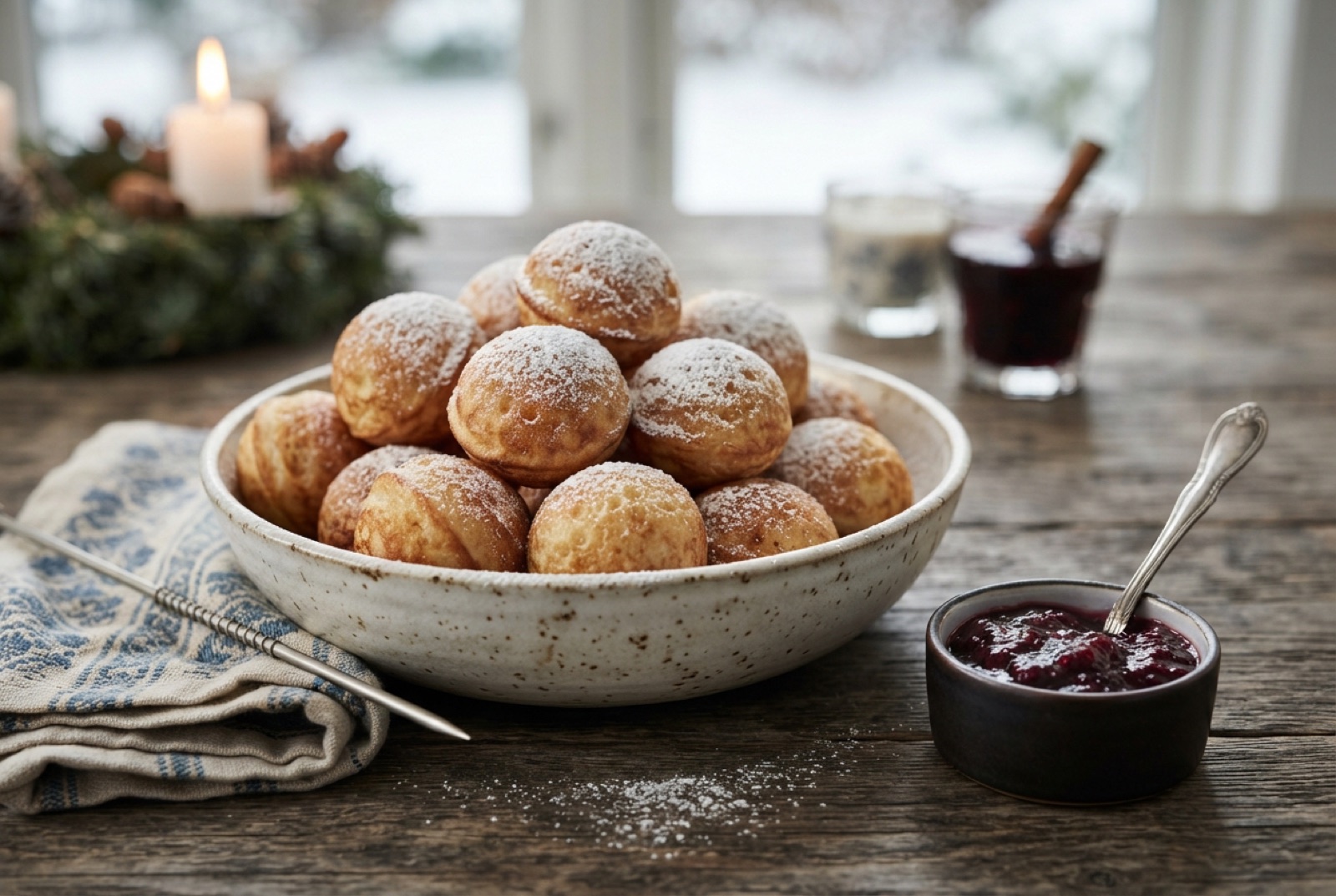
Æbleskiver are round Danish pancake puffs cooked in a heavy cast-iron pan with hemispherical dimples, turned gradually with a knitting needle or skewer so the raw batter runs down and sets into a complete sphere. The inside stays light and slightly custardy, the outside is thin and golden, and the flavour is mostly cardamom, butter and a little lemon zest. They are eaten hot, rolled in icing sugar and dipped in raspberry or strawberry jam, and in Denmark they belong to December — sold at Christmas markets, made at home during advent, and drunk alongside gløgg.

- Gate
- Denmark
- Prep
- 20 min
- Cook
- 25 min
- Total time
- 1 hr 15 min incl. 30 min rest
- Serves
- 4
- Status
- Medium
- Nutrition / serving · estimated
- Calories 420 kcal
- Protein 12 g
- Carbs 55 g
- Fat 16 g
- Fiber 2 g
- Sugar 12 g
- Sodium 480 mg
Why this recipe works.
- Whipped egg whites folded in at the end, which is what gives the puffs their light, almost hollow interior instead of a doughy centre.
- Buttermilk in the batter for the tang and the lift, matching how the batter is actually made in Danish homes.
- A clear description of the turning sequence, timed to what the batter looks like rather than to the clock.
- Honest about the pan: this is one recipe that genuinely needs the right equipment, and the recipe says so rather than pretending otherwise.
Ingredients.
11 itemsThe batter
To cook and serve
Equipment
- Æbleskiver pan (or poffertjes/takoyaki pan)
- Knitting needle or thin wooden skewer
- Electric whisk for the egg whites
Instructions.
Mix the batter base
Whisk the flour, baking powder, sugar, cardamom and salt together in a bowl. Beat the egg yolks with the buttermilk, melted butter and lemon zest, then pour into the dry mix and whisk just until smooth — a few small lumps are fine, overworking is not.
Rest it
Cover the bowl and leave the batter at room temperature for 30 minutes. The flour hydrates and the cardamom infuses through, and the finished puffs come out lighter than if you cook straight away.
Whip and fold the whites
Whip the egg whites to soft peaks that hold their shape but still curl over at the tip. Fold them into the batter in three additions with a spatula, cutting down and lifting over, until just combined — some streaks of white are better than a deflated batter.
Heat and butter the pan
Set the æbleskiver pan over medium heat until a drop of batter sizzles on contact. Drop a small knob of butter into each well and let it foam before you pour — every batch needs fresh butter, not just the first.
Fill the wells
Fill each well about three-quarters full. Leave them for 1–2 minutes, until the edges have set into a firm ring and the top is still visibly wet and glossy in the middle.
Turn in quarters
Slide the needle down the inside edge of one puff and rotate it a quarter turn, letting the raw batter pour out into the well underneath. Wait until that sets, then turn again. Four turns in all and the puff closes into a sphere with only a faint seam.
Tip Work around the pan in the same order each time so every puff gets the same rest between turns.
Finish and serve hot
Cook 6–8 minutes in total, until the spheres are golden all over and a skewer pushed into the middle comes out clean. Tip them into a warm bowl, dust heavily with icing sugar and serve at once with jam for dipping.
Tips from our kitchen.
- Rest the batter 30 minutes before cooking. The flour hydrates, the cardamom infuses, and the puffs come out noticeably lighter.
- Fold the whipped whites in with a spatula in a few decisive strokes. Stirring them in flat costs you the entire point of whipping them.
- Get the pan properly hot before the first batch — a drop of batter should sizzle immediately. A cool pan means the shell never sets and the first turn tears.
- Fill each well about three-quarters full. Overfilled wells overflow and weld the puffs together into a sheet.
- Turn in stages, not all at once: a quarter turn at a time as each edge sets, four turns in total. Trying to flip them like a pancake never works.
- Expect the first batch to be ugly. That is the calibration batch, and it will still taste good.
Substitutions.
- Æbleskiver pan → A Dutch poffertjes pan or a Japanese takoyaki pan
- Both have the same hemispherical wells and work identically. Without a dimpled pan there is no substitute — the batter will simply spread into a pancake, which is a fine breakfast but not this dish.
- Buttermilk → Whole milk with 1 tbsp lemon juice per 250 ml, left 10 minutes to curdle
- Or plain yogurt loosened with milk. The acidity reacts with the baking powder and matters for the rise, so do not just use plain milk.
- Ground cardamom → Freshly crushed cardamom pods, or vanilla and lemon zest alone
- Cardamom is the classic Nordic baking spice here and pre-ground loses its perfume quickly. Crushing green pods yourself makes a real difference.
Variations.
- With apple
- A small cube of tart apple dropped into each well before the batter, which is the older version the name points at. It makes the centre wetter, so add it after the first turn.
- Savoury æbleskiver
- A modern Copenhagen café habit: leave out the sugar and cardamom, fold cheese and chives into the batter, and serve with remoulade or a herb cream.
- Filled æbleskiver
- A teaspoon of jam or chocolate pushed into the centre after the second turn, sealed in by the remaining batter as the ball closes.
Storage & reheating.
Æbleskiver are at their best within minutes of leaving the pan and go noticeably heavier once they cool. They keep 2 days in an airtight container at room temperature and reheat reasonably in a 180°C oven for 5 minutes, which crisps the outside again — a microwave turns them rubbery. Cooked and cooled puffs freeze for 2 months; reheat from frozen at 180°C for about 10 minutes. The batter itself does not hold well because the whipped whites collapse, so mix the base the night before if you want a head start and whip and fold the whites just before cooking.
Serve with
Icing sugar and raspberry jam for dipping, with hot gløgg or strong black coffee.
The story behind Æbleskiver.
The name means "apple slices", which nobody can fully explain any more. The older versions did contain a piece of apple dropped into the batter as it cooked, and some Danish families still make them that way, but the standard modern æbleskive has no apple in it at all and keeps the name regardless. The pan came first and the recipe followed: a thick cast-iron plate with seven round wells, heated over a fire, is a very efficient way to cook batter with almost no fat, and versions of it exist across northern Europe and as far as Japan.
The turning technique is what makes them. You pour batter into each hot, buttered well and let it set at the edges. Then you rotate each one about a quarter turn with a needle so the cooked shell tips up and the still-liquid centre pours down into the well, where it sets in turn. Repeat that three or four times and the ball closes on itself, with a faint seam and a hollow, tender interior. Danish grandmothers do this with a knitting needle at speed and without looking, and the first dozen anyone makes come out as lopsided lumps. This is genuinely a skill, and it is learned in one afternoon.
Æbleskiver are firmly tied to Christmas in Denmark, though there is nothing seasonal in the ingredients. They appear at julefrokost lunches, in cafés through December, and at markets served in paper cones with a bowl of jam and a dredging of icing sugar. There is a running domestic argument about whether they should be eaten with jam alone or with jam and a small glass of hot spiced wine, which is not much of an argument.
Questions, answered.
Do I really need a special pan?
Yes. Æbleskiver are defined by being cooked in hemispherical wells, and without them the batter spreads flat. A Dutch poffertjes pan or a Japanese takoyaki pan has the same shape and works perfectly, and cast-iron æbleskiver pans are widely sold online and last for generations.
Why do my æbleskiver come out lopsided or raw in the middle?
Usually the heat is too high, so the shell sets and browns before the interior batter has anywhere to go. Lower the heat to medium and turn each puff a quarter at a time — four small turns — instead of trying to flip it in one movement. Overfilled wells cause the same problem.
Is there apple in æbleskiver?
Not in the standard modern recipe, despite the name meaning "apple slices". Older versions did include a piece of apple in the batter and some families still make them that way, but most Danes today eat them plain with jam and icing sugar.
What do I use to turn them if I have no knitting needle?
A bamboo skewer, a thin wooden chopstick or a metal trussing needle all work. Avoid a fork, which tears the shell, and avoid anything with a sharp point wide enough to leave a hole the batter will leak out of.
Can I make the batter in advance?
Mix the base batter up to a day ahead and refrigerate it, but whip and fold in the egg whites just before cooking. Whipped whites collapse within an hour or two, and without them the puffs come out dense rather than light and hollow.
You might also like.
All recipes →
Keep exploring Denmark.
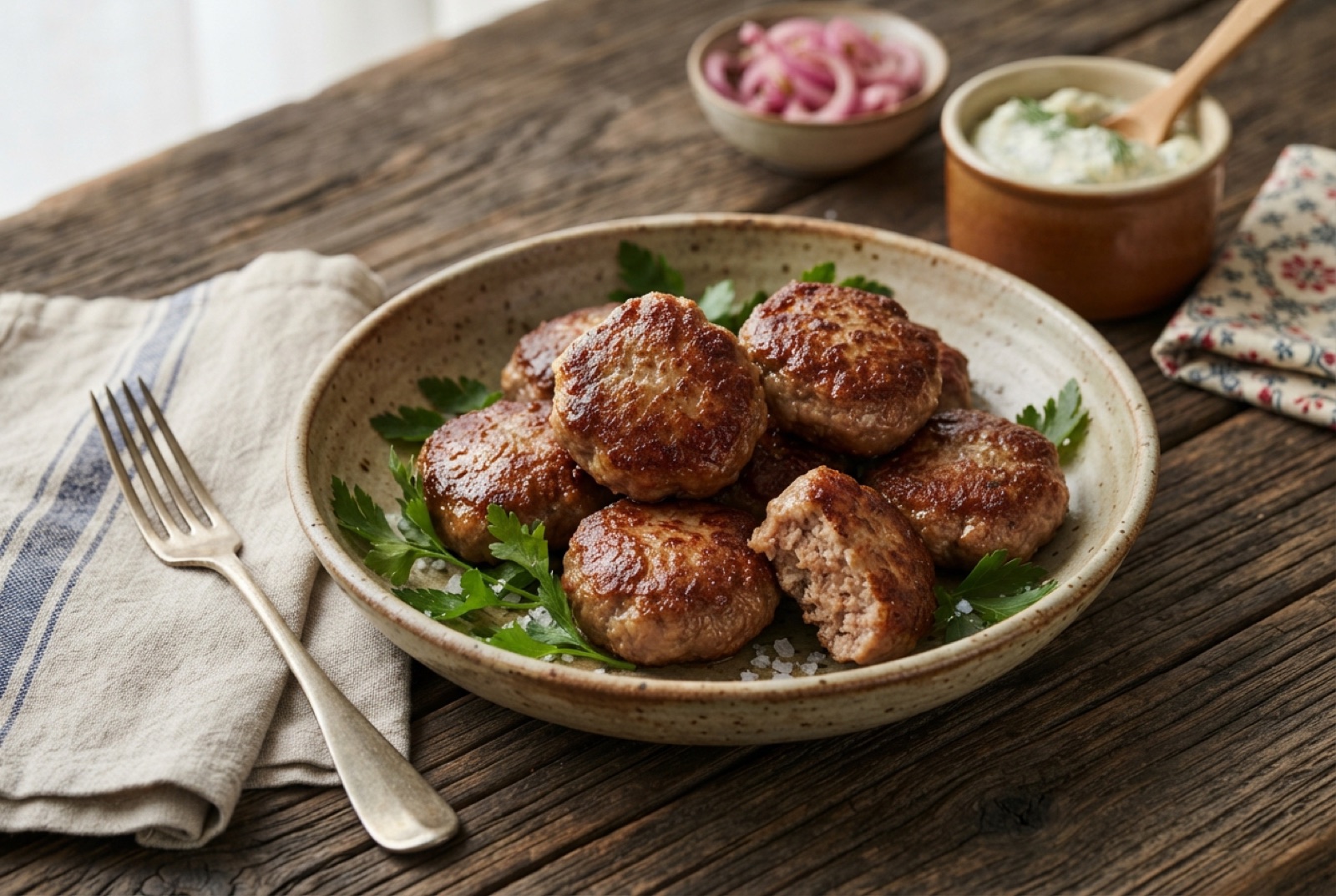
Denmark has 9 more dishes in the atlas — Flæskesteg and Frikadeller, and 7 more.
Recipe by The DishRoute Kitchen · published August 19, 2026 · updated August 19, 2026