Rugbrød.
Danish Sourdough Rye Bread
Rugbrød · say it: ROO-broadh
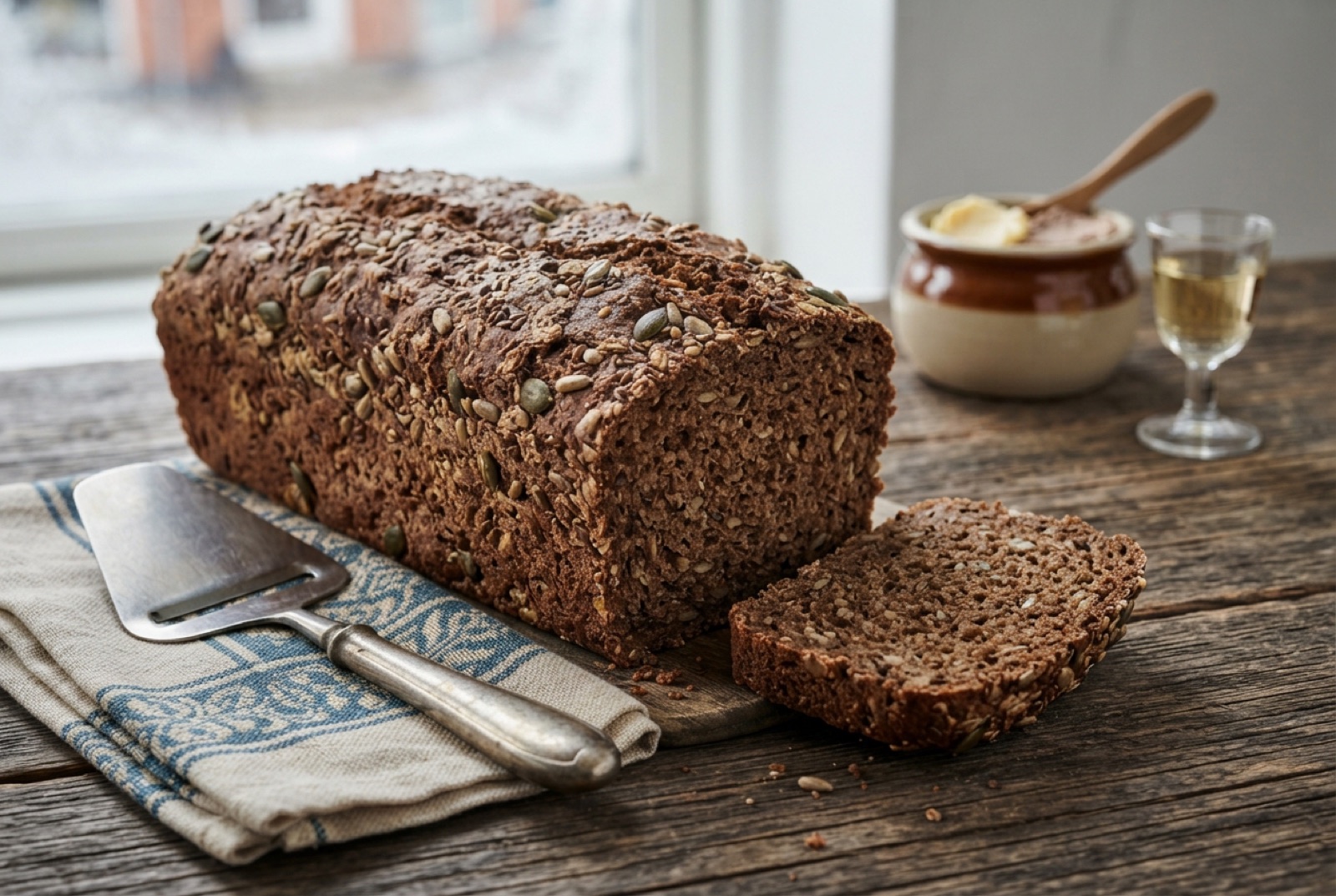
Rugbrød is a dense, dark, sour wholegrain rye loaf, closer in texture to a firm pudding than to any wheat bread, and it is the base of every piece of smørrebrød in Denmark. There is no kneading — rye has almost no gluten, so the dough is stirred rather than worked, poured into a tin and left to rise slowly. The flavour comes from a rye sourdough starter, a spoonful of dark syrup, and a long low bake; the texture comes from cracked rye kernels and seeds soaked overnight so they stay chewy rather than gritty. It must rest a full day after baking before it can be sliced thin without crumbling.

- Gate
- Denmark
- Prep
- 30 min
- Cook
- 1 hr 30 min
- Total time
- 18 hr incl. 16 hr rest
- Serves
- 16
- Status
- Takes skill
- Nutrition / serving · estimated
- Calories 210 kcal
- Protein 7 g
- Carbs 33 g
- Fat 5 g
- Fiber 6 g
- Sugar 3 g
- Sodium 320 mg
Why this recipe works.
- A real rye sourdough build rather than a yeasted imitation, which is what gives the loaf both its flavour and its sliceable structure.
- Grains and seeds soaked separately overnight, so they stay chewy inside the crumb instead of stealing water from the dough.
- A long, low bake with a clear internal-temperature target — the only reliable doneness test for a loaf this dense.
- Honest about timing: three days from starter to first slice, with the actual hands-on work under half an hour.
Ingredients.
12 itemsOvernight soaker
The dough
Equipment
- 1.5–2 litre loaf tin
- Large mixing bowl
- Sturdy wooden spoon
- Instant-read thermometer
- Long serrated bread knife
Instructions.
Soak the grains overnight
Stir the cracked rye kernels and all the seeds together with the cold water in a bowl, cover, and leave at room temperature for at least 8 hours or overnight. They should absorb nearly all the water and swell to a loose, porridge-like mass.
Tip Feed your rye starter at the same time so both are ready together the next morning.
Mix the dough
Tip the soaker into a large bowl with the starter, rye flour, wheat flour, lukewarm water, syrup and salt. Stir hard with a wooden spoon for 2 minutes until there are no dry patches — the dough will be a thick, sticky batter that drops slowly off the spoon. Do not knead it.
Fill the tin
Oil the loaf tin well and scrape the dough in, filling it about three-quarters full. Wet a spatula and your hand with cold water and smooth the top flat, pushing the dough into the corners so no air pockets are trapped at the ends.
Rise slowly
Cover loosely and leave at room temperature for 4–6 hours, until the dough has risen by about a third and the surface is dotted with small bubbles and fine cracks. It will never double the way wheat dough does — the cracked surface is the signal to bake.
Bake low and long
Heat the oven to 180°C. Bake for 30 minutes, then lower to 160°C and bake for another 55–60 minutes. The crust will darken to near-black at the edges and the loaf should sound dull and solid when tapped, not hollow.
Check the temperature
Push a probe into the centre of the loaf: it must read 96–98°C. If it is short, return it to the oven for another 10 minutes and check again. A rye loaf gives no other reliable sign of being cooked through.
Cool, wrap, and wait a day
Turn the loaf out onto a rack and cool it completely, at least 4 hours. Then wrap it in a clean tea towel and leave it 24 hours before cutting. Slice thin with a long serrated knife — the crumb will be dark, moist and firm enough to hold a wet topping.
Tip This wait is the step people skip and regret. Warm rugbrød is gummy and tears under the knife.
Tips from our kitchen.
- Feed your rye starter twice in the two days before baking so it is lively. A sluggish starter gives a flat, heavy loaf and a sour aftertaste without the depth.
- Do not knead. Stir the dough with a sturdy spoon for two minutes until it is uniformly wet and sticky, then stop — there is no gluten to develop.
- Wet the spatula and your hands with cold water before smoothing the top. Rye dough sticks to everything dry and to nothing wet.
- Bake to an internal temperature of 96–98°C, not to a time or a colour. A dense rye loaf can look finished on the outside with a raw seam in the middle.
- Wrap the cooled loaf in a clean tea towel and leave it at least 24 hours before slicing. Cutting it warm gives you a gummy crumb that tears.
- Slice it thin — 5 mm to 1 cm — with a long serrated knife. Thick rugbrød is unpleasant to eat and makes bad smørrebrød.
Substitutions.
- Rye sourdough starter → 7 g dried yeast plus 200 ml buttermilk in place of the same weight of water
- This produces a decent everyday loaf faster, but it will be milder and softer than real rugbrød. The acidity of a sourdough also does structural work in rye, so the yeasted version is slightly stickier in the crumb.
- Cracked rye kernels → Whole rye berries, coarsely chopped, or steel-cut oats
- Both need the same overnight soak. Oats make the crumb softer and slightly sweeter, and move the loaf away from the classic Danish texture.
- Dark syrup or molasses → Malt extract, dark honey or a spoonful of brown sugar
- Its job is colour and a faint bitterness, not sweetness. Danish bakers often use maltsirup; molasses is the easiest global equivalent.
Variations.
- Seed-heavy rugbrød
- Double the sunflower and pumpkin seeds and add flax. Popular in Danish bakeries as kernerugbrød, with a crumb that is more seed than bread and a shorter shelf life.
- Beer rugbrød
- Replace half the water in the dough with dark Danish beer. It deepens the malt flavour noticeably and gives the crust a darker colour.
- Buttermilk loaf
- Using buttermilk instead of water adds a second layer of acidity and a softer crumb. Common in home baking, particularly with the yeasted shortcut version.
Storage & reheating.
Rugbrød keeps far better than wheat bread: 5 to 7 days wrapped in a tea towel or paper at room temperature, cut side down on a board. Do not refrigerate it — the crumb goes dry and crumbly within a day. It freezes very well pre-sliced for 3 months, and slices can go straight from the freezer into a toaster. If a loaf does dry out, it is still perfect toasted, or blitzed into the coarse rye crumbs Danes fry in butter with sugar for øllebrød and rye-crumb desserts.
Serve with
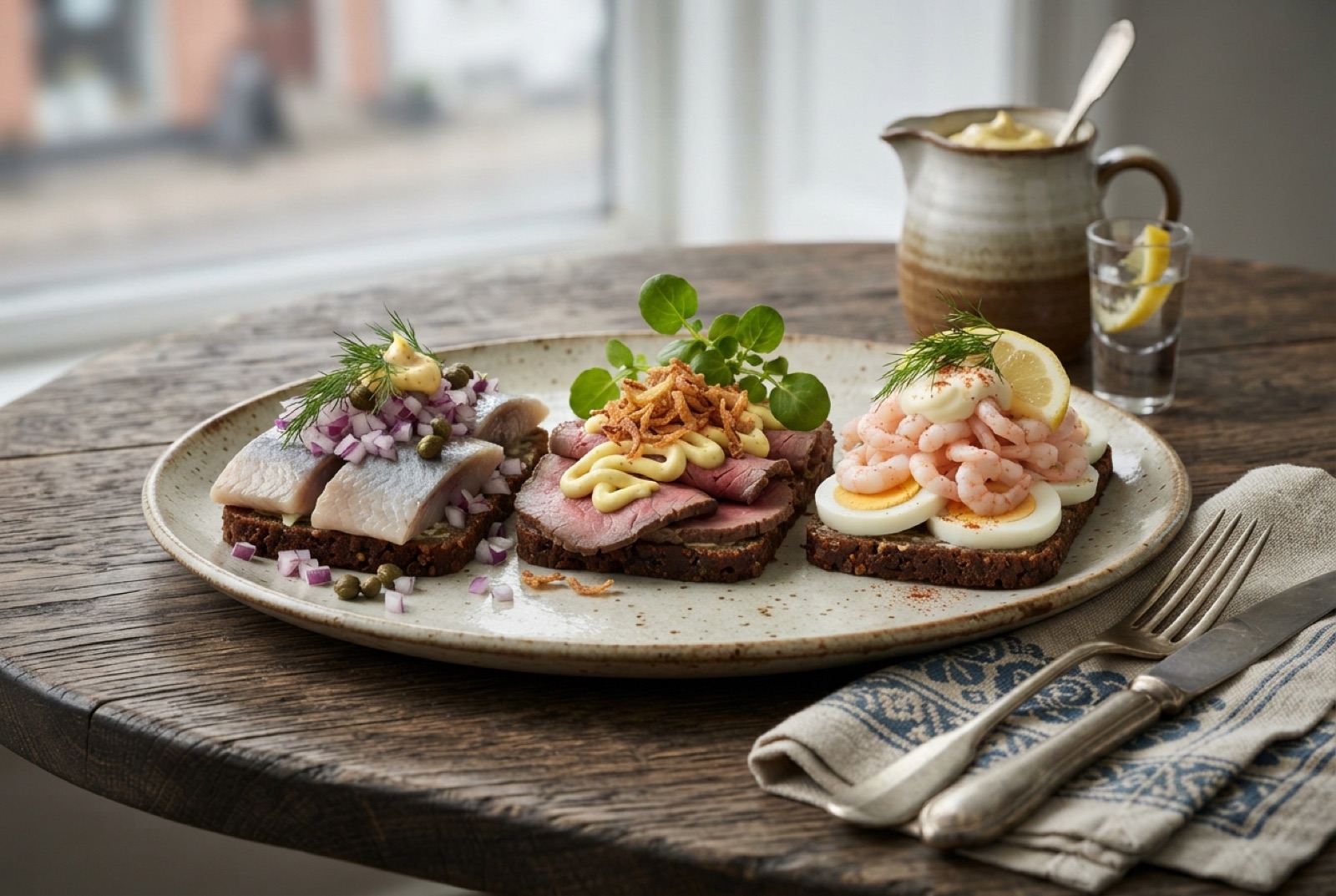
Salted butter and a slice of aged cheese, or as the base for any smørrebrød — pickled herring, liver pâté, cold roast pork.
The story behind Rugbrød.
Rye grows where wheat struggles — in cold, wet, poor soil — which is why northern Europe from Denmark to Russia built its bread on it. In Denmark rye bread never became a peasant relic to be replaced by white loaves; it stayed the everyday bread, and it still is. Danes eat it at lunch almost daily, children take it to school, and a household running out of rugbrød treats that as a real problem. The wheat loaf is called franskbrød, French bread, which quietly marks it as the foreign one.
Because rye protein does not form a gluten network, everything about the technique is different from wheat baking. There is no windowpane test, no shaping, no oven spring. The dough is a thick, sticky batter that is spread into a tin with a wet spatula and rises only modestly. Acidity does the structural work instead of gluten: a sour rye starter lowers the pH enough to keep the starches from turning to glue during baking, which is why an unsoured rye loaf can come out sticky and dense in the wrong way. This is the one place where sourdough is not a preference but a functional requirement.
What varies between households is the mix-in. Cracked rye kernels are close to universal; beyond that people add sunflower, pumpkin, flax or sesame seeds in whatever proportion they grew up with, and some add dark beer or buttermilk to the liquid. Commercial bakeries in Denmark sell dozens of versions, and Danes have strong regional and family loyalties about seed content, crumb darkness and whether the loaf should contain any wheat flour at all. The one point of agreement is the waiting: a rugbrød cut warm is gummy and falls apart, and every Danish baker will tell you to leave it until the next day.
Questions, answered.
Why does rye bread need a sourdough starter?
Rye has almost no gluten, so acidity rather than protein structure holds the loaf together. A sour starter lowers the pH enough to stop rye starches from breaking down into a gummy paste during baking. A yeasted rye loaf is possible but will always be slightly stickier and milder than a properly soured one.
Why is my rugbrød gummy inside?
Almost always because it was cut too soon. A dense rye loaf continues to set for a full day after baking, and slicing it warm produces a sticky, torn crumb even when the bake was perfect. The other cause is underbaking — check for 96–98°C in the centre with a probe rather than trusting the crust.
Can I make it without a bread tin?
Not really. Rye dough is a thick batter with no structure of its own and will spread flat on a baking sheet. A standard 1.5 to 2 litre loaf tin is what the recipe is built for; any deep straight-sided tin of similar volume works, lined with baking paper.
How long does the whole process take?
About three days end to end, though the hands-on time is under thirty minutes. Day one is feeding the starter and soaking the grains, day two is mixing and a long rise followed by the bake, and day three is when you can finally slice it. The waiting is not optional.
Can I use only rye flour, with no wheat at all?
Yes, and many Danish loaves are 100% rye. The small proportion of wheat flour here makes the dough marginally easier to handle and the crumb slightly less dense. Leaving it out gives a heavier, darker, more traditional loaf — add about 30 ml more water to compensate.
You might also like.
All recipes →
Keep exploring Denmark.
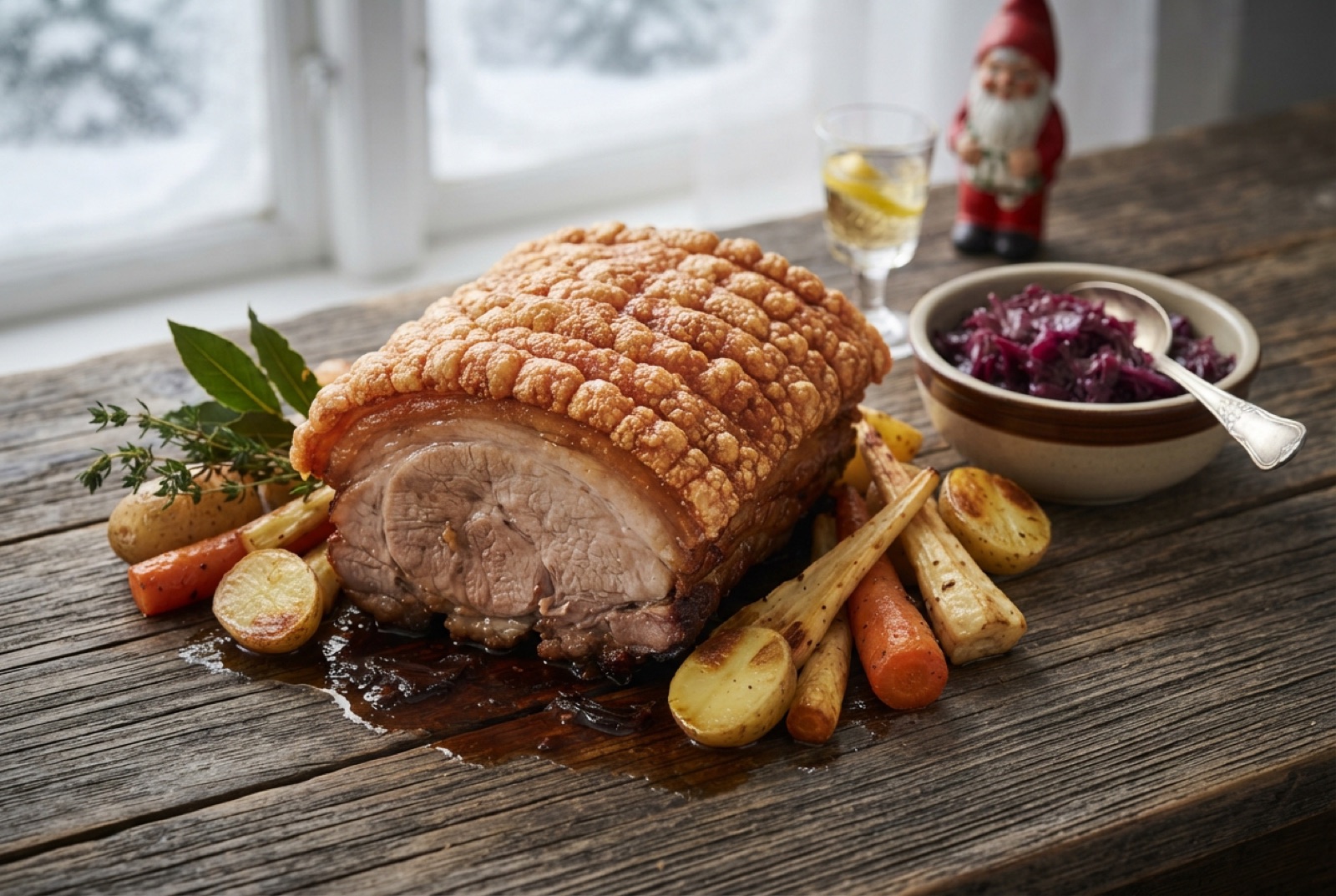
Denmark has 9 more dishes in the atlas — Æbleskiver and Flæskesteg, and 7 more.
Recipe by The DishRoute Kitchen · published August 19, 2026 · updated August 19, 2026