Arancini.
Sicilian Fried Stuffed Rice Balls
Arancini di riso · say it: ah-rahn-CHEE-nee
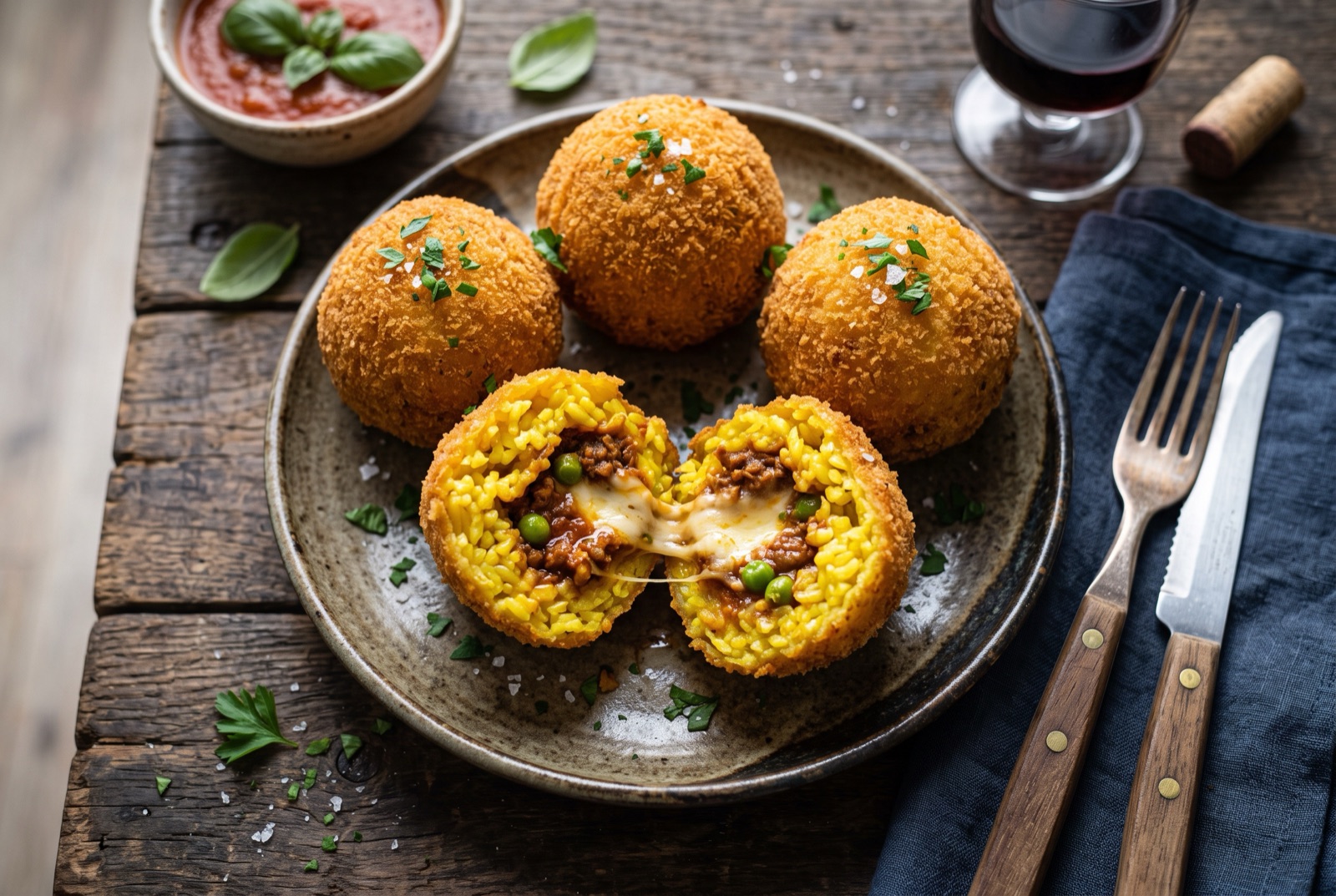
Arancini are fist-sized balls of saffron rice with something rich buried in the middle, breaded and deep-fried until the outside is crackling and the inside is hot enough to steam when you break it open. The classic filling is a slow-cooked meat ragù with peas, though ham and mozzarella runs a close second across Sicily. They taste of three distinct layers — crisp crumb, dense savoury rice, and a molten, tomato-heavy centre — and they are engineered for eating with your hands on a street corner. Making them is not difficult, but it is a two-stage job: the rice must be cooked and chilled properly before anything can be shaped.

- Gate
- ItalySicily
- Prep
- 1 hr
- Cook
- 1 hr 10 min
- Total time
- 6 hr 10 min incl. 4 hr rest
- Serves
- 6
- Status
- Medium
- Nutrition / serving · estimated
- Calories 610 kcal
- Protein 26 g
- Carbs 68 g
- Fat 26 g
- Fiber 4 g
- Sodium 830 mg
Why this recipe works.
- The rice is cooked risotto-style and then chilled overnight, which is the only reliable way to get balls that hold together in hot oil.
- The ragù is cooked down until almost dry, so the filling does not steam its way out through the crust mid-fry.
- Gives a clear temperature window for the oil and explains what goes wrong above and below it.
- Shows the cupped-hand shaping method that seals the seam properly instead of leaving a fault line.
Ingredients.
19 itemsFor the rice
For the ragù
For coating
Equipment
- Wide heavy pan for the rice
- Tray for cooling the rice
- Deep heavy saucepan or fryer
- Kitchen thermometer
- Wire cooling rack
Instructions.
Cook the saffron rice
Toast 500 g of rice in a wide pan for 2 minutes, then add hot broth a ladle at a time, stirring, for about 18 minutes until the grains are fully tender with no chalky centre — softer than you would want for risotto. Stir in the saffron broth halfway through.
Tip Unlike risotto, this rice should be cooked all the way through; it firms up considerably once cold.
Enrich and chill the rice
Beat in the butter and grated cheese off the heat, season well, then spread the rice in a thin layer on a tray. Cool to room temperature, cover, and refrigerate for at least 4 hours or overnight until it is firm and slightly sticky.
Make the ragù
Soften the onion and carrot in olive oil for 8 minutes, add the mince and brown it hard, breaking it up, until the pan is dry and the meat has caught in places. Pour in the wine and let it evaporate, then add the passata and simmer for 30–35 minutes until the sauce is thick and glossy with no free liquid.
Tip Stir in the peas for the last 5 minutes, then cool the ragù completely — a warm filling will burst the arancini.
Shape the balls
With wet hands, take a heaped 80 g of cold rice and press it into a cup in your palm. Spoon in a teaspoon of ragù and a cube of mozzarella, then close the rice over the top and roll firmly into a ball or press into a cone, checking for cracks and patching any with a little extra rice.
Tip Mix the beaten egg through the rice first if it feels loose — it makes the shell much easier to close.
Bread them
Roll each ball in flour, then beaten egg, then breadcrumbs, pressing the crumbs on so no rice shows through anywhere. Set them on a tray and chill for 20 minutes so the coating sets.
Fry in batches
Heat the oil to 175 °C. Lower in three or four arancini at a time and fry for about 4 minutes, turning, until the crust is deep golden brown all over and the balls float and feel light. Let the oil come back up to temperature between batches.
Drain and rest
Lift the arancini onto a wire rack and sprinkle with a little salt. Leave them 5 minutes before eating — the centre comes out of the oil hot enough to burn, and the crust firms as it stands.
Tips from our kitchen.
- Cook the rice a day ahead. Warm rice will not hold a shape and any ball you manage to build will burst in the oil.
- Keep a bowl of water beside you while shaping and wet your hands often — rice sticks to dry skin and tears the shell.
- Use a filling that is thick and cool. A wet or warm centre turns to steam under the crust and blows the arancino open.
- Fry at 175 °C. Hotter and the crumb burns before the middle warms through; cooler and the shell soaks oil and goes greasy.
- Fry in small batches of three or four. A crowded pot drops the oil temperature by 20 degrees or more in seconds.
- Rest the fried arancini on a rack, never on paper on a plate — trapped steam softens the bottom crust within a minute.
Substitutions.
- Beef ragù filling → Diced ham and mozzarella with a spoonful of thick béchamel
- This is arancino al burro, equally traditional in Sicily and considerably faster since there is no long simmer.
- Carnaroli or arborio rice → Any short-grain risotto rice, or Spanish bomba
- You need high-starch short grain so the cooled rice binds. Long-grain, basmati and parboiled rice will not hold a ball together at all.
- Dried breadcrumbs → Panko
- Panko gives a lighter, crunchier and slightly shaggier crust. It is not Sicilian, but it fries cleanly and stays crisp longer if you are making a batch ahead.
Variations.
- Arancino al burro
- The other Sicilian standard: béchamel, ham and mozzarella instead of ragù, giving a milder, creamier centre. Usually shaped round even in Catania to tell the two fillings apart.
- Arancini agli spinaci
- A meat-free version filled with spinach cooked down with garlic and folded through ricotta or mozzarella — common in Sicilian bars and genuinely traditional rather than a modern concession.
- Baked arancini
- Sprayed with oil and baked at 200 °C for about 25 minutes. The crust is drier and paler than a fried one, but the middle behaves the same and the kitchen stays clean.
Storage & reheating.
Shaped, unfried arancini keep 2 days in the fridge and freeze for 3 months; fry them straight from frozen at 165 °C for about 8 minutes so the centre thaws before the crust darkens. Fried arancini keep 3 days refrigerated and reheat well in a 190 °C oven for 12–15 minutes, which restores most of the crispness. Do not microwave them — the crumb goes leathery and the rice turns pasty. The cooked rice base itself can be made up to 2 days ahead and kept covered in the fridge.
Serve with
Nothing, really — arancini are eaten standing up in paper. If plating them, a bowl of warm tomato sauce for dipping and a squeeze of lemon on the side.
The story behind Arancini.
Rice, saffron and the technique of frying sweet or savoury balls all reached Sicily during the period of Arab rule between the ninth and eleventh centuries, and arancini are usually traced to that inheritance, though the breadcrumb coating is a later addition — probably from the era when frying in a crumb crust became standard across southern Italy. The name comes from arancia, orange, for the colour and rough shape of the finished ball.
Sicily is divided on both the shape and the grammar. In Palermo and the west they are round and called arancine, feminine, on the logic that they resemble the fruit. In Catania and the east they are conical, said to echo Mount Etna, and called arancini, masculine. Both cities consider the other wrong, the Accademia della Crusca has weighed in without ending the argument, and the disagreement is enjoyed rather than resolved. Catanese arancini are frequently filled with ragù al sugo — arancino al ragù — while a butter version, arancino al burro, with béchamel and ham, is the other standard.
They are festival food as much as everyday food. Arancini are traditionally eaten on 13 December for Santa Lucia, when many Sicilians avoid bread and pasta in observance of the saint's day and eat rice and chickpea dishes instead; friggitorie sell them by the thousand. The rest of the year they are the default snack of bars, train stations and beach kiosks, sold warm from a glass case and eaten standing up, wrapped in a square of paper.
Questions, answered.
Why do my arancini fall apart or burst in the oil?
Almost always because the rice was not cold enough or the filling was too wet. Rice needs to be spread thin, cooled and refrigerated for at least four hours — overnight is better — so the starch sets and binds. The filling must be thick and fully cooled too, since a warm, loose centre generates steam that forces the seam open. Also make sure the ball is fully coated in egg and crumb with no bare rice showing.
Is it arancini or arancine?
Both, depending on where in Sicily you are. Palermo and western Sicily say arancine and make them round; Catania and the east say arancini and shape them into a cone. The singular forms are arancina and arancino respectively. Neither is incorrect, and the argument between the two cities is a genuine and long-running one that Sicilians treat as a point of local pride rather than a question needing an answer.
What oil temperature should I use for frying?
Around 175 °C, checked with a thermometer if you have one. At that temperature a ball takes roughly 4 minutes to reach a deep golden brown and heat through. Below about 160 °C the crust absorbs oil instead of sealing and the arancini come out heavy and greasy; above 190 °C the crumb browns and then burns while the middle is still cool. Let the oil recover between batches.
Can I make arancini without a deep fryer?
Yes. A heavy saucepan with 6–8 cm of neutral oil works fine as long as the pot is deep enough that the oil does not rise above halfway when you add the balls. Use a thermometer, fry three or four at a time, and turn them with a slotted spoon so all sides colour. You can also bake or air-fry them, accepting a drier, less crackly crust.
Can arancini be made ahead for a party?
They are ideal for it. Shape and bread them up to two days ahead, keep them uncovered on a tray in the fridge so the crumb dries slightly, and fry to order in about four minutes. Alternatively fry them earlier in the day and reheat the whole batch in a hot oven for twelve minutes just before serving — this works far better than trying to fry twenty balls while guests wait.
You might also like.
All recipes →
Keep exploring Italy.
Italy has 9 more dishes in the atlas — Classic Tiramisu and Focaccia Genovese, and 7 more.
Recipe by The DishRoute Kitchen · published August 19, 2026 · updated August 19, 2026