Ash-e Reshteh.
Persian Noodle, Bean and Herb Soup
آش رشته · say it: AASH-eh resh-TEH
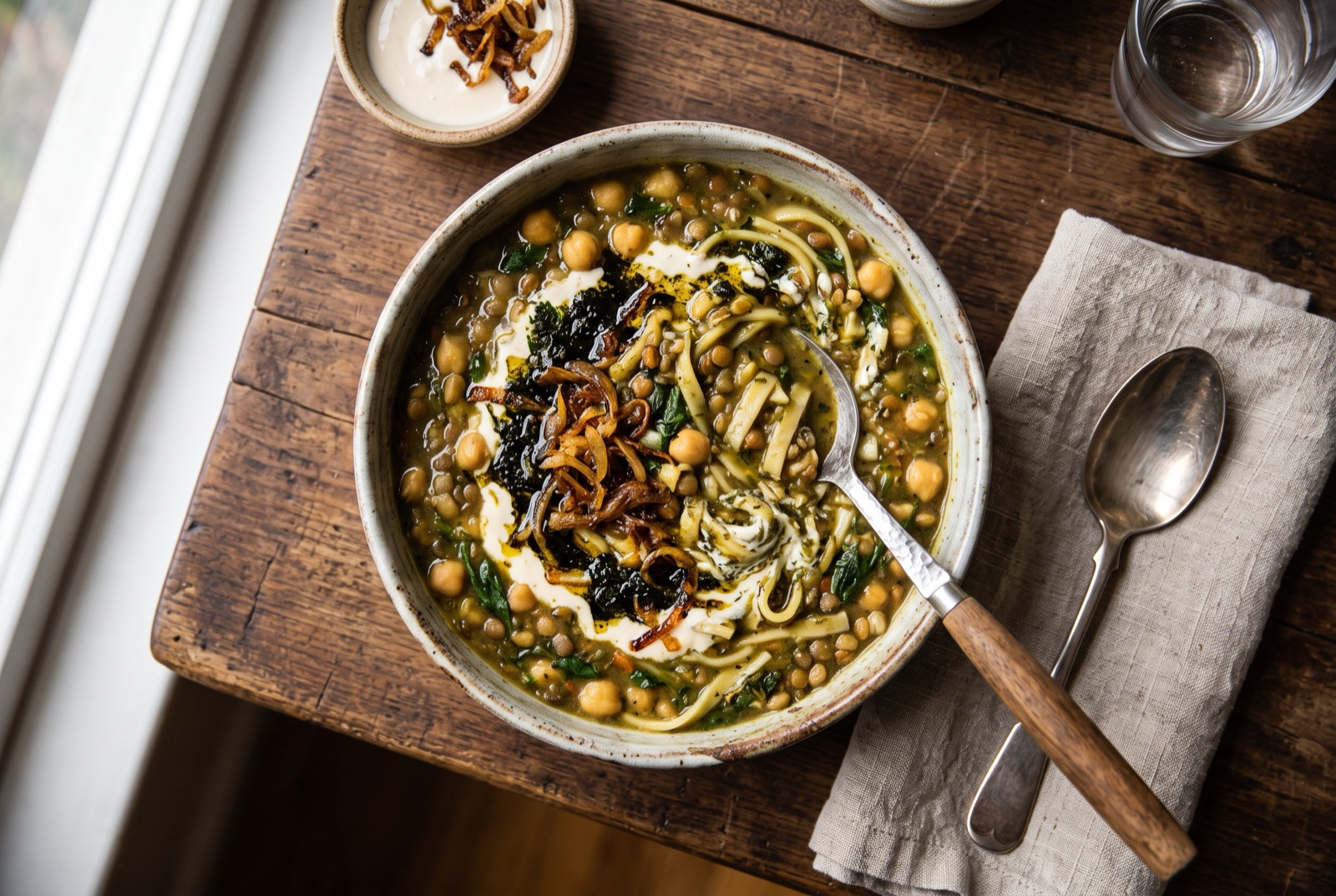
Ash-e reshteh is a soup only in the loosest sense — it is thick enough that a spoon stands up in it, and Iranians eat it as a complete meal. Chickpeas, white beans and lentils cook down with an enormous quantity of chopped parsley, coriander, spinach and chives until the whole pot turns dark green and slightly porridge-like, and flat reshteh noodles are broken in near the end to thicken it further. What lifts it out of worthy-lentil-soup territory is the finish: crisp fried onions, a slick of oil that has been darkened with dried mint until it smells almost like tobacco, and swirls of kashk, the intensely sour dried whey that gives the dish its tang. Salty, sour, herbal and filling all at once.

- Gate
- Iran
- Prep
- 30 min
- Cook
- 1 hr 15 min
- Total time
- 1 hr 45 min
- Serves
- 6
- Status
- Medium
- Nutrition / serving · estimated
- Calories 480 kcal
- Protein 20 g
- Carbs 62 g
- Fat 17 g
- Fiber 14 g
- Sodium 980 mg
Why this recipe works.
- Fries the mint properly in hot oil, a five-second step that changes the whole aroma of the pot and is usually skipped in English-language recipes.
- Uses tinned pulses without pretending otherwise, so this is a weeknight-possible version of a dish usually made in a cauldron.
- Explains how to get the right thickness whether you find real reshteh or use linguine.
- Gives a workable kashk substitute for cooks who cannot find the real thing, and says honestly what changes.
Ingredients.
16 itemsFor the fried onion
For the soup
For the greens
To finish
Equipment
- Large heavy pot
- Small frying pan for the mint oil
- Sharp knife or food processor for the herbs
Instructions.
Fry the onions until deep brown
Heat the oil in a wide pan and fry 3 of sliced onions over medium-low heat for 20 to 25 minutes, stirring occasionally, until they collapse, then dry out and turn a deep even brown with crisp edges. Lift out two-thirds with a slotted spoon and set aside for the garnish.
Tip Onions go through a soggy grey stage around minute twelve. Keep going — the colour arrives all at once near the end.
Add garlic and turmeric
Add the sliced garlic to the onions left in the pan and fry for 1 minute until it smells sweet rather than sharp, then stir in the turmeric and cook for another 30 seconds so it loses its raw, dusty edge.
Cook the pulses
Tip the onion mixture into a large pot with the lentils, chickpeas, beans, salt and the water. Bring to a boil, then simmer covered for 30 minutes, until the lentils are completely soft and starting to break apart into the liquid.
Add the greens
Stir in all the parsley, coriander, spinach and chives — the pot will look impossibly full for a minute, then collapse. Simmer uncovered for 25 minutes, until the soup turns dark green and thickens enough that a spoon leaves a brief trail through it.
Cook the noodles in the soup
Drop in the broken noodles and stir well, then simmer for 8 to 10 minutes, stirring every couple of minutes so nothing sticks to the base. The soup should thicken noticeably as the noodles release their starch. Loosen with hot water if it becomes stiff.
Make the fried mint oil
Heat 3 tablespoons of oil in a small pan until it shimmers, then take it off the heat and stir in the dried mint. Swirl for 3 to 5 seconds only — the mint should darken and the smell should turn deep and almost smoky — then pour it immediately into a cold bowl.
Tip Leave it in the hot pan and it will go black and bitter within seconds. Get it out fast.
Stir in the kashk and serve
Take the pot off the heat, thin the kashk with a little hot soup, and stir two-thirds of it through. Taste and correct the salt — it should be distinctly sour and savoury. Ladle into bowls and decorate the surface with swirls of the remaining kashk, the reserved crisp onions and a drizzle of mint oil.
Tip Stir kashk in off the boil. At a rolling simmer it can split into grainy curds.
Tips from our kitchen.
- Fry the onions low and slow, 20 to 25 minutes, until they are properly brown and crisp rather than golden and soft. Rushing them on high heat gives you burnt edges and raw centres.
- The mint takes seconds, not minutes. Drop it into hot oil off the heat and watch it — the moment it darkens and smells deep rather than fresh, pour it out of the pan or it will turn bitter.
- Chop the herbs finely and do not be alarmed by the volume. Nearly a kilo of greens collapses into almost nothing once it hits the pot.
- Add the noodles only in the last 10 minutes and stir often afterwards, since they sink and stick to the bottom while they release starch.
- Thin with hot water rather than cold, and expect to add some. The soup keeps thickening as it sits and can go from perfect to solid within twenty minutes.
- Stir most of the kashk in off the heat, not while boiling, so it does not split, and save some to swirl on top for the pattern.
Substitutions.
- Reshteh noodles → Linguine or flat tagliatelle, broken into 5 cm lengths
- The most common substitute abroad. Italian pasta releases less starch, so the soup ends up thinner — compensate by mashing some of the chickpeas against the side of the pot.
- Kashk → Thick sour cream thinned with a squeeze of lemon, or strained yogurt with extra salt
- Neither is nearly as sour or as savoury as real kashk, which tastes closer to a very sharp aged cheese. Iranian and Middle Eastern grocers sell it in jars and it keeps for months once opened.
- Fresh spinach → Frozen chopped spinach, thawed and squeezed dry, or chard leaves
- Frozen works perfectly well here since everything cooks down anyway. Squeeze out the water or the soup will be thinner than you want.
Variations.
- Ash-e jow
- The barley version, made with pearl barley and often cream instead of the noodles and kashk. Milder, thicker and a common winter soup in Tehran.
- Ash-e anar
- A northern version soured with pomegranate juice and studded with meatballs, sweet-sour rather than salty-sour. Traditional around Yalda night in December.
- Vegan ash-e reshteh
- Skip the kashk and finish instead with a squeeze of lemon and extra fried mint. The soup is already meat-free, and the sourness that kashk provides can come from citrus without much loss.
Storage & reheating.
Ash-e reshteh keeps 4 days refrigerated but thickens dramatically as the noodles and pulses keep absorbing liquid — expect to loosen it with a good deal of hot water when reheating, and season again once it has thinned. Reheat gently and stir often, since the starchy base catches easily on the bottom of the pan. It freezes for 2 months, though the noodles soften noticeably; if you plan to freeze it, cook the base without noodles and add fresh ones when reheating.
Serve with
Warm flatbread for scooping, and a small bowl of extra kashk and fried mint at the table so everyone can adjust their own bowl.
The story behind Ash-e Reshteh.
Aash is a whole family of Iranian soups rather than a single dish, and the word is old enough that the person who cooks it, the ashpaz, gives Persian its general word for cook. Ash-e reshteh is the most famous of them, and it is tied to specific occasions: it is made in huge cauldrons for Nowruz and the last Wednesday of the year, distributed as nazri — food cooked as a votive offering and given away to neighbours and passers-by — and eaten to mark the start of something new. The noodles carry that symbolism directly, since reshteh also means thread or strand, and eating them is associated with taking hold of the thread of your fate.
Reshteh themselves are flat, salted wheat noodles made specifically for this soup, softer and starchier than Italian pasta and deliberately designed to release starch into the pot. That starch is not incidental — it is a large part of what makes ash-e reshteh thick rather than brothy. Linguine broken into lengths is the usual substitute abroad and works acceptably, but it stays firmer and does not thicken the soup the same way, so the texture ends up looser than it should be.
The two garnishes are not optional in any meaningful sense. Piaz dagh, onions fried slowly until deep brown and crisp, adds sweetness and a texture contrast to a bowl that is otherwise entirely soft. Nana dagh is dried mint fried for a few seconds in hot oil until it darkens and its aroma turns from grassy to deep and slightly bitter — pour it over the surface and the smell of the whole pot changes. Kashk, the third element, is dried and reconstituted whey with a sourness far sharper than yogurt, sold in jars at Iranian grocers. Together the three make a pattern of pale swirls on dark green that is the visual signature of the dish, and cooks decorate the surface with real care before it goes to the table.
Questions, answered.
What is kashk and do I need it?
Kashk is fermented whey that has been drained and dried, then reconstituted into a thick pale paste. It tastes intensely sour and savoury, somewhere between sharp yogurt and aged cheese, and it is what gives ash-e reshteh its characteristic tang. You can finish the soup with sour cream and lemon instead and it will be good, but noticeably milder — the dish loses its sharp edge and reads more like a herb and lentil soup.
Can I use normal pasta instead of reshteh?
Yes. Linguine or tagliatelle broken into short lengths is the standard substitute outside Iran. The difference is starch: real reshteh are softer, saltier and release far more starch, which is part of what makes the soup thick. To compensate, mash a ladleful of the chickpeas against the side of the pot before adding the pasta.
Why did my fried mint turn bitter?
It was in the oil too long. Dried mint burns in a matter of seconds at frying temperature, so take the pan off the heat before the mint goes in, swirl it for three to five seconds until it darkens and the smell turns deep and smoky, and pour it straight out of the hot pan. Anything approaching black is bitter and cannot be salvaged.
Is ash-e reshteh vegetarian?
The standard version is vegetarian but not vegan, since kashk is a dairy product and the soup is often built on a meat stock in restaurants. Made with water or vegetable stock, as here, it is fully vegetarian, and leaving out the kashk in favour of lemon juice makes it vegan without changing the character of the dish very much.
When do Iranians actually eat this soup?
It is strongly associated with occasions rather than everyday meals: Nowruz and the days around the new year, the last Wednesday of the old year, and votive cooking where enormous pots are made and given away to neighbours. It is also common comfort food in cold weather, and many Iranian cities have shops that sell nothing but aash by the ladle.
You might also like.
All recipes →
Keep exploring Iran.
Iran has 9 more dishes in the atlas — Faloodeh and Fesenjan, and 7 more.
Recipe by The DishRoute Kitchen · published August 20, 2026 · updated August 20, 2026