Kuku Sabzi.
Persian Herb Frittata
کوکو سبزی · say it: KOO-koo sab-ZEE
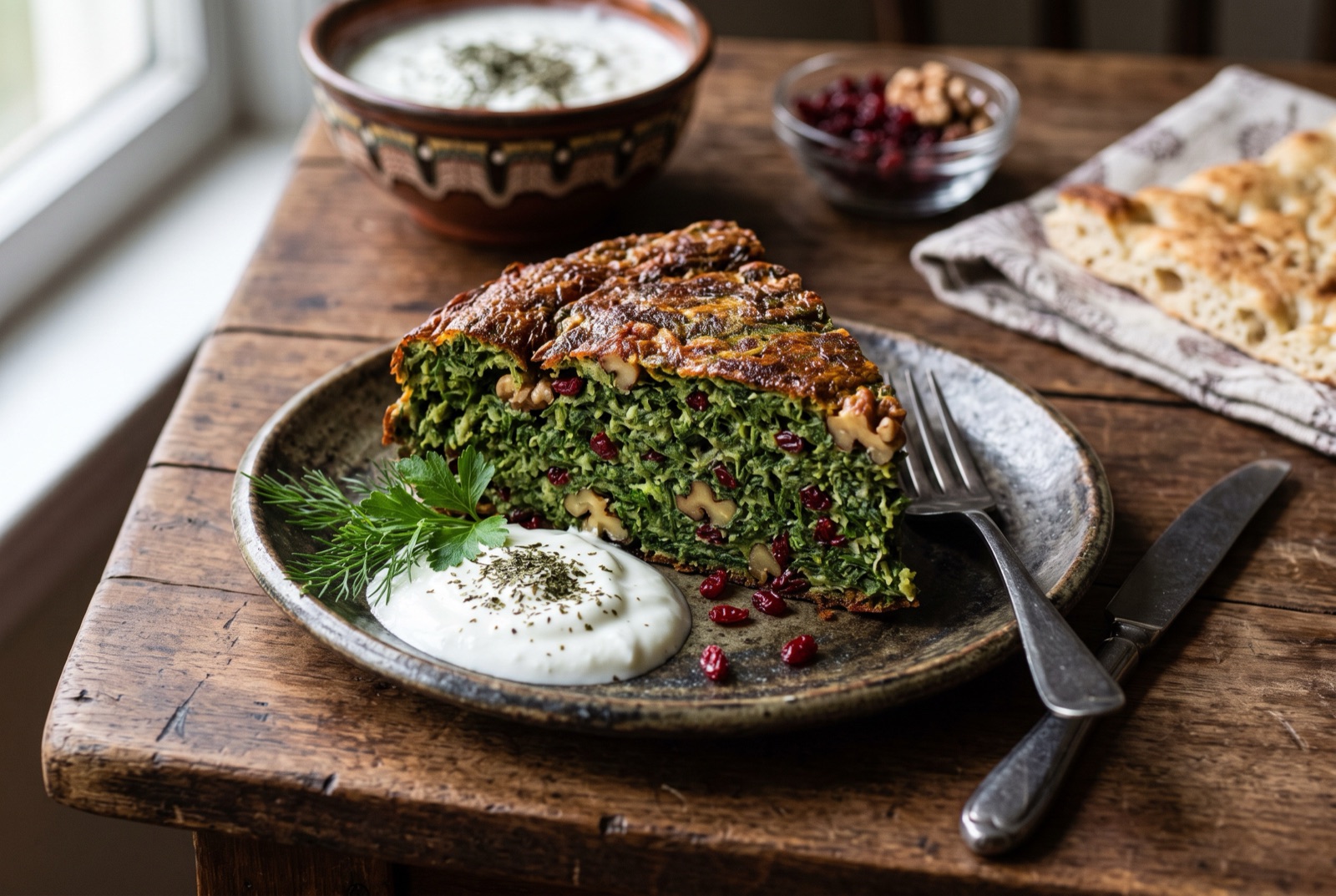
Kuku sabzi is a frittata in structure only. The ratio is inverted from anything Italian: close to a kilo of parsley, coriander, dill and chives held together by six eggs, so the finished cake is dark green all the way through and tastes overwhelmingly of herbs rather than egg. Walnuts add crunch and a slight bitterness, barberries add sour red flecks, and a little turmeric warms the background. Cooked slowly under a lid it sets soft in the middle with a crisp browned base; cut into wedges or squares it is eaten warm, cold, in bread as a sandwich, or as part of the Nowruz table, where its greenness stands for renewal.

- Gate
- Iran
- Prep
- 25 min
- Cook
- 35 min
- Total time
- 1 hr 5 min incl. 5 min rest
- Serves
- 6
- Status
- Easy
- Nutrition / serving · estimated
- Calories 260 kcal
- Protein 12 g
- Carbs 8 g
- Fat 20 g
- Fiber 4 g
Why this recipe works.
- Keeps the herb-to-egg ratio where it belongs, so this reads as a green cake rather than a herby omelette.
- Cooks it low and covered, which is the only reliable way to set the middle without burning the base.
- Offers both the stovetop flip and the oven method, with an honest account of what each one costs you.
- Uses walnuts and barberries as they are actually used in Iran, for texture and sourness rather than decoration.
Ingredients.
14 itemsFor the herbs
For the batter
To cook
Equipment
- Heavy non-stick frying pan with a lid, about 24 cm
- Large plate for flipping
- Sharp knife for chopping herbs
Instructions.
Wash, dry and chop the herbs
Wash all the herbs and dry them thoroughly in a salad spinner or between towels — any water left behind will leach out and stop the kuku setting. Chop everything as finely as you can by hand, thin stems included, and pile it into a very large bowl.
Tip It looks like far too much. It is the right amount, and it compacts once the egg goes in.
Make the batter
Beat 6 of eggs in a separate bowl just until the yolks and whites come together, then whisk in the chickpea flour, baking powder, turmeric, salt and pepper until no lumps remain. Do not aerate them — a foamy batter puffs up and then sinks.
Combine everything
Pour the egg mixture over the herbs, add the walnuts and drained barberries, and fold with a spatula until every strand of herb is coated. The mixture should look like damp green stuffing rather than a pourable batter.
Start it low and covered
Heat 3 tablespoons of oil with the butter in a heavy non-stick pan over low heat. Tip in the mixture, press it flat with the back of the spatula into an even layer, cover, and cook for 20 to 25 minutes, until the top has lost its wet gloss and the edges pull slightly away from the pan.
Tip If you hear anything more than a faint whisper from the pan, the heat is too high. Kuku burns underneath long before it sets in the middle.
Flip and crisp the second side
Slide the kuku onto a large flat plate, add the remaining oil to the pan, then invert the pan over the plate and turn the whole thing back so the pale side lands face down. Cook uncovered for 8 to 10 minutes, until the base is firm, browned and comes away cleanly when you lift an edge.
Tip If the flip alarms you, bake it instead: pour the mixture into an oiled dish and give it 35 to 40 minutes at 180C.
Rest and cut
Slide the kuku onto a board and let it rest for 5 minutes so it firms up, then cut into wedges or diamonds. Serve warm or at room temperature with flatbread, yogurt and pickles.
Tips from our kitchen.
- Dry the herbs completely after washing. Wet greens release water into the mixture and the kuku steams into something soggy instead of setting.
- Chop by hand if you can. A food processor bruises the herbs and turns them dark and slimy, and the texture of the finished cake suffers.
- Beat the eggs only until the yolks and whites are combined. Whipping air into them makes the kuku puff and then collapse.
- Cook on genuinely low heat with a lid for at least 20 minutes before you think about flipping. The centre needs steam, not a hot pan.
- Rinse and soak the barberries for ten minutes first — they arrive with grit, and dry ones scorch and turn bitter in the pan.
- Let it rest for five minutes before cutting. Straight out of the pan it crumbles; rested, it slices cleanly into wedges.
Substitutions.
- Barberries (zereshk) → Dried sour cherries or cranberries, roughly chopped
- Both are sweeter than barberries, so use about two-thirds the quantity or the kuku starts tasting like a fruit cake.
- Fresh herbs → Frozen chopped herb mix, thawed and squeezed very dry
- Acceptable and widely used, but squeeze out every bit of water you can — this is the main cause of a wet, unset kuku.
- Walnuts → Toasted pistachios, or leave them out
- The kuku works without nuts, though it loses a texture contrast that the soft herb base needs.
- Chickpea flour → 1 tbsp plain flour, or nothing at all
- The binder is optional and slightly contentious. Without it the kuku is more fragile but tastes purer; chickpea flour keeps it gluten-free.
Variations.
- Kuku sibzamini
- The potato version: grated boiled potato with egg, turmeric and onion, fried into small patties rather than one large cake. Softer and more filling, and standard lunchbox food.
- Baked kuku sabzi
- The same mixture poured into an oiled dish and baked at 180C for 35 to 40 minutes. Removes the flip entirely and cuts more cleanly, at the cost of a properly crisp base.
- Kuku sabzi with lettuce or spinach
- Some cooks stretch the herbs with shredded lettuce or spinach, which softens the intensity and makes the dish cheaper. Common in larger households and perfectly traditional.
Storage & reheating.
Kuku sabzi keeps 4 days refrigerated and is arguably better cold on day two, when the herb flavour has settled and the texture has firmed. Traditionally it travels without refrigeration for a day, which is why it is picnic and journey food. Bring it back to room temperature rather than reheating hard, or warm wedges briefly in a dry pan to re-crisp the base. It freezes for 2 months in portions, though the texture becomes slightly spongy on thawing.
Serve with
Flatbread, thick yogurt and torshi pickles — or cut cold into a sandwich with tomato and herbs the next day.
The story behind Kuku Sabzi.
Kuku is a whole category of Iranian egg dishes — potato kuku, aubergine kuku, courgette kuku, chicken kuku — and sabzi, the herb version, is the most famous of them. It belongs firmly to the same herb-heavy tradition as ghormeh sabzi, and the two dishes share the idea that greens are a bulk ingredient rather than a seasoning. The technique is old and practical: eggs stretch expensive protein across a lot of cheap garden produce, and the cake keeps well for days without refrigeration, which made it ideal travelling and picnic food long before it became a festival dish.
Its strongest association is with Nowruz, the Persian new year at the spring equinox. The traditional new year meal is sabzi polo ba mahi — herbed rice with fish — and kuku sabzi appears alongside it or in its place, with the green of the herbs read as a symbol of rebirth and the year ahead. Families make it in large trays, cut it into diamonds, and it stays on the table through days of visiting relatives, eaten cold with bread and pickles.
The cooking itself is where kuku sabzi is easy to get wrong, because it is not really an omelette and should not be treated like one. There is very little egg relative to solids, so the mixture cannot set quickly the way a thin frittata does — it needs low heat and a lid for twenty minutes or more, letting the steam cook the middle while the base slowly crisps. Cooked too fast, the outside browns to bitterness while the centre stays raw and wet. Some cooks add a spoonful of flour or a pinch of baking powder to help it hold and lighten, some consider that cheating, and both camps produce good kuku. Baking it in a dish in the oven is now common and removes the terrifying flip entirely, at the cost of a slightly less crisp crust.
Questions, answered.
Why is my kuku sabzi raw in the middle?
Too much heat, too little time, or both. Because there is far more herb than egg in the mixture, it cannot set quickly the way a thin omelette does. It needs at least twenty minutes over low heat with a lid on, so the trapped steam cooks the centre while the base browns slowly. If the outside is dark and the inside is still wet, your pan was too hot from the start.
Do I have to flip it?
No. Sliding the half-cooked kuku onto a plate and inverting it back into the pan gives the best result, with a crisp surface on both sides, but it is the step most likely to end in disaster. Baking the mixture in an oiled ovenproof dish at 180C for 35 to 40 minutes avoids the flip completely and produces a cake that slices more neatly, just with a softer crust.
What are barberries and can I skip them?
Zereshk are small dried red berries used across Persian cooking for sharp bursts of sourness, most famously scattered over saffron rice. They are sold at Iranian and Middle Eastern grocers and keep for a year in the freezer. You can leave them out, or use chopped dried sour cherries, but something acidic in the mixture stops the herbs and eggs tasting flat.
Can I use dried herbs?
Not for a dish that is mostly herbs. Dried parsley and dill lose the volume and moisture that give kuku its structure, and the result is a dense, dusty egg cake. Frozen chopped herbs work well and are commonly used in Iranian kitchens — thaw them, then squeeze out as much water as you can before mixing.
Is kuku sabzi served hot or cold?
Either, and cold is more common. It is standard picnic, lunchbox and Nowruz-table food, cut into diamonds or wedges and eaten at room temperature with bread, yogurt and pickles. Straight from the pan it is softer and the crust is at its best, so both versions have their argument.
You might also like.
All recipes →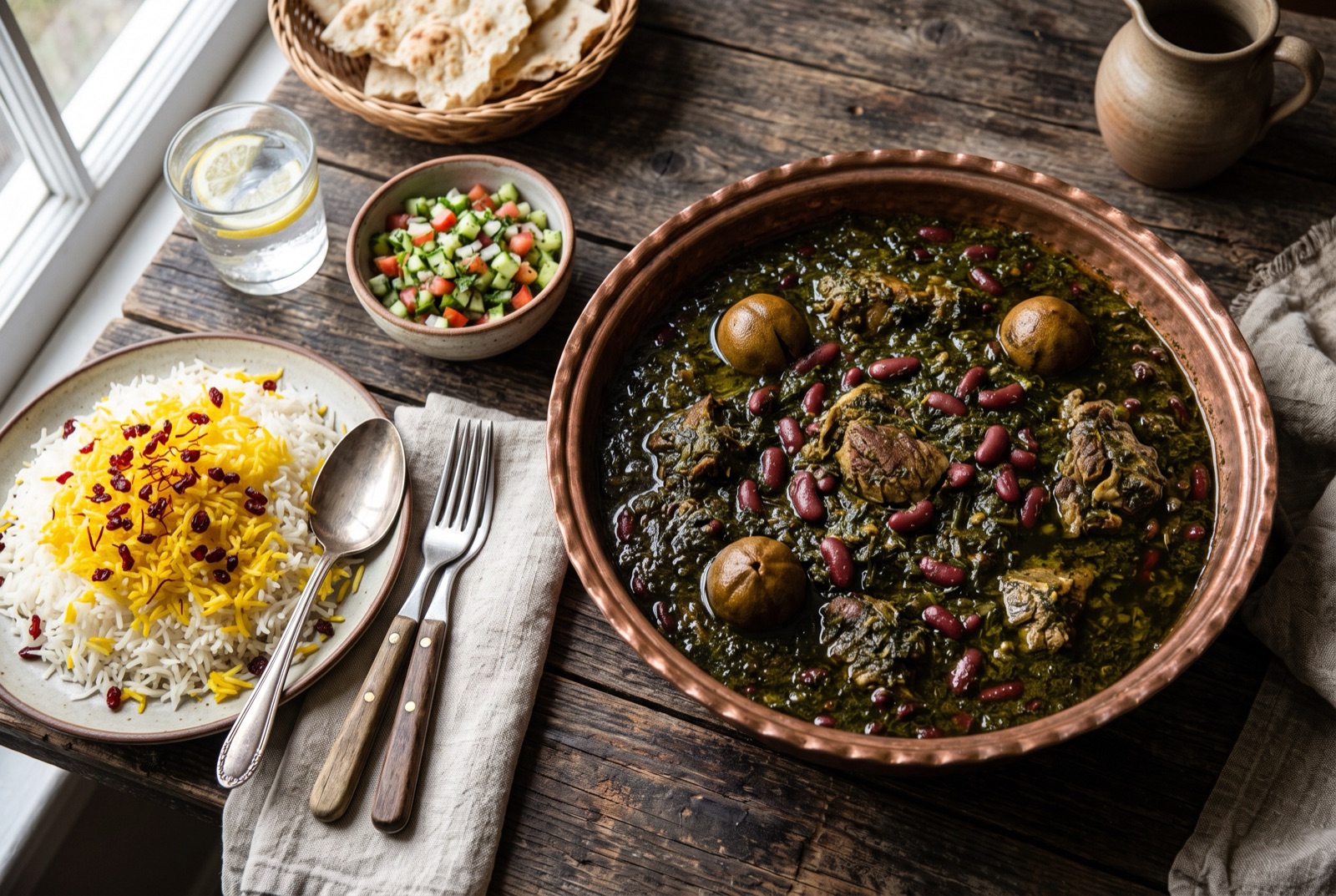
Keep exploring Iran.
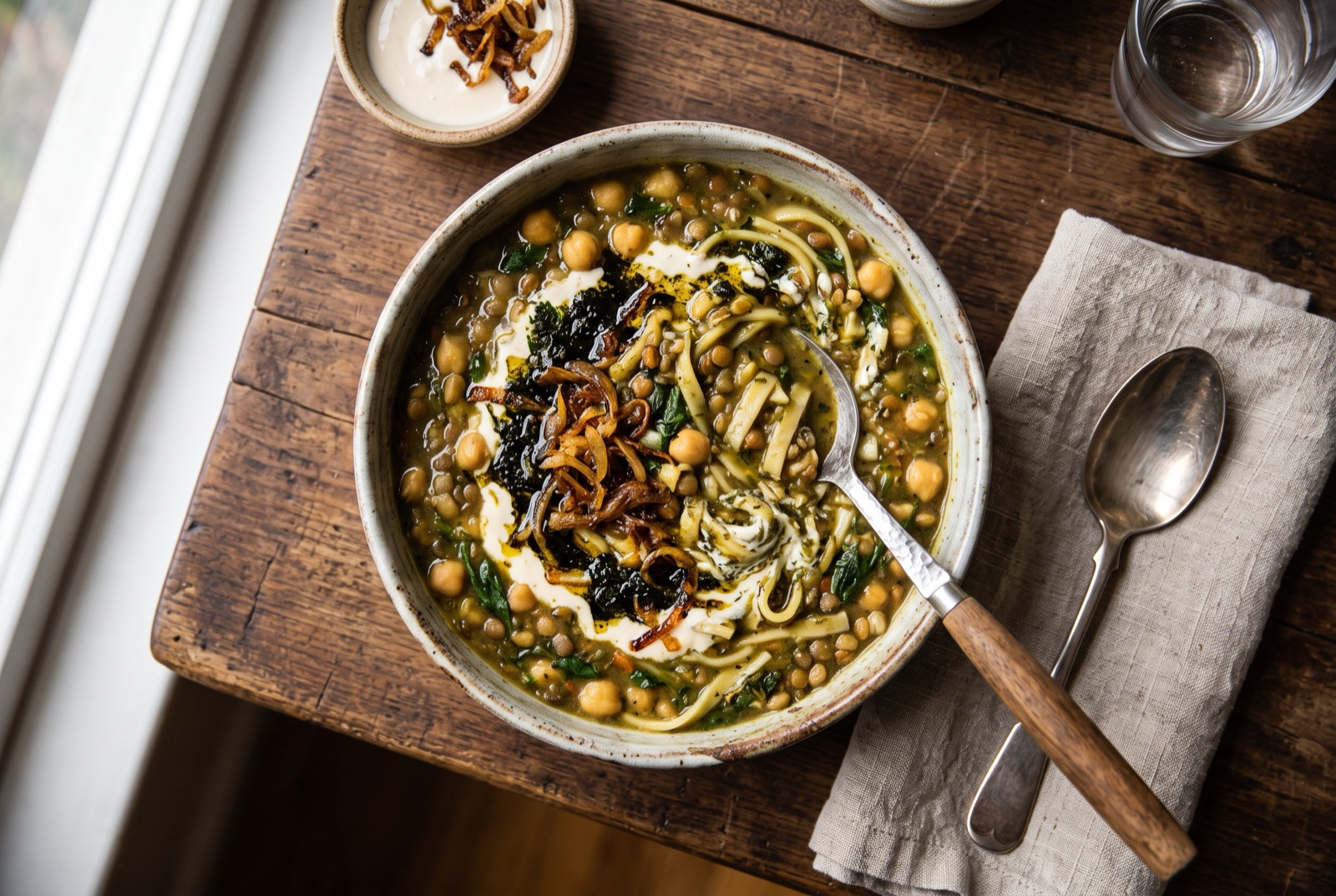
Iran has 9 more dishes in the atlas — Ash-e Reshteh and Faloodeh, and 7 more.
All Iran recipes Eggs recipes Parsley recipes Cilantro recipes appetizermainsnackvegetariangluten freeRecipe by The DishRoute Kitchen · published August 20, 2026 · updated August 20, 2026