Banku.
Ghanaian Fermented Corn and Cassava Dough
Banku · say it: BAN-koo
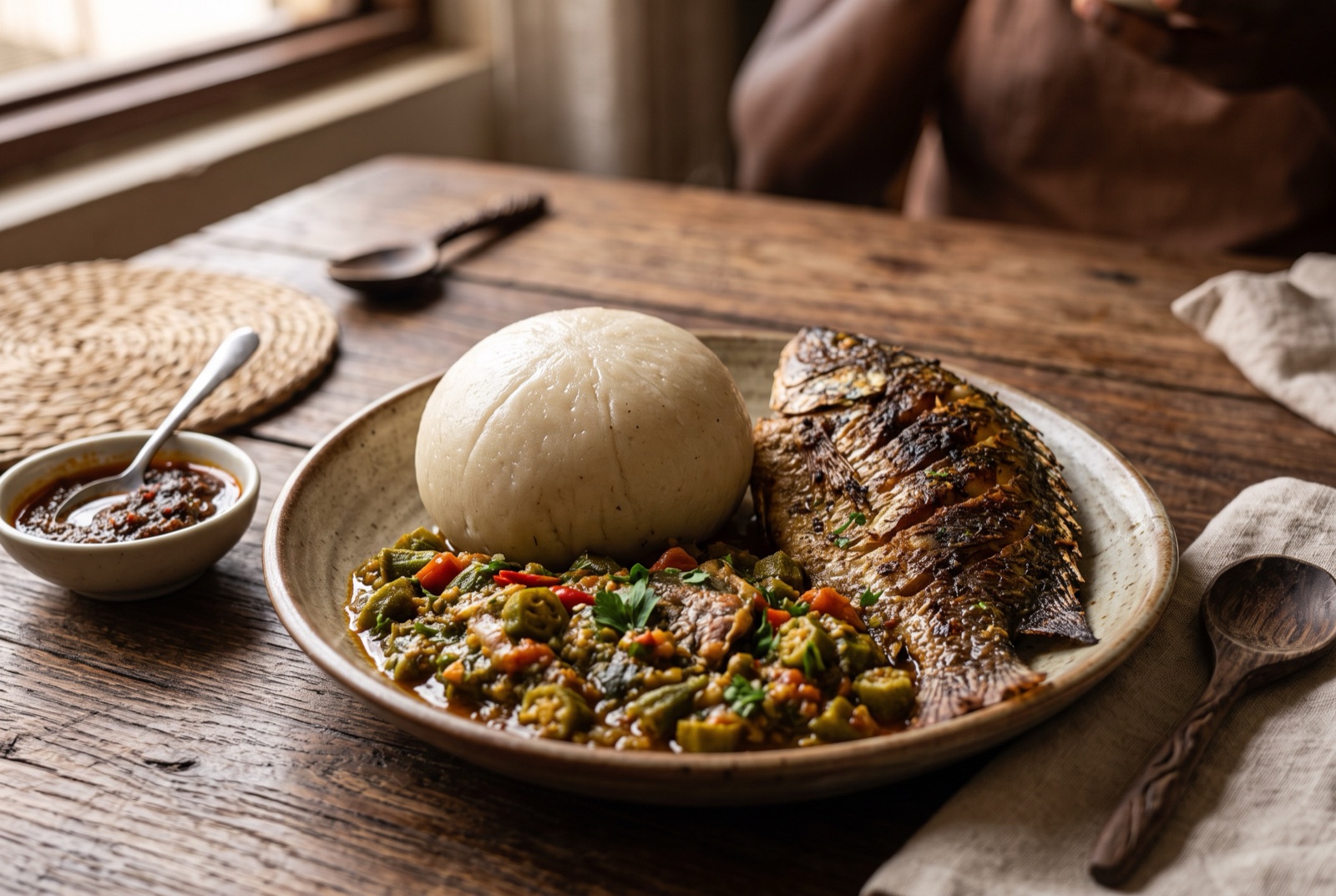
Banku is a cooked dough of fermented maize and cassava, stirred over a flame until it stops tasting raw and turns glossy, dense and slightly elastic. The flavour is its distinguishing feature: a clean lactic sourness from the fermented corn, closer to sourdough or plain yogurt than to anything sweet, which is exactly why it stands up to fiery grilled fish and thick okro stew. Texture is firmer and heavier than fufu and it is shaped into a smooth ball rather than pounded. Anyone who has stirred a pot of it will tell you the work is in the arm.

- Gate
- GhanaGreater Accra and Volta
- Prep
- 10 min
- Cook
- 35 min
- Total time
- 45 min
- Serves
- 4
- Status
- Medium
- Nutrition / serving · estimated
- Calories 355 kcal
- Protein 7 g
- Carbs 78 g
- Fat 2 g
- Fiber 5 g
- Sodium 730 mg
Why this recipe works.
- Gets you past the lumpy middle stage, which is where most first attempts are abandoned.
- Specifies the corn-to-cassava proportion instead of leaving the ratio vague, since it decides whether the ball is springy or claggy.
- Offers a workable approximation for cooks who cannot buy fermented corn dough, and says plainly where it falls short.
- Cooks the dough long enough that the raw starch taste is gone — undercooked banku is chalky and sits badly.
Ingredients.
4 itemsFor the dough
Equipment
- Heavy-based pot
- Flat-ended wooden spatula or banku paddle
- Whisk
- Small bowl of water for shaping
Instructions.
Slake the doughs
Crumble the corn dough and the cassava dough into a heavy pot with the cold water and the salt. Whisk hard until you have a smooth, thin batter with no visible lumps — pinch any stubborn pieces between your fingers to break them up before the heat goes on.
Tip Everything must be dispersed in cold liquid. Dough dropped into a hot pot sets into knots you will never beat out.
Bring it to the thickening point
Set the pot over medium heat and stir steadily with a flat wooden spatula, keeping the edge against the base. After 8–10 minutes the batter will start to grab at the spoon and turn from milky to opaque.
Work through the stiff stage
Keep beating as it thickens. It will go stiff, lumpy and awkward for several minutes — press the mass repeatedly against the side of the pot and fold it back on itself instead of stirring in circles. Do not stop here.
Tip This is the point where most home batches are given up on. It genuinely does smooth out.
Cook it out
Lower the heat slightly and continue working for another 15 minutes, adding a splash of hot water if it gets too tight to move. The banku is ready when it is uniformly smooth and glossy, comes away from the pot wall as one lump, and tastes sour with no chalky raw edge.
Shape the balls
Dip a serving spoon in water, scoop out a portion into a wet bowl and swirl it against the sides until the surface is round and shiny. Turn each ball out onto the plate seam-side down.
Serve hot
Plate each ball with grilled tilapia and a spoonful of fresh ground pepper, or set it beside a bowl of okro stew. Eat with the right hand while the banku is still hot and pliable.
Tips from our kitchen.
- Whisk the doughs into cold water before the pot goes on the heat. Adding dough to hot water guarantees lumps that will not break down later.
- Use a flat-ended wooden spatula, not a spoon. You need to scrape the base and press against the sides, and a round spoon slides past both.
- Keep the heat at medium and never walk away. Banku catches on the bottom in under a minute and burnt corn dough scents the whole batch.
- Push through the stage where it goes stiff and lumpy and your arm complains — that is the halfway point, not a failure. It smooths out on the far side.
- Taste before shaping. Properly cooked banku tastes sour and clean; if there is any raw, chalky flour note left, add a splash of hot water and work it for another five minutes.
- Shape with a wet spoon or wet hands against the inside of a bowl, rolling until the surface is smooth and shiny. Dry contact tears the surface.
Substitutions.
- Fresh fermented corn dough → 500 g fine white cornmeal whisked with 400 ml water and 3 tbsp plain live yogurt, left covered at room temperature for 48 hours
- This gets a real lactic sourness going and makes a decent ball. It is thinner in flavour than properly milled fermented maize and slightly less springy, but it is the honest home workaround. African grocers sell the real dough fresh or frozen and it is worth seeking out.
- Fermented cassava dough → Finely grated fresh cassava, or 150 g cassava flour slaked in water
- The cassava is there for stretch and body more than for flavour, so unfermented works. Frozen grated cassava from the same shops is the easiest route.
- A banku ta (wooden paddle) → A sturdy flat-ended wooden spatula or a small wooden spurtle
- What matters is a flat edge that reaches the corner where the base meets the wall of the pot. Silicone flexes too much to move a stiff dough.
Variations.
- Akple
- The Ewe version, usually with a higher proportion of corn dough and a firmer set, eaten with okro soup and fish from the Volta.
- Kenkey
- The same fermented corn dough partly cooked, wrapped in corn husks or plantain leaves and steamed for hours. Sourer, denser, and sold in wrapped balls.
- Banku with okro stew
- Served with a thick, deliberately slippery okra stew loaded with smoked fish and crab instead of grilled tilapia. The other half of the banku canon.
Storage & reheating.
Banku is meant to be eaten hot and stiffens as it cools, so cook it to order where you can. Wrapped tightly in cling film it holds 2 days in the fridge; steam the ball for 8–10 minutes to bring it back, then work it briefly with a wet spoon to restore the smooth surface. Reheating in a microwave dries the outside into a rubbery skin. Do not freeze — the texture turns crumbly and grainy on thawing and cannot be worked smooth again.
Serve with
Grilled tilapia with fresh ground pepper sauce, or okro stew with smoked fish and crab. Shito on the side, and cold water rather than anything sweet.
The story behind Banku.
Banku belongs first to the Ga and Ewe kitchens of the coast and the Volta, and it starts days before anyone lights a stove. Whole maize is soaked, milled and left to ferment for two or three days until it smells sharp and sour; grated cassava is fermented separately. Those two doughs, mixed roughly three parts corn to one part cassava, are what the whole dish rests on. In Accra fermented corn dough is bought fresh by weight from the market rather than made at home, which is why the recipe reads as short — most of the work happened at someone else's premises.
The cooking is a technique rather than a set of steps. The slurry goes into a pot over medium heat and is beaten continuously with a broad wooden paddle, the banku ta, held against the base at an angle so nothing catches. It thickens, then it seizes, then it goes lumpy and difficult, and then — if you keep working it — it smooths out into a single mass that pulls away from the pot. Stopping during the lumpy stage is why home banku so often comes out grainy. In chop bars the pot is braced between the cook's feet so both arms can be used.
What it is served with is close to fixed. Grilled tilapia with fresh ground pepper is the classic Accra plate, sold from open-air grills across the city; okro stew or okro soup with crab and smoked fish is the other. Banku also has a family of relatives worth knowing: kenkey is the same fermented corn dough shaped and steamed in husks rather than stirred, and akple is the Ewe version with a different corn-to-cassava balance. Ghanaians distinguish them easily and are quick to correct anyone who does not.
Questions, answered.
What is the difference between banku and kenkey?
They start from the same fermented corn dough but are cooked differently. Banku is stirred hard in a pot with grated cassava until smooth and served hot as a soft ball. Kenkey is partly cooked, wrapped in corn husks or plantain leaves and steamed for a long time, which makes it denser, sourer and firm enough to keep for a couple of days.
Why is my banku lumpy?
Either the dough went into hot water, or the stirring stopped too early. Always whisk the doughs into cold water first so they disperse before any heat is applied, and keep beating through the difficult stiff stage in the middle — that is when lumps break down. A round spoon also leaves lumps that a flat wooden paddle would crush against the pot wall.
Can I make banku without fermented corn dough?
You can approximate it. Whisk fine white cornmeal with water and a few spoons of live yogurt and leave it covered at room temperature for about two days until it smells distinctly sour. It will not have the depth of properly milled fermented maize, but it produces a recognisable, sour, workable banku.
How do I know when banku is fully cooked?
It pulls away from the sides of the pot in one mass, looks glossy rather than matt, and tastes cleanly sour with no chalky raw-flour edge. Undercooked banku has a dry, powdery finish on the tongue and sits heavily afterwards. If you find that, add a little hot water and keep working it over the heat.
Is banku sour on purpose?
Yes, and it should be noticeably so. The corn dough is fermented for days precisely to develop that lactic tang, which cuts through rich, oily and fiercely peppery accompaniments like grilled tilapia and okro stew. Banku that tastes flat and neutral has usually been made with underfermented dough.
You might also like.
All recipes →

Keep exploring Ghana.
Ghana has 9 more dishes in the atlas — Fufu and Ghana Jollof, and 7 more.
Recipe by The DishRoute Kitchen · published August 20, 2026 · updated August 20, 2026