Nkatenkwan.
Ghanaian Groundnut Soup with Chicken
Nkatenkwan · say it: n-kah-ten-KWAN
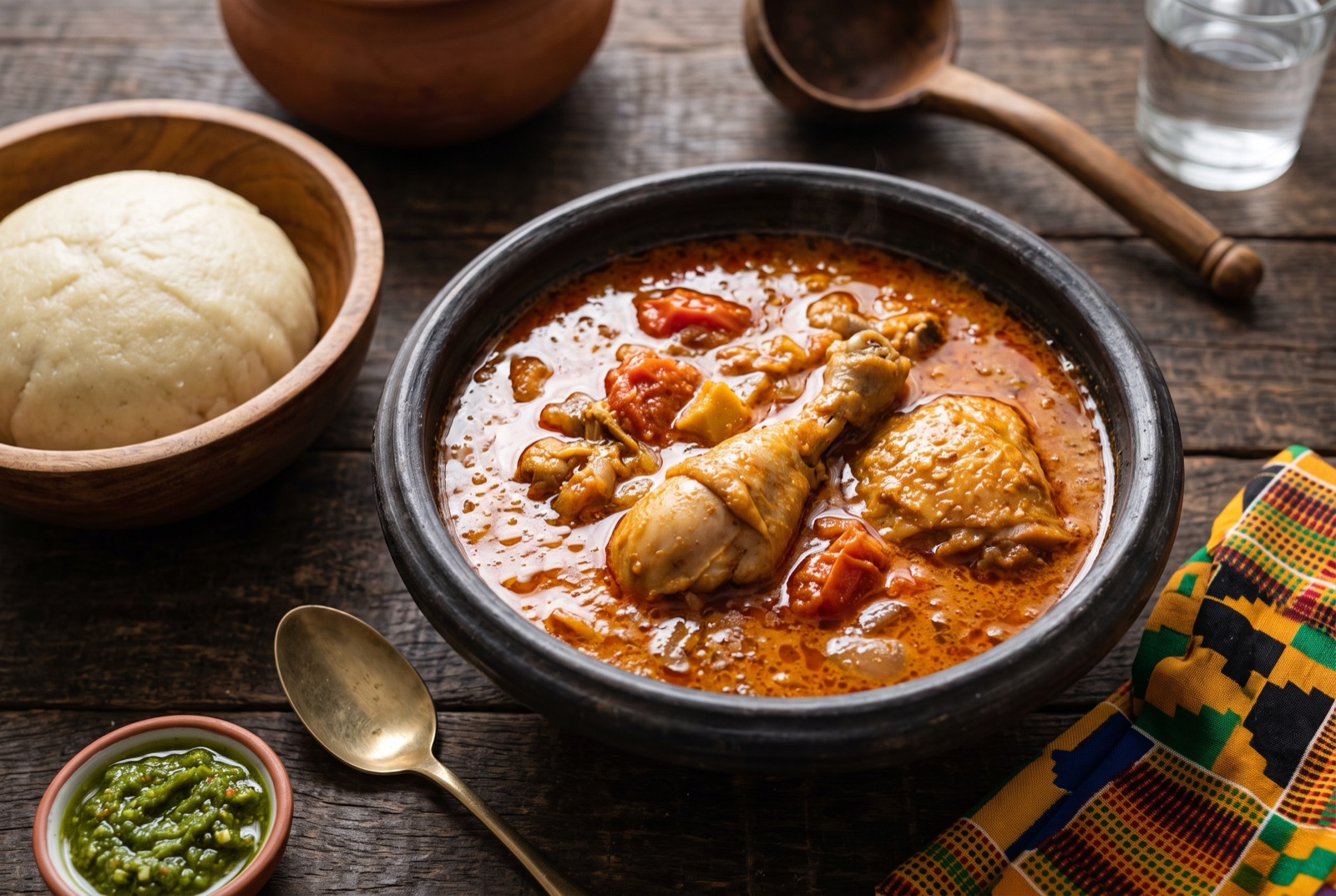
Nkatenkwan is peanut soup, but nothing about it resembles a smooth Western-style peanut sauce. Unsweetened groundnut paste is thinned into hot stock and boiled hard with chicken or goat, tomato, onion, ginger and scotch bonnet until the mixture splits slightly and a bright orange film of groundnut oil floats to the surface — the visual signal Ghanaian cooks watch for. The soup is thick, savoury and nutty with a slow chili burn, deeply filling, and it is eaten with fufu or with rice pounded into balls rather than with a spoon on its own.

- Gate
- GhanaAshanti
- Prep
- 15 min
- Cook
- 1 hr 15 min
- Total time
- 1 hr 30 min
- Serves
- 6
- Status
- Medium
- Nutrition / serving · estimated
- Calories 640 kcal
- Protein 46 g
- Carbs 18 g
- Fat 43 g
- Fiber 5 g
- Sodium 860 mg
Why this recipe works.
- Dilutes the groundnut paste in stages, which is the only reliable way to avoid a pot full of gritty lumps.
- Uses the oil rising to the surface as the doneness signal rather than a fixed clock.
- Explains why sweetened supermarket peanut butter behaves badly here, and what to buy instead.
- Builds the broth from bone-in chicken first, so the soup has meat flavour underneath the groundnut rather than beside it.
Ingredients.
11 itemsFor the broth
For the soup
Equipment
- Large heavy pot
- Blender
- Whisk
- Ladle
Instructions.
Season and sweat the chicken
Put the chicken, chopped onion and salt in a dry heavy pot, cover and cook over medium heat for 10 minutes, shaking now and then. The pieces should firm up and give off a pool of savoury juices without taking on colour.
Build the broth
Add the water or stock, bring to a boil, skim the foam, then simmer covered for 20 minutes. Lift out the chicken and set it aside so it does not overcook while the soup develops.
Blend and add the vegetables
Blend the tomatoes, quartered onion, ginger, garlic and scotch bonnets to a smooth purée and stir it into the broth with the tomato paste. Boil uncovered for 10 minutes, until the sharp raw tomato smell has gone.
Let down the groundnut paste
Put the groundnut paste in a bowl and whisk in ladlefuls of hot broth, one at a time, until you have a smooth pourable cream with no lumps at all. Only then pour it back into the pot, stirring as it goes in.
Tip Skipping this and dropping the paste straight into the pot is how you get grit that never dissolves.
Boil until the oil rises
Boil uncovered for 25–30 minutes, stirring into the corners of the pot every few minutes. The soup will darken, thicken and then break slightly, sending a distinct film of orange groundnut oil up to the surface. That slick is the sign it is cooked out.
Tip Groundnut soup catches on the base the moment you leave it. Stay with the pot.
Return the chicken
Slide the chicken back in with the garden eggs, if using, and simmer for a final 10 minutes until the meat is tender enough to pull from the bone and the garden eggs are soft. Loosen with hot water if the soup has gone claggy.
Serve around a swallow
Taste for salt and heat, then place a ball of fufu or omo tuo in each bowl, pour the soup around it and set the chicken on top. Serve while the oil is still visible on the surface.
Tips from our kitchen.
- Buy paste with one ingredient. Anything containing sugar, hydrogenated oil or emulsifiers will not split and release oil the way this soup needs.
- Whisk the paste with a ladleful of hot broth into a smooth cream before it goes anywhere near the pot. Spooning it in whole guarantees lumps.
- Boil it uncovered for the first twenty minutes. A covered pot at this stage either boils over or steams instead of reducing, and the raw groundnut flavour survives both.
- Stir right into the corner where the base meets the wall of the pot every few minutes. That is where groundnut soup catches first, and once it burns the whole batch tastes of it.
- If the surface never develops an oil slick, the soup is either too dilute or has not boiled hard enough. Turn the heat up rather than adding more paste.
- Serve it thinner than it looks in the pot — it thickens as it stands, and it needs to be loose enough to pour around a ball of fufu.
Substitutions.
- Ghanaian groundnut paste → Natural unsweetened peanut butter, smooth
- Check the label reads peanuts and possibly salt, nothing else. Stir the jar thoroughly first, since the separated oil at the top is part of what you want in the pot.
- Bone-in chicken → Goat on the bone, or smoked turkey wings
- Goat is the richer, more traditional choice and needs about 40 minutes longer. Smoked turkey is a common shortcut in Ghanaian diaspora kitchens and brings its own depth.
- Garden eggs → Whole okra added in the final 8 minutes, or nothing at all
- Both are optional additions for body and texture. The soup is complete without either, so leave them out rather than substituting something unrelated.
Variations.
- Nkatenkwan with goat
- The version most often cooked for guests. Goat on the bone simmered until it gives, with a richer, gamier broth under the groundnut.
- Groundnut soup with okra
- Whole young okra dropped in for the last few minutes so they stay firm, adding a slippery bite against the thick soup.
- Vegetarian nkatenkwan
- Built on a strong mushroom and onion stock with garden eggs and smoked paprika standing in for the meat depth. Not traditional, but it holds together honestly.
Storage & reheating.
Groundnut soup keeps 3 days refrigerated and thickens into a near-solid block when cold; loosen it with hot water or stock as you reheat, stirring constantly so the base does not catch again. It freezes for 2 months, though the oil separates on thawing and needs vigorous stirring over heat to come back together. Reheat only what you need — repeated heating and cooling dulls the ginger and chili noticeably by the third round.
Serve with
Fufu or omo tuo in the bowl with the soup poured around, and a cold drink — this is a heavy soup and the heat builds as you eat.
The story behind Nkatenkwan.
Groundnuts arrived in West Africa from the Americas and were absorbed so completely that they now behave like an indigenous staple across the whole region, from Senegalese mafé to Nigerian groundnut stew to this. In Ghana the soup belongs particularly to the Akan-speaking interior, where it shares Sunday duty with light soup and palm nut soup and where the question of which of the three is on the fire is a genuine household negotiation.
The paste is the thing to get right. Ghanaian groundnut paste is roasted peanuts ground to a loose, oily, completely unsweetened purée, and it is sold in tubs or by weight rather than in jars. Ordinary supermarket peanut butter with added sugar, salt and palm fat behaves differently in a pot: it stays emulsified, refuses to release its oil, and leaves the soup tasting faintly of a sandwich. Natural peanut butter with nothing but peanuts on the label is the workable substitute, and it needs the same treatment — diluted gradually into hot liquid, then boiled uncovered long enough to lose its raw edge.
The cooking has two rules everyone repeats. The first is that the soup must boil rather than merely simmer for a good stretch, because that is what cooks out the raw groundnut taste and drives the oil out of suspension. The second is that it will catch on the bottom of the pot the moment you stop paying attention, and burnt groundnut is unmistakable and unfixable. Some cooks add garden eggs, some add whole okra near the end, and in the north a similar soup is thickened further and served with tuo zaafi. On the table, the meat goes on top of the swallow and the soup is poured around it.
Questions, answered.
Can I use ordinary peanut butter from the supermarket?
Only the natural kind whose label lists peanuts and maybe salt. Standard peanut butter contains sugar and stabilising fats that keep it emulsified, so it will not split and release the oil that defines this soup, and the added sugar makes the finished pot taste subtly wrong. Natural unsweetened peanut butter works well.
Why has no oil risen to the top of my soup?
Either the heat has been too low or the paste was a stabilised product. The oil separates out only after a decent stretch of genuine boiling, so if the pot has only been ticking over, raise the heat and keep stirring. If the label listed emulsifiers or hydrogenated fat, no amount of boiling will produce the slick.
My groundnut soup tastes raw and chalky. What now?
It has not cooked long enough. Raw groundnut paste has a dry, dusty flavour that only disappears after boiling out, so keep the pot going at a proper boil for another fifteen to twenty minutes, adding hot water if it gets too thick. Taste again before serving; the change is obvious when it happens.
How do I stop it burning on the bottom?
Use the heaviest pot you own, keep the heat at a strong but controlled boil rather than maximum, and stir into the corner where the base meets the side every few minutes. Groundnut solids sink and stick fast. Once the base has scorched, the burnt flavour spreads through the entire pot and cannot be strained or diluted out.
What is the difference between this and Senegalese mafé?
They share the groundnut base and a common regional ancestry, but mafé is usually a thicker stew served over rice, often with root vegetables and a heavier tomato presence. Nkatenkwan is looser, hotter with scotch bonnet, built around ginger, and eaten with a starchy swallow rather than spooned over rice.
You might also like.
All recipes →

Keep exploring Ghana.
Ghana has 9 more dishes in the atlas — Banku and Fufu, and 7 more.
All Ghana recipes Chicken recipes Tomato recipes Ginger recipes soupmaingluten freedairy freehalal friendlyRecipe by The DishRoute Kitchen · published August 20, 2026 · updated August 20, 2026