Belgische Frieten.
Twice-Fried Belgian Chips with Mayonnaise
Belgische frieten / frites belges · say it: BEL-khee-suh FREE-tuhn
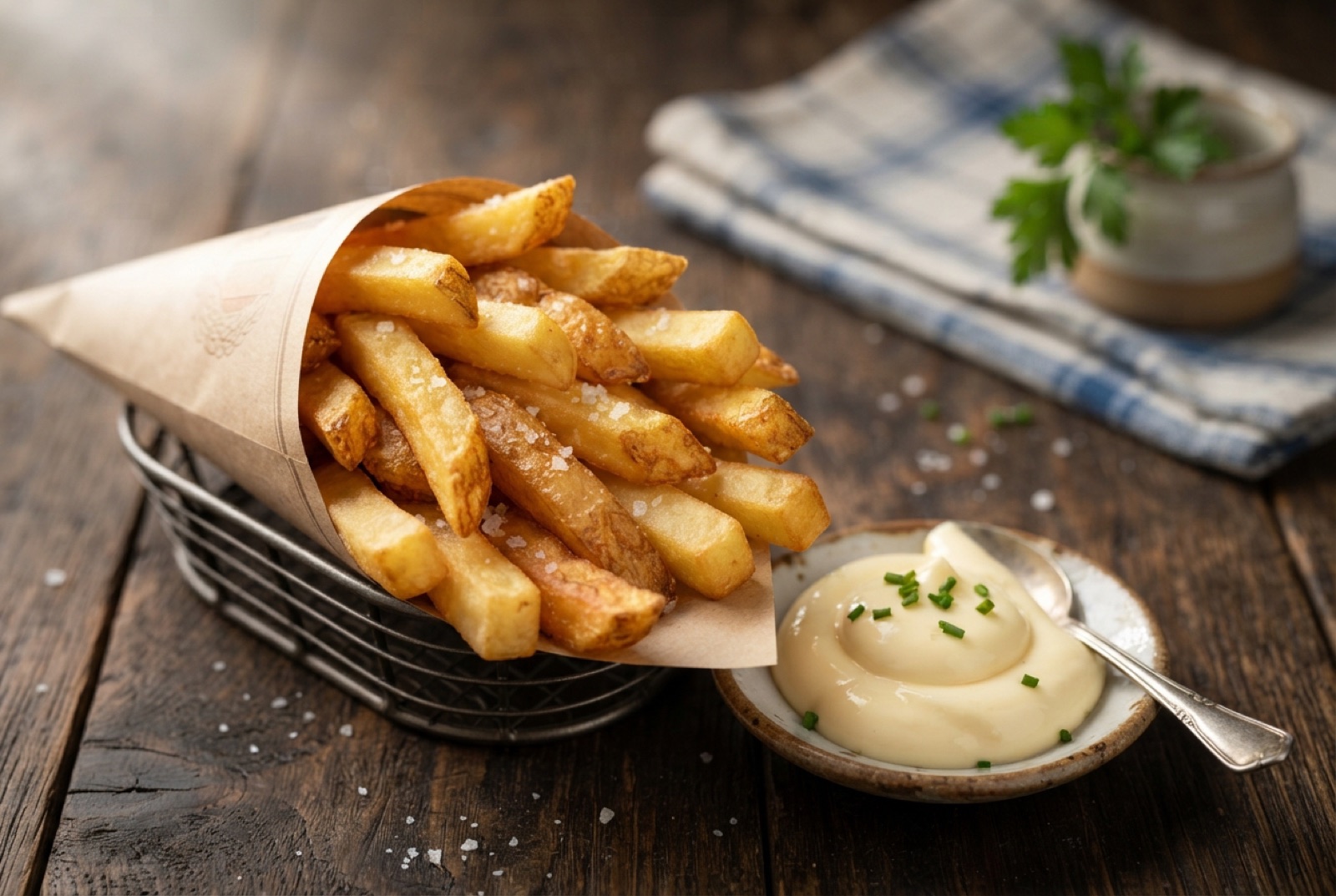
A Belgian frite is a thick baton of floury potato, roughly a centimetre square, fried at two different temperatures so the inside turns to steam-fluffed mash while the outside sets into a thin shell that crackles when you bite it. The first fry, around 150°C, cooks the potato through without colouring it. The frites then rest and cool completely, which is the step almost everyone skips and the reason home fries go limp. The second fry, hot and short, drives out surface moisture and locks the crust. Fried in beef fat as the friteries do, they carry a savoury depth no vegetable oil gives. Salt them in the basket, eat them standing up, and do not let them sit.

- Gate
- BelgiumNationwide
- Prep
- 20 min
- Cook
- 25 min
- Total time
- 1 hr 15 min incl. 30 min rest
- Serves
- 4
- Status
- Medium
- Nutrition / serving · estimated
- Calories 520 kcal
- Protein 7 g
- Carbs 48 g
- Fat 33 g
- Fiber 5 g
- Sodium 420 mg
Why this recipe works.
- Gives the two exact frying temperatures and the mandatory cooling rest, which is where most home versions fail.
- Explains the potato variety and the cut size, both of which change the result more than technique does.
- Includes a proper friterie-style mayonnaise that is thick enough to stand up on a fork.
- Honest about beef fat versus oil, and what you actually lose by using oil.
Ingredients.
8 itemsFor the frites
For the mayonnaise
Equipment
- Deep heavy pot or deep fryer
- Frying thermometer
- Spider or frying basket
- Trays lined with kitchen paper
Instructions.
Cut the potatoes
Peel 1.2 kg of potatoes and square off the sides, then cut them into batons about 1 cm thick and 1 cm wide — thicker than a French fry, thinner than a steak chip. Keep the thickness consistent so every frite finishes at the same moment.
Rinse and dry thoroughly
Rinse the batons in several changes of cold water until the water runs clear rather than milky, then drain and dry them hard between two clean tea towels. They should feel dry and slightly chalky to the touch before they go anywhere near fat.
Tip Any water left on the surface will boil violently on contact with the fat and can push it over the pot.
First fry at 150°C
Heat the fat to 150°C in a deep pot filled no more than halfway. Fry the potatoes in three or four small batches for 6–8 minutes each, until they are floppy, pale blond with no real colour, and a baton crushes easily between your fingers. Lift them out and spread them on a paper-lined tray in a single layer.
Tip Colour at this stage means the fat is too hot. You want cooked-through and pale, nothing more.
Cool them completely
Leave the blanched frites to cool for at least 30 minutes, until they are fully at room temperature and their surfaces look dry and matte. Do not stack or cover them — trapped steam is what turns them soggy later.
Make the mayonnaise
Whisk the egg yolk with the mustard, half the vinegar, sugar and a pinch of salt. Dribble in the neutral oil drop by drop at first, whisking constantly, then in a thin stream once the mixture thickens and holds the whisk marks. Finish with the rest of the vinegar; it should be thick enough to sit in a peak.
Tip If it splits, start a fresh yolk in a clean bowl and whisk the broken mixture into it a spoonful at a time.
Second fry at 180°C
Raise the fat to 180°C. Fry the cooled frites in small batches for 2–3 minutes, until the bubbling quietens noticeably, they turn deep gold, and they rattle against the basket like they are hollow. Drain briefly on paper, tip into a bowl, salt generously and toss.
Serve immediately
Pile the frites into paper cones or a warm bowl and serve within two minutes with a thick spoonful of the mayonnaise on top or alongside. They will never be better than they are right now, so do not hold them in the oven.
Tips from our kitchen.
- Use floury potatoes — Bintje, Maris Piper, russet or King Edward. Waxy salad potatoes stay dense and never go fluffy inside.
- Rinse the cut potatoes in cold water until it runs clear, then dry them obsessively. Wet potatoes spit violently and steam instead of frying.
- Cool the blanched frites completely between fries, at least 30 minutes. This is not optional; it is the whole reason the crust sets.
- Fry in batches no larger than a big handful. Adding too much at once crashes the fat temperature and the frites absorb it instead of sealing.
- Salt only after draining, in a bowl or the basket, and serve within two minutes. Salt applied in the pan draws out moisture and softens the crust.
- Keep a thermometer in the fat. Guessing costs you the difference between a crackling shell and a greasy stick.
Substitutions.
- Beef fat (blanc de boeuf) → Refined peanut oil, or sunflower oil
- Both work and both are used in modern friteries. You lose the savoury background note but keep the texture entirely.
- Homemade mayonnaise → Good jarred mayonnaise loosened with a teaspoon of mustard and a squeeze of lemon
- Belgian frietsaus is slightly sweeter and thicker than French mayonnaise, so a pinch of sugar gets you closer.
- Deep pan of fat → An air fryer with 2 tbsp oil, 12 minutes at 160°C then 8 minutes at 200°C
- A decent chip, but not a frite — the shell is thicker and drier, and it will not crackle the same way.
Variations.
- Frites with andalouse
- The most ordered friterie sauce after mayonnaise: mayonnaise blended with tomato paste and finely diced peppers, mildly sweet and faintly smoky.
- Mitraillette
- A split baguette loaded with fried meat, a handful of frites on top and sauce over everything — the late-night Brussels order, and a full meal in one hand.
- Stoofvleessaus
- Frites drowned in leftover carbonnade gravy. Belgium's answer to poutine, sold at friteries by the tub and best when the stew is a day old.
Storage & reheating.
Fried frites do not keep — they are at their best for about three minutes and become leathery within twenty. What does keep is the blanching stage: after the first fry, cool the frites completely, spread them on a tray and refrigerate for up to 2 days, or freeze them in a single layer and bag them for up to 3 months. Fry frozen blanched frites straight from the freezer at 180°C, adding 30 seconds to the time and expecting a more dramatic spit as the ice hits the fat.
Serve with
Mussels, carbonnade, a fried snack from the same friterie, or simply a paper cone and cold beer.
The story behind Belgische Frieten.
Belgium treats the frite as national property, and the friterie — a kiosk, a caravan, a tiled shopfront with a hatch — is a fixture of nearly every town square. There are thousands of them, they open late, and they sell frites in a paper cone with a plastic fork stuck in the top and a choice of sauces that runs well past mayonnaise into andalouse, samouraï, brasil and pickles. In 2017 Belgium put its friture culture forward for heritage recognition, which tells you how seriously it is taken. The claim that Belgians invented the fried potato is repeated constantly and cannot honestly be proven; the often-told story about villagers on the Meuse frying potato batons when the river froze appears only in much later writing, and food historians treat it with scepticism. What is not disputed is that Belgium industrialised the double fry, made beef fat standard, and built an entire eating culture around the result.
The technical choices are specific and they matter. The potato is traditionally a Bintje — a floury Dutch-bred variety with low sugar that fluffs rather than turns waxy, and browns evenly instead of scorching. The fat is ossewit or blanc de boeuf, refined beef tallow sold in blocks, which has a high smoke point and leaves the savoury note that separates a Belgian frite from a French fry. Purists insist the cut is between 10 and 13 millimetres: any thinner and the interior cannot stay fluffy, any thicker and the shell has too much soft potato behind it.
At home the biggest obstacle is not skill but patience. The frites must cool right down between the two fries — half an hour minimum, and friteries commonly blanch in the morning for the evening service. Skipping that rest gives you a fry that browns on the outside while the interior is still wet, and it collapses within a minute of leaving the pan. The second obstacle is quantity: frites need room to move. Fry in small batches, accept that the first batch will be eaten before the last one is out, and salt only after the fat has drained.
Questions, answered.
Why do Belgian fries need to be fried twice?
The two fries do different jobs. The first, at about 150°C, cooks the potato all the way through and drives off internal moisture without browning it. After cooling, the second fry at 180°C hits an already-cooked, drier surface and instantly sets it into a crisp shell. A single fry cannot do both: by the time the centre is cooked, the outside is either pale or burnt.
Do I really have to let them cool in between?
Yes. The rest lets steam escape and the surface starch dry and firm up, which is what allows the second fry to form a crust rather than just reheating a soft chip. Thirty minutes at room temperature is the minimum; professional friteries blanch hours ahead. Skipping the rest is the single most common reason home fries go limp within a minute.
What potatoes work best?
Floury, low-sugar varieties. Bintje is the Belgian standard; Maris Piper, King Edward, Agria and russet potatoes all behave the same way. Waxy varieties such as Charlotte or new potatoes hold together too well and give a dense, slightly soapy interior. Avoid potatoes stored in the fridge, since cold converts starch to sugar and makes fries brown far too fast.
Is beef fat necessary?
Not necessary, but it is traditional and it does change the flavour. Blanc de boeuf, refined beef tallow, has a high smoke point and leaves a savoury, faintly roast-meat note on the finished frite. Refined peanut or sunflower oil produces the same texture with a cleaner, more neutral taste, and many modern Belgian friteries use oil for vegetarian customers.
How much fat do I need and can I reuse it?
You need enough for the potatoes to float freely — about 2 litres in a deep pot, filled no more than halfway up the sides. Strain it through a fine sieve once cool and store it covered in a dark place; beef fat solidifies and keeps well. Discard it once it darkens, smells fishy or foams heavily when heated, usually after six to eight uses.
You might also like.
All recipes →
Keep exploring Belgium.
Belgium has 9 more dishes in the atlas — Carbonnade Flamande and Chicons au Gratin, and 7 more.
Recipe by The DishRoute Kitchen · published August 19, 2026 · updated August 19, 2026