Moules-Frites.
Belgian Mussels Steamed with Chips
Mosselen-friet / moules-frites · say it: MOOL-FREET
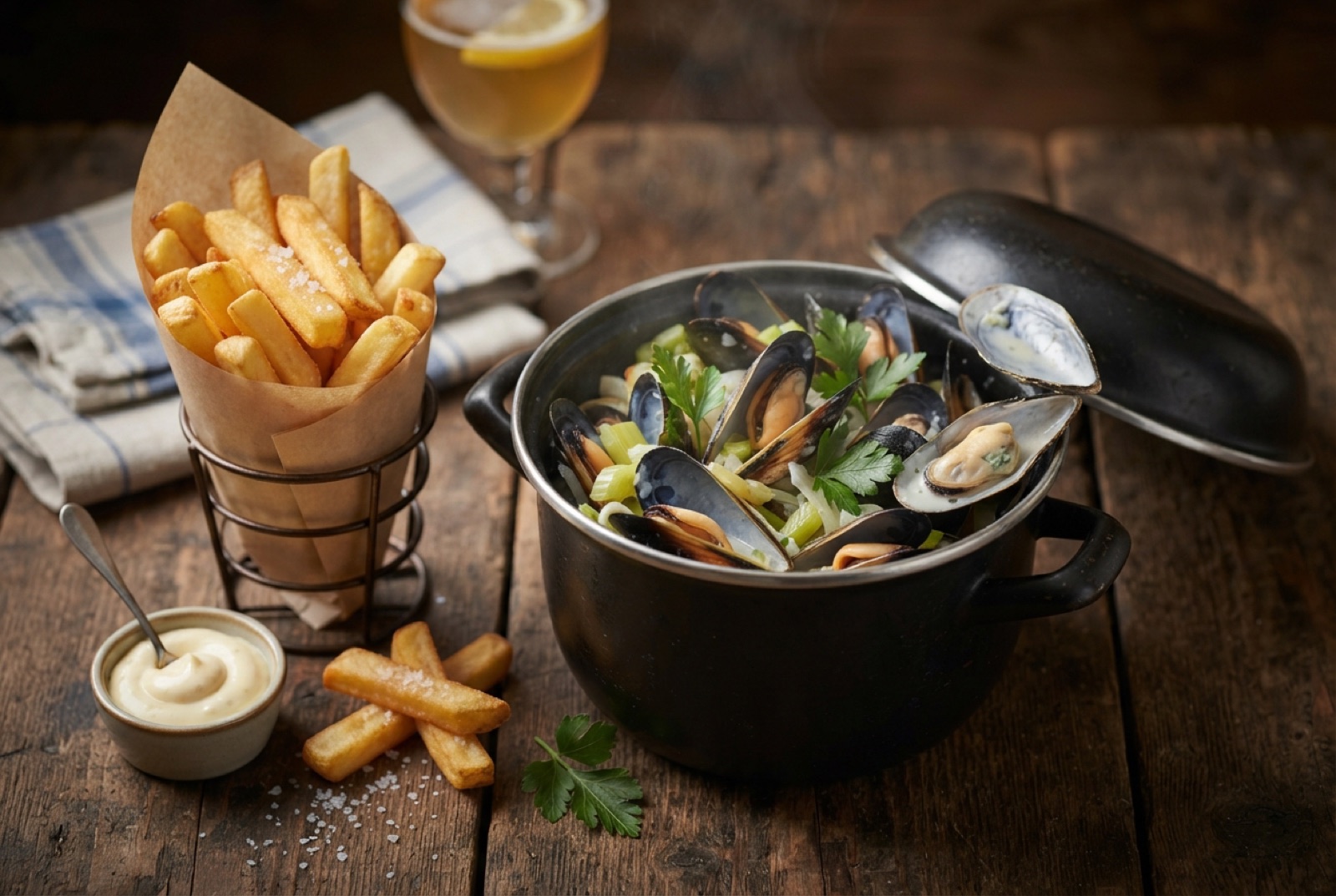
Moules-frites is a pot of mussels steamed over a base of celery, onion and leek with butter and white wine, brought to the table still rattling under its lid, with fries served separately so they stay crisp. The mussels give up their own salty liquor as they open, and that liquor — not the wine — is the backbone of the broth. It takes about six minutes of actual cooking. What makes the Belgian version distinct from a French marinière is the celery: a generous amount of both stalk and leaf, which adds a green, slightly peppery note that cuts the richness. You eat it with your hands, using an empty shell as pincers, and you finish by drinking the broth from the bowl.

- Gate
- BelgiumBrussels and the Flemish coast
- Prep
- 25 min
- Cook
- 15 min
- Total time
- 40 min
- Serves
- 4
- Status
- Medium
- Nutrition / serving · estimated
- Calories 690 kcal
- Protein 42 g
- Carbs 55 g
- Fat 30 g
- Fiber 6 g
- Sodium 1250 mg
Why this recipe works.
- Builds the broth on the mussels' own liquor rather than drowning them in wine, so the pot tastes of the sea.
- Uses celery stalk and leaf the way Belgian brasseries do, which is what separates this from a French marinière.
- Gives clear, blunt rules on sorting mussels before and after cooking, so nobody eats a bad one.
- Six minutes of cooking, one pot, and a technique that does not change whether you cook one kilo or four.
Ingredients.
12 itemsFor the pot
To finish
To serve
Equipment
- Large pot with a tight-fitting lid (a black enamel mosselpot if you have one)
- Stiff brush for scrubbing
- Slotted spoon
Instructions.
Clean and sort the mussels
Scrub 2.4 kg of mussels under cold running water and pull off any beards towards the hinge. Tap any open shell against the sink: if it does not close within a few seconds, throw it away, along with anything cracked. Drain and keep cold until the pot is ready.
Tip Do this no more than an hour before cooking — debearded mussels do not keep well.
Soften the vegetables
Melt the butter in a large pot over medium heat and add the onion, celery with its leaves, and leek. Cook for 8 minutes, stirring, until everything is limp and translucent and smells sweet, with no colour at all on the onion.
Build the steam
Add the thyme, bay leaves and cracked pepper, pour in the wine and bring it to a hard boil for 1 minute to burn off the raw alcohol. The pot should be actively steaming before the mussels go anywhere near it.
Steam the mussels
Tip in all the mussels, clamp the lid on and cook over high heat for 4–6 minutes, gripping the lid and tossing the whole pot twice so the bottom layer swaps with the top. They are done the moment most shells have gaped open and the meat has shrunk slightly from the shell.
Tip Peek once at four minutes. Waiting for every last shell to open overcooks everything else.
Taste and finish
Take the pot off the heat, discard any mussels still shut, and taste the broth at the bottom — it should be clearly briny and buttery. Only now add salt if it needs it. Scatter over the parsley and toss once more.
Serve in the pot
Bring the pot straight to the table, put the upturned lid alongside for empty shells, and serve the hot frites in a separate dish so they stay crisp. Give everyone a spoon for the broth and bread for what the spoon misses.
Tips from our kitchen.
- Sort the mussels twice: before cooking discard any that are cracked or that stay open after a sharp tap, and after cooking discard any that never opened.
- Debeard by pulling the tuft of fibres firmly towards the hinge, not away from it — the wrong direction tears the mussel.
- Do not salt the pot before tasting. Mussels release a lot of salty liquor and it is very easy to end up with an inedible broth.
- Use a pot big enough that the mussels sit no more than two-thirds up the sides. They need room to be tossed, or the bottom layer overcooks.
- Serve the frites in a separate dish. Fries sitting in mussel broth go soft in under a minute, which is why brasseries never plate them together.
- Cook mussels the day you buy them, kept in the fridge under a damp cloth and never sealed in a plastic bag or submerged in fresh water.
Substitutions.
- Dry white wine → Belgian witbier or a splash of extra stock
- Wheat beer is a genuine brasserie option and gives a rounder, faintly citrus broth. Mussels nature use no alcohol at all.
- Celery stalk → Fennel bulb, thinly sliced
- Not traditional, but it keeps the aromatic, slightly aniseed lift that celery provides. Include some leaves either way.
- Fresh mussels → Frozen half-shell mussels, added at the very end for 2 minutes
- A compromise. They are already cooked, so they will not give up any liquor, and the broth needs stock to make up for it.
Variations.
- Moules à la crème
- Once the mussels are out, reduce the broth briefly and stir in a splash of cream. Richer, and the standard order for anyone who finds marinière too lean.
- Moules au vin blanc nature
- The purist version: butter, onion, celery, pepper and nothing else, letting the mussel liquor make the entire broth. Lighter and saltier.
- Moules à la bière
- Steamed with witbier instead of wine, sometimes with a strip of orange peel — a Flemish brasserie standard that leans sweeter and softer.
Storage & reheating.
Cooked mussels are best eaten straight from the pot and do not reheat well — a second heating shrinks them into rubber. If you have leftovers, pick the meat from the shells within an hour, cover it with the strained broth, and refrigerate for up to 1 day. Use it cold in a salad, or stir it into a soup or rice dish off the heat at the very last moment so it just warms through. Never store or reheat mussels still in their shells, and never freeze cooked ones.
Serve with
A separate cone of Belgian frites, mayonnaise, crusty bread for the broth, and a cold witbier.
The story behind Moules-Frites.
It reads like a coastal dish, but moules-frites is really a story about trade. Belgium's own mussel beds were never enough, and the overwhelming majority of mussels eaten in Belgian brasseries come from the Dutch province of Zeeland, just across the border, where they are grown on ropes and bottom beds and graded by size. The Belgian contribution was to marry them to the frite and to the black enamel casserole they arrive in, and to fix the whole thing as the default order in every brasserie from Ostend to Liège.
Season matters more here than in almost any other dish. The old rule is that mussels are eaten in months containing the letter R — September through April — which lines up with the period when the animals are plump and not spawning. Modern rope-grown mussels stretch that window, but Belgians still treat July and August mussels with suspicion, and the best pots come from the cold end of the year. Menus list the grade, and locals have opinions: jumbo mussels look impressive but the smaller, sweeter grades usually taste better.
The brasserie menu offers a long list of preparations — nature, marinière, à la crème, provençale, with white beer, with garlic, with curry — and the argument over which is correct is settled entirely by personal habit. What does not change is the service. The mussels come in the pot; the lid, turned upside down, becomes the bowl for empty shells; the frites arrive in their own container so they never touch the broth; and there is bread on the table for the last of it. Portions are unreasonable by design. A Belgian order is around a kilo of mussels per person, which sounds absurd until you remember that most of that weight is shell.
Questions, answered.
How do I know if a mussel is safe to eat?
Before cooking, a live mussel is either closed or closes when you tap it sharply on the counter; discard any that stay open, feel unusually heavy with sand, or have a cracked shell. After cooking, discard any mussel that has stayed firmly shut. Fresh mussels smell of clean seawater — if a batch smells sour or of ammonia, throw the lot out rather than trying to sort it.
Why are my mussels rubbery?
They were cooked too long. Mussels need only four to six minutes of hard steaming and are done the moment the shells gape; every extra minute shrinks and toughens the meat. Cook them over high heat with the lid on so the steam works fast, and pull the pot off the heat as soon as most shells are open rather than waiting for every last one.
Do I need to soak mussels in water first?
Rope-grown mussels, which is what most shops sell, need only a rinse and a debearding. Do not soak them in fresh water for long periods — it kills them. If you have wild or bottom-grown mussels that feel gritty, a 20-minute sit in cold salted water helps them expel sand, but even then a good scrub under the tap does most of the work.
How many mussels do I need per person?
Belgian brasseries serve about a kilo of mussels in the shell per person as a main course, which is roughly 250 g of actual meat. At home, 500 to 750 g per person with fries and bread is a generous portion. If mussels are a starter rather than the main event, count on 300 to 400 g each.
Can I make the broth ahead?
Yes. The vegetable base of butter, onion, celery and leek can be softened up to a day in advance and refrigerated in the pot. Reheat it, add the wine, bring it to a boil and only then tip in the mussels. The mussels themselves must be cooked to order, since the whole dish depends on the liquor they release in those final minutes.
You might also like.
All recipes →

Keep exploring Belgium.
Belgium has 9 more dishes in the atlas — Belgische Frieten and Carbonnade Flamande, and 7 more.
Recipe by The DishRoute Kitchen · published August 19, 2026 · updated August 19, 2026