Carbonnade Flamande.
Flemish Beef Braised in Dark Beer
Stoofvlees / Carbonnade flamande · say it: kar-bo-NAHD flah-MAHND
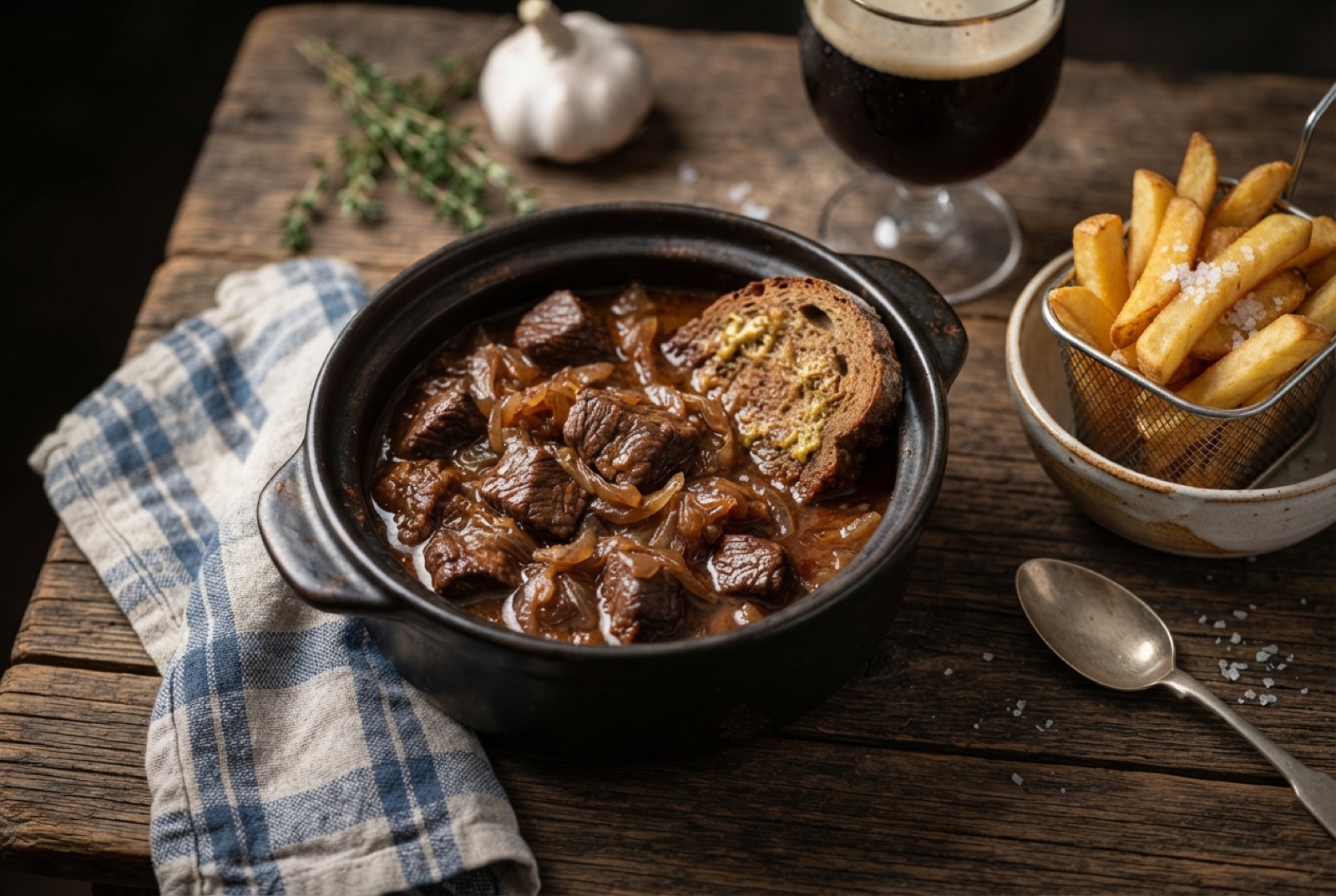
Carbonnade flamande is the beef stew Flanders makes instead of boeuf bourguignon: the same slow braise, but the liquid is dark Belgian beer rather than red wine, and the result tastes malty, faintly bitter and sweet-sour all at once. Beef chuck is browned hard in butter, buried under a mountain of sliced onions, and left to collapse over three hours while a slice of bread thickly spread with mustard melts into the pot and thickens the sauce without any flour. What comes out is almost black, glossy enough to coat a spoon, and deeply savoury rather than boozy — the alcohol cooks off entirely and leaves malt behind. Eat it with frites, and use them to mop the plate.

- Gate
- BelgiumFlanders
- Prep
- 25 min
- Cook
- 3 hr 5 min
- Total time
- 3 hr 30 min
- Serves
- 4
- Status
- Medium
- Nutrition / serving · estimated
- Calories 640 kcal
- Protein 52 g
- Carbs 28 g
- Fat 33 g
- Fiber 3 g
- Sugar 12 g
- Sodium 780 mg
Why this recipe works.
- Uses the real bread-and-mustard thickening method instead of a flour slurry, so the sauce sets glossy rather than pasty.
- Tells you exactly which beers work and which will wreck the stew after three hours of reduction.
- Browning in batches with a proper deglaze builds the dark colour that makes carbonnade look like carbonnade.
- Scales cleanly to a big pot and tastes better reheated, which is how it is actually eaten in Belgium.
Ingredients.
12 itemsFor the stew
For the thickening
To finish
Equipment
- Heavy cast-iron Dutch oven with a tight lid
- Tongs
- Sharp knife for slicing onions
Instructions.
Dry and brown the beef
Pat 1.2 kg of beef completely dry and season with salt and pepper. Melt half the butter in a heavy Dutch oven over high heat and brown the cubes in two or three uncrowded batches, turning until each side is deep mahogany and the pan bottom is coated in dark stuck-on fond. Lift the meat to a plate.
Tip If steam rises instead of sizzling and the meat turns grey, the batch is too big. Take half out and carry on.
Sweat the onions
Lower the heat to medium, add the remaining butter and all 700 g of sliced onions with a good pinch of salt. Cook for 15 minutes, scraping the fond off the base as the onions release their water, until they are limp, translucent and lightly gold at the edges.
Deglaze with the beer
Pour in the beer and let it bubble hard for 2 minutes, scraping until nothing is stuck to the pan and the foam subsides. Return the beef and any juices, add the stock, brown sugar, vinegar, bay leaves and thyme, and top up with a little water if the meat is not almost covered.
Add the mustard bread
Spread the bread slices thickly with the mustard and lay them mustard-side down on top of the stew. Do not stir them in — they will sink and break apart on their own over the next hour.
Braise low and slow
Bring to a bare simmer, cover, and cook over the lowest heat or in a 150°C oven for 2 hours 45 minutes, stirring twice. It is done when a piece of beef gives way completely under a spoon and the sauce has turned dark and glossy rather than watery.
Tip The surface should barely tremble. A visible rolling boil makes beef stringy no matter how long you cook it.
Balance and rest
Remove the bay leaves and thyme stalks and stir well to break up any bread that has not dissolved. Taste: it should read malty and savoury with a clear sweet-sour edge — correct with a pinch more sugar or a few drops of vinegar, then salt. Let it sit off the heat for 10 minutes before serving with frites.
Tips from our kitchen.
- Brown the beef in two or three batches with space between the pieces. Crowded meat steams grey and you lose the fond that colours the whole sauce.
- Use a dark abbey dubbel, a brown Oud Bruin or a Flemish red. Avoid IPA and anything labelled hoppy — bitterness triples as the pot reduces.
- Slice the onions thickly rather than dicing them. They should soften into ribbons you can still see, not vanish into mush.
- Do not skip the vinegar or the sugar. The stew needs both poles; if it tastes flat at the end, it is almost always missing acid, not salt.
- Cook it a day ahead if you can. The sauce sets, the flavours knit, and reheating gently the next day makes a visibly better stew.
Substitutions.
- Dark Belgian abbey beer → English brown ale, dunkel, or half stout and half water
- Aim for malty and low bitterness. Stout on its own can turn the sauce roasty and slightly ashy, so cut it.
- Mustard-smeared bread → Two speculoos biscuits crumbled into the pot, plus 1 tbsp mustard stirred in at the end
- A genuine regional alternative — the biscuits bring spice and sweetness along with the thickening.
- Beef chuck → Beef shin, cheek or brisket
- All work. Cheek gives the silkiest result but needs an extra 30–45 minutes to become tender.
Variations.
- Stoofvlees op zijn Gents
- The Ghent version, built on sour Oud Bruin and balanced with more brown sugar, giving a sharper sweet-sour sauce that leans towards the Flemish red-ale style.
- Carbonnade with prunes
- A handful of pitted prunes added in the last hour dissolve slightly and push the stew richer and darker — common in Limburg and around Hasselt.
- Konijn met pruimen
- The same method built on rabbit instead of beef, with prunes and a lighter beer. Braising time drops to about 90 minutes.
Storage & reheating.
Carbonnade keeps 4 days refrigerated and genuinely improves for the first two. Cool it in the pot, refrigerate, then reheat covered over low heat until it just steams; a hard boil toughens the meat that the long braise worked to relax. It freezes well for 3 months, though the sauce may look grainy on thawing — a minute of gentle stirring over low heat brings it back together. Loosen with a splash of stock if it has set too thick.
Serve with
Belgian frites, plain boiled potatoes, or stoemp — plus the same beer you cooked with, served cold.
The story behind Carbonnade Flamande.
Stoofvlees, as most Flemish people actually call it, belongs to the brown-café tradition: dark wood, tiled floors, a stew pot that has been going since morning, and a beer list longer than the menu. The name carbonnade comes from the French for cooking over coals, which describes an older, drier ancestor of the dish; what survives today is a braise, and one built entirely around the ingredient Belgium has in unreasonable variety. Abbey doubles, Oud Bruin from East Flanders, and Flemish red ales all end up in the pot depending on who is cooking and what is in the cellar.
The beer choice is where cooks genuinely disagree. A dark abbey ale gives caramel, dried fruit and enough residual sugar to balance the beef. An Oud Bruin or Flemish red pushes the stew sour, and in Ghent and around Oudenaarde that sourness is considered the whole point, corrected with a lump of brown sugar or a spoonful of apple syrup. What nobody recommends is a hop-forward beer: modern IPAs concentrate their bitterness over three hours of reduction into something genuinely unpleasant. If the label boasts about hops, leave it in the fridge and drink it instead.
The bread trick is the other thing that makes this stew Belgian rather than generically northern. A slice of country bread, spread thickly with strong mustard, is laid on top of the meat and left to disintegrate. The crumb thickens the sauce, the crust adds a toasted note, and the mustard supplies the sharp edge that stops all that malt and onion from turning cloying. Grandmothers use speculoos biscuits or a spoonful of Liège apple syrup instead, and the argument about which is correct is roughly as settled as the beer question. Like most braises it is better on the second day, and Belgians cook it accordingly — a Sunday pot that quietly improves until Tuesday.
Questions, answered.
Which beer should I use for carbonnade?
A dark, malty, low-hop Belgian beer: an abbey dubbel, a brown Oud Bruin, or a Flemish red ale. These give caramel and dried-fruit sweetness that stands up to three hours of reduction. Avoid IPAs and heavily hopped beers entirely, because bitterness concentrates as the liquid cooks down and can make the finished sauce harsh.
Will my stew taste alcoholic?
No. Three hours of uncovered-then-covered simmering drives off essentially all the alcohol and leaves the malt sugars, caramel notes and slight acidity behind. The finished sauce tastes of dark bread and onions rather than of beer. If it does taste sharp or boozy, it has not cooked long enough or the heat was too high to reduce properly.
How is carbonnade different from boeuf bourguignon?
Both are slow beef braises, but the French version uses red wine, bacon, mushrooms and pearl onions and is thickened with flour or a beurre manié. Carbonnade uses dark beer, a very large quantity of sliced onions, brown sugar and vinegar, and is thickened by a slice of mustard-covered bread breaking down in the pot. The Belgian version tastes sweeter and maltier.
My sauce is too thin. What do I do?
Fish out the bay leaves and thyme stalks, then simmer uncovered for 10 to 15 minutes so the liquid reduces and the bread crumb finishes dissolving. Stirring firmly helps break up any remaining bread. If it is still loose, mash a tablespoon of soft butter with a tablespoon of flour and whisk that in, then simmer two minutes more.
Can I make carbonnade in advance?
Yes, and you should. It is better on day two, when the sauce has set and the flavours have knitted together. Cook it completely, cool, refrigerate, and reheat gently over low heat. It is a standard Belgian Sunday dish precisely because it holds and reheats without losing anything.
You might also like.
All recipes →
Keep exploring Belgium.
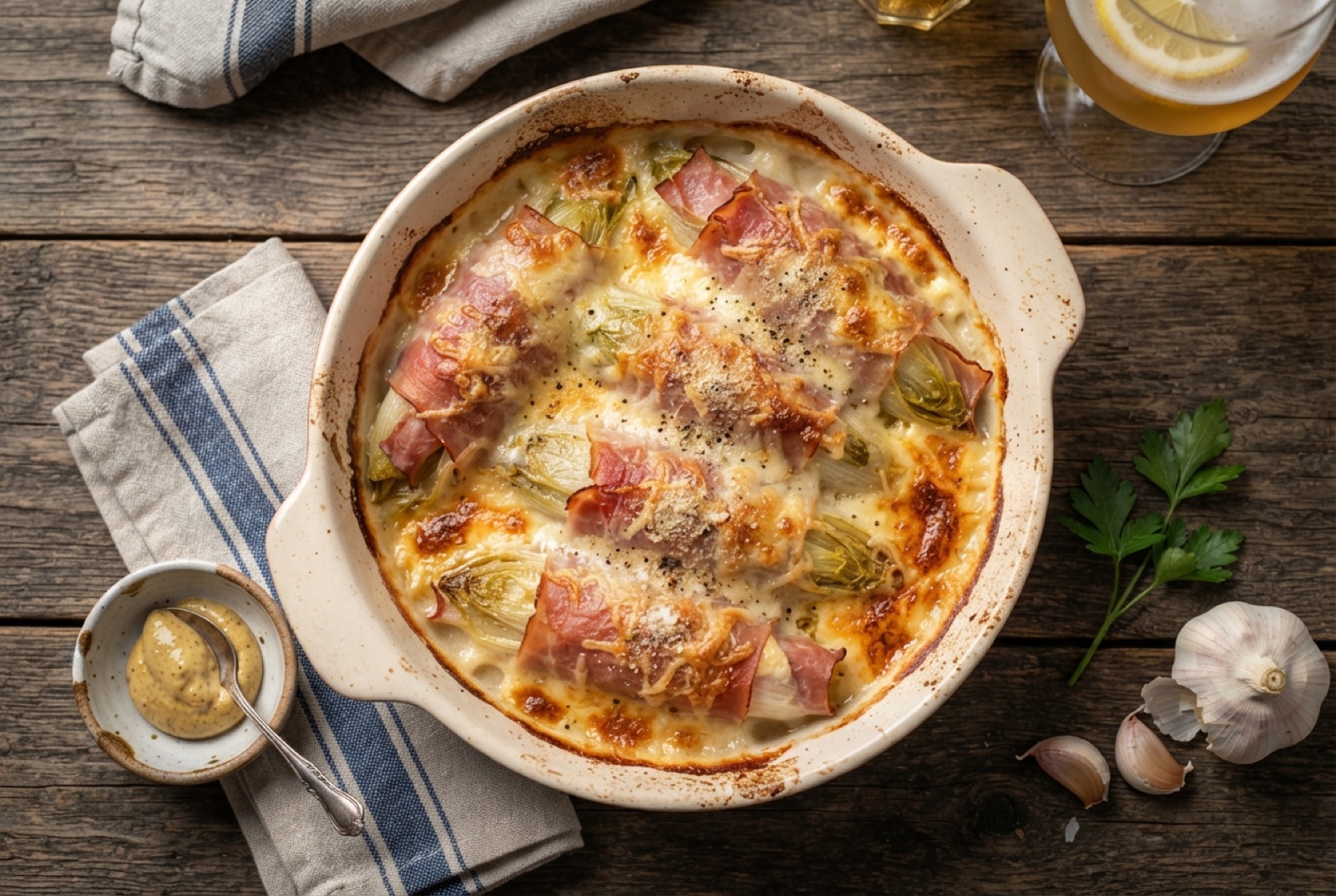
Belgium has 9 more dishes in the atlas — Belgische Frieten and Chicons au Gratin, and 7 more.
Recipe by The DishRoute Kitchen · published August 19, 2026 · updated August 19, 2026