Speculoos.
Belgian Spiced Brown Sugar Biscuits
Speculoos / speculaas · say it: SPEH-kew-lohs
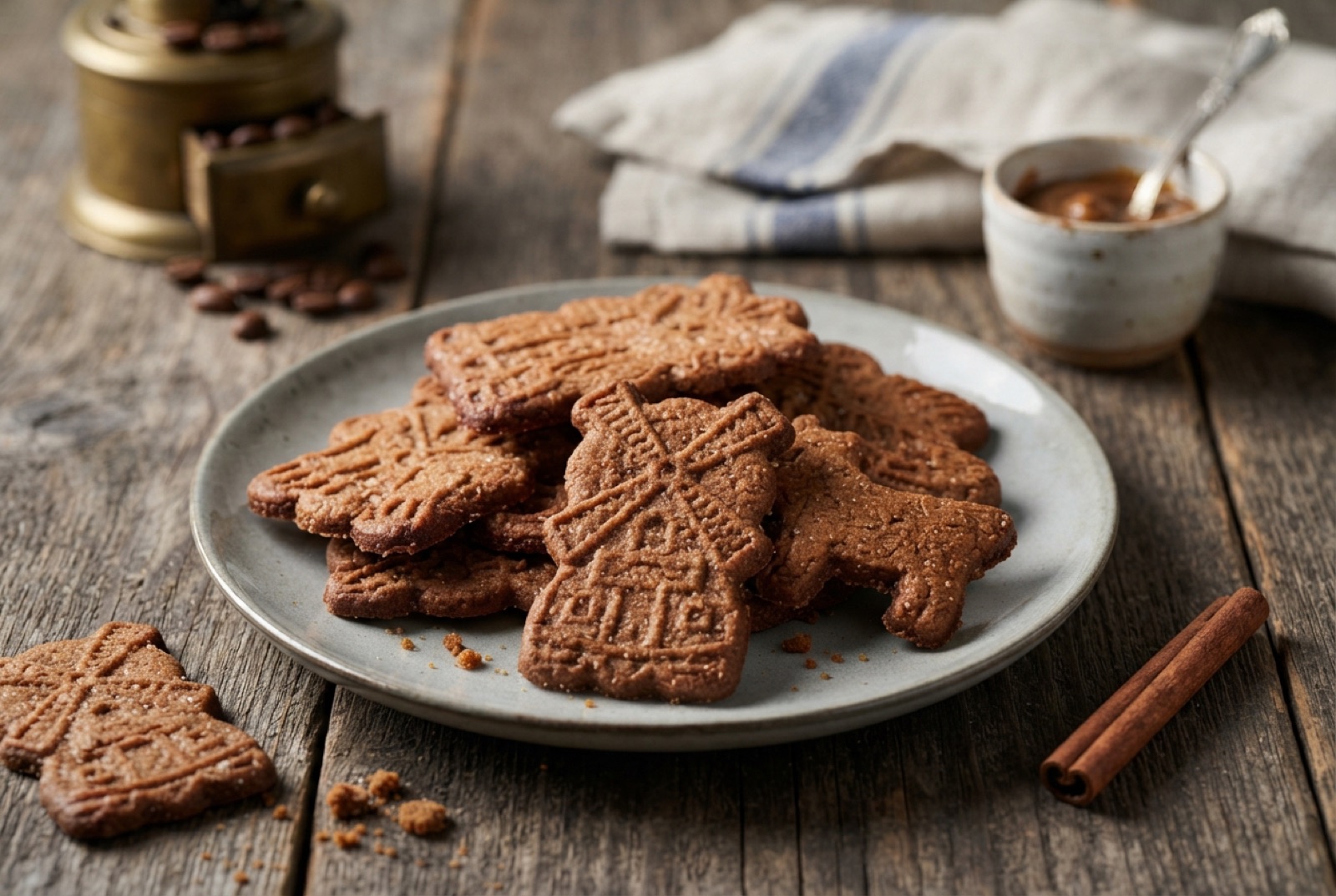
Speculoos are thin, hard, dark-gold biscuits made from brown sugar, butter, flour and spice, baked until they snap rather than bend. The flavour comes almost entirely from the sugar: dark brown sugar or Belgian cassonade caramelises in the oven and gives the biscuit its bittersweet, faintly toffee edge, with cinnamon leading the spice and clove sitting behind it. There is no egg, so the dough is short and sandy and rolls out beautifully thin. Two details make the difference between a good speculoos and a dull one: an overnight rest in the fridge, which lets the spice bloom and the sugar dissolve, and rolling thin enough that the biscuit crisps all the way through. This is the biscuit on the saucer of every Belgian coffee.

- Gate
- BelgiumNationwide
- Prep
- 25 min
- Cook
- 14 min
- Total time
- 12 hr 39 min incl. 12 hr rest
- Serves
- 30
- Status
- Easy
- Nutrition / serving · estimated
- Calories 95 kcal
- Protein 1 g
- Carbs 14 g
- Fat 4 g
- Fiber 0.4 g
- Sugar 8 g
- Sodium 55 mg
Why this recipe works.
- Rests the dough overnight, which is the step that turns flat sweetness into deep caramel and spice.
- Uses dark brown sugar as the primary flavour rather than treating it as interchangeable with white.
- Rolls to a specified thickness, so the biscuits actually snap instead of bending like a soft cookie.
- Explains how to use a wooden mould, and how to get the same result without one.
Ingredients.
11 itemsFor the dough
For the spice
Equipment
- Mixing bowl
- Rolling pin
- Baking sheets and parchment
- Wire cooling rack
- Carved wooden mould (optional)
Instructions.
Rub the butter in
Combine 250 g of flour with the baking powder, salt and all the ground spices in a bowl. Add the cold butter cubes and rub them in with your fingertips until the mixture looks like coarse damp sand with no visible lumps of butter left.
Tip Work quickly and with cool hands. If the butter starts to melt and smear, put the bowl in the fridge for ten minutes.
Add the sugar and bring together
Stir in 200 g of dark brown sugar, breaking up any hard clumps with your fingers, then add the milk and press the mixture together. It will look too dry at first; keep compressing it against the bowl until it forms a firm, slightly crumbly dough.
Rest overnight
Flatten the dough into a thick disc, wrap it tightly and refrigerate for at least 2 hours and ideally overnight. This is where the spice flavour develops and the sugar dissolves, so do not treat it as an optional chilling step.
Roll thin
Let the dough sit at room temperature for 15 minutes, then roll it out on a lightly floured surface to exactly 3 mm — thin enough to see the shadow of your hand through the flour dust. Cut rectangles or press the dough into a floured wooden mould and knock the shapes out onto lined baking sheets.
Bake until dark
Bake at 170°C for 12–14 minutes, until the biscuits have turned a deep reddish brown, the edges are visibly darker than the centres, and the kitchen smells strongly of cinnamon and caramel rather than raw flour. They will still feel soft in the middle when you take them out.
Tip Pull them at pale gold and they will never crisp. Speculoos want to go further than most biscuits.
Cool completely
Slide the biscuits onto a wire rack and leave them for at least 20 minutes without touching them. They harden as they cool, and a biscuit that bends while warm should snap cleanly once cold. Store in an airtight tin.
Tips from our kitchen.
- Use the darkest brown sugar you can find — Belgian cassonade, muscovado or dark brown soft sugar. Light brown sugar makes a pale, one-dimensional biscuit.
- Chill the dough overnight if you possibly can. Two hours works, twenty-four hours tastes markedly better, and the difference is not subtle.
- Roll to 3 mm and no thicker. A 5 mm speculoos stays chewy in the middle and never develops the characteristic snap.
- Bake until the biscuits look slightly darker than you are comfortable with. They firm up and lose their softness only as they cool.
- If you use a wooden mould, dust it heavily with flour and knock out the excess before pressing in the dough, or the pattern will tear on release.
- Cool the biscuits completely on a wire rack before stacking them. Trapped steam softens the crust within minutes.
Substitutions.
- Belgian cassonade → Dark muscovado or dark brown soft sugar
- Cassonade is a soft dark candi sugar with a pronounced caramel note. Muscovado is the closest widely available match.
- Individual spices → 2 tsp ready-made speculaas spice mix
- A Dutch-style blend gives a more complex, less cinnamon-forward biscuit — closer to speculaas than to Belgian speculoos, but very good.
- Butter → A firm plant-based baking block
- Works, since there is no egg in the dough. Choose a block rather than a spread; high-water spreads make the dough sticky and hard to roll.
Variations.
- Speculaas with almonds
- The Dutch direction: a fuller spice blend and chopped or flaked almonds worked into the dough, or a layer of almond paste sandwiched inside (gevulde speculaas).
- Moulded Saint Nicholas biscuits
- Dough pressed into carved wooden moulds of the saint, windmills and animals, then baked flat. Traditional for 6 December and the origin of the biscuit's shape.
- Speculoos crumb base
- Crushed with melted butter and pressed into a tin, the biscuits make an excellent cheesecake or tart base with a built-in spice note.
Storage & reheating.
Speculoos keep 3 weeks in an airtight tin at room temperature and are arguably better after two or three days, once the spice has settled. Keep them away from anything soft: stored with cake or bread they draw in moisture and lose their snap within a day. If they do soften, five minutes in a 150°C oven and a full cooling on a rack brings the crispness back. The raw dough freezes well for 3 months, either as a block or as pre-cut shapes ready to bake from frozen with two extra minutes.
Serve with
Strong black coffee — one biscuit on the saucer is the Belgian default — or crumbled over vanilla ice cream.
The story behind Speculoos.
Speculoos belongs to the feast of Saint Nicholas on 6 December, which is the real children's festival across Belgium and the Netherlands, and the biscuits were traditionally pressed into carved wooden moulds showing the saint, windmills, ships and animals. The moulds were made by joiners in the same towns as the bakeries, and old ones are collected and displayed as folk art. The name is usually traced either to the Latin for mirror, because the moulded biscuit is a mirror image of the carving, or to speculator, an old title for a bishop; neither explanation is settled, and any source that states one as fact is overselling its evidence.
The Belgian and Dutch versions have drifted apart in a way worth knowing. Dutch speculaas leans on a full spice blend — cinnamon, clove, nutmeg, ginger, cardamom, white pepper — and often carries almonds. Belgian speculoos is generally simpler and more sugar-forward, with cinnamon dominant and the other spices used sparingly, which lets the caramel note of the cassonade come through. This recipe follows the Belgian direction: heavy on brown sugar, cinnamon in front, clove and nutmeg present but restrained.
What happened next is a small commercial phenomenon. From the 1930s a Belgian family bakery began producing individually wrapped speculoos for cafés, and the biscuit-with-coffee habit spread far beyond Belgium — the little rectangular biscuit served with an espresso on airlines and in hotel lobbies across Europe is a direct descendant. Later the same biscuit was ground into a spread, which Belgians treat with a mixture of pride and mild embarrassment. The homemade version tastes noticeably better than any of them, mostly because you can use real butter and a genuinely dark sugar.
Questions, answered.
What is the difference between speculoos and speculaas?
They are the same family of biscuit with different accents. Belgian speculoos is simpler and more sugar-forward, dominated by brown sugar and cinnamon. Dutch speculaas uses a fuller spice blend including clove, nutmeg, ginger, cardamom and white pepper, and frequently contains almonds. Both are traditionally moulded in carved wood and associated with the Saint Nicholas feast on 6 December.
Why does the dough need to rest overnight?
Two things happen during the rest. The ground spices hydrate and their flavour spreads through the dough instead of sitting in dry pockets, and the sugar dissolves fully so it caramelises evenly in the oven. The fat also firms up, which makes a very short dough much easier to roll thinly. Two hours is the minimum; a full day gives a noticeably deeper flavour.
Why are my speculoos soft instead of crisp?
Most likely they were rolled too thick or pulled from the oven too early. Speculoos should be rolled to about 3 mm and baked until distinctly darker than a pale biscuit, because they harden only as they cool. Cooling them on a wire rack rather than the hot tray also matters, since steam trapped underneath will soften the base.
Do I need a wooden speculoos mould?
No. The moulds are traditional and beautiful, but the dough bakes identically whether it is pressed into carving or simply rolled out and cut with a knife or cutter. If you do use one, flour it heavily, press the dough in firmly, level the back, and knock it out onto the tray straight away before the dough warms and sticks.
Can I make speculoos without egg or dairy?
There is no egg in a traditional speculoos dough to begin with, so it is already egg-free. For a dairy-free version, replace the butter with a firm plant-based baking block of similar fat content and use a plant milk for the small amount of liquid. The texture holds up well, though the flavour is slightly less rounded without real butter.
You might also like.
All recipes →
Keep exploring Belgium.
Belgium has 9 more dishes in the atlas — Belgische Frieten and Carbonnade Flamande, and 7 more.
Recipe by The DishRoute Kitchen · published August 19, 2026 · updated August 19, 2026