Braġioli.
Maltese Beef Olives with Egg and Bacon
Braġioli · say it: brah-JO-lee
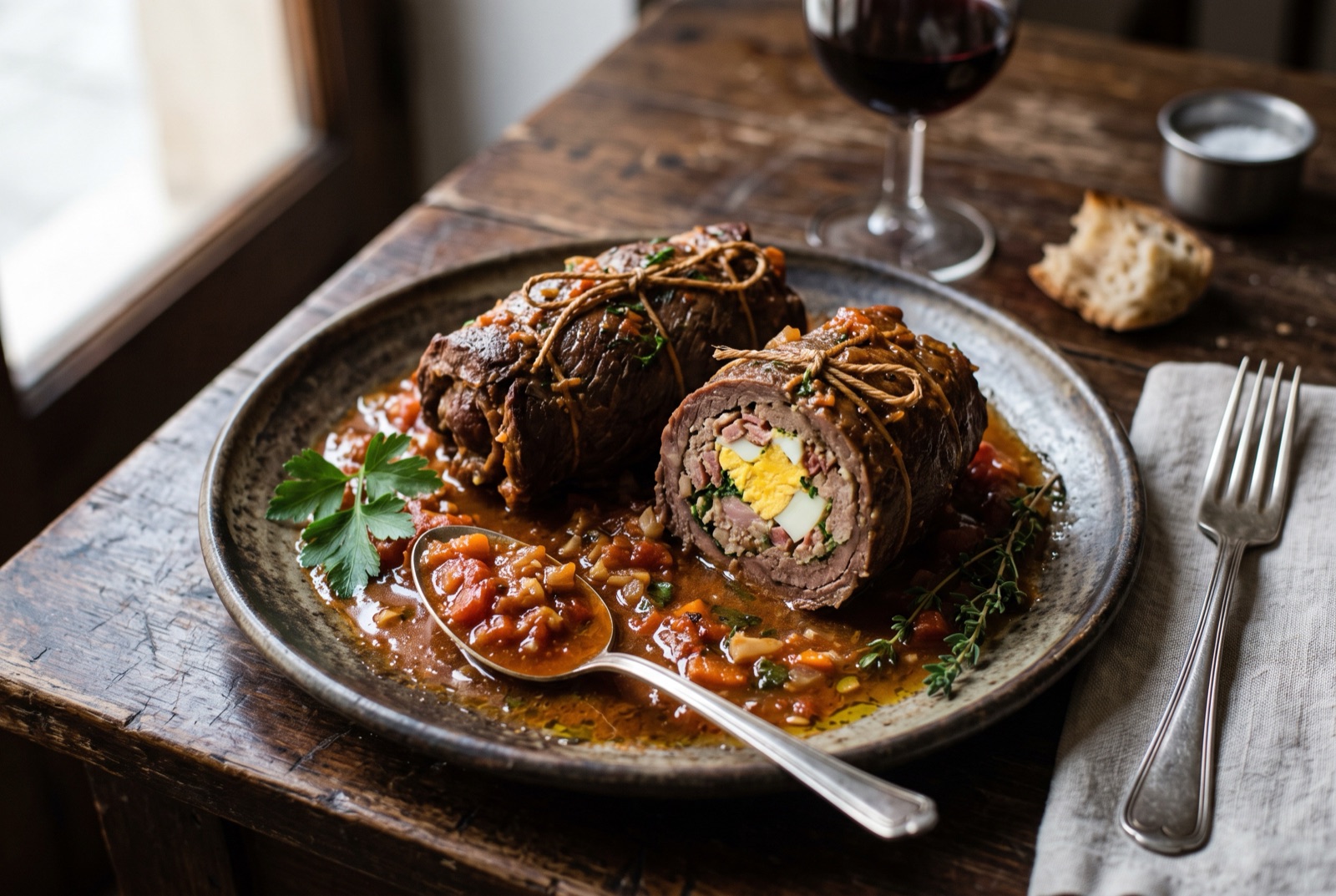
Braġioli are Maltese beef olives: wide, thin slices of beef wrapped around a stuffing of minced pork, chopped bacon, hard-boiled egg, parsley and breadcrumbs, tied shut and braised slowly in red wine and tomato. They contain no olives at all — the name refers to the shape, a fat little bundle roughly the size of a large olive once rolled. Cut one open and you get a spiral: soft beef outside, savoury pork mince within, and a bright ring of yolk in the centre. The sauce they cook in is dark, sweet with onion and slightly tannic from the wine, and it is spooned generously over the top. This is Sunday food and celebration food, the sort of dish a Maltese grandmother judges you on.

- Gate
- Malta
- Prep
- 40 min
- Cook
- 1 hr 40 min
- Total time
- 2 hr 20 min
- Serves
- 4
- Status
- Medium
- Nutrition / serving · estimated
- Calories 590 kcal
- Protein 45 g
- Carbs 18 g
- Fat 34 g
- Fiber 3 g
- Sodium 780 mg
Why this recipe works.
- Beef pounded thin and tied properly, so the rolls hold their spiral instead of collapsing in the pot.
- Filling seasoned and bound so it stays juicy through a long braise rather than turning into a dry plug.
- The braise is timed to the actual cut — you get fork-tender beef, not chewy beef in good sauce.
- Honest about the egg debate rather than pretending there is one correct Maltese version.
Ingredients.
16 itemsFor the rolls
For the filling
For the braise
Equipment
- Meat mallet or heavy rolling pin
- Kitchen string
- Heavy lidded casserole or deep sauté pan
Instructions.
Flatten the beef
Lay each escalope between two sheets of baking paper and pound with a mallet or rolling pin until roughly 3–4 mm thick and evenly wide. Work from the centre outwards so the edges do not tear into holes.
Mix the filling
Combine the minced pork, chopped bacon, breadcrumbs, parsley and garlic in a bowl with a generous pinch of salt and plenty of black pepper. Squeeze it together with your hands until it holds in a ball rather than crumbling apart.
Tip Fry a teaspoon of the mixture and taste it before rolling — this is your only chance to adjust the seasoning.
Roll and tie
Spread a heaped tablespoon of filling over each slice, leaving a 1 cm border, and press a quarter of hard-boiled egg into the middle. Fold the sides in, roll up firmly from the short end, and tie each parcel in two places with kitchen string.
Tip Do not overfill. A thin, even layer rolls tight; a mound forces the seam open in the pot.
Brown the parcels
Heat the olive oil in a heavy casserole over medium-high heat and brown the rolls seam-side down first, then all over, about 6 minutes total per batch, until they are burnished and the seam has sealed itself shut. Remove and set aside.
Start the sauce
Lower the heat, add the onions and carrot to the same pot and cook for 8–10 minutes until soft and just beginning to colour at the edges, scraping the fond off the base as they release moisture.
Deglaze and build
Stir in the tomato paste for a minute until it turns brick-coloured, then pour in the red wine and boil for 3 minutes until the raw alcohol smell has gone. Add the tinned tomatoes, bay leaves and stock, and season lightly.
Braise gently
Return the rolls to the pot, spooning sauce over them, and bring to a bare simmer. Cover and cook for 1 hour 15 minutes, turning them once halfway, until a fork slides into the beef with no resistance and the sauce has darkened to a deep brick red.
Tip If the sauce reduces too far before the beef is tender, add a splash of hot water rather than raising the heat.
Rest, untie and serve
Take the pot off the heat and let the rolls sit in the sauce for 15 minutes so the filling sets. Lift them out, snip and remove the string, then slice each in half on the diagonal and serve with the sauce spooned over.
Tips from our kitchen.
- Ask for beef topside or silverside cut into thin escalopes, then pound them to 3–4 mm between sheets of baking paper. Thin is what makes them roll.
- Season the filling and fry a teaspoon of it to taste before you roll anything — once it is inside the beef you cannot fix the salt.
- Tie each roll in two places with kitchen string, or secure with two cocktail sticks. Untied braġioli come apart during the braise, every time.
- Brown the rolls seam-side down first so the flap seals itself against the hot pan before you turn them.
- Keep the braise barely bubbling. Lean beef boiled hard goes tight and stringy no matter how long you cook it afterwards.
- Let them sit in the sauce for 15 minutes off the heat before slicing — the filling firms up and the rolls cut cleanly instead of crumbling.
Substitutions.
- Beef topside escalopes → Thin-cut veal escalopes or flank steak sliced across the grain
- Veal is more delicate and needs about 20 minutes less braising. Flank is beefier and benefits from an extra 15 minutes.
- Minced pork → Minced beef with 2 extra tablespoons of chopped bacon
- Pork brings fat and softness, so if you swap to beef you need the bacon to make up the difference or the filling turns dry.
- Red wine → Beef stock with 1 tbsp red wine vinegar
- You lose some depth, but the acidity keeps the tomato from tasting flat. Add an extra bay leaf to compensate.
Variations.
- Braġioli without egg
- A large minority of Maltese households skip the hard-boiled egg and increase the breadcrumbs and parsley instead, giving a lighter, more uniform filling.
- Braġioli with peas
- Peas stirred into the sauce for the last ten minutes, which is common when the dish is served as a one-pot family meal rather than a formal course.
- Oven-braised braġioli
- Brown on the hob, then transfer covered to a 160°C oven for 2 hours. The gentler, all-round heat is more forgiving if you are cooking a big batch.
Storage & reheating.
Braġioli keep 3 days refrigerated in their sauce and are arguably better on day two. Reheat covered over low heat or in a 150°C oven until hot through, about 20 minutes. They freeze well for up to 3 months: freeze whole rolls submerged in sauce, thaw overnight in the fridge, then reheat gently. Slice only after reheating — pre-sliced rolls dry out at the cut faces.
Serve with
Roast or mashed potatoes to absorb the sauce, a plain green vegetable, and Maltese bread for the sauce left on the plate.
The story behind Braġioli.
Stuffed and rolled meat is a very old Mediterranean idea, and versions of it turn up across southern Europe — Sicilian involtini, Italian braciole, Greek rolls of the same shape. Malta sits directly between Sicily and North Africa and absorbed the technique through centuries of Sicilian contact, keeping the Sicilian word almost intact. What the islands did with it, though, is characteristically their own. Where Sicilian involtini are often small, quick and grilled, braġioli are larger, always braised, and the filling leans on pork and bacon rather than cheese and pine nuts.
The hard-boiled egg in the centre is the detail Maltese cooks argue about. Some households insist on it, quartering the egg lengthwise so each roll carries a stripe of yolk; others leave it out entirely and add extra breadcrumbs. Both are defended as the correct version, and the disagreement usually splits along family lines rather than regional ones. What almost nobody skips is the string: braġioli must be tied, because the roll relaxes as the beef relaxes, and an untied one unravels into a sad pile of mince halfway through the braise.
The dish belongs to the same occasion category as stuffat tal-fenek — festas, Sundays, family lunches where more people arrive than were counted. It also reflects the practical logic of Maltese cooking on a small, historically poor island: a modest amount of beef, sliced thin and stretched around a cheaper filling, feeds more people than the same beef would as steak, and hours of gentle braising turn a lean, unpromising cut into something that yields to a spoon. The sauce is never wasted either — leftovers go over pasta the next day, exactly as the rabbit sauce does.
Questions, answered.
Why are they called beef olives if there are no olives?
The name describes the shape, not the ingredients. Once rolled and tied, each parcel is a fat oval roughly resembling a large olive. The same naming logic appears in British "beef olives" and it has nothing to do with the fruit — no olives go into the filling or the sauce.
What cut of beef should I ask for?
Topside or silverside sliced into escalopes is standard, since it is lean, wide and cheap enough to be worth stuffing. Ask the butcher for thin slices for beef olives and they will usually know exactly what you mean. Whatever you get, pound it to about 3–4 mm so it rolls without cracking.
Can I prepare braġioli ahead of time?
Yes, and it is the sensible way to cook them. Roll and tie the parcels up to a day in advance and keep them covered in the fridge, then brown and braise when you need them. The finished dish also reheats better than most braises, so cooking it entirely the day before is a legitimate strategy.
My rolls fell apart in the sauce — what happened?
Either they were not tied, or the sauce was boiling rather than simmering. String in two places per roll is the reliable fix, and the braise should show only occasional bubbles. Overfilling is the third culprit: a heaped mound of stuffing forces the flap open as the beef contracts.
Do I need to remove the string before serving?
Yes, always. Lift the rolls out of the sauce, let them rest for a few minutes so they hold their shape, then snip and pull the string away before plating. Removing it while the rolls are still very hot and loose is what causes them to tear.
You might also like.
All recipes →
Keep exploring Malta.
Malta has 9 more dishes in the atlas — Aljotta and Bigilla, and 7 more.
Recipe by The DishRoute Kitchen · published August 20, 2026 · updated August 20, 2026