Imqarrun il-Forn.
Maltese Baked Macaroni with Meat Sauce
Imqarrun il-forn · say it: im-ka-ROON il-FORN
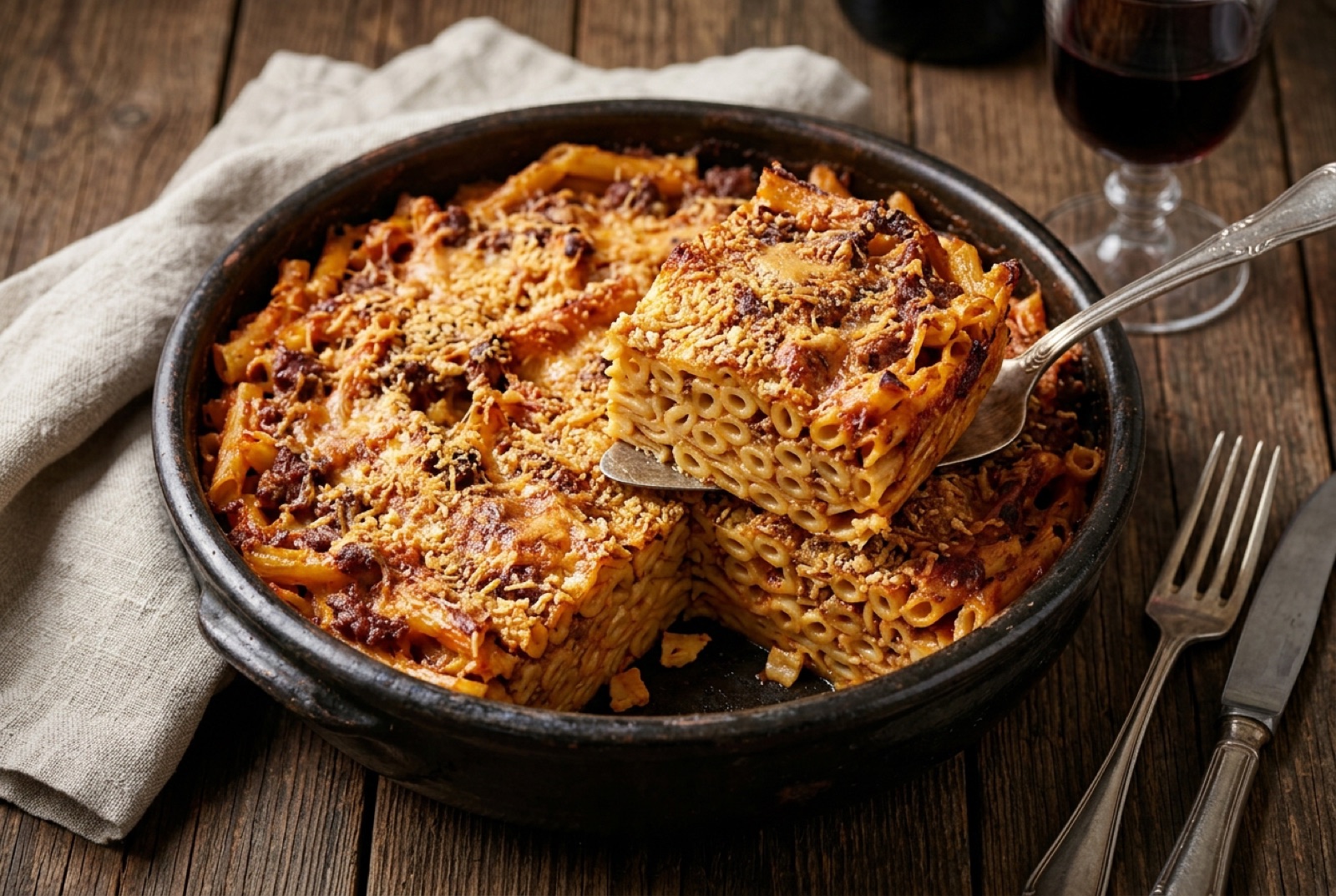
Imqarrun il-forn is baked macaroni, Maltese style — and the detail that separates it from every other pasta bake is the egg. Beaten eggs are stirred through the sauced macaroni before it goes into the oven, so instead of a loose, saucy dish you get a set, sliceable slab with a crisp brown top and a dense, savoury interior. The ragù underneath is cooked long and slow with beef and pork, onion, tomato and a pinch of warm spice, and there is usually more cheese in it than politeness allows. It is cheap, filling, made in enormous trays, and eaten hot on Sunday and cold from the fridge on Monday, which many Maltese will tell you is when it is actually best.

- Gate
- Malta
- Prep
- 25 min
- Cook
- 2 hr
- Total time
- 2 hr 45 min incl. 20 min rest
- Serves
- 6
- Status
- Easy
- Nutrition / serving · estimated
- Calories 680 kcal
- Protein 38 g
- Carbs 66 g
- Fat 29 g
- Fiber 5 g
- Sodium 720 mg
Why this recipe works.
- The egg binding is measured properly, so the bake sets into cuttable squares rather than scrambling or staying sloppy.
- Ragù cooked long enough to taste finished — no thin, raw-tomato pasta bake pretending to be Sunday food.
- Pasta deliberately undercooked so it finishes in the oven instead of turning to mush.
- Scales straight up to a big tray for a crowd without changing any of the ratios.
Ingredients.
16 itemsFor the ragù
For the bake
Equipment
- Deep baking tin, about 30 x 22 cm
- Large heavy pot for the ragù
- Large mixing bowl
Instructions.
Build the soffritto
Warm the olive oil in a heavy pot and cook the onions and carrot over medium heat for 10 minutes until soft and golden at the edges, then add the garlic and cook for another minute, until it smells sweet rather than raw.
Brown the meat
Raise the heat, add both minces and break them up with a wooden spoon. Cook for 8–10 minutes until all the liquid has evaporated and the meat starts to sizzle and catch brown in the pan rather than stewing in its own juices.
Tip Wait for the sound to change from a wet bubbling to a dry sizzle — that is when browning actually begins.
Simmer the ragù
Stir in the tomato paste and cook for 2 minutes until it darkens, then add the passata, bay leaves, curry powder if using and the nutmeg. Season, half-cover and simmer very gently for 1 hour 15 minutes, stirring occasionally, until the sauce is thick and a film of orange oil rises at the edges.
Cook the pasta short
Boil the penne in well-salted water for 3 minutes less than the packet says, so it is still distinctly firm in the middle. Drain, reserving a mugful of the water, and tip the pasta into a large bowl.
Tip It will finish cooking in the oven while it drinks up sauce, so genuinely undercooked is correct here.
Combine and bind
Remove the bay leaves and let the ragù cool for 10 minutes. Fold it through the pasta with two-thirds of the grated cheese, then stir in the beaten eggs quickly and thoroughly so they coat everything without setting in strands.
Tip If the mixture looks stiff, loosen it with a splash of the reserved pasta water — it should be slightly wetter than you think it needs to be.
Fill the tin
Heat the oven to 180°C. Oil a deep tin, spoon in the mixture and press it down firmly with the back of a spoon to drive out air pockets, then level the top and scatter over the remaining cheese mixed with the breadcrumbs.
Bake until set and crusted
Bake for 40–45 minutes, until the top is deep golden brown with darker crisp ridges and the centre feels firm rather than wobbly when pressed. A skewer pushed into the middle should come out hot and clean of loose sauce.
Rest, then cut
Let the tray stand for at least 20 minutes before cutting — this is not optional if you want clean squares. Cut into portions with a sharp knife and lift them out with a fish slice.
Tips from our kitchen.
- Boil the macaroni 3 minutes short of the packet time. It keeps cooking in the oven and absorbs sauce as it goes.
- Let the ragù cool for ten minutes before adding the eggs. Straight off the heat it will scramble them into yellow threads.
- Use a deep tin, at least 6 cm, and pack the mixture down firmly — air pockets are what cause the bake to crumble when cut.
- Save a ladle of pasta water and hold it back; if the mixture looks dry before it goes in the oven, loosen it slightly with the water rather than more sauce.
- Rest the finished bake at least 20 minutes out of the oven. Cutting it hot gets you a landslide instead of neat squares.
- A mix of breadcrumbs and grated hard cheese on top browns far better than cheese alone, which can go greasy and leathery.
Substitutions.
- Maltese ġbejniet or local hard cheese → Pecorino romano, or parmesan for a milder result
- Maltese kitchens use whatever sharp hard cheese is around. Pecorino is the closest widely available match in saltiness and bite.
- Penne or macaroni → Rigatoni, ziti or any short tube
- Tubes are essential — they trap sauce and lock together as the egg sets. Small shapes like fusilli give a pastier, less structured bake.
- Minced pork → All beef, plus 2 tbsp olive oil
- You lose a little sweetness and fat, so compensate with the extra oil or the bake can taste dry.
Variations.
- Ross il-forn
- The rice version of the same dish, made with short-grain rice added raw or par-boiled to the sauce. Equally common in Malta and cooked in exactly the same tins.
- With chicken livers
- Some family recipes add finely chopped chicken livers to the ragù with the mince, giving a deeper, faintly mineral savour.
- Béchamel-topped
- A more modern restaurant style spreads a thin layer of béchamel over the top before baking, for a creamier crust closer to a lasagne finish.
Storage & reheating.
Keeps 4 days covered in the fridge and is genuinely good eaten cold, which is how most Maltese leftovers get finished. Reheat squares in a 170°C oven for 15 minutes to bring back the crust, or in a dry frying pan cut-side down for a crisp edge. Freezes well for 3 months, either whole or in portions — wrap tightly, thaw overnight in the fridge and reheat covered so the top does not dry out before the centre is hot.
Serve with
A sharp green salad with plenty of vinegar to cut the richness, and Maltese bread with butter.
The story behind Imqarrun il-Forn.
Malta ate pasta long before pasta was fashionable elsewhere in northern Europe, thanks to centuries of trade and traffic with Sicily just 90 km north. But imqarrun il-forn is not an imported Italian bake — it belongs to a specifically Maltese family of oven dishes that also includes ross il-forn, the same idea made with rice instead of macaroni. Both are built to be assembled in a wide tin and taken to the village bakery, where the residual heat of the bread oven after the morning bake was rented out cheaply to households. Families would carry the tray down in the morning and collect it at lunchtime, browned and bubbling, and older Maltese still remember the queue of trays with the family name chalked on the side.
That bakery origin explains the format. The dish had to survive being carried through the street, so it needed to set solid; it had to feed a large family and any relatives who turned up, so it was made in quantity; and it had to be good at room temperature, because it rarely arrived home piping hot. The egg binding, the deep tray, the square-cut portions — all of it follows from a communal oven rather than a domestic one.
The ragù itself is where households diverge. Some cooks use only beef, others insist on a mix with pork for fat and sweetness; some add a little curry powder or a grating of nutmeg, a habit that surprises visitors and that Maltese cooks defend without much interest in explaining it. Chicken livers appear in some family versions. What is constant is the slow cooking — the sauce is not a 20-minute affair — and the layer of cheese and breadcrumbs on top that browns into a crust. Every Maltese family thinks their mother's is the correct one, and in practical terms they are all right.
Questions, answered.
Why does the recipe add beaten egg to the pasta?
The egg is what makes this Maltese rather than a generic pasta bake. As it cooks it sets between the tubes and binds the whole tray into a firm slab that can be cut into squares and eaten by hand or cold from the fridge. Without it you get a loose, saucy bake that collapses on the plate.
Why is there curry powder or nutmeg in the meat sauce?
A small amount of warm spice in the ragù is a genuine Maltese habit, though not universal — some families use a pinch of curry powder, others nutmeg or a clove. It is used at background level, adding warmth rather than any recognisable curry flavour. Leave it out if you prefer a straightforwardly Italian-tasting sauce.
Can I assemble it in advance?
Yes. Assemble the whole tray, cover and refrigerate for up to 24 hours, then bake straight from cold, adding about 15 minutes to the oven time. This is how it is usually handled for family lunches. Do not freeze it unbaked — the pasta softens too much on thawing.
My bake fell apart when I cut it. Why?
Almost always because it was cut too soon. The egg needs to cool and firm up, so rest the tray at least 20 minutes, ideally 30, before the first cut. The other causes are too little egg for the quantity of pasta, or not pressing the mixture down firmly into the tin before baking.
Is it supposed to be dry?
It should be firm and sliceable but still moist inside, not dry. Because the pasta keeps absorbing liquid in the oven, the mixture should look slightly wetter than seems right when you spoon it into the tin. If yours came out dry, use a little more sauce next time and undercook the pasta more aggressively.
You might also like.
All recipes →
Keep exploring Malta.
Malta has 9 more dishes in the atlas — Aljotta and Bigilla, and 7 more.
Recipe by The DishRoute Kitchen · published August 20, 2026 · updated August 20, 2026