Ćevapi.
Balkan Grilled Minced Meat Sausages
Ћевапи · Ćevapi · say it: CHEH-vah-pee
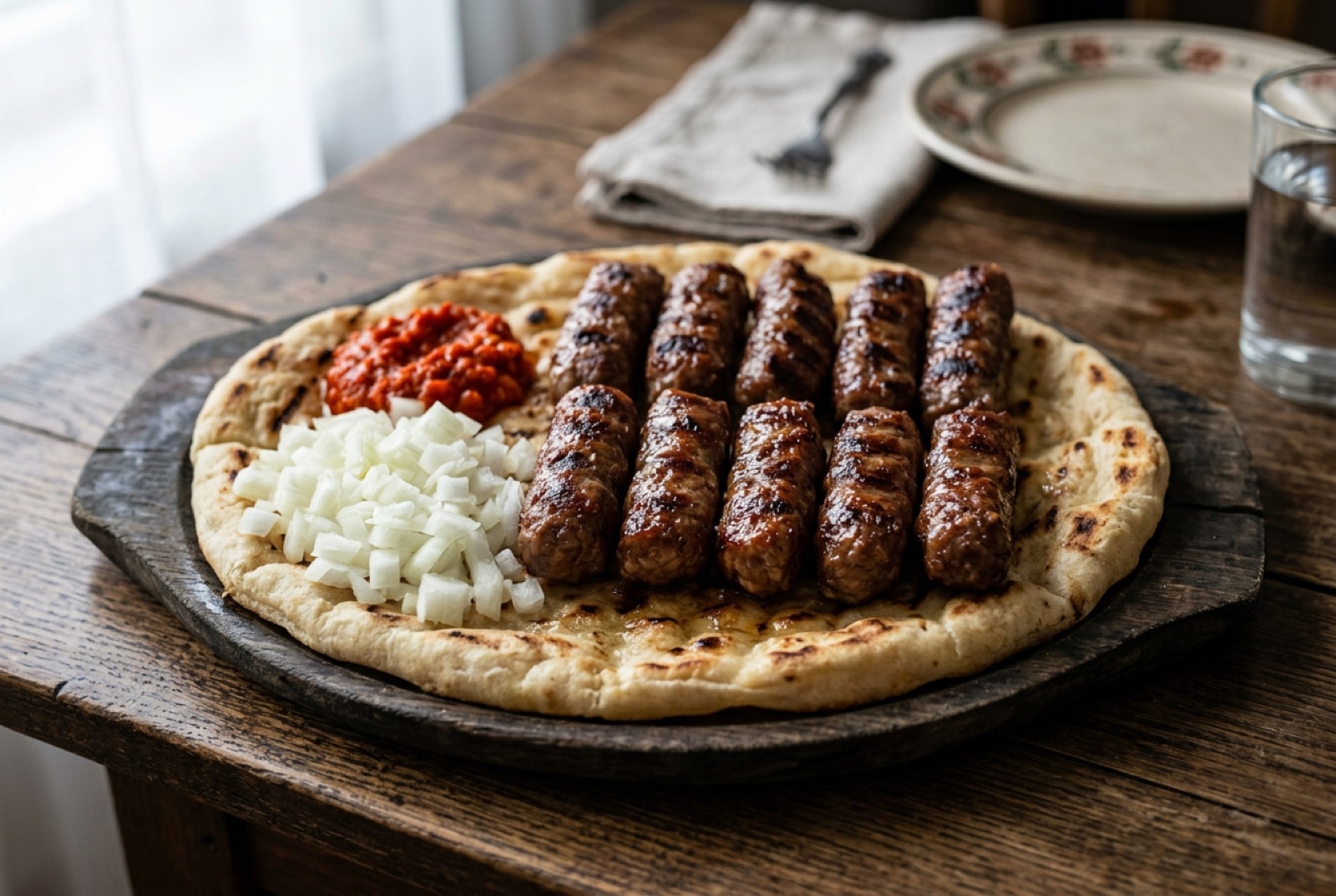
Ćevapi are small, skinless sausages of minced beef — or beef and pork, in much of Serbia — seasoned with little more than salt, garlic and pepper, grilled hard, and eaten by the handful stuffed into soft flatbread with a pile of raw chopped onion. The flavor is pure beef and char; the surprise is the texture, which is not crumbly like a burger but springy, almost bouncy, with juice that runs when you bite. That texture comes from technique, not ingredients: a little baking soda and an overnight rest that transform the meat. This recipe gives you the grill-house version at home, on a charcoal grill or a smoking-hot cast-iron pan.

- Gate
- Serbia
- Prep
- 25 min
- Cook
- 15 min
- Total time
- 12 hr 40 min incl. 12 hr rest
- Serves
- 4
- Status
- Medium
- Nutrition / serving · estimated
- Calories 730 kcal
- Protein 45 g
- Carbs 42 g
- Fat 42 g
- Fiber 3 g
- Sodium 1400 mg
Why this recipe works.
- Uses the real grill-house method — salt, baking soda, hard kneading and an overnight rest — for the springy texture that defines ćevapi.
- The beef-and-pork ratio is the common Serbian one, with the all-beef Sarajevo route noted for purists.
- Works on charcoal or in a cast-iron pan, with honest timing for each.
- Serving is done properly: warmed flatbread, raw onion, kajmak or ajvar — nothing that does not belong.
Ingredients.
11 itemsFor the ćevapi
For serving
Equipment
- Charcoal grill or cast-iron pan
- Large mixing bowl
- Tongs
- Cutting board for resting
Instructions.
Knead the meat
Combine 700 g of ground beef with the pork, garlic, salt, pepper, paprika and baking soda. Knead hard with your hands for a full 5 minutes, adding the sparkling water in splashes, until the mixture turns sticky, pale and paste-like and smears against the side of the bowl.
Tip When a handful holds to your upturned palm for a second before falling, the bind is right.
Rest overnight
Press the mixture flat in the bowl, cover it tightly, and refrigerate at least 12 hours and up to 24. The rest lets the salt and soda restructure the proteins — the mixture will feel noticeably firmer and tackier the next day.
Shape the ćevapi
With wet hands, roll the mixture into cylinders about 2 cm thick and 8 cm long — roughly 20 pieces. Line them up on a tray and keep them cold until the moment they hit the grill; warm meat slumps and sticks.
Tip A piping bag with the end cut to 2 cm, or a cut plastic bottle, extrudes perfectly even cylinders — an old grill-house trick.
Grill hard
Heat a charcoal grill or cast-iron pan until it is fiercely hot. Lay the ćevapi across the grates and cook, turning only when they release freely, until all sides are deeply browned with charred spots and the meat feels springy when pressed, 8–10 minutes total.
Warm the bread
In the last minute, split the flatbreads and warm them cut-side down over the grill until soft, steamy and lightly toasted at the edges. If there are meat juices on the board, press the cut faces into them.
Stuff and serve
Rest the ćevapi for 2 minutes, then pack 4–5 pieces into each flatbread with a big spoonful of raw chopped onion and kajmak or ajvar if you like. Serve immediately, with napkins rather than cutlery.
Tips from our kitchen.
- Do not skip the overnight rest. The salt and baking soda need those hours to restructure the meat — it is the difference between ćevapi and small burgers.
- Knead the meat far longer than feels reasonable, 5 full minutes, until it turns sticky and smears against the bowl. That paste-like bind is what holds the casing-free shape.
- Ask the butcher for a fattier grind, around 20% fat. Lean meat makes dry, dense ćevapi no technique can rescue.
- Shape with wet hands to a uniform thumb thickness — about 2 cm by 8 cm — so every piece finishes at the same moment.
- Grill over strong, steady heat and turn only when the meat releases on its own; tearing them off early rips the crust that is half the flavor.
- Warm the flatbread over the grill in the final minute, and if you can, press its cut face into the meat juices on the board — that is how the grill houses do it.
Substitutions.
- Beef and pork mix → All beef (chuck or a 20% fat grind)
- The Sarajevo standard, and the route to keep if you avoid pork. Flavor is beefier; texture is identical with the same technique.
- Somun or lepinja flatbread → Thick Greek-style pita or any soft, pillowy white flatbread
- Nothing matches fresh somun, but a soft pita warmed over the grill is a fair stand-in. Avoid thin wrap-style breads — they cannot hold the juices.
- Kajmak → Full-fat clotted cream or crème fraîche with a pinch of salt
- Kajmak's tang and richness sit between the two; clotted cream is closer in body, crème fraîche in acidity.
Variations.
- Sarajevo style
- All beef, gently seasoned, served in somun with kajmak and onion — the Bosnian benchmark, revered across the region.
- Leskovac style
- From Serbia's self-declared grill capital: more assertive seasoning, often with hot paprika, and frequently shaped into larger patties (pljeskavica) from the same mixture.
- Cheese-loaded
- A grill-house indulgence: the split flatbread spread thickly with kajmak so it melts into the hot meat — order-by-default for many Serbians.
Storage & reheating.
Cooked ćevapi keep 3 days refrigerated and reheat well in a covered pan over medium heat with a spoonful of water — the microwave makes them rubbery. The raw rested mixture can be shaped and frozen in a single layer for up to 3 months; grill from thawed. The overnight rest, however, cannot be shortcut on the day.
Serve with
Warm lepinja or somun flatbread, raw chopped onion, kajmak or ajvar, and a simple tomato-cucumber salad.
The story behind Ćevapi.
Ćevapi descend from the Ottoman kebab — the name itself comes from the Persian-Turkish "kebap" — and small grilled cylinders of minced meat spread through the Balkans during the centuries of Ottoman rule. What happened after is the interesting part: the region made the dish so completely its own that today ćevapi (or ćevapčići, the diminutive) are claimed with equal passion by Bosnia, Serbia, and beyond. Sarajevo insists on all-beef ćevapi served in somun, its pillowy flatbread, often with kajmak; Serbia's grill capital Leskovac, home of a famous annual grill festival, is proud of its own school of grilled minced meat, typically more aggressively seasoned and often mixing beef with pork. Who makes them best is a debate that has outlived several countries, and this recipe takes no side — it takes the technique.
And the technique is what separates real ćevapi from seasoned mini-burgers. Grill masters in Serbia and Bosnia knead the salted meat until it turns sticky and pasty, add a small amount of baking soda (or sparkling mineral water), and rest the mixture overnight in the fridge. The salt and soda change the protein structure so the meat binds to itself, which is why ćevapi hold a clean cylindrical shape with no casing and bite with that distinctive springy snap. Skip the rest and you get decent grilled meat; do it properly and you get ćevapi.
In Serbia they are the anchor of the ćevabdžinica — the grill house — and of every roštilj, the backyard barbecue that is practically a national institution. The serving ritual barely varies: ten pieces in a split lepinja or somun that has been waved over the grill and sometimes dragged through the meat drippings, a heap of raw chopped onion, maybe kajmak or ajvar on the side, and nothing else. Cutlery is optional; the flatbread is the plate.
Questions, answered.
Are ćevapi Serbian or Bosnian?
Both, and the argument is eternal. Ćevapi descend from Ottoman-era kebabs and took root across the Balkans; today Bosnia (especially Sarajevo, with its all-beef ćevapi in somun bread) and Serbia (especially Leskovac, the grill capital) both claim the definitive version, and North Macedonia and Croatia have proud traditions too. The honest answer is that ćevapi are a shared Balkan dish with fierce regional schools rather than one owner.
Why do ćevapi have that springy, bouncy texture?
Technique, not additives you would object to. The minced meat is kneaded hard with salt and a small amount of baking soda (some cooks use sparkling mineral water), then rested overnight in the fridge. Salt and soda change how the meat proteins bind, so the mixture turns sticky and holds together without any casing, giving the finished ćevapi their characteristic snap and juiciness instead of a crumbly burger texture.
What meat goes into ćevapi?
It depends where you are. Sarajevo-style ćevapi are strictly beef. In Serbia a mix of beef and pork is very common, and some regions add lamb. What matters more than the species is the fat — around 20% — and the fine grind. This recipe uses the common Serbian beef-and-pork mix and notes the all-beef route, which also keeps the dish halal-compatible.
What do you serve with ćevapi?
The classic plate is minimal: a warmed flatbread (lepinja or somun) split open and stuffed with the ćevapi, a generous heap of raw chopped onion, and optionally kajmak (a rich, tangy Balkan dairy spread) or ajvar (roasted red pepper relish). No ketchup, no lettuce, no cheese slices. Fries appear in tourist spots; locals mostly just order more bread.
Can I cook ćevapi without a charcoal grill?
Yes. A cast-iron pan or ridged grill pan heated until it just smokes gives an excellent crust — cook in batches so the pan stays hot, about 4 minutes per side. You lose the charcoal smoke, which is real but not fatal; the overnight-rested texture, the char, and the raw onion carry the dish. A broiler set to high with the ćevapi close to the element also works.
You might also like.
All recipes →
Keep exploring Serbia.
Serbia has 9 more dishes in the atlas — Gibanica and Karađorđeva Šnicla, and 7 more.
All Serbia recipes Ground beef recipes Garlic recipes Onion recipes mainstreet fooddairy freenut freeRecipe by The DishRoute Kitchen · published August 18, 2026 · updated August 18, 2026