Sopaipillas.
Chilean Fried Pumpkin Flatbreads
Sopaipillas · say it: soh-pye-PEE-yahs
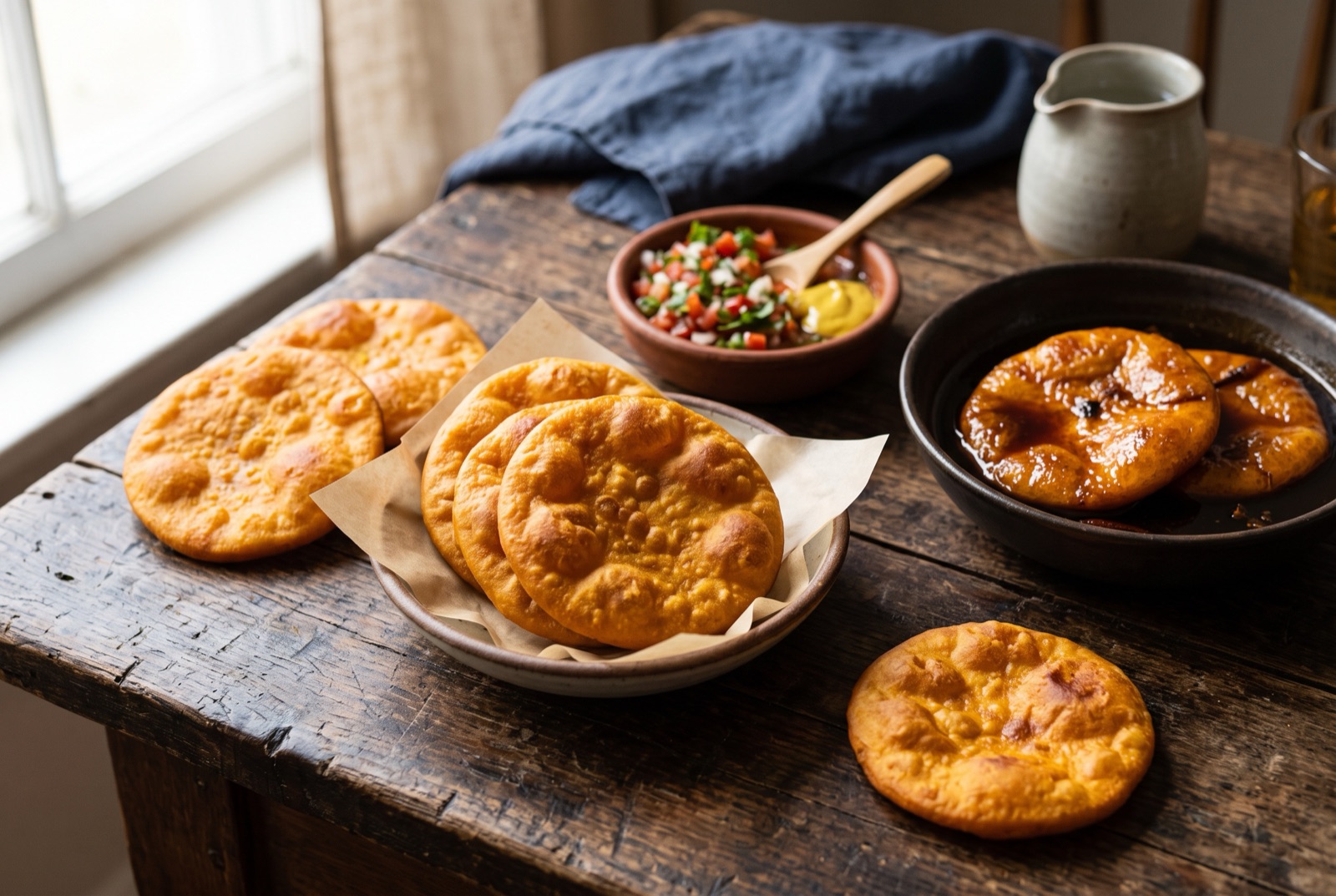
A Chilean sopaipilla is a flat round of dough made with cooked squash, fried in hot oil until it inflates, colours unevenly and goes crisp at the rim while staying soft in the middle. The squash does two jobs: it keeps the dough tender for hours and gives it a faint orange colour and a sweetness that works in either direction. Eaten hot from the pan with pebre and mustard, they are savoury street food; simmered in dark chancaca syrup with cinnamon and orange peel, the same discs become a pudding called sopaipillas pasadas. The dough takes ten minutes to make, and frying is the only part that demands attention.

- Gate
- ChileZona Central
- Prep
- 30 min
- Cook
- 30 min
- Total time
- 1 hr 30 min incl. 30 min rest
- Serves
- 6
- Status
- Easy
- Nutrition / serving · estimated
- Calories 340 kcal
- Protein 6 g
- Carbs 52 g
- Fat 12 g
- Fiber 3 g
- Sugar 14 g
- Sodium 480 mg
Why this recipe works.
- The squash is roasted rather than boiled, so the purée is dry and the dough does not need extra flour to hold together.
- Dough rests before rolling, which stops the discs shrinking back and makes them puff evenly in the oil.
- Fork-pricking is explained properly — it is what gives a flat Chilean sopaipilla instead of a hollow balloon.
- Includes the chancaca syrup with the cornstarch trick that makes it cling to the dough instead of sliding off.
Ingredients.
12 itemsFor the dough
For frying
For the chancaca syrup
Equipment
- Deep heavy pan for frying
- Cooking thermometer
- Rolling pin
- 8 cm round cutter
- Wire rack
Instructions.
Cook and dry the squash
Roast 600 g of squash at 200°C for 30 minutes, or steam it until a knife goes through without resistance. Mash it smooth and, if it looks wet, stir it in a dry pan over medium heat for a few minutes until it holds its shape on the spoon. Cool completely.
Make the dough
Mix the flour, baking powder and salt in a bowl, add 350 g of the cooled squash purée and the melted butter, and bring it together with your hands. Knead 3–4 minutes to a soft, slightly tacky dough that pulls cleanly from the bowl, adding flour a spoonful at a time only if it sticks to your palms.
Rest, roll and prick
Cover the dough and rest it 30 minutes so it stops fighting the rolling pin. Roll out to 5 mm thick, cut 8 cm rounds, and prick each one three or four times with a fork, pushing the tines right through the dough.
Fry until puffed and blistered
Heat the oil to 180°C and fry the discs three or four at a time for about 90 seconds a side, turning once. They are done when they have puffed into flat cushions, the surface is blistered and mottled gold, and the edges look crisp. Drain on a wire rack.
Tip If a test disc sinks and stays down, the oil is too cool; if it browns in under 30 seconds, pull the pan off the heat for a moment.
Make the chancaca syrup
Break the chancaca into a saucepan with the water, cinnamon, cloves and orange peel, and simmer 15 minutes until fully dissolved and syrupy. Stir in the slaked cornstarch and cook 2 minutes more, until the syrup coats the back of a spoon and a line drawn through it holds.
Serve savoury or pasadas
For savoury sopaipillas, serve them straight from the rack with pebre and mustard. For sopaipillas pasadas, drop the fried discs into the hot syrup and simmer 3–4 minutes, turning once, until they are dark, glossy and soaked most of the way through, then serve in bowls with syrup spooned over.
Tips from our kitchen.
- Roast or steam the squash and let it cool completely; warm purée melts the butter into the flour and gives a greasy dough.
- Add flour gradually — squash varies enormously in water content, and the dough should be soft and slightly tacky, not stiff.
- Roll thin, about 5 mm. Thick discs stay doughy in the middle even when the outside is well browned.
- Prick each disc three or four times with a fork so it puffs into a flat cushion rather than a hollow ball that collapses.
- Keep the oil at 180°C. Cooler and the dough absorbs fat and turns heavy; hotter and it browns before the inside cooks.
- Drain on a rack rather than paper towel — sitting on paper steams the underside soft within a minute.
Substitutions.
- Zapallo camote (Chilean squash) → Butternut squash, kabocha or any dense orange-fleshed pumpkin
- Avoid the watery field pumpkins sold for carving. If your purée is loose, cook it dry in a pan for a few minutes before mixing it into the flour.
- Chancaca → Panela, piloncillo, jaggery or dark muscovado sugar
- All are unrefined cane sugars with the same molasses depth. Ordinary brown sugar works but gives a thinner, flatter syrup — add a tablespoon of molasses to compensate.
- Butter in the dough → Lard, or a neutral oil
- Lard is the traditional fat and gives the most tender result. Oil makes a slightly chewier disc and keeps the recipe dairy-free.
Variations.
- Sopaipillas pasadas
- The fried discs simmered a few minutes in chancaca syrup with cinnamon, cloves and orange peel until they are soaked through and glossy. Eaten hot with a spoon in winter.
- Sopaipillas del norte
- The northern Chilean style, made without squash and cut into squares or thicker rounds, closer to plain fried bread and usually eaten savoury.
- Sopaipilla con queso
- Split hot from the pan and filled with a slice of melting cheese, a street-cart variation that has become common in Santiago.
Storage & reheating.
Fried sopaipillas are best within an hour but stay perfectly good for 2 days in a paper bag at room temperature, going a little firmer as they sit. Refresh them in a 180°C oven for 5 minutes rather than a microwave, which makes them chewy. Do not refrigerate them; the fridge stales fried dough faster than the counter does. Uncooked dough keeps 2 days wrapped in the refrigerator and can be frozen for a month, and day-old sopaipillas are actually preferred for making sopaipillas pasadas, since a firmer disc absorbs the syrup without falling apart.
Serve with
Pebre, mustard and ají for the savoury version; a cup of black tea for the syrup-soaked ones.
The story behind Sopaipillas.
Fried dough of this kind travelled to the Americas from Spain, where the word sopaipa has Mozarabic roots and named a fried, syrup-soaked pastry. It landed in more than one place: the sopaipillas of New Mexico are a distant relative but a different thing entirely — thick puffed pillows served with honey, made without squash. The Chilean version is flat, orange-tinged and stamped with fork holes, and its identity comes almost entirely from the zapallo, the winter squash worked into the dough.
In Santiago they are welded to weather. Rain is infrequent enough in central Chile to be an event, and when it comes, sopaipillas appear — from home kitchens, from carts pushed out onto street corners, from windows of houses selling them by the dozen in paper bags. The association is strong enough that Chileans joke about it as a reflex, and it makes practical sense: hot fried dough with pebre is exactly what a cold wet afternoon calls for, and the ingredients live in any pantry.
The savoury and sweet versions belong to different moments. On the street the discs come with pebre, mustard or a smear of ají, sold two or three at a time and eaten standing up. Sopaipillas pasadas are made at home in winter, the fried discs dropped into a syrup of chancaca — unrefined cane sugar, sold in hard cones or blocks — simmered with cinnamon, cloves and a strip of orange peel until it thickens enough to cling. Day-old sopaipillas are ideal for the sweet version, since a slightly stale disc drinks the syrup without disintegrating, which means the two dishes tend to arrive in sequence rather than in competition.
Questions, answered.
Why is there pumpkin in the dough?
Squash makes the dough tender and keeps it that way for far longer than plain flour dough, which goes leathery within an hour of frying. It also lends a faint sweetness and the pale orange colour that distinguishes Chilean sopaipillas from other fried breads. Practically, it stretches expensive flour with a cheap vegetable, which is how the recipe came to be built this way.
Why do my sopaipillas soak up oil and turn greasy?
The oil was too cool. Below about 170°C the dough absorbs fat before its surface can seal, and every disc comes out heavy. Use a thermometer, keep the oil at 180°C, and fry in small batches — adding four or five discs at once drops the temperature sharply. Wet dough from a watery squash purée has the same effect.
What is chancaca?
Chancaca is unrefined cane sugar sold in hard cones or blocks in Chile, the same product known as panela in Colombia, piloncillo in Mexico and jaggery in South Asia. It has a strong molasses flavour that plain sugar cannot reproduce. Dissolved in water with cinnamon, cloves and orange peel, it becomes the dark syrup used for sopaipillas pasadas.
Do I have to prick the dough before frying?
For the Chilean shape, yes. Unpricked discs inflate into hollow balloons that collapse into a wrinkled shell as they cool. Three or four fork holes let steam escape steadily so the sopaipilla puffs into a flat, even cushion with a soft interior — which is what you want whether you are eating it with pebre or soaking it in syrup.
Can I bake them instead of frying?
You can bake the discs at 220°C for about twelve minutes and they will be pleasant enough, but they are a different food: drier, breadier, and without the blistered, crisp-edged surface that frying gives. If you want to reduce the oil, the more effective route is to keep the temperature accurate and drain on a rack, which uses much less fat than badly managed frying.
You might also like.
All recipes →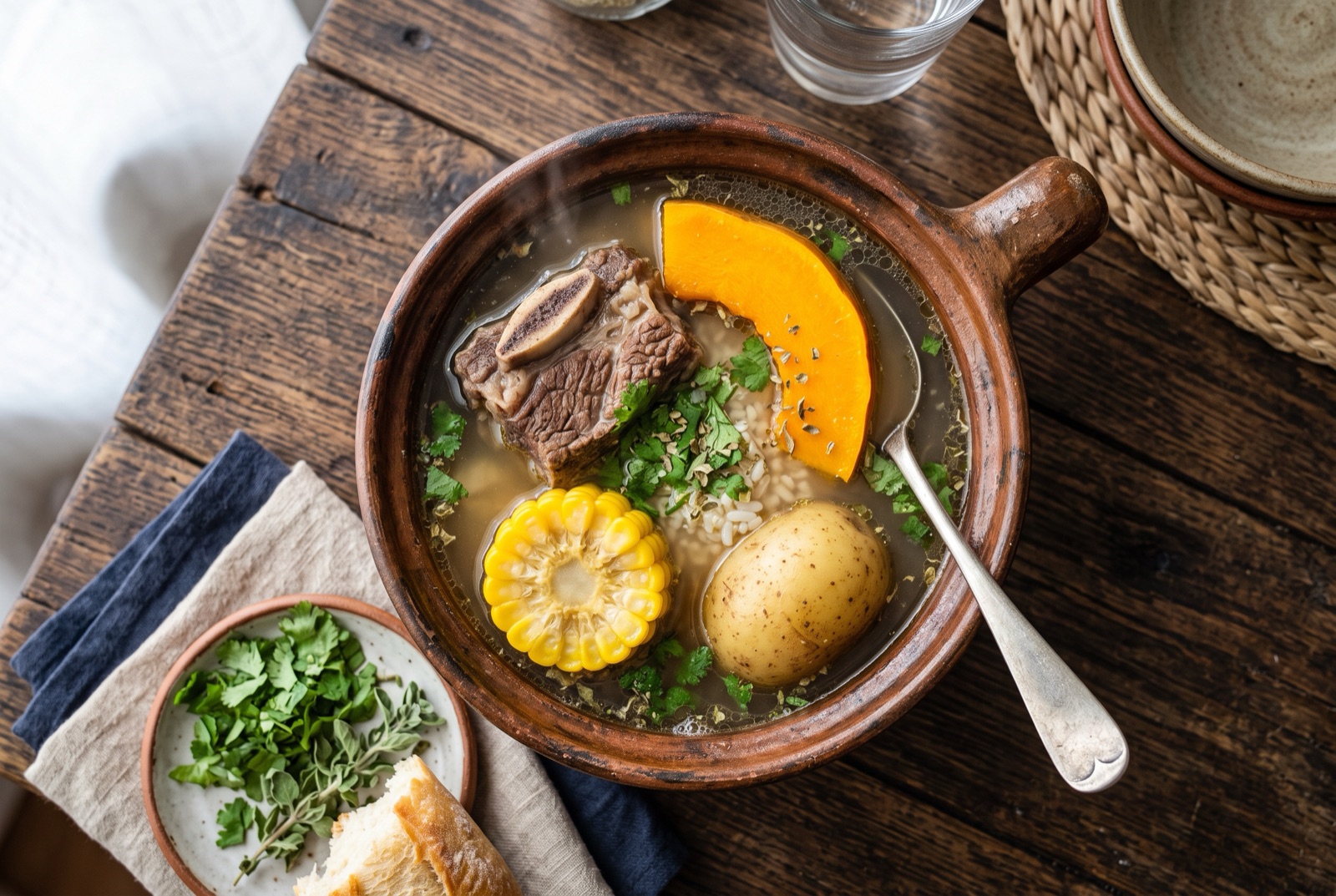

Keep exploring Chile.
Chile has 9 more dishes in the atlas — Caldillo de Congrio and Cazuela de Vacuno, and 7 more.
Recipe by The DishRoute Kitchen · published August 20, 2026 · updated August 20, 2026