Cholent.
Overnight Sabbath Beef and Barley Stew
טשאָלנט · Cholent / Tsholnt · say it: CHUH-lent
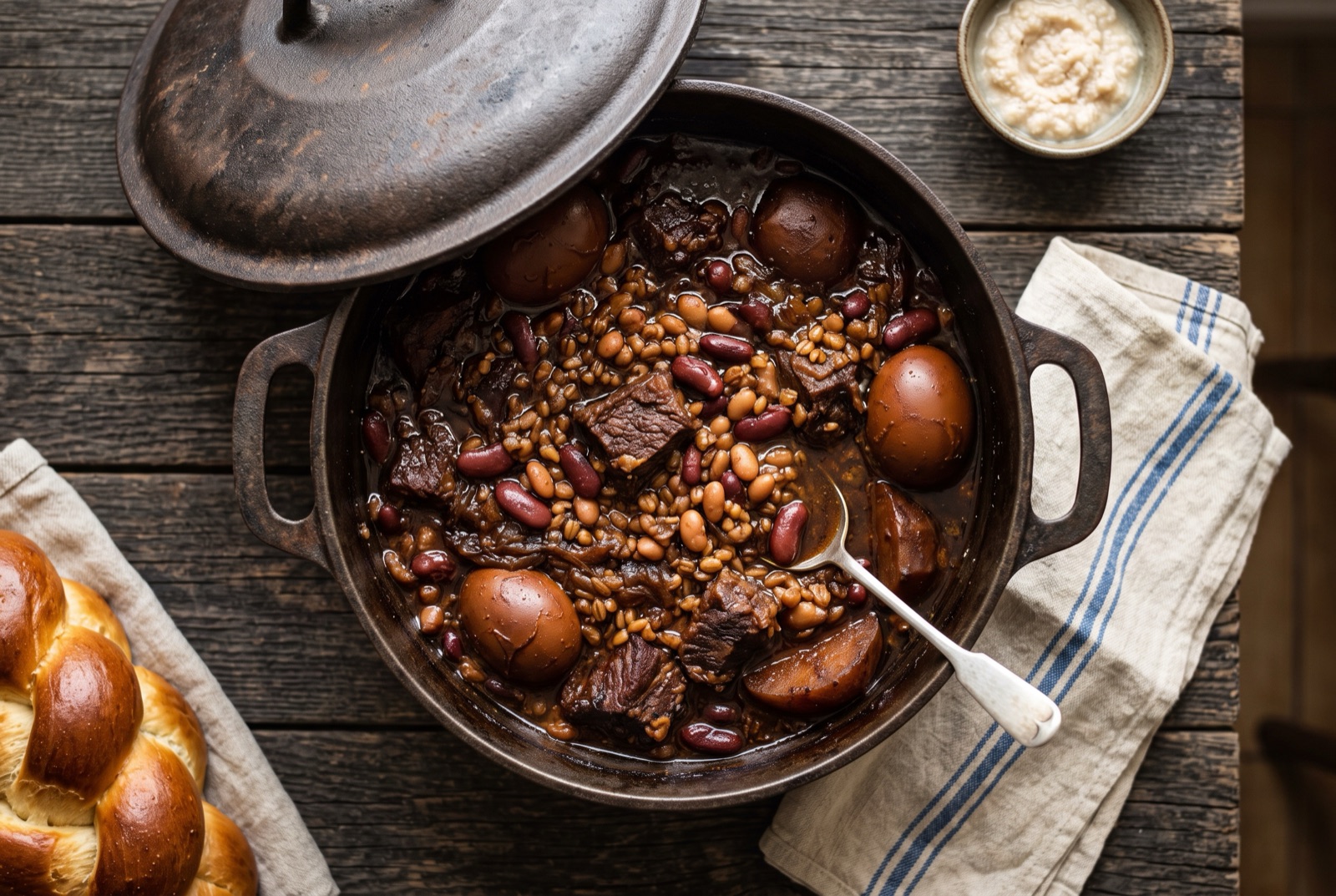
Cholent is a stew defined by its cooking time rather than its ingredients. Chunks of beef, soaked beans, pearl barley, whole potatoes and onions go into a heavy pot with paprika, pepper and a spoon of honey, get covered with water, and then cook for twelve to eighteen hours at the lowest heat a stove will hold. What comes out is not a stew in the ordinary sense: the liquid has thickened to a dark gravy by starch alone, the potatoes have gone waxy-gold at the edges, the beef pulls apart with a spoon, and everything tastes of everything else. Whole eggs buried in the pot come out brown-shelled with custardy yolks. It is heavy food, unapologetically, and it exists because Jewish law forbids cooking on the Sabbath while a hot meal on Saturday is expected anyway.

- Gate
- IsraelAshkenazi kitchens, Jerusalem and Bnei Brak
- Prep
- 35 min
- Cook
- 13 hr
- Total time
- 21 hr 35 min incl. 8 hr rest
- Serves
- 6
- Status
- Takes skill
- Nutrition / serving · estimated
- Calories 720 kcal
- Protein 47 g
- Carbs 62 g
- Fat 30 g
- Fiber 14 g
- Sodium 1240 mg
Why this recipe works.
- Browns the meat and onions first, which a slow overnight cook cannot do for you and which supplies most of the colour and depth.
- Gets the liquid level right at the start — the single decision that determines whether you get gravy or soup twelve hours later.
- Buries whole eggs in the pot for the brown, custardy yolks that are half the reason people look forward to it.
- Gives working timings and temperatures for an ordinary oven, a slow cooker and a hotplate.
Ingredients.
16 itemsFor the pot
For the seasoning
Equipment
- Large heavy cast-iron casserole with a tight lid, or a slow cooker
- Oven that holds a low steady temperature
Instructions.
Soak the beans the night before
Cover the dried beans with three times their volume of cold water and leave them overnight. Drain and discard the soaking water — it holds the compounds that make beans hard to digest, and beans that skip this step stay chalky even after twelve hours in the pot.
Brown the beef
Heat the dripping in a heavy casserole until it shimmers and sear 1 kg of beef chunks in two batches, 3–4 minutes a side, until each piece has a genuinely dark brown crust. Do not crowd the pan; grey meat here means a pale pot in the morning.
Tip This is the only browning the dish will ever get. Take it further than feels comfortable.
Cook the onions and spices
Lift out the beef and cook the sliced onions in the same fat over medium heat for 10 minutes until soft and golden at the edges, scraping up the stuck brown bits. Stir in the tomato paste, both paprikas, the pepper and the honey and fry for one more minute until the mixture darkens and smells sweet.
Layer the pot
Return the beef, then add the drained beans, barley, whole garlic cloves and bay leaves around it, and sit the whole potatoes on top. Rest the eggs on the very top layer so they do not crack against the base, and add the salt.
Set the liquid level
Pour in boiling stock until everything is covered by about 4 cm and no more. Bring the pot back to a simmer on the stove, skim any grey foam, then clamp on the lid.
Tip Get this right now. Adding water later dilutes the gravy, and you should not be opening the pot anyway.
Cook it overnight
Transfer to an oven set to 110–120°C, or a slow cooker on low, and leave it for 12–14 hours without opening the lid. If your oven will not go that low, use its lowest setting with the door propped very slightly by a wooden spoon.
Check it in the morning
Open the pot and look: the liquid should have reduced to a dark, thick gravy that coats a spoon, the beef should collapse under gentle pressure, and the potatoes should be gold-edged and soft to the centre. If it looks too dense, stir in a cup of boiling water gently, without breaking up the potatoes.
Serve at the table
Peel the brown eggs and set them back on top, then bring the whole pot out and serve by the ladle straight into bowls. Give everyone a potato, an egg and a piece of beef, and put pickles, mustard and challah on the table.
Tips from our kitchen.
- Use a fatty, collagen-rich cut — chuck, brisket point, short rib or shin. Lean beef turns to dry threads over twelve hours no matter how gently you cook it.
- Soak the beans overnight and discard the soaking water. Unsoaked beans stay chalky even after a very long cook and are harder to digest.
- Cover the ingredients by about 4 cm of liquid and no more. Too little and the pot scorches; too much and you get soup with no body.
- Leave the potatoes whole or in very large pieces. Cut small, they dissolve completely into the gravy and you lose the best texture in the pot.
- Once the lid goes on, leave it on. Every look costs heat and liquid, and the dish is built to be ignored.
- Barley thickens as it sits. If the pot looks alarmingly thick in the morning, loosen it with a cup of boiling water rather than stirring hard and breaking everything up.
Substitutions.
- Beef chuck → Brisket, beef shin, short ribs or a mix
- Anything with connective tissue works. Shin gives the silkiest gravy; short ribs make the richest pot and the greasiest one.
- Pearl barley → Wheat berries, spelt or an extra 100 g of beans
- Barley is the Ashkenazi standard, but Sephardi hamin often uses wheat berries or rice cooked in a bag. For a gluten-free pot, use beans and potatoes only.
- Kishke → A cloth or foil parcel of flour, grated onion, carrot, paprika and oil, tied and buried in the pot
- Traditional kishke is stuffed intestine casing; the home version is a flour-and-onion dumpling that steams into a dense savoury pudding. Neither is essential.
Variations.
- Hamin (Sephardi and North African)
- The Sephardi parallel: chickpeas and wheat berries instead of white beans and barley, often with lamb, whole eggs, dates or a bag of rice buried in the pot.
- Cholent with kishke
- Bury a parcel of seasoned flour, onion and carrot in the centre of the pot. It steams into a dense savoury pudding that soaks up gravy, and it is the most argued-over addition in the dish.
- Vegetarian cholent
- Drop the meat, double the beans and barley, add mushrooms and a whole head of garlic, and use a well-seasoned vegetable stock. Long cooking still does the work; you just lose the collagen richness.
Storage & reheating.
Cholent keeps 4 days refrigerated and is famously good reheated, since the barley continues to absorb and the flavours flatten out into something rounder. Reheat gently in a covered pot over low heat with a splash of water, stirring as little as possible — the potatoes are fragile by this point. It freezes for 3 months, though the potatoes turn slightly grainy on thawing; if you plan to freeze it, undercook the potatoes slightly or leave them out and add fresh ones on reheating. Remove any eggs before freezing.
Serve with
Challah, sharp pickles, hot mustard or horseradish, and a plain green salad — the pot needs something acidic beside it.
The story behind Cholent.
The Sabbath rules are the recipe. Kindling or adjusting a fire from Friday sunset to Saturday nightfall is prohibited, but eating a hot meal on Saturday is a positive part of the day, so Jewish communities everywhere developed dishes that could be set going before sunset and left alone. In Central and Eastern Europe that dish was cholent; in Sephardi and North African communities it was hamin, dafina or skhina, with chickpeas, rice, wheat berries and often lamb; Yemenite Jews baked jachnun and kubaneh overnight in a sealed pot. Different larders, identical logic.
In many European towns families did not have ovens capable of holding heat that long, so pots were carried on Friday afternoon to the communal baker, sealed and left in the bread oven as it cooled, and collected after synagogue on Saturday morning. That practice shaped the dish: it had to survive a long unattended cook, which is why cholent is built from cuts and starches that only improve after ten hours and would be ruined by two.
The name is disputed. The most-repeated theory derives it from Old French chaud and lent — hot and slow — which fits and is plausible given medieval Jewish settlement in northern France; others propose a Yiddish origin from shul ende, the end of synagogue, which fits the timing but is generally treated as folk etymology. No explanation is settled, and food historians have argued about it for a long time.
In Israel the dish arrived with Ashkenazi immigrants and stayed stubbornly itself while everything around it changed. It is eaten at Saturday lunch in observant homes across the country, sold by the ladle in Jerusalem and Bnei Brak, and has picked up local habits along the way — more paprika, sometimes chickpeas borrowed from hamin, and a great deal of arguing about whether kishke belongs in the pot.
Questions, answered.
Do I have to cook cholent overnight?
For the real thing, yes — the long cook is not a scheduling quirk but the entire technique. Twelve to eighteen hours at very low heat is what breaks down the collagen, dissolves the beans into the gravy and gives the dish its dark colour and depth. You can make a beef, bean and barley stew in three hours and it will be pleasant, but it will not be cholent.
Can I make cholent in a slow cooker?
Yes, and many households use one specifically because it can be set before sunset and left untouched. Brown the meat and onions in a pan first, then transfer everything to the slow cooker on low for 12 to 16 hours. Use slightly less liquid than you would in an oven, since a sealed slow cooker loses almost nothing to evaporation.
Why did my cholent burn or dry out?
Either the heat was too high or there was not enough liquid to start with. The pot should sit at the very bottom of your oven range — around 110 to 120°C — with the ingredients covered by about 4 cm of water, and a heavy lid that seals well. A thin-based pot is also a common culprit; a cast-iron casserole distributes heat far more forgivingly over a long cook.
What are the eggs in the pot for?
Whole eggs cooked in their shells among the other ingredients for many hours emerge with brown shells, tan whites and dense, creamy yolks — the same tradition as haminado eggs. They absorb some of the pot flavour, and they are widely considered the best thing in the dish. Add them raw and unpeeled, resting on top of the other ingredients so they do not crack against the base.
What is the difference between cholent and hamin?
They are the same idea from different communities. Cholent is the Ashkenazi version from Central and Eastern Europe, built on beef, white beans, pearl barley and potatoes. Hamin, dafina or skhina is the Sephardi and North African version, typically with chickpeas, wheat berries, often lamb, and sometimes dates, cinnamon or a bag of rice. Both are Sabbath stews left on low heat overnight because cooking is forbidden on the day.
You might also like.
All recipes →

Keep exploring Israel.
Israel has 9 more dishes in the atlas — Challah and Chraime, and 7 more.
Recipe by The DishRoute Kitchen · published August 20, 2026 · updated August 20, 2026