Patacones.
Colombian Twice-Fried Green Plantains
Patacones · say it: pah-tah-KOH-ness
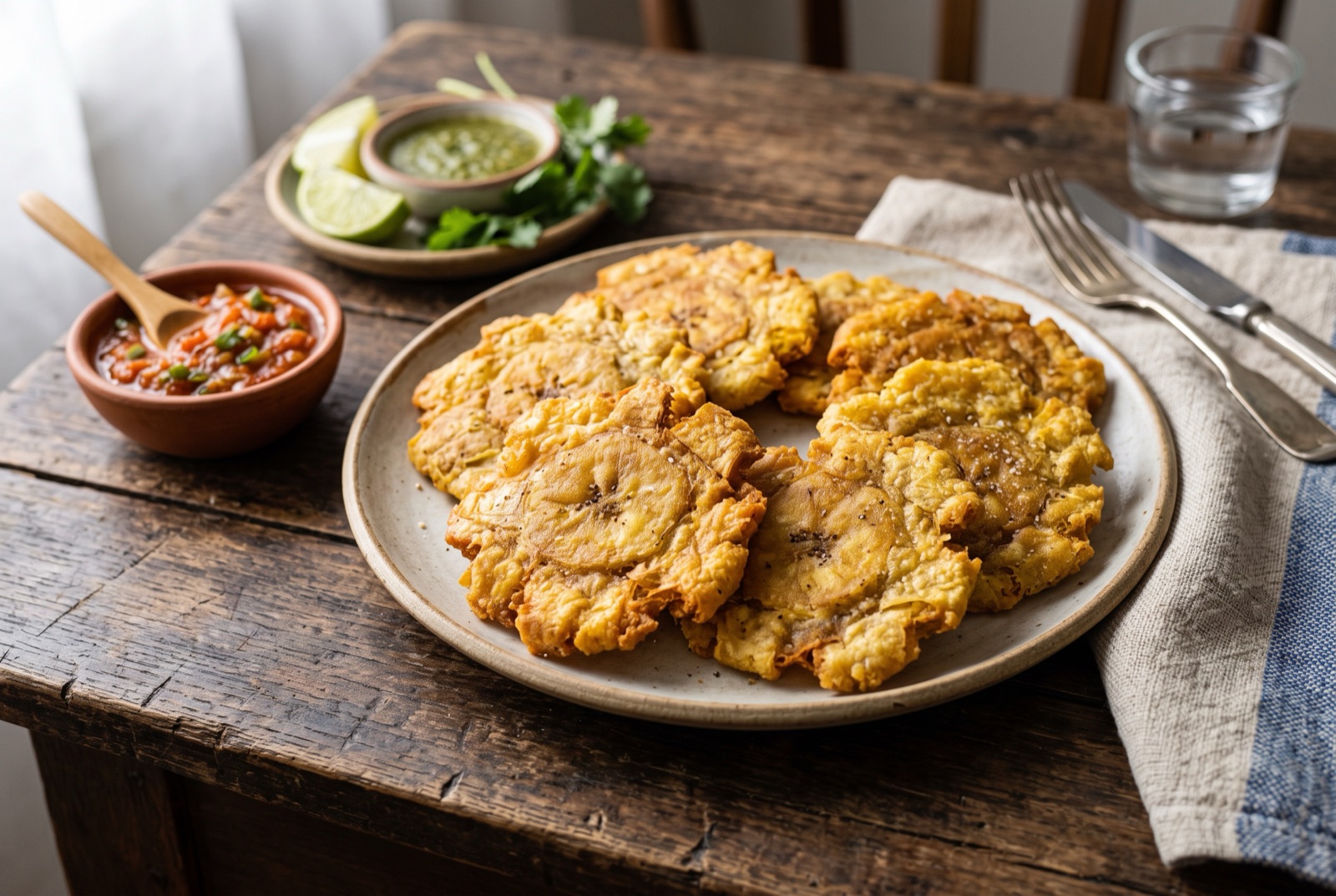
A patacón is a disc of unripe plantain that has been fried twice, with a flattening in between. The first fry cooks the starch through and turns the plantain tender and mild; the second fry, at a higher temperature, drives out surface moisture and builds a crust, so the finished round is crisp and slightly lacy at the rim while the centre stays dense and soft like a very good chip. Green plantain is not sweet — it is starchy and faintly grassy, closer to potato than to banana — which is why patacones function as a side, a scoop and a base rather than as a snack that tastes of fruit.

- Gate
- ColombiaCaribbean and Pacific coasts
- Prep
- 15 min
- Cook
- 20 min
- Total time
- 35 min
- Serves
- 4
- Status
- Easy
- Nutrition / serving · estimated
- Calories 265 kcal
- Protein 2 g
- Carbs 41 g
- Fat 11 g
- Fiber 3 g
- Sugar 6 g
- Sodium 420 mg
Why this recipe works.
- Two oil temperatures given as numbers, because the whole technique lives or dies on the gap between them.
- The salted garlic-water dip between fries, which seasons the interior and makes the crust noticeably crisper.
- A peeling method that actually works on green plantain, whose skin does not come away like a banana.
- Tells you what a correctly finished patacón sounds and looks like, not just how many minutes to count.
Ingredients.
7 itemsFor the patacones
For the salted dip
To finish
Equipment
- Deep saucepan or wok for frying
- Kitchen thermometer
- Tostonera, flat-bottomed glass or small plate for flattening
- Slotted spoon
- Wire rack
Instructions.
Peel and cut
Trim both ends off each plantain and score the skin lengthways along its ridges, cutting only as deep as the flesh. Lever the skin off in strips, then cut the plantain into 3 cm chunks straight across.
Tip Rub a little oil on your hands first — the sap is sticky and stains dark.
Make the garlic salt water
Stir the crushed garlic and fine salt into the warm water in a wide bowl and set it beside the stove. Leave it to sit while the plantain cooks so the garlic has time to give up its flavour.
First fry, gently
Heat the oil to 160 °C. Fry the chunks in two batches for 5 to 6 minutes, turning once, until they are pale gold and give easily when pressed with a spoon. They should look barely coloured — this stage is cooking, not browning.
Tip If the oil bubbles furiously and the plantain darkens fast, it is too hot; pull the pan off the heat for a minute.
Smash them flat
Lift the chunks onto a board and, while still hot, press each one to about 1 cm thick with a tostonera, the flat base of a glass or a small plate. Some cracking at the edges is right and makes the crust; a disc that shatters into pieces was fried too briefly.
Dip and drain
Dunk each flattened round into the garlic salt water for no more than two seconds, then lift it out and set it on a rack. Blot the surface with kitchen paper so no free water goes into the oil.
Tip This is the step most recipes leave out and the one that seasons the plantain right through.
Second fry, hot
Bring the oil up to 190 °C and fry the rounds in batches for 2 to 3 minutes, turning once, until they are deep gold, the edges have gone thin and lacy, and they rattle against the slotted spoon.
Salt and serve at once
Lift them straight onto a rack, scatter flaky salt over while the surface is still glossy with oil, and take them to the table within a few minutes with lime wedges and something to dip into. They lose their crunch fast.
Tips from our kitchen.
- Buy plantains that are hard and fully green with no yellow at the tips. Anything turning yellow has started converting starch to sugar and will burn before it crisps.
- Peel under running warm water or with oiled hands — green plantain sap is sticky, dries black on skin and boards, and does not wash out of fabric.
- Do not crowd the pan. Six pieces at a time in a medium saucepan keeps the oil temperature stable; a full pan drops it and the plantain absorbs oil instead of frying in it.
- Flatten while hot but not scorching, to about 1 cm. Thinner than that and the middle goes hard and biscuit-like instead of staying soft.
- The garlic-water dip should be a quick in-and-out, no more than two seconds. Soaking waterlogs the plantain and the oil will spit violently when it goes back in.
- Salt immediately out of the fryer while the surface is still slick, so it sticks. Patacones salted after cooling taste bland with gritty patches.
Substitutions.
- Green plantain → The greenest, firmest plantains you can find, or green cooking bananas
- There is no real substitute — potato behaves differently under a smash. If your plantains are slightly yellow, cut them thicker and fry the first stage a minute longer.
- Sunflower or vegetable oil → Refined coconut oil
- Used on parts of the Colombian Pacific coast and it suits the plantain. Avoid olive oil, which smokes below the temperature the second fry needs.
- Hogao, for serving → Guacamole, suero costeño, or garlic mayonnaise
- All four are normal on a Colombian table. The plantain is a vehicle and it is not fussy about what rides on it.
Variations.
- Patacón pisao
- One whole plantain fried in a long diagonal cut and pressed into a single plate-sized disc, then topped with shredded beef, cheese and sauces as a coastal open sandwich.
- Patacones con hogao y queso
- Finished rounds spooned with warm tomato-and-scallion hogao and scattered with crumbled fresh cheese so it softens on contact — a standard Colombian bar snack.
- Tostones rellenos
- Pressed into cups rather than flat discs, using the base of a small glass, then filled with shrimp or shredded chicken after the second fry.
Storage & reheating.
Patacones are at their best within ten minutes and genuinely poor the next day, when the crust softens and the interior turns waxy. The useful shortcut is to stop after the first fry and the flattening: the pressed rounds keep three days covered in the fridge, or three months frozen flat on a tray then bagged, and go into hot oil for the second fry straight from cold or frozen with about a minute added. That is how coastal kitchens keep up with orders, and it works exactly as well at home.
Serve with
Fried fish and coconut rice for a full coastal plate, or on their own with a bowl of hogao and a sharp ají to dip into.
The story behind Patacones.
Twice-fried green plantain is eaten across the Caribbean and much of northern South America, and the naming tells you roughly where you are standing. In Colombia, Panama, Ecuador and Venezuela they are patacones; in Puerto Rico, Cuba and the Dominican Republic the same thing is a tostón. Colombia's Caribbean coast adds its own distinction: patacón pisao is the enormous version, a whole plantain flattened into a plate-sized round that arrives under grilled fish or gets loaded like an open sandwich, while the small rounds served in a bowl are just patacones. None of these is more correct than the others, and the argument about which country invented the technique is unwinnable, since plantain arrived with the Atlantic slave trade and was being fried in every port on the same sea at the same time.
The reason the method exists is that green plantain resists a single fry. Its starch has not converted to sugar, it holds a lot of water, and a thick piece dropped into hot oil browns outside long before the inside stops being chalky. Cooking it gently first and then crushing it solves both problems at once: the flattening increases surface area and opens the interior so heat and oil reach it, and the second, hotter fry crisps everything the crushing exposed. The same logic drives twice-fried chips in Belgium and elsewhere, arrived at independently by cooks with a different starch and the same problem.
On the Colombian coast patacones turn up at every level of eating. Beach shacks stack them beside fried fish and coconut rice, home cooks make them to go under whatever stew is on the stove, and street carts sell them in paper cones with a slick of garlic sauce and ají. Inland they show up less often — the interior belongs to the potato and the arepa — which is one of the clearest food borders in the country. The traditional flattening tool is a tostonera, a hinged wooden press, but the coast has been perfectly happy with the flat bottom of a glass or a plate for as long as anyone has been frying.
Questions, answered.
Why did my patacones turn out hard instead of crisp?
Two usual causes. Either they were flattened too thin, so there is no soft interior left and the whole disc dries into a cracker, or the first fry was too hot and cooked the outside before the middle softened. Aim for about 1 cm thick after pressing, and keep the first fry at a gentle 160 °C where the plantain barely colours.
Can I make patacones in an air fryer or the oven?
You can get something good, though not identical. Toss the pieces in oil, cook at 180 °C for about 12 minutes, smash them, brush with more oil and return at 200 °C for 8 to 10 minutes. The result is drier and less lacy at the edges than a deep-fried patacón, because it is the oil contact that makes that particular crust.
How do I peel a green plantain?
Cut both ends off, then run a knife lengthways through the skin along its ridges, going deep enough to reach the flesh but no further. Slide your thumb or the back of a spoon under the skin and lever each strip away. It will not slip off like a banana peel, and the sap is sticky, so oiling your hands first saves a lot of scrubbing.
What is the difference between patacones and tostones?
Nothing in the method. It is regional naming: Colombia, Ecuador, Panama and Venezuela say patacones, while Puerto Rico, Cuba and the Dominican Republic say tostones. Colombia further separates the big plate-sized patacón pisao from the small rounds, but the frying, smashing and second frying are the same across all of them.
Can I reuse the frying oil?
Yes, and coastal cooks do. Let it cool completely, strain out the plantain fragments through a fine sieve or coffee filter, and keep it sealed in a dark cupboard. It is good for two or three more batches of plantain or potato before it starts to smell heavy and darken. Do not use it for fish afterwards, or the reverse.
You might also like.
All recipes →
Keep exploring Colombia.
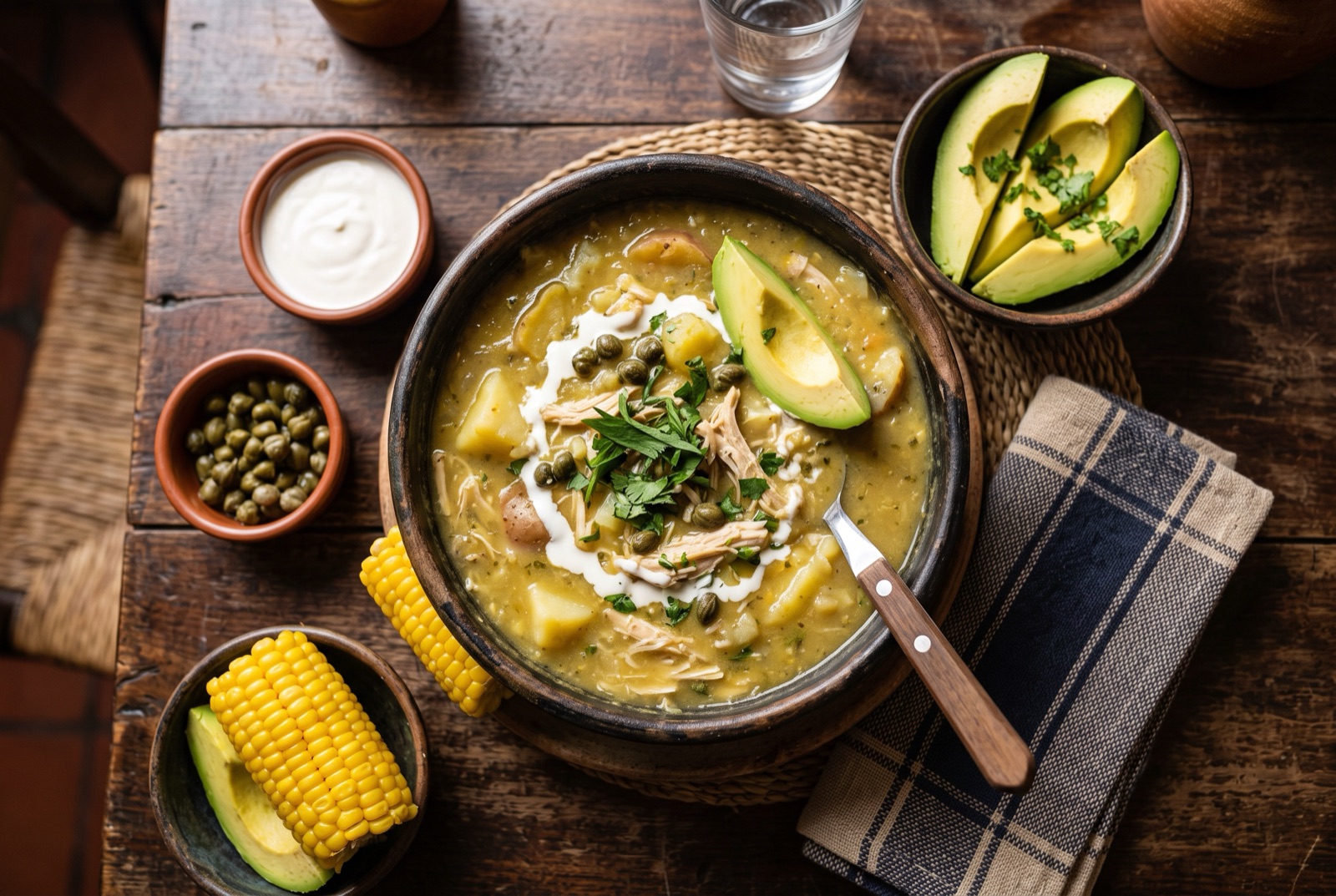
Colombia has 9 more dishes in the atlas — Ajiaco Santafereño and Arepa de Maíz, and 7 more.
All Colombia recipes Plantain recipes Garlic recipes sidesnackstreet foodveganvegetariangluten freedairy freenut freeRecipe by The DishRoute Kitchen · published August 20, 2026 · updated August 20, 2026