Ceviche Tico.
Costa Rican Lime-Cured Fish
Ceviche tico · say it: seh-VEE-cheh TEE-koh
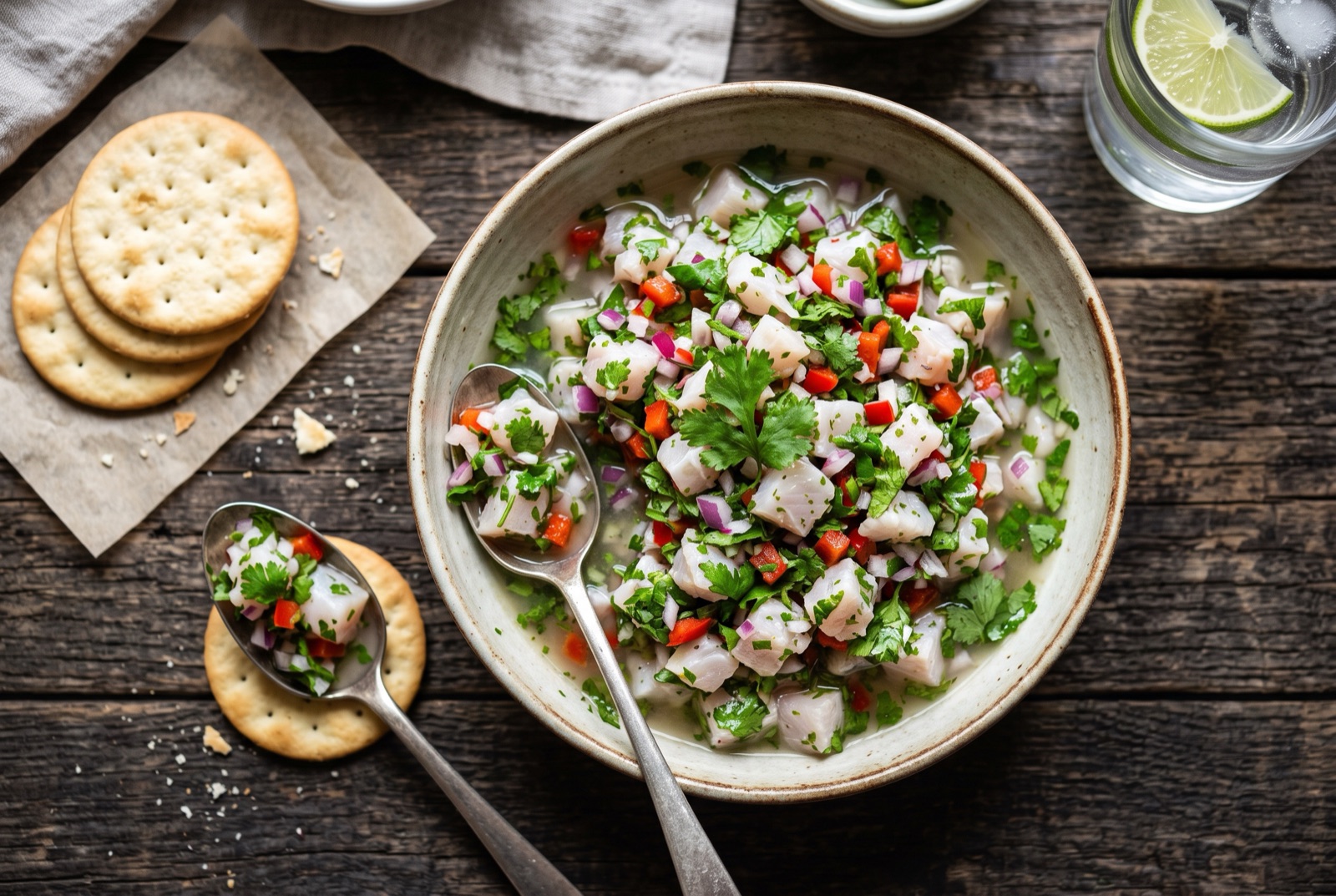
Ceviche tico is white fish diced to the size of a fingernail and cured in lime juice with finely chopped red onion, sweet pepper and enough coriander to turn the bowl green. Unlike Peruvian ceviche, which is dressed and eaten within minutes, the Costa Rican version sits in the fridge for two to four hours until the fish is opaque all the way through and firm rather than silky. It is milder too — no chile in the bowl, no ají, no sweet potato on the plate — and it comes with a stack of salted soda crackers to scoop with. The taste is clean and sharp, sweet from the onion, herbal from the coriander, with the fish reading somewhere between raw and poached. It is the standard beachside snack of the Pacific coast, always with a cold beer.

- Gate
- Costa RicaPacific coast
- Prep
- 25 min
- Cook
- 0 min
- Total time
- 2 hr 55 min incl. 2 hr 30 min rest
- Serves
- 4
- Status
- Easy
- Nutrition / serving · estimated
- Calories 190 kcal
- Protein 31 g
- Carbs 9 g
- Fat 3 g
- Fiber 2 g
- Sodium 720 mg
Why this recipe works.
- A small, even dice and a measured cure time, which is what separates firm Tico ceviche from mushy over-marinated fish.
- Onion is rinsed and salted first, so it stays crisp and sweet instead of dominating the bowl with raw sulphur.
- Honest about fish safety — what to buy, what to ask for, and when freezing first is the sensible route.
- Nothing to cook, nothing to plate: it is made hours ahead and improves while you do something else.
Ingredients.
9 itemsEquipment
- Sharp filleting knife
- Glass or ceramic bowl
- Fine sieve
Instructions.
Prepare the fish
Pat the fillet completely dry, run your fingers over it to find and pull any pin bones, and cut it into an even 1 cm dice. Keep the bowl on ice or in the fridge while you work — the fish should never come up to room temperature.
Tame the onion
Soak the finely chopped red onion in cold salted water for 10 minutes, then drain well and pat dry. It will stay crisp and taste sweet rather than aggressively raw.
Mix and cure
Combine the fish, onion, sweet pepper and celery in a glass bowl and pour over just enough lime juice to cover. Stir once, cover, and refrigerate for 2 hours.
Tip Use glass or ceramic. A metal bowl can pick up a tinny edge from all that acid.
Check the cure
Lift out a piece and cut it in half. It should be white and opaque right through, firm to the bite, with no glassy centre left. If it is still translucent inside, give it another 30 minutes and check again.
Drain and season
Tip the ceviche into a sieve and let most of the lime drain away, keeping a few spoonfuls back. Return it to the bowl, season with the salt and black pepper, and taste — it should be sharp and clean, not puckering.
Finish and serve
Fold through the coriander and spring onions just before serving so they stay bright green. Spoon into small bowls or cups with soda crackers on the side and the chile bottle on the table.
Tips from our kitchen.
- Dice the fish small and evenly, about 1 cm. Uneven pieces cure at different rates and you get raw centres beside chalky edges.
- Use fresh limes only. Bottled juice tastes flat and slightly bitter, and its acidity is unreliable, which matters when acid is doing the cooking.
- Soak the chopped onion in cold salted water for ten minutes and drain it. It stays crunchy and loses the harsh raw edge.
- Use just enough lime to cover the fish. Swimming in juice makes it chalky and sour rather than firm and bright.
- Check at two hours: the fish should be white and opaque right through when you cut a piece. Past four hours the texture starts turning grainy.
- Salt at the end, not the beginning. Salt added early draws water out of the fish and dilutes the cure.
Substitutions.
- Sea bass or corvina → Snapper, grouper, halibut or any firm white fish
- Avoid soft, oily or thin-fleshed fish — mackerel, sardines and sole all break down into paste in the acid.
- Fresh fish → Good-quality frozen-at-sea white fish, thawed in the fridge
- Genuinely a good option and often safer, since commercial freezing kills parasites. Thaw slowly and pat very dry before dicing.
- Soda crackers → Plantain chips or tortilla chips
- Crackers are the Costa Rican default because they are neutral and salty, but fried plantain chips are common at beach restaurants and give more crunch.
Variations.
- Ceviche de camarón
- Made with prawns blanched for 30 seconds first, then marinated. Because they are already cooked, the lime time drops to about 20 minutes.
- Ceviche mixto
- Fish with octopus, squid and prawns — the shellfish briefly poached, the fish cured raw, all combined in the same dressing.
- Ceviche con leche de coco
- A Caribbean-coast version finished with a splash of coconut milk, which rounds the acidity and turns the dressing pale and creamy.
Storage & reheating.
Eat within 24 hours and keep it refrigerated the whole time. The texture is at its best between 2 and 5 hours after mixing; after that the fish gradually firms towards chalky and the coriander darkens. Never freeze cured ceviche — thawing turns the fish woolly and weeps liquid. If you need to hold it, drain off most of the lime after the cure to slow it down.
Serve with
Salted soda crackers, plantain chips, lime wedges and pickled chile panameño, with a cold lager.
The story behind Ceviche Tico.
Ceviche belongs to the whole Pacific coast of the Americas, and the argument about where it began — pre-Columbian Peru, Spanish influence, Moorish antecedents — has never been settled and probably cannot be. What is clear is that each country took the same basic transaction, acid against raw fish, and adjusted it to local taste. Peru cut the fish in large cubes, dressed it hard with lime, chile and onion, and served it within minutes so the fish stays translucent at the centre. Mexico chopped it fine and put it on a tostada. Costa Rica did something quieter.
The Tico version is defined by three choices. The dice is small, roughly one centimetre, so the acid works quickly and evenly. The cure is long, hours rather than minutes, which gives a firmer, whiter, more thoroughly cooked-tasting fish. And the seasoning is restrained: onion, sweet pepper, coriander, salt, sometimes a little celery, and no chile at all in the bowl. Anyone who wants heat adds it at the table from the ever-present bottle of pickled chile panameño. That mildness is not a failure of nerve — it is the same instinct that runs through the whole cuisine, which consistently prefers clarity to intensity.
The fish of choice is corvina, a firm white Pacific fish sold all along the Costa Rican coast and in every Central Valley market on Fridays. Sea bass, snapper and grouper all behave the same way. Marlin ceviche is common too, and shrimp, octopus and conch versions turn up at seaside restaurants. The service, however, barely varies: a plastic cup or a small bowl, soda crackers on the side, a wedge of lime, and mayonnaise or ketchup on the table for people who want it, which offends outsiders and bothers no Costa Rican at all. If you are buying fish for this, freshness is not a preference but a safety requirement — see the note in the FAQ.
Questions, answered.
Is ceviche safe to eat, since the fish is not cooked?
Lime juice denatures the proteins so the fish looks and behaves cooked, but acid does not reliably kill parasites or bacteria the way heat does. Buy from a fishmonger you trust, ask specifically for fish suitable for raw preparation, keep everything cold, and eat it the same day. Fish that has been commercially frozen at sea is a genuinely safe option because deep freezing kills parasites. Pregnant people and anyone immunocompromised should avoid it.
How long should the fish sit in lime?
Two to four hours in the fridge for a 1 cm dice, which is the Costa Rican standard. Check at two hours by cutting a piece: it should be white and opaque all the way through with no translucent centre. Longer than four hours and the flesh starts to go grainy and chalky as the acid keeps working, so drain off most of the juice once it reaches the texture you want.
How is Costa Rican ceviche different from Peruvian ceviche?
Costa Rican ceviche uses a much smaller dice, cures for hours rather than minutes, and contains no chile at all. The result is firmer and milder, with sweet pepper and a lot of coriander doing the flavouring. Peruvian ceviche uses larger cubes, is dressed and served almost immediately so the fish stays translucent, and is built around ají chiles and leche de tigre. Costa Ricans eat theirs with soda crackers; Peruvians with sweet potato and corn.
Which fish should I use?
A firm, lean white fish. Corvina is the Costa Rican default; sea bass, snapper, grouper, halibut and mahi-mahi all work the same way. Avoid oily fish like mackerel and salmon, which turn greasy and strong in acid, and avoid thin delicate fillets like sole, which disintegrate into paste. Cut whatever you use into an even small dice for consistent curing.
Can I make ceviche a day in advance?
Not really, if you want it at its best. You can chop the onion, pepper and coriander a day ahead and keep them refrigerated, but the fish should not meet lime more than about five hours before eating. If you must get ahead, dice the fish, keep it cold and undressed, and mix everything two to three hours before serving.
You might also like.
All recipes →

Keep exploring Costa Rica.
Costa Rica has 9 more dishes in the atlas — Agua Dulce and Casado, and 7 more.
All Costa Rica recipes Lime recipes Onion recipes Cilantro recipes appetizersnackpescatariangluten freedairy freenut freeRecipe by The DishRoute Kitchen · published August 20, 2026 · updated August 20, 2026