Chifrijo.
Costa Rican Rice, Beans and Pork Bowl
Chifrijo · say it: chee-FREE-hoh
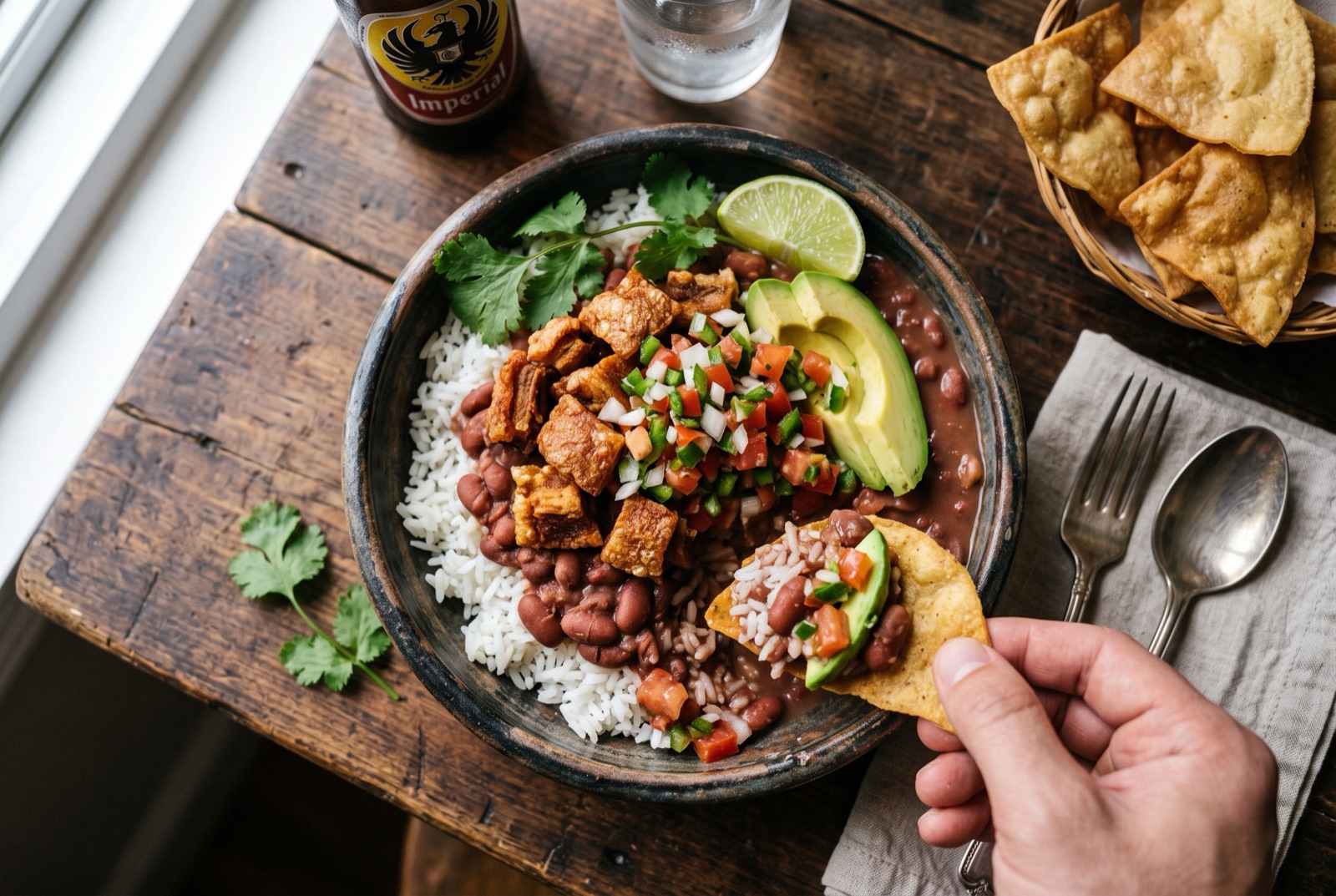
Chifrijo is a layered bowl of hot rice, brothy beans, crackling fried pork and cold, sharp pico de gallo, eaten with tortilla chips instead of a spoon. The name is a squash of chicharrón and frijoles, and the appeal is entirely about temperature and texture hitting at once — soft rice, loose beans, crunchy pork, cold tomato and lime, and a chip that has to survive the trip from bowl to mouth. It is bar food, invented to be eaten with a cold beer in one hand, and it is salty enough to make that inevitable. Nothing about it is difficult; the only real work is frying the pork properly so it is genuinely crisp rather than merely cooked, and assembling at the last minute so the layers stay distinct.

- Gate
- Costa RicaSan José
- Prep
- 25 min
- Cook
- 1 hr
- Total time
- 1 hr 25 min
- Serves
- 4
- Status
- Medium
- Nutrition / serving · estimated
- Calories 760 kcal
- Protein 32 g
- Carbs 64 g
- Fat 42 g
- Fiber 12 g
- Sodium 850 mg
Why this recipe works.
- Two-stage pork method — simmer, then fry hard — which is the only reliable way to get real chicharrón crunch at home.
- Beans stay deliberately loose in their broth, the way San José bars serve them, instead of being cooked down to paste.
- Pico de gallo is salted separately and drained, so the bowl does not turn watery halfway through eating.
- Everything except the final fry can be prepared hours ahead, which is how bars manage it at speed.
Ingredients.
15 itemsFor the chicharrón
For the bowl
For the pico de gallo
To serve
Equipment
- Heavy saucepan for the pork
- Slotted spoon
- Small saucepan for the beans
- Serving bowls
Instructions.
Simmer the pork
Put the pork cubes in a heavy pan with the crushed garlic, orange juice, salt and enough water to barely cover. Simmer uncovered for about 45 minutes, until the water has gone, the fat has rendered out and a knife slides into a cube with no resistance.
Tip Towards the end the pork will start frying in its own fat — that is the signal that the water has cooked off.
Dry and cool the pork
Lift the cubes onto a rack or kitchen paper and let them cool for at least 15 minutes until the surface is dry to the touch. Wet pork will spit dangerously in the fryer and steam instead of crisping.
Fry the chicharrón
Heat the oil to about 190C and fry the pork in two batches for 3 to 4 minutes each, until the cubes are deep mahogany and rattle audibly against the slotted spoon. Drain on paper and salt while hot.
Make the pico de gallo
Toss the diced tomato with a good pinch of salt and leave it in a sieve for 10 minutes to shed its liquid. Combine with the red onion, lime juice and coriander, and taste — it should be sharp enough to make you blink.
Warm the beans
Heat the beans with their broth and the chopped coriander until steaming, loosening with hot water if they have thickened. They should be pourable, not spoonable — the broth is meant to run down into the rice.
Layer the bowls
Put a bed of hot rice in the bottom of each bowl, ladle the soupy beans over it, pile on the hot chicharrón, then spoon the cold pico de gallo across the top and fan the avocado alongside.
Serve immediately
Tuck tortilla chips around the rim, add a lime wedge and the pickled chile, and take the bowls to the table while the pork is still crackling and the pico is still cold.
Tips from our kitchen.
- Simmer the pork gently until a knife slides in with no resistance before you fry it. Frying raw pork gives you a hard shell around a chewy middle.
- Dry the simmered pork thoroughly and let it cool before the second fry, or the oil will spit violently and the crust will steam rather than crisp.
- Salt the chopped tomato for the pico and let it drain for ten minutes. That single step is the difference between a fresh topping and a soup.
- Keep the beans soupy enough to pour. If they thicken while sitting, loosen with hot water rather than serving them stiff.
- Assemble in the bowl at the last possible moment so the chip-and-crunch contrast survives to the table.
- Cut the pork small, around 2 cm cubes. Big pieces are hard to scoop onto a tortilla chip.
Substitutions.
- Home-fried chicharrón → Shop-bought pork scratchings, roughly broken
- Faster and genuinely used in some bars, but the texture is drier and there is none of the tender interior that makes real chicharrón worth the effort.
- Red beans → Black beans in their broth
- Traditionalists insist on red, but black beans appear in plenty of home versions. The flavour is slightly sweeter and the bowl looks darker.
- Pork → Fried chicken thigh cut small, or crisped mushrooms for a meatless bowl
- Neither is traditional, but both work with the same layering and the same pico. Season them harder than you think — the bowl needs salt from that layer.
Variations.
- Chifrijo con aguacate
- The most common upgrade: a generous fan of avocado over the top, which softens the salt and makes the bowl a full meal rather than a snack.
- Chifrijo de pollo
- Fried or grilled chicken in place of pork, now standard on menus for people who avoid pork. The layering is unchanged.
- Chifrijo grande
- The full-meal version served in a deep bowl with extra rice and a whole basket of tortilla chips, usually shared between two.
Storage & reheating.
Store components separately for up to 3 days: beans and rice refrigerated, pico for no more than a day, and chicharrón in an open container at room temperature so it does not sweat. Refry the pork in a dry hot pan for 2 minutes to bring back the crunch — a microwave will make it leathery. Assembled bowls do not keep at all.
Serve with
Fried corn tortilla chips, lime wedges, pickled chile panameño and a very cold lager.
The story behind Chifrijo.
Chifrijo is the rare national dish with a name attached to it. It is widely credited to Miguel Cordero, who began serving it at his bar in Tibás, on the northern edge of San José, in the early 1990s, and it spread through the country's bocas culture — the tradition of small plates served with drinks — so fast that within a decade it was on menus everywhere. Cordero later registered the name as a trademark, which produced years of legal argument with restaurants that considered it public property by then. The courts and the public have largely landed on the practical side: everyone sells it, everyone calls it chifrijo, and its inventor's claim is acknowledged more in stories than in licensing.
That recency is unusual and worth noticing. Most of what a country eats accretes over centuries with no author; chifrijo has a decade, a neighbourhood and a person. It also explains its structure. This is not a peasant dish adapted from scarcity but a bar snack engineered for drinking: salty, crunchy, sharp with lime, and served in a bowl so a table of people can each have their own without sharing cutlery.
The components themselves are older than the dish. Chicharrón — pork simmered in its own fat until tender, then fried hard until the outside shatters — is Central American everywhere. Frijoles tiernos, red beans kept loose in their broth rather than drained, are a Costa Rican staple. Pico de gallo of tomato, onion, coriander and lime is a shared regional habit. What Cordero did was stack them. Purists in San José will tell you the beans must be red and slightly soupy, that the rice goes on the bottom and not the top, and that avocado is optional but expected. Beyond that, every bar makes it slightly differently, and the version below aims for the standard bar build rather than any single establishment's.
Questions, answered.
Who invented chifrijo?
It is generally credited to Miguel Cordero, a bar owner in Tibás near San José, who began serving it in the early 1990s. The name combines chicharrón and frijoles. He later trademarked the name, which led to a long-running legal dispute with restaurants that had adopted the dish, and in practice chifrijo is now made and sold across Costa Rica regardless of that claim.
How do I get chicharrón properly crisp?
Cook the pork twice. First simmer the cubes gently in water or their own rendered fat with salt until they are completely tender, which takes about 45 minutes. Then dry them, cool them, and fry them in hot fat for a few minutes until the outside is deep brown and audibly crackles when stirred. Skipping the first stage leaves a tough interior; skipping the drying step means the crust never forms.
Should the beans be red or black?
Red beans are the standard in San José bars and what most Costa Ricans will describe as correct. Black beans appear in home versions and are not wrong, just different — slightly sweeter and darker in the bowl. What matters more than colour is that the beans stay soupy in their own broth rather than being drained, because that liquid seasons the rice underneath.
Can I make chifrijo ahead of time?
You can prepare every component in advance but you cannot assemble it in advance. Rice and beans reheat perfectly, and the pork can be simmered a day ahead and given its final fry just before serving. The pico is best made within a few hours. Once layered, the bowl has about ten minutes before the chips soften and the layers blur together.
What do I eat chifrijo with?
Fried corn tortilla chips, used as scoops rather than as a side. Each chip picks up a bit of rice, beans, pork and pico in one go, which is the whole point of the layered arrangement. A fork works but misses the texture contrast that the crisp chip provides against the soft rice and beans.
You might also like.
All recipes →
Keep exploring Costa Rica.
Costa Rica has 9 more dishes in the atlas — Agua Dulce and Casado, and 7 more.
All Costa Rica recipes Pork belly recipes Rice recipes Black beans recipes mainappetizergluten freedairy freenut freeRecipe by The DishRoute Kitchen · published August 20, 2026 · updated August 20, 2026