Casado.
Costa Rican Soda Lunch Plate
Casado · say it: kah-SAH-doh
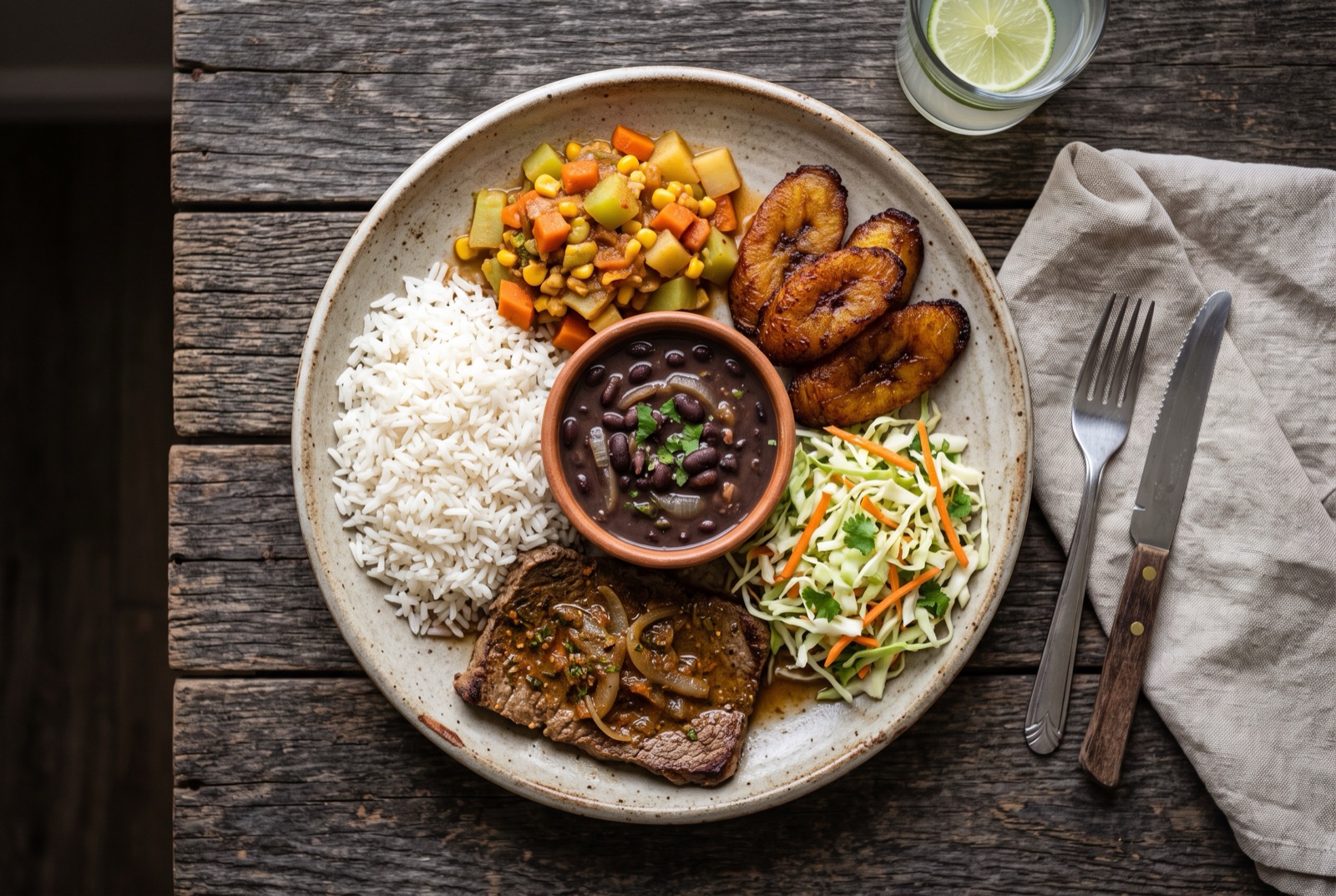
A casado is not a recipe so much as an assembly, and that is exactly why it is worth learning. Six components go onto one plate without touching: rice cooked dry and grain-separate, black beans still loose in their dark broth, ripe plantain fried until the edges caramelise, raw cabbage dressed sharply with lime, a soft chayote or potato picadillo, and a protein — most often chicken in a tomato-onion sauce, sometimes beef, fish or pork. Nothing is spicy. The pleasure is in contrast: sweet plantain against salty beans, cold crunchy cabbage against warm rice, and a little of each in every forkful. This is the lunch that most of Costa Rica actually eats, served in the family diners called sodas from around eleven in the morning, and it is genuinely achievable at home if you work in the right order.

- Gate
- Costa RicaCentral Valley
- Prep
- 30 min
- Cook
- 45 min
- Total time
- 1 hr 15 min
- Serves
- 4
- Status
- Medium
- Nutrition / serving · estimated
- Calories 720 kcal
- Protein 44 g
- Carbs 92 g
- Fat 21 g
- Fiber 12 g
- Sodium 780 mg
Why this recipe works.
- Gives you a working order of operations so all six components land on the plate hot at the same time.
- The chicken is cooked in a proper Tico olor base — onion, sweet pepper, celery, coriander — not just seasoned and fried.
- Beans are kept deliberately soupy, the way sodas serve them, instead of drained into a dry side.
- Every element is scalable and most of it can be cooked the day before without losing anything.
Ingredients.
20 itemsRice and beans
For the chicken
Plantain and salad
For the picadillo
Equipment
- Rice pan with a lid
- Large frying pan
- Medium saucepan
- Mixing bowl
Instructions.
Start the rice
Fry the crushed garlic in a tablespoon of oil for 30 seconds until it smells nutty, add the rice and stir to coat, then pour in 600 ml of salted water. Bring to a boil, cover, drop to the lowest heat and cook 15 minutes without lifting the lid.
Build the olor and cook the chicken
In a wide pan, soften the onion, sweet pepper and celery in 2 tablespoons of oil for 6 minutes until translucent. Stir in the achiote until the oil turns orange, add the chicken and brown it on both sides, then add the tomatoes and Salsa Lizano.
Simmer the chicken down
Add a splash of water, cover and simmer for 20 minutes, until the chicken pulls apart easily and the tomatoes have collapsed into a thick sauce that clings to the meat rather than pooling around it. Season and keep warm.
Tip If the sauce is thin at the end, lift the chicken out and boil the liquid hard for a minute.
Cook the picadillo
In a second pan, soften the picadillo onion and sweet pepper in a tablespoon of oil until translucent, add the diced chayote and 100 ml water, cover and cook 12 to 15 minutes until the dice are tender enough to crush against the pan but still hold their cubes. Finish with coriander and salt.
Warm the beans
Heat the black beans with their broth and the chopped coriander over low heat until steaming. Keep them loose — they should pour from the spoon, not sit in a mound.
Fry the plantain
Fry the plantain slices in 2 tablespoons of hot oil, 2 to 3 minutes a side, until the cut faces are deep amber and the edges look caramelised and slightly crinkled. Drain briefly on paper.
Tip Do not crowd the pan — steamed plantain never caramelises.
Dress the cabbage
Toss the shredded cabbage and grated carrot with the lime juice and a good pinch of salt just before serving, so it stays crisp and sharp rather than wilting.
Assemble the plate
Give each plate a mound of rice, a ladle of soupy beans beside it, the chicken with its sauce, a spoonful of picadillo, a small pile of cabbage salad and two or three slices of plantain. Keep them separate — mixing is the diner's job.
Tips from our kitchen.
- Cook the beans and rice ahead. A casado assembled from components made that morning is easier and tastes no worse — this is how sodas actually work.
- Choose plantains that are mostly black. Yellow ones with a little green fry up starchy and bland instead of sweet and caramelised.
- Dress the cabbage no more than fifteen minutes before serving, or the lime will wilt it into something limp and watery.
- Keep the components apart on the plate. Ticos mix them bite by bite; pre-mixing turns six textures into one.
- The chicken sauce should coat, not pool. If it looks watery, lift the chicken out and boil the sauce down for a minute before returning it.
- Warm your plates. A casado has a lot of surface area and cools fast on a cold plate.
Substitutions.
- Salsa Lizano → Worcestershire sauce with a pinch of cumin and sugar
- Close in tang, less vegetal. Real Lizano is inexpensive at Latin grocers and lasts a year in the fridge.
- Chayote for the picadillo → Courgette, chopped potato or green beans
- Courgette cooks faster and needs less liquid; potato needs a few more minutes. All three are used in Costa Rica depending on the season.
- Chicken → Grilled steak, fried white fish or pork chop
- The protein is the one variable in a casado. Whichever you choose, keep it simply seasoned — the plate already has plenty going on.
Variations.
- Casado con pescado
- Coastal version with a whole fried fish or a pan-fried fillet in place of the chicken, usually with an extra lime wedge.
- Casado vegetariano
- Increasingly common in sodas: the protein slot is filled by a second picadillo, fried cheese or a plain omelette, with everything else unchanged.
- Casado con chuleta
- A thin pork chop marinated with garlic and Lizano and griddled hard, the most popular option after chicken in much of the Central Valley.
Storage & reheating.
Store the components separately for up to 3 days refrigerated. Rice and picadillo reheat well in a covered pan with a splash of water; beans reheat best on the hob with a little extra liquid. Fry the plantain and dress the cabbage fresh — plantain goes leathery on reheating and dressed cabbage collapses overnight. The chicken can be frozen in its sauce for a month.
Serve with
A bottle of Salsa Lizano and pickled chile on the table, plus a fresco natural — fruit blended with water or milk.
The story behind Casado.
Casado means "married man", and the naming is a joke that has hardened into a national institution. The usual explanation is that this is the plate a married man could expect at home — everything arranged neatly, a full meal rather than a snack — while the bachelor made do with whatever he could find. A second, more literal reading is that the elements are "married" on the plate, joined but distinct. Ticos tell both versions, often in the same conversation, and neither has documentary proof behind it; the honest answer is that nobody knows which came first.
The casado is inseparable from the soda, the small owner-run diner found on nearly every street in Costa Rica. A soda is not a restaurant in the ambitious sense — plastic chairs, a handwritten board, a woman cooking within sight of the tables — and its economics depend on exactly this plate: cheap staples that are already cooked, portioned generously, with one variable protein. Ordering is a matter of choosing that protein, and the rest arrives without discussion. For a large part of the working population this is lunch five days a week, which makes the casado a rare thing in world food: a dish that is simultaneously the everyday cheapest option and the most representative national plate.
What it also does, quietly, is preserve the country's vegetable habits. The picadillo compartment rotates through chayote, green beans, potato, green papaya and arracache depending on what is cheap that week, so the plate keeps feeding people vegetables they might not otherwise cook. The cabbage salad — repollo with lime, sometimes with tomato and carrot — does the same job for raw greens. And the fried plantain is not dessert; it is a deliberate sweet element in the middle of a savoury meal, the same structural role that chutney plays in an Indian thali. Take any one component away and Ticos will tell you the plate is incomplete, which is a fairly clear sign that the arrangement, not any single recipe, is the dish.
Questions, answered.
What does casado actually mean?
It translates as "married man". Two explanations circulate in Costa Rica: that this is the complete plate a married man was served at home, in contrast to a bachelor's scrappier meals, and that the components are "married" together on one plate. Neither has documented proof, and Ticos generally tell both versions without picking a side.
Can I make a casado ahead of time?
Mostly yes, and that is how it is done commercially. Rice, beans, picadillo and the chicken can all be cooked a day ahead and reheated. Only two things must happen at the last minute: frying the plantain, which turns tough and dull once it cools, and dressing the cabbage salad, which loses its crunch within about twenty minutes of meeting lime juice.
Is a casado spicy?
No. Costa Rican cooking is one of the mildest in Latin America, and nothing on a casado is made hot in the kitchen. A bottle of chile panameño pickled in vinegar sits on the table so individual diners can add heat to their own plate. If you want a spicy casado, that bottle is the correct route rather than adding chile to the components.
Which plantains should I buy for the fried sweet plantain?
Buy plantains whose skin is at least two-thirds black. At that stage the starch has converted to sugar, so the slices caramelise in the pan and taste sweet and custardy inside. Yellow or green-tipped plantains stay starchy, brown without sweetening, and belong in patacones — the twice-fried savoury version — rather than on a casado.
Why are the beans served soupy rather than drained?
Because the bean broth is a seasoning for the rice sitting next to it. In a soda the beans come to the plate loose in their dark liquid so it runs into the rice and flavours it, which is also why the rice is cooked dry and unsalted-tasting on its own. Draining the beans gives you two dry components and a noticeably duller plate.
You might also like.
All recipes →
Keep exploring Costa Rica.
Costa Rica has 9 more dishes in the atlas — Agua Dulce and Ceviche Tico, and 7 more.
Recipe by The DishRoute Kitchen · published August 20, 2026 · updated August 20, 2026