Coxinha de Frango.
Brazilian Chicken Croquettes
Coxinha de frango · say it: ko-SHEEN-yah
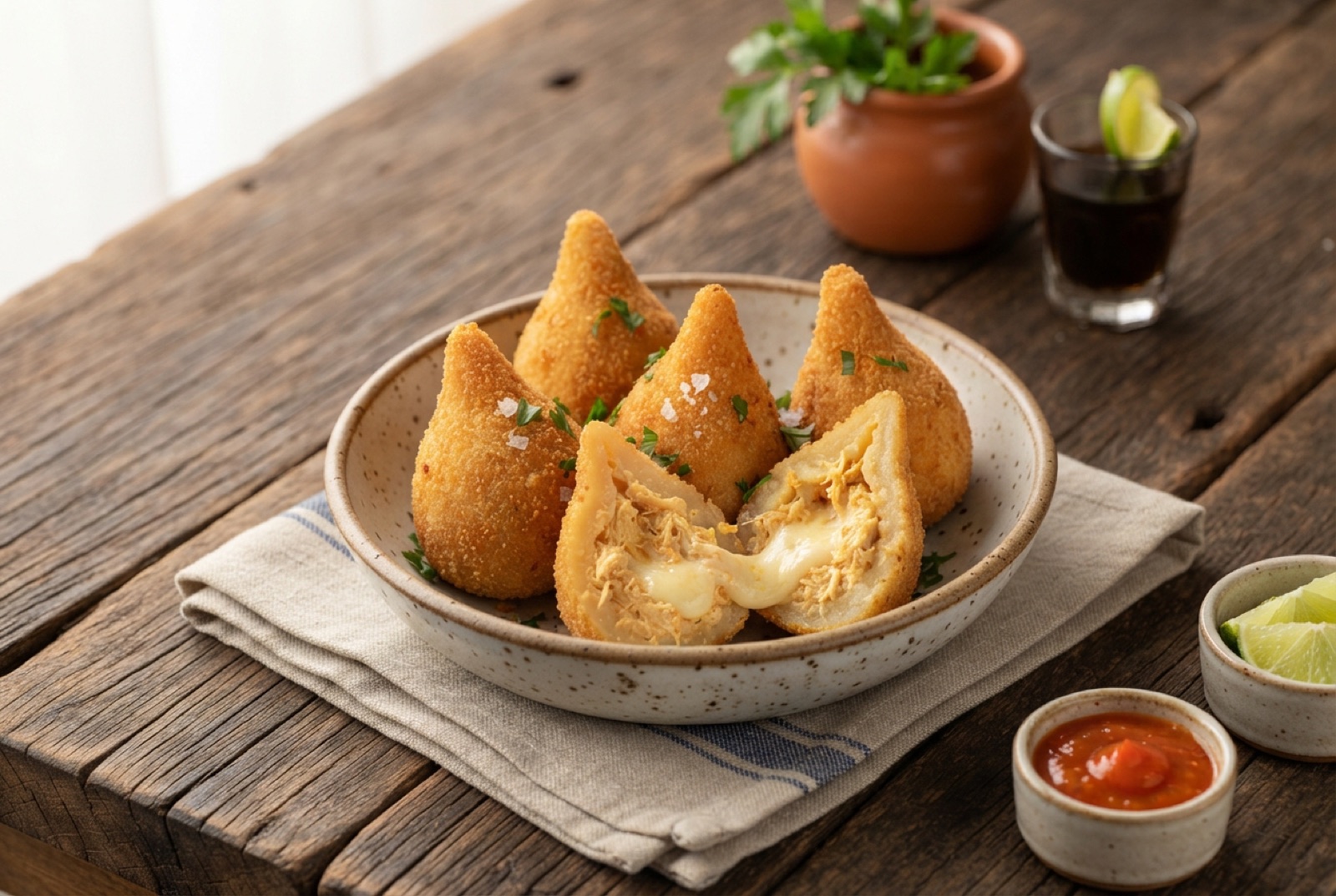
A coxinha is a teardrop-shaped croquette with a thin, crackling crust and a soft, almost gnocchi-like dough inside, filled with shredded chicken bound in a light tomato refogado and a plug of creamy catupiry. The name means little thigh, and the shape is meant to suggest a chicken drumstick. What makes it different from every other breaded snack is the dough: flour cooked directly into boiling chicken broth, so the wrapper itself tastes of chicken rather than of plain fried batter. Eaten hot from a padaria counter with a squeeze of hot sauce, it is the most Brazilian snack there is.

- Gate
- BrazilSão Paulo
- Prep
- 50 min
- Cook
- 35 min
- Total time
- 2 hr 25 min incl. 1 hr rest
- Serves
- 6
- Status
- Medium
- Nutrition / serving · estimated
- Calories 560 kcal
- Protein 30 g
- Carbs 58 g
- Fat 22 g
- Fiber 3 g
- Sodium 900 mg
Why this recipe works.
- The dough is cooked in the poaching broth from the chicken itself, so nothing tastes of plain boiled flour.
- Gives the two dough checkpoints that decide the texture — when it pulls from the pan, and how it should feel once kneaded warm.
- Includes a shaping method that produces a smooth, seamless teardrop instead of a lumpy ball with a point stuck on.
- Designed for batch cooking and freezing raw, which is how coxinhas are actually made in Brazilian kitchens.
Ingredients.
15 itemsFor the filling
For the dough
To coat and fry
Equipment
- Medium saucepan
- Wooden spoon
- Two forks for shredding
- Deep heavy pan or fryer
- Frying thermometer
Instructions.
Poach the chicken
Simmer the chicken thighs gently in the stock with a pinch of salt for 20 minutes, until they shred easily with a fork. Lift the meat out and, crucially, keep the broth — measure out 750 ml of it for the dough and top up with water if you are short.
Tip Keep it at a lazy simmer. A hard boil tightens the meat and makes it stringy.
Make the filling
Shred the cooled chicken with two forks. Soften the onion in a little oil until translucent, add the garlic and tomato paste and cook for 2 minutes until the paste darkens to brick red and stops smelling raw, then stir in the chicken, scallions, parsley and lime juice. Season well and spread it on a plate to cool completely.
Tip The filling should look moist but leave no liquid behind on the plate.
Cook the dough
Bring the 750 ml of reserved broth to a rolling boil with the butter and salt, then tip in all the flour at once and stir hard with a wooden spoon. Keep stirring over low heat for 3 to 4 minutes until the dough comes together into one smooth ball that pulls cleanly away from the sides of the pan.
Knead while hot
Turn the dough onto a lightly oiled worktop and knead for 4 to 5 minutes, folding it over on itself, until it is smooth, elastic and no longer sticky — it should feel like warm modelling clay and hold a thumbprint without cracking.
Tip Work as hot as your hands can stand; the dough stiffens fast as it cools.
Shape the coxinhas
Pinch off a golf-ball piece, flatten it into a disc in your oiled palm, put a spoonful of chicken and a teaspoon of catupiry in the middle, then gather the edges up and over the filling. Roll the sealed ball between your palms and draw one end into a point so it looks like a small drumstick.
Tip Smooth over any visible seam. Seams are where they split in the oil.
Chill, then bread
Refrigerate the shaped coxinhas on a tray for at least 30 minutes until firm. Roll each one in beaten egg, letting the excess drip off, then press it thoroughly into the breadcrumbs so no dough shows through.
Fry until deep gold
Heat the oil to 175°C and fry the coxinhas five or six at a time for 3 to 4 minutes, turning once, until they are an even deep gold and float high in the oil. Drain on a wire rack so the underside stays crisp.
Tip Let the oil come back to temperature between batches or the later ones will be pale and greasy.
Serve hot
Rest them for 2 minutes so the filling stops scalding, then pile them on a plate with lime wedges and hot sauce. Eat them with your hands, holding the pointed end.
Tips from our kitchen.
- Poach the chicken rather than boiling it hard, and keep every drop of the broth — you need it for the dough and it is where the flavour lives.
- Add the flour to the boiling broth all at once and stir immediately. Trickling it in gives you lumps you will never smooth out.
- Knead the dough while it is still hot enough to be slightly uncomfortable. Cooled dough turns stiff and cracks when you shape it.
- The filling must be cool and quite dry before it goes in. Warm, wet filling steams inside the dough and splits the coxinha in the fryer.
- Shape with lightly oiled palms rather than floured ones — flour dries the surface and leaves visible seams after frying.
- Chill the shaped coxinhas for at least 30 minutes before breading. They hold their point far better and absorb noticeably less oil.
Substitutions.
- Catupiry (Brazilian requeijão) → Full-fat cream cheese loosened with a spoonful of cream, or a thick soft cheese spread
- Catupiry is milder and softer than cream cheese and melts to a flowing consistency. Cream cheese works well; low-fat versions do not, as they turn grainy when heated.
- Fresh breadcrumbs for coating → Panko for a crunchier shell, or farinha de rosca if you can find it
- Brazilian farinha de rosca is finer than panko and gives the smooth, even crust you see in bakeries. Panko produces a coarser, spikier coxinha.
- Chicken → Jackfruit or shredded hearts of palm with the same refogado
- Coxinha de palmito is a genuine and widely sold Brazilian version, not a modern invention. Use vegetable stock for the dough as well.
Variations.
- Coxinha de palmito
- Filled with shredded hearts of palm cooked in the same tomato and onion refogado. A standard vegetarian option in Brazilian bakeries rather than a substitute.
- Coxinha cremosa
- The filling is bound with a thick béchamel or extra requeijão so it flows when bitten. Richer, messier, and the version most bars in São Paulo actually sell.
- Coxinha de baixa caloria
- Brushed with oil and baked at 200°C rather than deep-fried. The crust is drier and less shattering, but the dough and filling still work.
Storage & reheating.
Fried coxinhas are best within an hour, but they keep 3 days refrigerated and reheat well in a 180°C oven for 10 minutes, which restores most of the crust. Do not microwave them: the dough goes gummy and the crust collapses completely. Raw breaded coxinhas freeze beautifully for up to 3 months — freeze them spread out on a tray first, then bag them, and fry from frozen at a slightly lower oil temperature for 6 to 7 minutes so the middle heats through.
Serve with
A wedge of lime, hot malagueta sauce, and very cold beer or a guaraná — the standard boteco order.
The story behind Coxinha de Frango.
The coxinha belongs to São Paulo more than anywhere else — to the padarias, the botecos and the lanchonete counters where it sits under a heat lamp beside pão de queijo and esfihas, and to the after-work hours when someone orders a round of them with beer. It is genuinely everyday food: sold at bakeries, birthday parties, football grounds and school fairs, in sizes from a single mouthful to something the size of a fist.
There is a well-worn origin story involving the imperial family, in which a palace cook shaped chicken into drumstick form for a child who would eat nothing else. It is repeated endlessly and there is no solid evidence behind it — treat it as folklore rather than history. What is documentable is the food itself: a wheat-and-broth dough in the family of Portuguese and French croquette techniques, married to shredded chicken and, from the twentieth century onward, to requeijão. Catupiry, the brand of soft requeijão most associated with the filling, was created in Minas Gerais in the early 1900s and became so tied to the snack that Brazilians will specify coxinha com catupiry as if it were a separate dish.
The shape is the part people underestimate. A proper coxinha is a smooth teardrop with a narrow pinched tip and no seams, and getting there takes a warm, well-kneaded dough and a certain amount of practice. Brazilian home cooks make them in production lines — one person shaping, one breading, one frying — and freeze trays of them raw so there is always something to fry when people turn up. That is the right way to approach a first attempt: make a big batch, accept that the first six will look wrong, and keep going.
Questions, answered.
Why did my coxinhas burst open in the oil?
Usually because the filling was still warm or too wet, so it turned to steam inside the sealed dough and blew a seam apart. Cool the filling completely and drain off any loose liquid before you shape. Cracks in the dough are the other cause, so seal each coxinha by smoothing the surface with oiled fingers before breading.
What is catupiry and what can I use instead?
Catupiry is a Brazilian brand of requeijão, a soft, mild, spreadable cheese with a texture between cream cheese and thick crème fraîche. It melts smoothly and is the classic partner to shredded chicken in a coxinha. Outside Brazil, full-fat cream cheese thinned with a little cream is the closest easy substitute.
Can I bake coxinhas instead of frying them?
Yes. Brush the breaded coxinhas generously with oil and bake at 200°C for about 25 minutes, turning once, until they are golden and firm. The crust will be drier and less shattering than a fried one and the colour is patchier, but the dough and filling are unaffected. An air fryer at 190°C for 15 minutes gives a closer result.
Why is the dough made with chicken broth?
Because the wrapper is meant to taste of chicken too, not of plain flour. Cooking wheat flour directly into hot, well-seasoned broth produces a soft, pliable dough similar to a scalded pastry, which is both easier to shape and far better flavoured than one made with water or milk.
Can I prepare coxinhas in advance?
They are designed for it. Shape and bread them, then freeze them on a tray until solid and transfer to a bag for up to 3 months. Fry straight from frozen at around 170°C for 6 to 7 minutes so the centre heats through before the crust darkens. You can also refrigerate shaped, breaded coxinhas for a day before frying.
You might also like.
All recipes →
Keep exploring Brazil.
Brazil has 9 more dishes in the atlas — Acarajé and Bolo de Fubá, and 7 more.
Recipe by The DishRoute Kitchen · published August 19, 2026 · updated August 19, 2026