Crème Brûlée.
Vanilla Custard Under Burnt Sugar
Crème brûlée · say it: krem broo-LAY
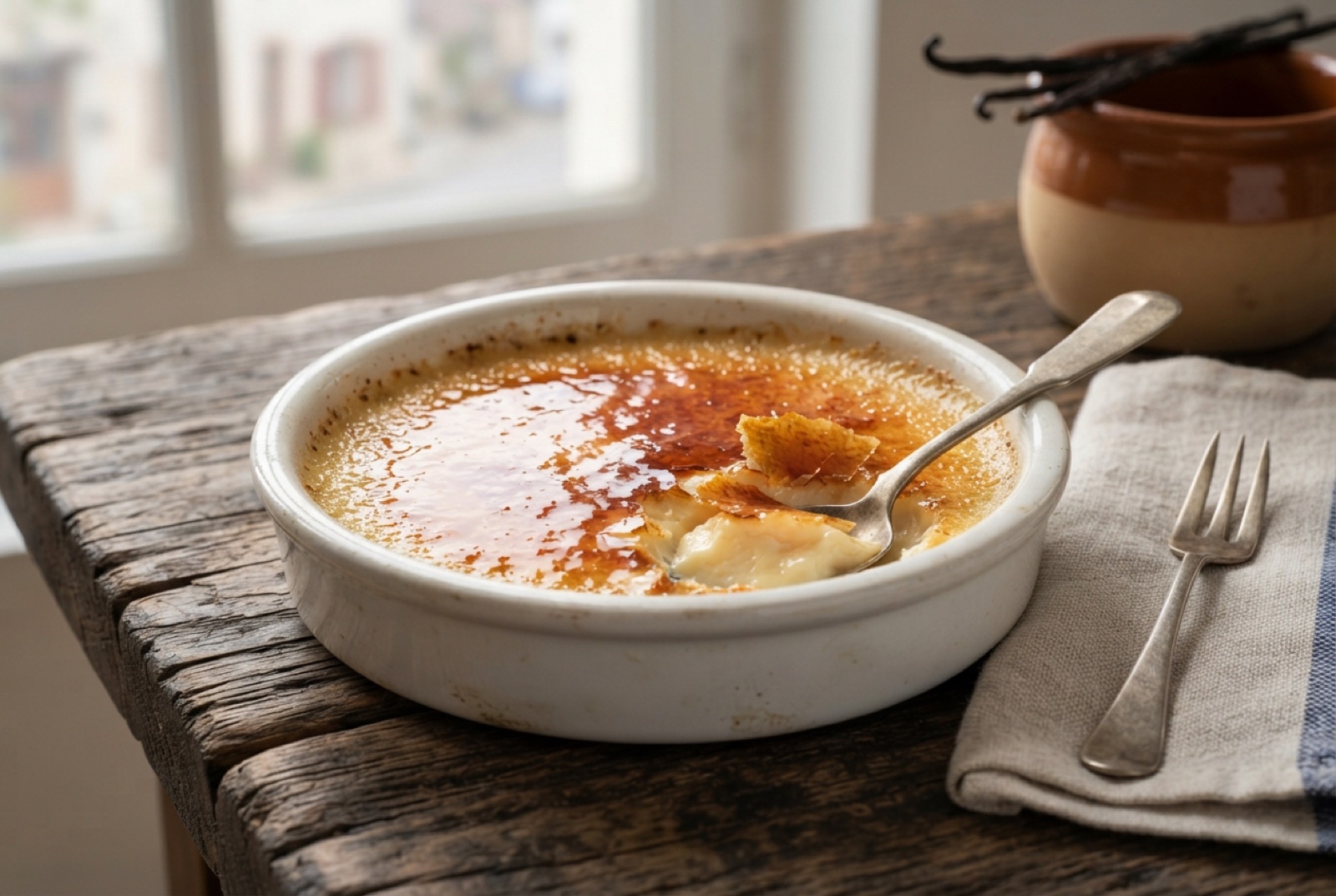
Crème brûlée is a chilled baked custard of cream, egg yolks, sugar and vanilla, finished at the last minute with a layer of sugar burnt to a brittle amber glass. The contrast is the entire point: cold, barely-set custard that collapses under almost no pressure, and a hot, bitter-edged caramel lid that you have to crack. The custard itself is restrained — properly made it is less sweet than most desserts, so the vanilla and the burnt sugar carry the flavour rather than sugar alone. There is no flour, no starch and no gelatine holding it together; only egg yolk, coaxed to set in a low oven sitting in a bath of warm water. That makes it a dessert of temperature control rather than skill, and it can be assembled entirely a day ahead.

- Gate
- France
- Prep
- 20 min
- Cook
- 40 min
- Total time
- 5 hr incl. 4 hr rest
- Serves
- 6
- Status
- Medium
- Nutrition / serving · estimated
- Calories 430 kcal
- Protein 5 g
- Carbs 30 g
- Fat 33 g
- Sugar 29 g
Why this recipe works.
- Ratios tuned for a soft set: enough yolk to hold, not enough to turn the custard into sweet scrambled egg.
- Tells you what "done" looks like — a single slow wobble, not a liquid ripple — instead of trusting a bake time.
- The custards keep three days in the fridge, so only the caramel happens at the last minute.
- Honest about the grill method for anyone without a blowtorch, including what it costs you.
Ingredients.
6 itemsFor the custard
For the caramel
Equipment
- Six shallow ramekins, about 150 ml each
- Roasting tin deep enough to hold them
- Fine-mesh sieve and a pouring jug
- Kitchen blowtorch (or a very hot grill and a tray of ice)
Instructions.
Infuse the cream
Scrape the seeds from the vanilla pod into a saucepan, drop in the pod itself, and add the cream and salt. Heat until steam rises and small bubbles gather at the rim, then pull it off the heat before it boils. Cover and leave to steep for 20 minutes.
Tip Boiling drives off the top notes of the vanilla and can catch on the base of the pan. You want it hot, not bubbling.
Whisk the yolks
Whisk the egg yolks with the 75 g of caster sugar for about 30 seconds, just until the mixture is smooth and slightly lighter. Stop there — any longer and you beat in air that will bake into a pocked, spongy surface.
Temper and strain
Pour the warm cream into the yolks in a slow stream while whisking steadily, then pour the whole lot through a fine sieve into a jug. Drag a spoon or a strip of kitchen paper across the surface to lift off every bubble.
Tip Fish out the vanilla pod, rinse it, dry it and bury it in a jar of sugar. Two pods make excellent vanilla sugar within a fortnight.
Bake in a water bath
Heat the oven to 150 °C. Stand the ramekins in a roasting tin, fill each to within 5 mm of the rim, then pour warm tap water into the tin until it reaches halfway up their sides. Bake for 30–40 minutes.
Tip Pour the water in at the oven door, not at the worktop — carrying a full tin across the kitchen is how custards end up with water in them.
Judge the wobble
Tap the side of a ramekin. The edges should be set and the centre should shift as one soft mass in a single slow wobble, like set jelly. If a liquid ripple runs across the middle, give it another 5 minutes and check again.
Chill thoroughly
Lift the ramekins out of the water and cool them on a rack for 30 minutes, then refrigerate uncovered until completely cold — at least 4 hours, preferably overnight. Cover only once they are cold.
Burn the sugar
Blot each chilled surface dry with kitchen paper. Sprinkle a teaspoon of sugar over each, tilt the ramekin to spread it into a thin even film and tip out any excess, then torch in small circles until the sugar bubbles, turns deep amber and stops moving.
Tip Keep the flame moving. A held flame burns a black hole through the sugar and into the custard beneath.
Rest two minutes, then serve
Let the caramel sit for 2 minutes so it cools from syrup to glass, then serve immediately. Tap the back of a spoon against it — a finished crust cracks in sheets rather than dimpling.
Tips from our kitchen.
- Whisk the yolks and sugar only until smooth — about thirty seconds. Whipping air into them puts foam on top that bakes into a pitted, spongy skin.
- Strain the custard through a fine sieve into a jug before filling the ramekins. It catches the chalaza, any set egg, and the vanilla pod debris.
- Skim every last bubble off the surface with a spoon, or drag a strip of kitchen paper across it, before the ramekins go into the oven.
- Use warm tap water for the bath, not boiling — boiling water keeps cooking the custard from the sides and gives you a set edge with a raw middle.
- Shallow, wide ramekins bake faster and give a better custard-to-caramel ratio than deep ones. Deep pots need fifteen to twenty minutes longer.
- Blot the chilled surface dry with kitchen paper before sugaring. Wet custard turns the sugar into syrup that never sets to glass.
Substitutions.
- Vanilla pod → 2 tsp vanilla bean paste, or 1 tbsp good vanilla extract added off the heat
- Paste is the closest and keeps the flecks. Add extract after the cream has cooled slightly — its aroma is volatile and boils away.
- Heavy cream (all of it) → 350 ml cream + 150 ml whole milk
- A lighter, more crema-catalana-like custard. It sets slightly firmer and tastes less rich; do not go below about two-thirds cream or the texture turns watery.
- Caster sugar for the top → Demerara or raw cane sugar
- Coarser crystals caramelise more slowly and give a thicker, more brittle crust with a faint molasses note. Grind it briefly if the grains are very large.
Variations.
- Crème brûlée au café
- Steep 2 tablespoons of coarsely crushed coffee beans in the hot cream alongside the vanilla, then strain. Bitter enough to stand up to the caramel.
- Orange and bay
- Infuse the cream with a wide strip of orange zest and one fresh bay leaf. Subtle, savoury-edged, and very good after a heavy meal.
- Crema catalana
- The Catalan cousin, not a variation of this recipe: milk instead of cream, thickened with cornflour on the stove, flavoured with lemon peel and cinnamon, chilled and burnt the same way.
Storage & reheating.
Bake the custards up to three days ahead. Cool them uncovered until completely cold, then cover with cling film pressed to the rim and refrigerate — covering them warm traps condensation that drips onto the surface. Caramelise only at the moment of serving: within about thirty to forty-five minutes the sugar begins pulling moisture from the custard and softens back to syrup. Crème brûlée does not freeze; the custard weeps and turns grainy on thawing.
Serve with
Nothing on the plate, and something sharp in the glass — a small measure of Sauternes, or plain black coffee.
The story behind Crème Brûlée.
The name shows up early: François Massialot printed a recipe called crème brûlée in Le Cuisinier royal et bourgeois in 1691, describing a cream set with egg yolks and then browned on top with a red-hot iron. That is the earliest widely cited written appearance, and it is why the dish is filed under French cooking. It is not, however, a clean claim of invention. Catalonia has crema catalana, made with milk rather than cream and thickened with starch on the stovetop, scented with lemon or orange peel and cinnamon, and traditionally eaten on 19 March for Sant Josep. England has burnt cream, associated for a long time with Trinity College, Cambridge, where the college arms are branded into the sugar crust. Which of the three came first is genuinely unsettled, and anyone who tells you otherwise is picking a side rather than reporting a fact.
What is not disputed is that crème brûlée spent most of the twentieth century as a quiet bistro dessert and then became, quite suddenly, ubiquitous. Its 1980s revival is usually credited to New York restaurant culture, and from there it spread onto every laminated dessert menu in the world — which is also how it acquired its bad reputation. The version that damaged it is the one made from a thick, over-set, faintly rubbery custard under a sugar layer thick enough to need a hammer. Neither is correct. A good one wobbles.
The technique that matters is heat management. Egg yolk proteins set somewhere around 80 °C and curdle not far above, so the custard is baked in a water bath in a low oven, where the water holds the ramekins at a gentle, even temperature and stops the outside overcooking while the middle catches up. Pull it while the centre still moves as one soft mass and the residual heat plus a long chill finish the job. The caramel goes on immediately before serving, because moisture from the custard begins to dissolve it within the hour — this is a dessert with a genuinely short window, which is exactly why restaurants torch it as it leaves the kitchen.
Questions, answered.
Why did my custard turn grainy or scrambled?
It was taken past the point where egg yolk sets and into the point where it curdles, which is a difference of only a few degrees. The usual causes are an oven that runs hot, boiling water in the bath, or baking until the centre is firm instead of pulling it while it still wobbles. Bake at 150 °C with warm water in the tin and check twenty minutes before you think it is ready.
Can I make crème brûlée without a blowtorch?
Yes, under a very hot grill, with two compromises. Set the oven grill to maximum and let it preheat for a full ten minutes, sit the sugared ramekins in a tray packed with ice, and put them as close to the element as they will go for two to four minutes. The ice keeps the custard cold while the top burns. The crust will be less even than a torched one and the top few millimetres of custard will warm slightly, but it works.
How do I know when the custard is baked?
Tap the side of a ramekin. The outer two-thirds should be set and the centre should move as one soft mass, like set jelly, in a single slow wobble. If a liquid ripple travels across the middle it needs longer; if nothing moves at all it is already overbaked. It will firm up considerably as it chills.
Why is my sugar topping soft and syrupy instead of crisp?
Either the custard surface was wet when you sugared it, or too much time passed between torching and serving. Blot the chilled surface with kitchen paper, dust on a thin even layer of sugar and tip out the excess, then torch and serve within a few minutes. A thick pile of sugar also melts into syrup before it can caramelise all the way through.
What is the difference between crème brûlée and crema catalana?
Crème brûlée is made with cream and egg yolks, set in the oven in a water bath, and flavoured with vanilla. Crema catalana is made with milk, thickened with cornflour or starch on the stovetop, and flavoured with citrus peel and cinnamon. Both are chilled and finished with burnt sugar, but the Catalan version is lighter, less rich and noticeably more aromatic.
Can I use whole eggs instead of just yolks?
You can, but it will not be crème brûlée. Egg whites set firmer and at a lower temperature, so the custard turns springy and slightly rubbery rather than pourable-soft, and it takes on a faint boiled-egg smell. Save the whites for meringues or financiers and keep the yolks for this.
You might also like.
All recipes →
Keep exploring France.
France has 9 more dishes in the atlas — Baguette and Bœuf Bourguignon, and 7 more.
Recipe by The DishRoute Kitchen · published August 19, 2026 · updated August 19, 2026