Cuñapé.
Santa Cruz Cassava and Cheese Rolls
Cuñapé · say it: koo-nyah-PEH
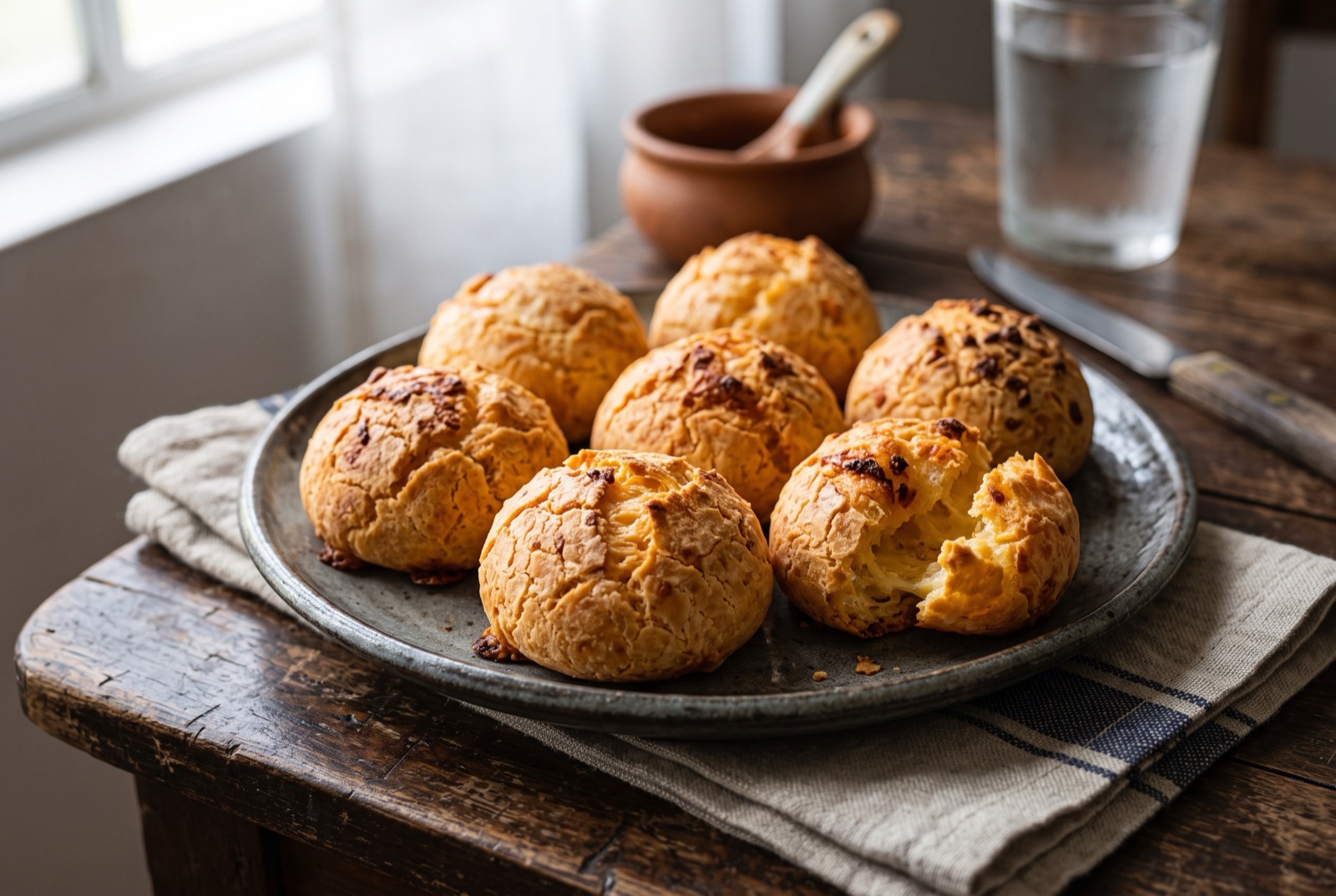
Cuñapé are small baked rolls made from cassava starch and cheese, with no wheat flour in them at all. Bitten open while warm they are almost entirely air and elastic strands: a shell thin enough to shatter under a thumb, a hollow middle, and walls that pull into threads because the cheese is doing structural work rather than just flavouring. They taste overwhelmingly of that cheese — salty, slightly sour, faintly grassy — with the cassava contributing chew and very little else. In Santa Cruz they are bakery and street-cart food, sold hot from mid-morning onwards and eaten with black coffee or api.

- Gate
- BoliviaSanta Cruz and the eastern lowlands
- Prep
- 20 min
- Cook
- 20 min
- Total time
- 55 min incl. 15 min rest
- Serves
- 6
- Status
- Easy
- Nutrition / serving · estimated
- Calories 320 kcal
- Protein 12 g
- Carbs 36 g
- Fat 15 g
- Fiber 1 g
- Sugar 1 g
- Sodium 480 mg
Why this recipe works.
- The rubbed-in lowland method, not the Brazilian scalded batter — this is what gives cuñapé their drier, crumblier shell.
- A tested cheese blend for cooks who cannot get queso menonita, with the reasoning behind each part.
- Hydration judged by how the dough behaves in the hand, since starch and cheese moisture vary wildly between brands.
- Baked hot and fast so the inside hollows out instead of setting into a dense little brick.
Ingredients.
8 itemsFor the dough
Equipment
- Fine grater
- Mixing bowl or food processor
- Baking tray
- Baking parchment
Instructions.
Rub in the butter
Tip the cassava starch, baking powder and salt into a wide bowl and add the cold butter cubes. Rub them through the starch with your fingertips until the mixture looks like fine sand with no visible lumps of butter left.
Tip Work quickly with cool hands — melted butter makes a greasy dough that bakes heavy.
Add the cheese
Stir in both grated cheeses and toss until every strand is coated in starch and the mixture looks pale and dusty. Breaking up any clumps of cheese now matters more than it seems: pockets of bare cheese leak fat during baking.
Bring the dough together
Pour in the beaten egg and mix with a fork, then add the milk a tablespoon at a time, working with your hands, until the dough holds together in a ball when squeezed. It should feel firm and slightly waxy, never sticky.
Tip Squeeze a small piece: if it crumbles apart, add another spoonful of milk; if it sticks to your palm, add a dusting of starch.
Shape the rolls
Divide the dough into 18 pieces of about 35 g each. Roll each between your palms into a smooth ball, then press gently to flatten it into a squat disc, and set them well apart on a parchment-lined tray.
Chill briefly
Slide the tray into the fridge for 15 minutes while the oven heats to 200 °C. Cold dough hitting a hot oven is what forces the steam upwards and hollows out the middle.
Bake hot
Bake for 18 to 20 minutes, until the rolls have risen visibly, the surface has split into a network of fine cracks and the undersides are golden. They should sound hollow when tapped and feel light for their size.
Tip Pale is better than dark here. Deep browning dries them into something tough.
Eat warm
Move them to a rack for two or three minutes so the steam escapes, then serve while still hot enough that the inside pulls into strands when you break one open. They are best within the first half hour.
Tips from our kitchen.
- Grate the cheese on the fine side of the grater. Coarse shreds melt into pockets and leak out of the base as puddles instead of binding the dough.
- Use sour cassava starch (almidón agrio) if you can find it — it puffs more and adds the faint tang that makes cuñapé taste right. Plain tapioca starch works but is milder.
- Add the milk a tablespoon at a time. The right dough holds together when squeezed but is not tacky; too wet and the rolls spread flat, too dry and they crack apart in the oven.
- Chill the shaped rolls for 15 minutes before baking. Cold dough holds its shape while the oven sets the outside, which is what creates the hollow centre.
- Bake hot at 200 °C. A moderate oven dries them out slowly and produces something dense and pale rather than puffed and cracked.
- They are done when the surface has split into fine cracks and they sound hollow tapped underneath. Deep browning means overbaked and tough.
Substitutions.
- Queso menonita → Two parts hard salty cheese such as aged Cheddar or Manchego to one part low-moisture mozzarella
- The hard cheese carries the salt and the sourness, the mozzarella supplies the stretch. Halloumi grated fine also works and is closer in salt level than most.
- Sour cassava starch (almidón agrio) → Plain tapioca starch, sold as tapioca flour
- Available in most supermarkets. The rolls will be a little denser and lack the sour note, but the texture is still correct. Do not use cassava flour, which is the ground whole root and behaves nothing like the starch.
- Milk → Water, or a beaten egg yolk loosened with water
- Bolivian home recipes vary. Milk gives a slightly softer crumb; water gives a crisper shell.
Variations.
- Cuñapé relleno
- A cube of cheese pressed into the centre of each ball before shaping, so the middle stays molten instead of hollow.
- Sonso de yuca
- The lowland relative: boiled cassava mashed with the same cheese, pressed onto a flat stick and grilled over coals until the outside blisters.
- Cuñapé de anís
- A teaspoon of crushed aniseed worked into the dough, common in home batches and unusual in bakeries.
Storage & reheating.
Cuñapé are a same-day food and everyone in Santa Cruz knows it: within a few hours the shell softens and the interior tightens into something rubbery. Ten seconds in a hot oven brings a day-old one most of the way back, though never fully. The real answer is to freeze them raw — shape the balls, freeze them solid on a tray, then bag them, and bake straight from frozen with four or five minutes added. Baked and frozen they survive a month but come back drier, so raw is the better bet.
Serve with
Black coffee, api or a cold tereré, and nothing else — cuñapé are eaten on their own, not as a side to anything.
The story behind Cuñapé.
The name is Guaraní: kuña for woman and pé roughly for flattened, a description of the shape that a lot of Cruceños will explain to you with some enjoyment. The ingredients are older than the name is useful, though — cassava has been the staple starch of the Bolivian lowlands and the wider Amazon basin for thousands of years, and pressing its starch out of the grated root is one of the region's foundational food technologies, developed originally to make the bitter varieties safe to eat.
Cuñapé belong to a family of cassava-and-cheese breads that runs across the whole lowland belt of South America, and the resemblances are not coincidence: chipá in Paraguay and Argentine Corrientes, pandebono and almojábana in Colombia, pão de queijo in Brazil. The technique moved along river networks and mission routes long before any of these borders existed. What separates cuñapé from its Brazilian cousin is method and cheese. Pão de queijo is built by scalding the starch with boiling milk and oil into a wet, sticky batter; cuñapé is rubbed together dry, like a shortcrust, with hard aged cheese doing most of the binding, and the dough comes out firm enough to roll between the palms. The result is drier, saltier, and considerably more cheese-forward.
The cheese question is the one that decides how good yours are. Santa Cruz uses queso menonita, made by Mennonite colonies farming in the department since the 1950s — a firm, salty, slightly acidic cow's milk cheese sold in wheels in every lowland market. Outside Bolivia it is essentially unfindable, and every Bolivian abroad has a personal formula for approximating it. The neighbouring dish worth knowing is sonso, the same cassava-and-cheese combination made from boiled and mashed root rather than extracted starch, packed onto a stick and grilled — proof that the pairing, not the format, is what the region is really committed to.
Questions, answered.
Why did my cuñapé come out flat and spread?
The dough was too wet, or the cheese was too high in moisture. Fresh mozzarella packed in water and soft young cheeses release liquid as they melt and the ball collapses in the oven. Use a firm, dry, aged cheese as the base of the blend, add liquid a spoonful at a time, and chill the shaped rolls before baking.
Can I use cassava flour instead of cassava starch?
No. Cassava flour is the whole root dried and milled, and it is fibrous, absorbent and beige. Cassava starch, sold as almidón de yuca or tapioca starch, is the pure white extracted starch and is what gives the rolls their stretch and hollow interior. Swapping one for the other produces a dense, sandy dough that will not puff.
How are cuñapé different from Brazilian pão de queijo?
The method and the cheese. Pão de queijo scalds the starch with boiling milk and oil to make a sticky batter, and uses fresh Minas cheese and eggs for a moist, soft interior. Cuñapé rub firm aged cheese into dry starch like a pastry, so the dough is rollable and the baked result is drier, saltier and crumblier. They come from the same lowland tradition but are not the same bread.
Can I make the dough in a food processor?
Yes, and it saves effort. Pulse the starch, cold butter and cheese together until the mixture looks like coarse crumbs, then add the egg and pulse again in short bursts, adding milk until it just clumps around the blade. Stop there — running it continuously warms the cheese and turns the dough greasy.
Why are mine hollow inside? Is that wrong?
That is correct, not a fault. A properly baked cuñapé has a large air pocket under a thin shell, formed as steam expands inside a dough that has no gluten to hold it together evenly. If yours are solid and heavy right through, the oven was too cool or the dough too wet, and the interior set before it had a chance to inflate.
You might also like.
All recipes →
Keep exploring Bolivia.
Bolivia has 9 more dishes in the atlas — Api con Pastel and Fricasé Paceño, and 7 more.
All Bolivia recipes Cheddar recipes Eggs recipes Butter recipes breadsnackvegetariangluten freenut freeRecipe by The DishRoute Kitchen · published August 20, 2026 · updated August 20, 2026