Molokhia.
Egyptian Jute Leaf Soup with Garlic Tasha
ملوخية · Mulūkhiyya · say it: moh-loo-KHEE-ya
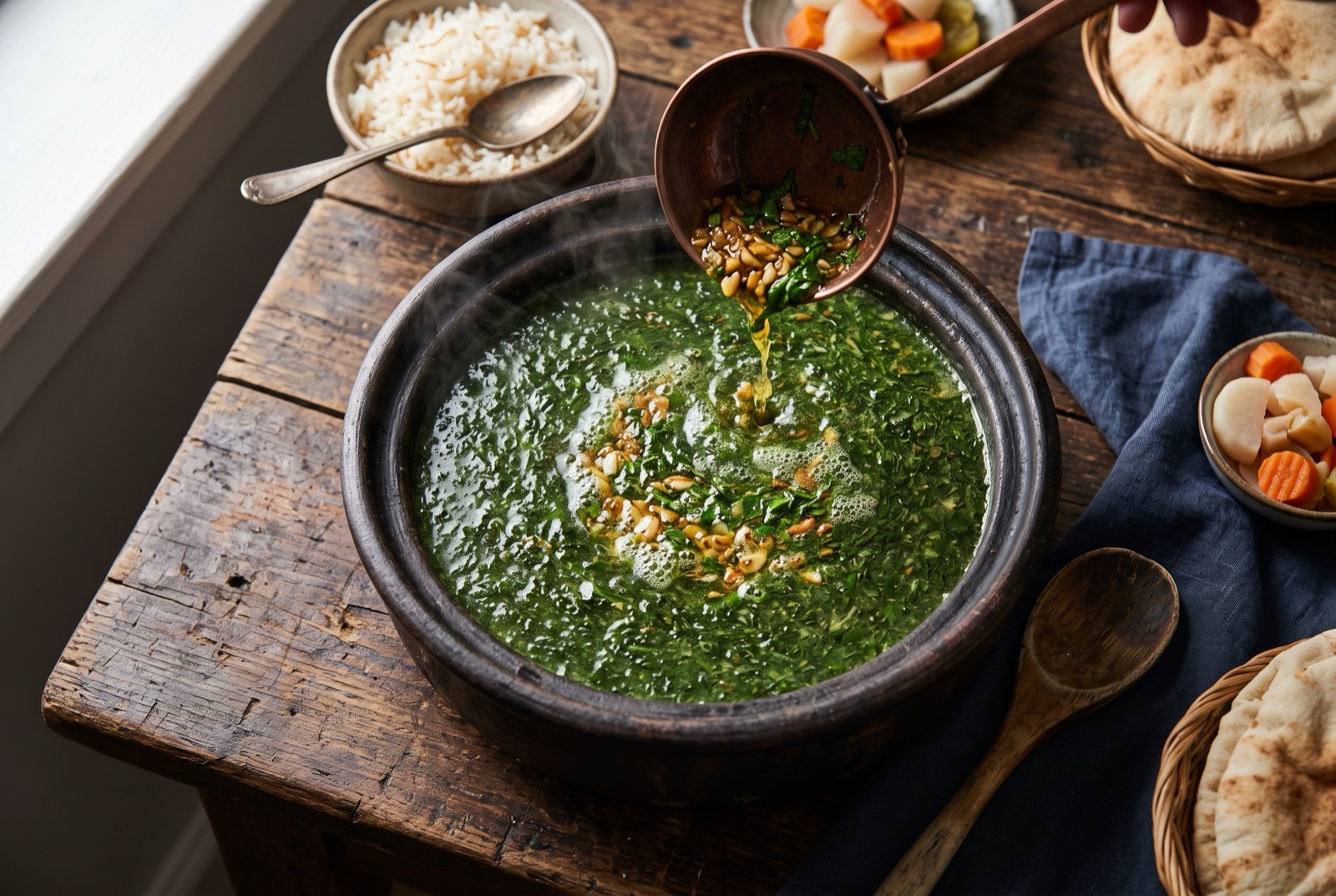
Molokhia is a soup made from jute mallow leaves chopped to a near-powder, stirred into hot broth and cooked for only a few minutes. The texture is the whole conversation: the leaves release a light viscosity, somewhere between okra and a good consommé, which Egyptians consider the mark of a proper pot and newcomers sometimes need one bowl to get used to. The flavour is deeply green and savoury, and it is defined by the tasha — garlic and ground coriander fried in butter or ghee until they roar, then tipped into the soup at the last second. Served over rice with the poached chicken alongside, it is Friday-lunch food and the dish Egyptians abroad ask their mothers to send.

- Gate
- Egypt
- Prep
- 15 min
- Cook
- 1 hr 15 min
- Total time
- 1 hr 30 min
- Serves
- 4
- Status
- Medium
- Nutrition / serving · estimated
- Calories 420 kcal
- Protein 38 g
- Carbs 12 g
- Fat 24 g
- Fiber 5 g
- Sugar 3 g
- Sodium 890 mg
Why this recipe works.
- Gets the texture right by keeping the pot below a boil — the single thing that separates good molokhia from a split, watery one.
- Builds the broth from a whole chicken first, so the soup tastes of something before the leaves ever go in.
- Times the garlic tasha to the last thirty seconds, which is where the aroma of the dish actually lives.
- Works with frozen minced molokhia, which is what most people outside Egypt will realistically buy.
Ingredients.
12 itemsThe broth
The soup
Garlic tasha
To serve
Equipment
- Large pot for the broth
- Small frying pan for the tasha
- Sharp knife or food processor if using fresh leaves
Instructions.
Poach the chicken
Put 1.2 kg of jointed chicken in a large pot with the onion, bay, cardamom, cinnamon and salt. Cover with 2 litres of cold water, bring slowly to a simmer and skim off every bit of grey foam that rises in the first ten minutes.
Tip Starting in cold water pulls more flavour out of the bird and makes skimming easier.
Build the broth
Simmer gently, uncovered, for about 50 minutes, until the meat pulls easily from the bone. Lift the chicken out onto a tray and strain the broth. You want roughly 1.5 litres of clear, well-seasoned liquid — taste it and salt again if it is flat.
Bring the broth to temperature
Return the strained broth to the pot and heat until it is steaming hard with small bubbles at the edge, but not boiling. This is the only heat molokhia should ever see.
Add the leaves
Stir in the molokhia and break up any frozen lumps with a spoon. Let it cook for 6–8 minutes, stirring now and then, until the leaves have separated evenly and the soup looks bright green and lightly bound. It should coat a spoon thinly, not cling to it.
Tip If the surface starts to shudder toward a boil, pull the pot half off the heat immediately.
Make the tasha
While the soup cooks, melt the ghee in a small pan over medium heat, add the garlic paste, ground coriander and chilli flakes, and fry for 30–45 seconds, until the garlic is pale gold and the pan is loud and fragrant. Do not let it brown.
Pour it in
Tip the sizzling tasha straight into the soup — it should hiss loudly — and stir once. Take the pot off the heat immediately and serve within a few minutes, over rice, with the chicken and lemon wedges alongside.
Tip The hiss is the point: it is aroma driven into the soup by heat, and it fades if the pot sits.
Tips from our kitchen.
- Frozen chopped molokhia is the normal choice outside Egypt and is genuinely good. Let it thaw only partly — half-frozen leaves break into the broth more evenly.
- Never let the soup reach a rolling boil after the leaves go in. It splits, the green dulls and the silkiness disappears.
- Fry the garlic for the tasha until it is pale gold and loud, then stop. Brown garlic makes the whole pot bitter and there is no fixing it.
- Skim the broth properly while the chicken poaches. Molokhia is a clear-tasting soup and any scum left in shows up in the finish.
- If you like it thicker, use more leaves rather than cooking longer — time makes it worse, quantity makes it better.
- Season the broth harder than a soup you would drink alone; it will be eaten over plain rice.
Substitutions.
- Fresh molokhia leaves → Frozen minced molokhia (400 g), or dried molokhia rehydrated in warm broth
- Frozen is closest to fresh. Dried gives a darker, earthier soup with less of the bright green colour — common in Tunisia, less so in Egypt.
- Chicken → Rabbit, or beef shank for a heavier broth
- Rabbit is the traditional countryside choice and gives a sweeter, leaner broth. Vegetable stock works for a meat-free pot, though the soup loses body.
- Ghee for the tasha → Butter, or olive oil for a dairy-free version
- Ghee has the highest smoke point and the most character. Olive oil works but goes bitter faster, so watch the garlic closely.
Variations.
- Molokhia with rabbit
- The rural Egyptian standard. Poach a jointed rabbit instead of chicken for a lighter, slightly sweeter broth, and serve the meat browned in ghee.
- Molokhia with seafood
- An Alexandrian coast version built on shrimp or fish stock, with prawns added to the bowl at the end instead of poultry.
- Vegetarian molokhia
- Use a strong vegetable stock with plenty of onion and celery, and double the garlic in the tasha to make up for the missing depth.
Storage & reheating.
Molokhia keeps 3 days refrigerated and thickens as it sits. Reheat it gently over low heat, stirring, and stop as soon as it steams — a second boil ruins the texture permanently. It freezes acceptably for a month, though the silkiness loosens on thawing; make a fresh tasha and pour it over after reheating to bring the aroma back.
Serve with
Plain Egyptian rice or vermicelli rice, the poached chicken browned under a grill, and raw onion soaked in vinegar to cut the richness.
The story behind Molokhia.
Molokhia is old enough that its history is tangled with Egyptian rulers. The leaf itself, Corchorus olitorius, has been eaten in the Nile valley since antiquity, and there is a well-repeated story that the Fatimid caliph al-Hakim banned the dish in the eleventh century — a ban usually cited as evidence of how popular it already was. How much of that account is fact and how much is later embellishment is genuinely disputed by historians, so it is best told as a story Egyptians tell rather than as settled history.
What is not disputed is how seriously the texture is taken. A cook is judged on whether the pot stays smooth and lightly bound rather than watery or gluey, and the rules that govern it are firm: the leaves go into broth that is hot but not violently boiling, they cook briefly, and the pot is never left to boil hard afterwards. Overcooking separates it. In Egypt the traditional chopping tool is the makhrata, a two-handled curved blade rocked over the leaves until they are almost a paste, and the sound of it on a wooden board is one of those kitchen noises people associate with a particular relative.
The dish runs across the eastern Mediterranean, and each country cooks it differently enough to argue. Levantine versions often keep the leaves whole and serve the soup thinner with lemon and onion on the side; Tunisia cooks a dried, powdered version into a dark stew that looks nothing like the Egyptian bowl. Egypt's is the fine-minced, bright-green, garlic-slapped one, traditionally made with rabbit broth in the countryside and chicken almost everywhere else.
Questions, answered.
Why did my molokhia separate into water and green sludge?
It boiled. Once the leaves are in, the pot must stay just under a simmer — the moment it rolls, the light binding that gives molokhia its texture breaks and cannot be recovered. Keep the heat low, stir gently, and take it off as soon as it is hot through.
What does molokhia actually taste like?
Deeply green and savoury, closer to cooked spinach or sorrel than to any herb, with a mild mineral edge and a slight slipperiness in the mouth. The garlic and coriander tasha poured in at the end gives it its distinctive aroma. It is mild on its own, which is why it is always eaten with rice and a squeeze of lemon.
Where can I buy molokhia leaves?
Middle Eastern and North African grocers sell frozen chopped molokhia year-round, usually in 400 g blocks, and that is what most home cooks use. Fresh bunches turn up in summer in the same shops. Dried molokhia is also sold, but it makes a noticeably darker, earthier soup.
Can I make molokhia ahead for guests?
Make the broth and poach the chicken a day ahead, then add the leaves and make the tasha just before serving. The soup itself is best within minutes of the garlic hitting it, and reheating a finished pot is the main way home cooks lose the texture.
You might also like.
All recipes →
Keep exploring Egypt.
Egypt has 9 more dishes in the atlas — Aish Baladi and Fattah, and 7 more.
Recipe by The DishRoute Kitchen · published August 20, 2026 · updated August 20, 2026