Tibs.
Ethiopian Sautéed Lamb with Rosemary
ጥብስ · Tibs · say it: TIBS
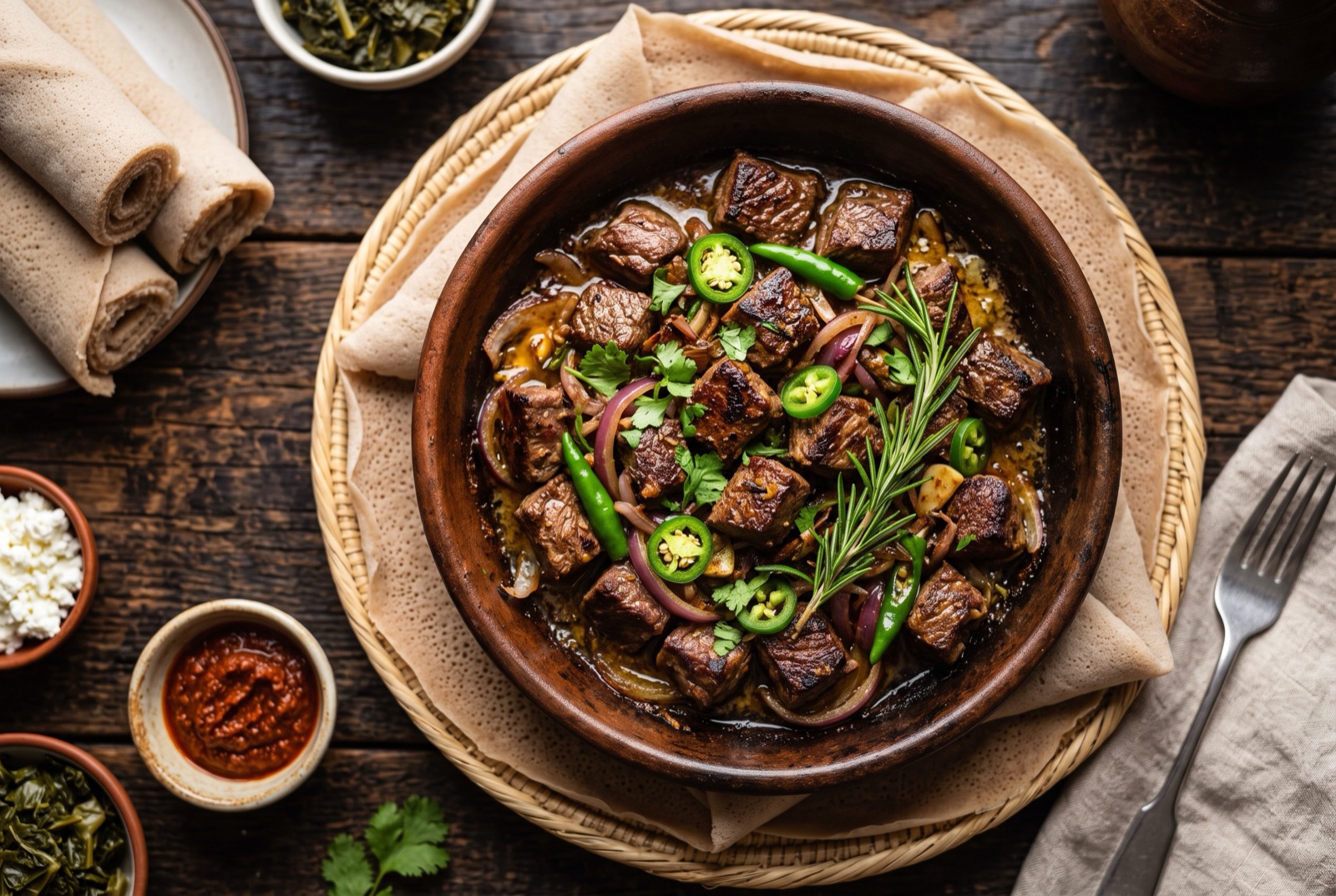
Tibs is meat cut into bite-sized cubes and cooked fast over high heat with onion, green chilli and niter kibbeh, seasoned lightly enough that you can still taste the lamb. Rosemary goes in whole and comes out whole, perfuming the fat without dominating it. Unlike the long-simmered wats, this is a dish about contrast: charred, crusted edges against a soft interior, sweet onion against sharp chilli, and a slick of spiced butter tying them together. In Ethiopian restaurants it often arrives on a shekla, a clay brazier holding live coals, still spitting as it hits the table. At home a heavy pan and a genuinely hot hob produce the same thing minus the theatre.

- Gate
- Ethiopia
- Prep
- 15 min
- Cook
- 20 min
- Total time
- 35 min
- Serves
- 4
- Status
- Easy
- Nutrition / serving · estimated
- Calories 510 kcal
- Protein 38 g
- Carbs 8 g
- Fat 36 g
- Fiber 2 g
- Sodium 640 mg
Why this recipe works.
- Batch searing and a properly hot pan, so the meat browns instead of releasing water and boiling.
- Rosemary used the Ethiopian way — whole sprigs infusing the fat, not chopped leaves scattered through.
- On the table in 35 minutes, which makes it the fastest genuinely traditional dish in this collection.
- Scales up without changing anything except how many batches you sear.
Ingredients.
10 itemsEquipment
- Heavy cast-iron or steel frying pan
- Tongs
- Kitchen paper for drying the meat
Instructions.
Dry and rest the meat
Spread the lamb cubes on kitchen paper and blot them thoroughly on all sides, then leave them uncovered at room temperature for 15 minutes. Dry, cool-room-temperature meat browns; wet, fridge-cold meat steams.
Sear in batches
Heat a heavy pan over high heat until a drop of water vanishes instantly, add a third of the niter kibbeh and sear 700 g of lamb in two or three batches, 2–3 minutes per batch, turning once. Each batch is ready when a deep brown crust has formed on two sides and the cubes release from the pan without sticking. Lift them out onto a plate.
Tip Do not stir constantly. The cubes need to sit still against hot metal long enough to build a crust.
Soften the onion
Lower the heat to medium-high, add the remaining butter and the onion wedges, and cook for 4 minutes until the layers separate and the edges take on colour but the wedges still have bite. Add the garlic, rosemary sprigs and slit chillies and cook for another minute, until the rosemary smells resinous.
Bring the meat back
Return the lamb and any juices to the pan along with the tomato and berbere if using. Toss over high heat for 3–4 minutes, until everything is coated in glossy spiced butter and the tomato wedges have just started to slump at the edges.
Tip This is the last of the cooking. Anything past the point where the tomato collapses turns tibs into a stew.
Season off the heat
Take the pan off the hob, season generously with salt and coarse black pepper, and squeeze over the lemon half. Turn everything once more and let it stand for 2 minutes so the centres finish on carryover heat.
Serve while it still spits
Tip the tibs onto injera or into a preheated cast-iron dish and take it straight to the table, rosemary sprigs still in. Eat with the fingers, wrapping pieces in torn injera.
Tips from our kitchen.
- Pat the meat completely dry with kitchen paper before it goes near the pan. Surface moisture is the single reason home tibs comes out grey.
- Sear in two or three batches with space between the cubes. A crowded pan drops below searing temperature and the meat steams in its own juices.
- Add the onion after the meat has taken colour, not before, so it softens in rendered fat rather than watering down the sear.
- Take the pan off the heat while the centres are still faintly pink — carryover heat finishes them in the minute it takes to reach the table.
- Green chilli is not optional in spirit, but it is in quantity. Two jalapeños give a background warmth; slit them lengthwise and leave the seeds in for a real edge.
- If you want the restaurant version, warm a cast-iron dish in a hot oven and tip the finished tibs into it so it keeps sizzling in front of people.
Substitutions.
- Lamb leg or shoulder → Beef sirloin, rump or top round, in the same 2 cm cubes
- Both are entirely traditional — sega tibs is the beef version and yebeg tibs the lamb one. Beef needs a slightly shorter sear because there is less fat to render.
- Niter kibbeh → Ghee or clarified butter with a pinch each of ground cardamom, fenugreek and turmeric
- Ordinary butter will burn at the temperature this dish needs. If you have neither, use half oil and half butter and add the butter only in the last two minutes.
- Fresh green chilli → 1 tsp berbere stirred in with the onion
- This makes it closer to awaze tibs — hotter, redder and less fresh-tasting. The green snap of raw chilli is lost, so add a squeeze of lemon at the end to compensate.
Variations.
- Zilzil tibs
- Cut into long thin strips rather than cubes, which gives more surface area and more char. Often served with the strips draped over the injera rather than piled.
- Awaze tibs
- Finished with awaze — berbere slackened into a paste with tej, wine or water — stirred through in the last minute. Considerably hotter and a deep red rather than brown.
- Shekla tibs
- Served in a clay brazier over live charcoal so it continues cooking and sizzling at the table. A restaurant presentation, and the reason many people first remember the dish.
Storage & reheating.
Tibs is best eaten within minutes of leaving the pan, since the contrast between crusted edge and soft centre is the whole point and it fades as the meat sits. Leftovers keep 3 days refrigerated and are best repurposed rather than reheated as they are: chop them small and fold them through firfir, or warm them briefly in a hot pan with a splash of water and extra butter. Freezing is possible for 2 months but the texture suffers noticeably — the meat comes back drier and the onion turns to mush.
Serve with
Injera and a spoonful of ayib, with cold beer or tej — the fresh cheese calms the chilli and the bread mops up the spiced butter.
The story behind Tibs.
Tibs occupies the celebratory-but-casual middle of Ethiopian eating: not the all-day production of doro wat, not the everyday economy of shiro, but what you order when friends meet, when something good has happened, or when an animal has been slaughtered for a holiday and there is fresh meat to use quickly. The word covers a family of dishes rather than one recipe, and the variants are named by cut and treatment. Zilzil tibs uses long strips instead of cubes. Derek tibs is cooked dry and hard until the edges are almost crisp. Awaze tibs is finished with awaze, the chilli paste made by slackening berbere with tej or wine. Shekla tibs is the version served over coals.
Rosemary is the detail that surprises people who expect an entirely different spice palette. It grows well in the Ethiopian highlands, is used with real conviction in meat cookery, and turns up in tibs as whole sprigs rather than chopped leaves — added early so the fat carries the resin, removed or pushed aside before serving. Alongside it goes karia, the long green chilli that appears in almost every Ethiopian dish that is not built on berbere; a jalapeño or a serrano stands in acceptably, adding heat and a green, vegetal snap that dried chilli cannot.
What determines success is heat and restraint. The pan must be hot enough that the cubes sear rather than stew, which means cooking in batches if the pan is small, and the total cooking time is short — long enough to brown the outside and cook the inside to just past pink, no longer. Ethiopian cooks often add the onion after the meat has coloured, so it softens in the rendered fat without releasing water into the sear. Lamb and beef are both standard; goat appears in rural cooking, and the same method works with any of them.
Questions, answered.
What cut of meat should I use for tibs?
Something tender enough for a short, hot cook: lamb leg or boned shoulder, or beef sirloin, rump or top round. Cubes of stewing cuts like chuck or shank will be tough, because 15 minutes in a pan is nowhere near enough to break down their connective tissue. If tender cuts are out of budget, cube the meat small and marinate it for an hour in lemon juice and grated onion first.
Why is there rosemary in an Ethiopian dish?
Rosemary grows well in the Ethiopian highlands and is a standard seasoning for meat there, not an outside addition. It appears in tibs as whole sprigs put in early so the fat takes on its resin, and it is used with restraint — the herb should be detectable behind the meat and butter rather than in front of them.
How do I keep the meat from stewing in the pan?
Dry the cubes thoroughly, get the pan properly hot before anything goes in, and cook in batches with space around each piece. Meat releases water as soon as it hits heat, and if the pan is crowded or not hot enough, that water pools and the temperature drops below the point where browning happens. Adding salt at the start makes it worse, so season after the sear.
What is the difference between tibs and wat?
Wat is a stew: aromatics cooked down slowly, spices bloomed in fat, then a long simmer with liquid until everything melds. Tibs is a sauté: high heat, short time, minimal liquid, and the components stay distinct. A plate of wat is spread across injera; a plate of tibs sits on top of it in identifiable pieces.
Can I make tibs without a very hot pan or a gas hob?
Yes, but adjust the method. On a weaker heat source use a heavy cast-iron pan, preheat it for a full five minutes, and sear in smaller batches — three or four rather than two. Alternatively brown the meat under a very hot grill on a tray, then finish it in the pan with the onion, chilli and butter, which gets you similar colour without relying on hob output.
You might also like.
All recipes →
Keep exploring Ethiopia.
Ethiopia has 9 more dishes in the atlas — Berbere and Doro Wat, and 7 more.
Recipe by The DishRoute Kitchen · published August 20, 2026 · updated August 20, 2026