Firfir.
Ethiopian Torn Injera in Berbere Sauce
ፍርፍር · Firfir · say it: fir-FIR
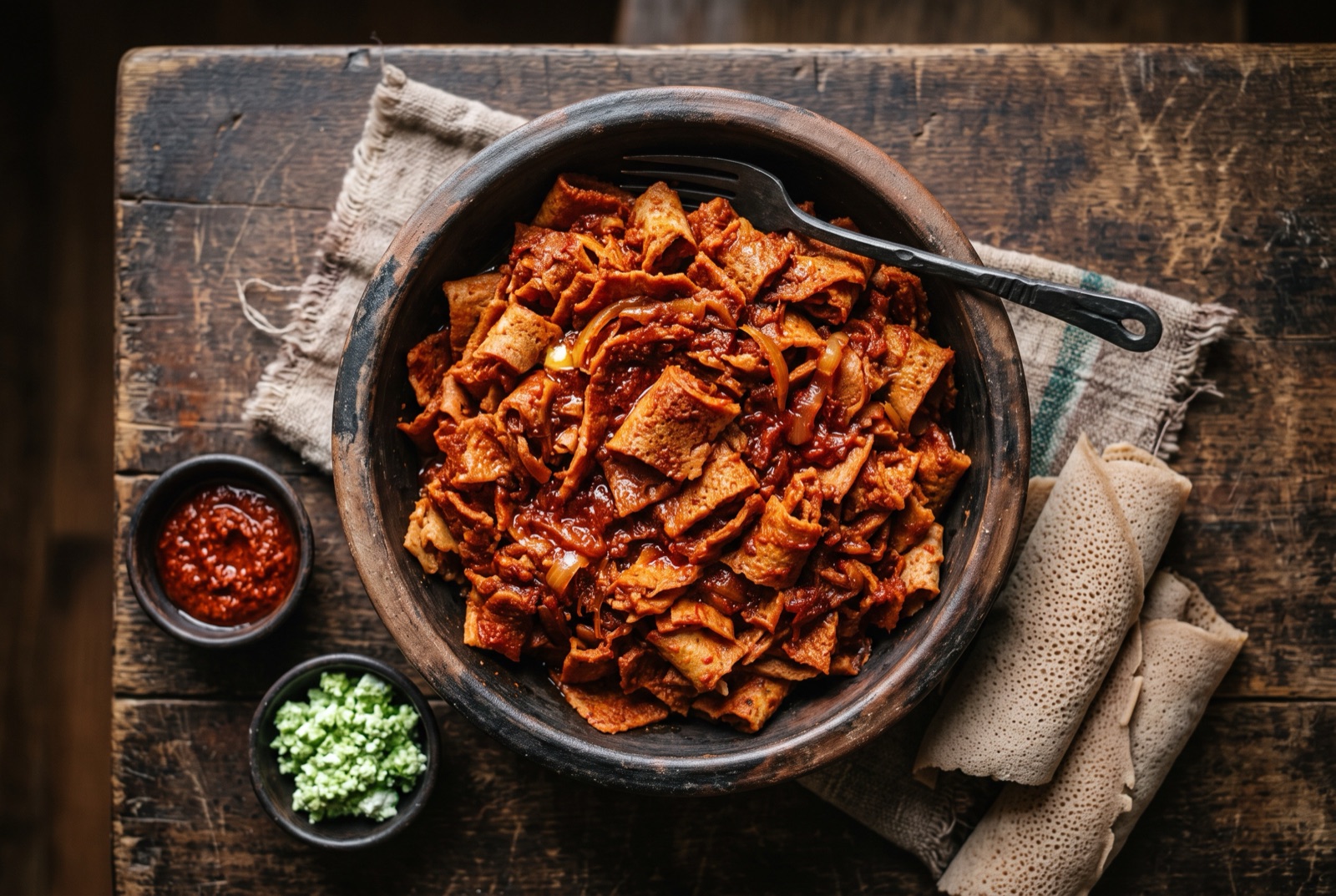
Firfir turns leftover injera into breakfast. Torn into rough pieces and tossed into a sauce of onion, tomato, berbere and niter kibbeh, the bread swells as it absorbs, the edges soften while the folded centres stay chewy, and the whole thing goes a deep uneven red. It is spicy, sour from the fermented bread, rich from the butter, and eaten hot in the morning with a glass of tea or a cup of coffee. Ethiopians eat it before work, in bus-station cafés, and the day after any large meal, and the version with meat scraps folded in is a standard way of finishing off yesterday's wat. Twenty minutes, one pan, and no special ingredient except the injera.

- Gate
- Ethiopia
- Prep
- 10 min
- Cook
- 20 min
- Total time
- 30 min
- Serves
- 4
- Status
- Easy
- Nutrition / serving · estimated
- Calories 480 kcal
- Protein 13 g
- Carbs 62 g
- Fat 20 g
- Fiber 9 g
- Sodium 780 mg
Why this recipe works.
- Treats the injera as the point rather than as a filler, with timing that keeps some pieces chewy instead of turning the pan to mush.
- Gives the fasting-day and the butter version side by side, since both are equally standard.
- Uses stale bread deliberately and explains why fresh injera actually works less well here.
- Assembles in twenty minutes with no ingredient you would not already have if you cook Ethiopian food.
Ingredients.
10 itemsEquipment
- Wide frying pan or shallow casserole
- Flexible spatula
- Sharp knife
Instructions.
Tear the bread first
Pull the injera apart by hand into ragged pieces about the size of a matchbox and pile them in a large bowl. Doing this before you start cooking matters, because once the sauce is ready you have only a minute or two to work.
Soften the onions
Melt the niter kibbeh in a wide pan over medium heat and cook the chopped onions for 10 minutes, stirring, until they are completely limp, glossy and beginning to turn gold at the edges.
Build the sauce
Stir in the garlic and berbere and fry for 2 minutes until the spice darkens and stops smelling dusty, then add the diced tomatoes and the chilli. Cook for 5 minutes more, pressing the tomatoes with the back of the spoon, until they break down into a thick paste and oil shows at the edge of the pan.
Loosen it deliberately
Pour in the water and simmer for 3 minutes until the sauce is smooth and distinctly looser than a finished stew — it should pour easily off a spoon. Season with salt now, because you cannot season evenly once the bread is in.
Tip Err on the wet side. The injera will drink far more than you expect.
Fold in the injera
Turn the heat to low, tip in the torn injera and fold it through with a spatula, lifting from underneath rather than stirring. After about 2 minutes most pieces will have gone deep red and swollen while a few stay paler and chewier — that unevenness is what you want.
Tip If the pan dries out before the bread is coated, splash in a little hot water rather than more oil.
Serve straight from the pan
Take it off the heat immediately and bring the pan to the table while it steams, with ayib or yogurt spooned on top and tea alongside. It stiffens as it sits, so do not let it wait.
Tips from our kitchen.
- Tear the injera by hand into pieces roughly the size of a matchbox. Cut squares look wrong and absorb unevenly — ragged edges are what catch the sauce.
- Day-old or two-day-old injera is the right ingredient. Fresh injera goes slimy in the sauce and loses all definition within a minute.
- Make the sauce slightly looser than you think you need. The bread drinks a startling amount and a sauce that looked generous can vanish entirely.
- Fold rather than stir once the bread is in, lifting from underneath with a spatula so the pieces stay intact.
- Take it off the heat while a few pieces are still visibly paler than the rest. Total uniformity means you have gone too far and the texture has flattened out.
- A spoonful of ayib or plain yogurt on top is the standard treatment for anyone who finds the berbere too much at breakfast.
Substitutions.
- Injera → Any soft flatbread, torn — lavash, thin pitta or a plain crêpe
- It will not be firfir, because none of these are sour, but the technique still produces a decent spiced bread dish. Add a squeeze of lemon to stand in for the missing fermentation tang.
- Niter kibbeh → Neutral oil
- This is ye tsom firfir, the fasting version, and it is completely standard rather than a compromise. The dish is then vegan.
- Berbere sauce made from scratch → Leftover doro wat, misir wat or any red stew, thinned with a little water
- The most traditional shortcut there is. Skip the sauce steps entirely, warm the leftover stew with a splash of water, and fold the bread straight into it.
Variations.
- Ye tsom firfir
- The fasting-day version: oil rather than butter, no meat, often with more tomato. Eaten on Wednesdays, Fridays and throughout Lent, and one of the most common breakfasts in Ethiopia.
- Yebeg firfir
- Made with lamb — either fresh pieces browned into the sauce or leftovers from a previous meal. Heavier, and usually a weekend rather than a weekday breakfast.
- Injera fitfit
- The cold, uncooked cousin: torn injera tossed with awaze paste, oil and raw onion and served at room temperature. Sharper and more direct, and often eaten as a light supper.
Storage & reheating.
Firfir does not keep in any satisfying way — the bread continues to absorb and soften in the fridge, and by the next day the texture has gone uniformly soft and the dish tastes tired. Eat it within an hour of making it. What does keep is the sauce: make a double quantity of the onion-berbere base, refrigerate it for up to 4 days or freeze it for 3 months, and tear fresh injera into a reheated portion whenever you want breakfast. That way the only step in the morning is warming a pan.
Serve with
Hot black tea or Ethiopian coffee, with a spoonful of ayib or yogurt on the side and extra rolled injera for scooping.
The story behind Firfir.
Every cuisine with a bread staple develops a dish for the bread that has gone stale, and firfir is Ethiopia's. Injera made on Sunday is still edible on Wednesday but has stiffened and dried at the edges, and firfir exists to make that a virtue rather than a problem: dry bread absorbs sauce faster and more completely than fresh, so slightly past-it injera is genuinely the better ingredient. Restaurants that make injera daily generate exactly the surplus the dish needs.
The naming is worth untangling, because it confuses people. Fitfit is the broader term for any dish made by tearing bread into a dressing. Injera fitfit — sometimes called yebeg or ye tsom fitfit depending on what is in it — is often the cold version: torn injera tossed with awaze, oil, onion and a little water, no cooking involved, served at room temperature. Firfir usually means the hot version, cooked in a pan with a berbere sauce and butter. Different regions and different households use the two words with varying strictness, so what arrives at your table depends on where you ordered it.
What goes into the sauce depends entirely on the day and the fridge. Ye tsom firfir is the fasting version, made with oil instead of butter and nothing animal in it at all — a fully vegan breakfast that happens to be one of the most common in the country. Yebeg firfir has lamb; doro wat firfir uses leftover chicken stew as the sauce itself, which is the most direct route and arguably the best. Kita firfir substitutes the unfermented flatbread when there is no injera to hand. All of them are assembled at the stove in a few minutes, and none of them are precise.
Questions, answered.
Can I make firfir with fresh injera?
You can, but stale is better. Injera that is a day or two old has dried slightly, which means it absorbs sauce steadily and keeps some structure. Fresh injera is already soft and saturated with moisture, so it goes limp and slippery on contact with the sauce and the dish loses its texture within a minute. If fresh is all you have, dry the torn pieces in a low oven for ten minutes first.
What is the difference between firfir and fitfit?
Both mean bread torn up and dressed, and usage varies by region and household. In general, firfir is the cooked version — the bread folded into a hot berbere sauce in a pan — while fitfit refers to the uncooked one, injera tossed with awaze, oil and onion and eaten at room temperature. Some places use the words interchangeably, so it is worth asking rather than assuming.
Is firfir a breakfast dish only?
It is most associated with breakfast and is what many Ethiopians eat before work, but nothing stops it appearing later. Fitfit in its cold form is often a light evening meal, and firfir made from the previous night's stew turns up at any hour. What ties it to the morning is practical rather than formal: it uses yesterday's bread and takes twenty minutes.
How do I stop it turning into mush?
Add the bread at the very end, off a fierce heat, and fold it through rather than stirring. The pieces should be coated and warmed rather than simmered, which takes about two minutes. Also make the sauce a little looser than seems right, because a thick sauce forces you to work the bread harder to distribute it, and that working is what breaks the pieces down.
Can I make a vegan version?
Yes, and it is the standard one for much of the year. Ye tsom firfir replaces the niter kibbeh with neutral oil and contains no meat, dairy or eggs, because it is made on Orthodox fasting days when all animal products are excluded. Provided your injera is pure teff or a teff-and-grain blend with nothing else added, the finished dish is entirely plant-based.
You might also like.
All recipes →
Keep exploring Ethiopia.
Ethiopia has 9 more dishes in the atlas — Berbere and Doro Wat, and 7 more.
Recipe by The DishRoute Kitchen · published August 20, 2026 · updated August 20, 2026