Farofa de Manteiga.
Toasted Brazilian Cassava Flour
Farofa de manteiga · say it: fah-ROH-fah
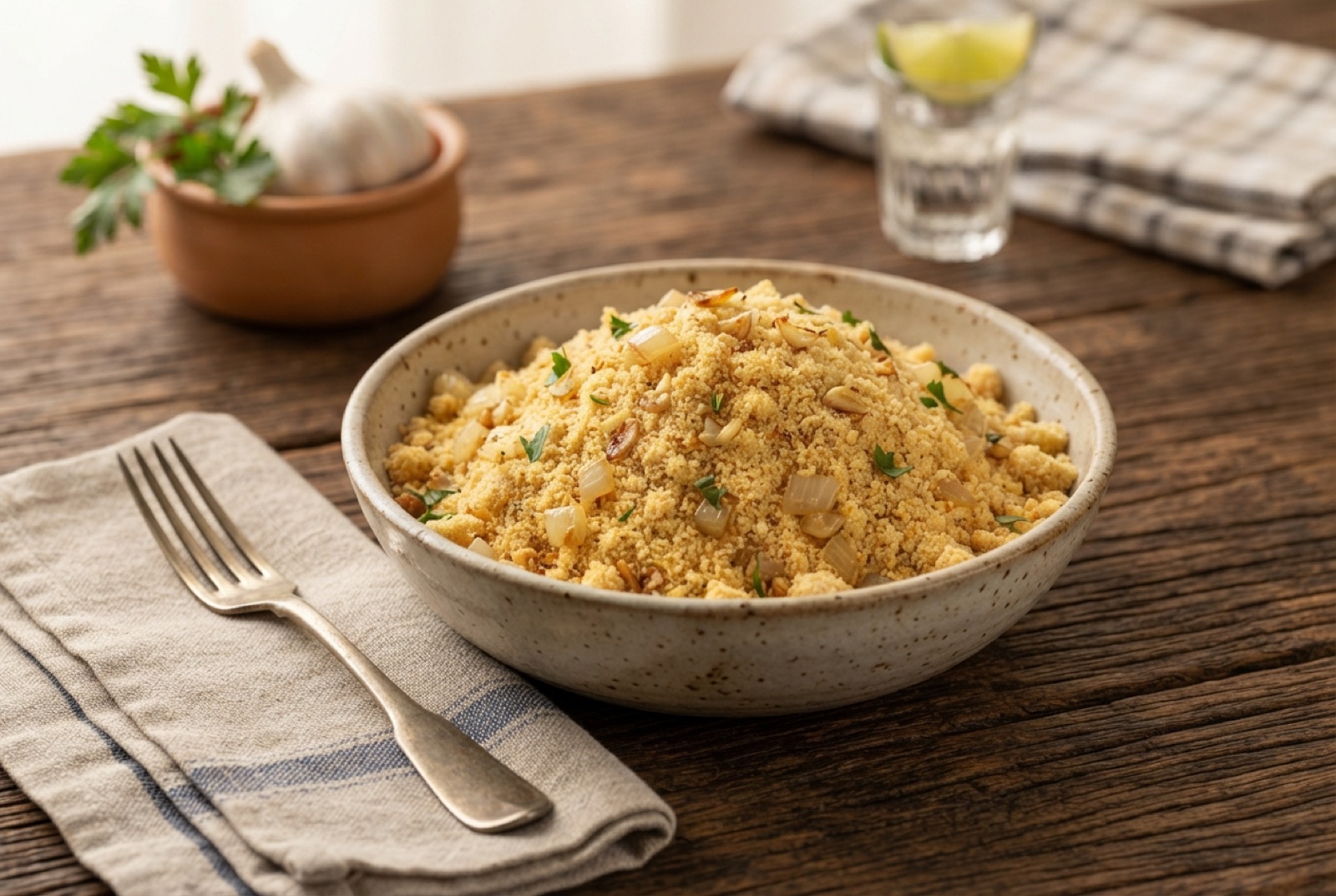
Farofa is toasted cassava flour, and it does a job nothing else on the Brazilian table can do — it goes over beans, over grilled meat, over stews, absorbing the juices and adding a dry, sandy crunch that keeps a rich plate from feeling heavy. Made with butter, onion and garlic it tastes nutty and savory, somewhere between toasted breadcrumbs and popcorn, with a faint sourness from the cassava itself. It takes about ten minutes and four ingredients, but it is easy to ruin: the flour scorches in seconds once it takes color, so the whole recipe is really an exercise in low heat and constant stirring.

- Gate
- BrazilNationwide
- Prep
- 10 min
- Cook
- 15 min
- Total time
- 25 min
- Serves
- 6
- Status
- Easy
- Nutrition / serving · estimated
- Calories 300 kcal
- Protein 4 g
- Carbs 38 g
- Fat 15 g
- Fiber 3 g
- Sodium 420 mg
Why this recipe works.
- Names the exact flour to buy and the two products constantly mistaken for it, which is the difference between farofa and paste.
- Builds the flavour base properly — onion cooked until sweet, garlic added late — instead of dumping everything in at once.
- Uses low heat and a visual endpoint, so the flour toasts evenly rather than catching in the last thirty seconds.
- Stays vegetarian in its base form, with the classic bacon and egg additions kept as clearly marked variations.
Ingredients.
9 itemsEquipment
- Wide heavy skillet
- Wooden spoon
Instructions.
Sweat the onion
Melt 80 g of butter in a wide skillet over medium heat and add the chopped onion with a pinch of the salt. Cook for 6 to 8 minutes, stirring now and then, until the onion is soft, translucent and turning gold at the edges — it should taste sweet, not sharp.
Add the garlic
Stir in the garlic and cook for one minute only, until it smells sweet and toasted rather than raw. Do not let it brown; burnt garlic will make the whole panful bitter and there is no fixing it afterwards.
Scramble the eggs, if using
Pour the beaten eggs into the pan and stir constantly for about a minute until they set into small soft curds distributed through the onion. Break up any large pieces with the edge of the spoon.
Tip Skip this step entirely for the plainer farofa de manteiga.
Toast the flour
Turn the heat down to medium-low and add the cassava flour in three additions, stirring constantly so every grain picks up butter. Toast for 6 to 8 minutes until the flour turns a pale sandy gold, smells nutty and toasted, and feels dry and loose rather than clumping.
Tip Stir without stopping from this point. It burns faster than you expect.
Season and finish
Take the pan off the heat and fold through the scallions, parsley, the remaining salt and the black pepper. Taste it hot and correct the salt — it should be assertively seasoned, since it is going onto other food.
Serve loose
Tip the farofa into a bowl and break up any clumps with a fork so it stays sandy and pourable. Put it on the table with a spoon and let people scatter it over their own plates.
Tips from our kitchen.
- Use farinha de mandioca — coarse, sandy manioc meal. Tapioca starch and fine cassava baking flour both turn into a gummy mass in a hot pan.
- If your flour is sold raw rather than pre-toasted, expect it to need a few extra minutes and to drink more butter as it dries out.
- Cook the onion slowly until genuinely sweet and golden before the flour goes in. Pale onion leaves the farofa tasting flat and slightly raw.
- Keep the heat at medium-low once the flour is in and stir without stopping. It goes from golden to burnt in about twenty seconds.
- Season while the pan is still hot and taste it there. Cooled farofa tastes noticeably blander than it does straight from the pan.
- Make it on the day. Farofa keeps but softens in the fridge, and refreshing it means toasting it again in a dry pan.
Substitutions.
- Farinha de mandioca → Coarse dry breadcrumbs or panko, toasted the same way
- Not the same flavour — you lose the faint sourness of cassava — but it delivers the crunch and works as a stand-in on a feijoada plate.
- Butter → Olive oil, or rendered bacon fat for a non-vegetarian version
- Olive oil keeps it vegan and works perfectly well, though butter is what gives farofa de manteiga its name and its roundness.
- Onion and garlic → Nothing at all
- Farofa simples is just flour toasted in fat with salt, and is entirely legitimate — especially when the plate it sits on is already loud.
Variations.
- Farofa de ovo
- Scramble two eggs in the pan before the flour goes in and break them up as you toast. The most common everyday version in Brazilian homes.
- Farofa natalina
- The Christmas version: bacon, sliced green olives, raisins, banana rounds fried in butter and toasted cashews folded through. A dish in itself rather than a side.
- Farofa de dendê
- Bahian style, with the butter replaced by red palm oil so the flour turns bright orange. Made to sit beside moqueca and other dendê-heavy dishes.
- Farofa de banana
- Thick slices of ripe plantain or banana fried in butter until caramelised, then folded into the toasted flour. Sweet, savoury and a classic partner to grilled meat.
Storage & reheating.
Farofa keeps 5 days in an airtight container at room temperature, which is where it belongs — refrigeration makes it damp and dull. If it softens, tip it into a dry pan over medium-low heat and stir for 3 to 4 minutes until it smells toasted and feels sandy again. Versions containing egg, bacon or banana must be refrigerated and eaten within 2 days, and do not refresh nearly as well. Farofa does not freeze usefully.
Serve with
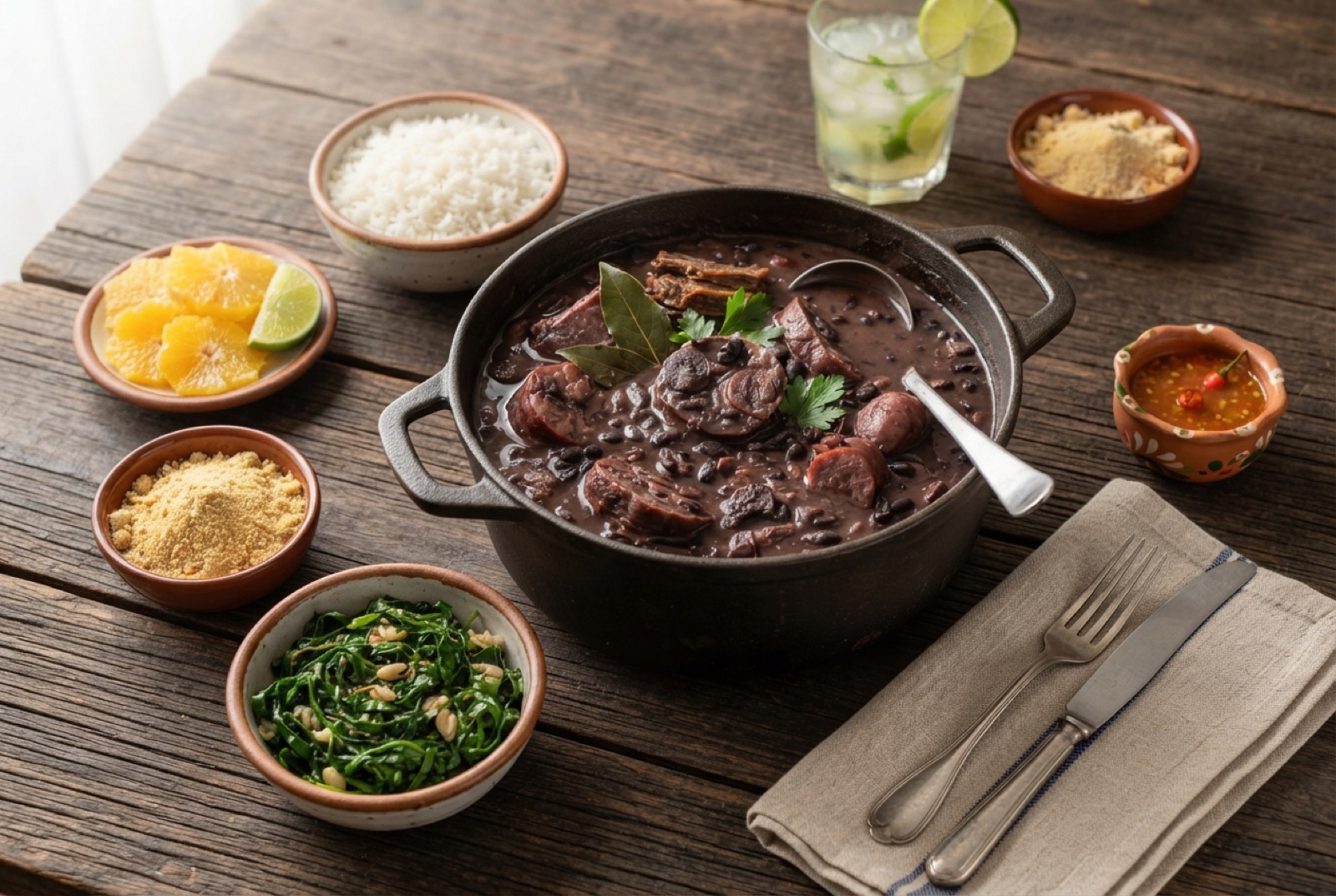
Feijoada, churrasco, roast chicken or a plain plate of rice and beans — anywhere a rich, wet dish needs something dry and crunchy on top.
The story behind Farofa de Manteiga.
Cassava is indigenous to Brazil, and so is farofa. Long before Portuguese ships arrived, Tupi and other Amazonian and coastal peoples were processing bitter manioc into flour — grating, pressing out the toxic liquid in a woven tipiti, and toasting the pulp on a hot griddle until it was dry, shelf-stable and safe. That flour, farinha de mandioca, was the staple carbohydrate of much of the continent, and the Portuguese adopted it immediately because it kept indefinitely on ships and in the interior where wheat would not grow. Frying it in fat with onion turned a plain staple into a seasoning.
Today farofa sits on the table at almost every Brazilian meal that involves beans or grilled meat, and it is regional in the way bread is elsewhere. In the north it appears alongside fish and tucupi; in Bahia it is often made with dendê; in the south it goes with churrasco; at Christmas it becomes an elaborate dish in its own right, loaded with bacon, egg, raisins, olives, banana and cashews and served as the centrepiece side to the roast bird. Households have positions on all of this, and someone will always insist that farofa with raisins is an abomination.
A word on the flour itself, because this is where recipes outside Brazil go wrong. Farinha de mandioca is dried, granular cassava pulp — coarse, off-white or pale yellow, and sold either raw (crua) or pre-toasted (torrada). It is not tapioca starch, which is the extracted starch and behaves like cornflour, turning to glue in a hot pan. It is also not cassava flour of the fine baking kind sold in health-food aisles. If the bag does not describe a coarse, sandy meal, it is the wrong product.
Questions, answered.
What is farinha de mandioca?
It is coarse, granular flour made from cassava root that has been grated, pressed to remove its liquid, and dried or toasted. It looks like fine sand or coarse semolina and is a staple across Brazil. It is sold either raw (farinha crua) or already toasted (farinha torrada), and both work for farofa — the toasted kind simply needs less time in the pan.
Can I use tapioca starch or tapioca flour instead?
No. Tapioca starch is the pure starch extracted from cassava, a fine white powder that behaves like cornflour and turns into a sticky paste when heated in fat. Farofa needs the coarse dried pulp, which stays granular. The two products come from the same root but are not interchangeable in any recipe.
What do you eat farofa with?
It is sprinkled over almost any savoury Brazilian plate: feijoada, rice and beans, grilled meat at a churrasco, roast chicken, stews and fish. It sits on the table in a bowl and each person adds their own. Its role is textural — the dry flour soaks up sauce and adds crunch to dishes that would otherwise be uniformly soft.
Why did my farofa turn out bitter?
Almost certainly because the flour caught and burnt. Cassava flour toasts very quickly and goes from golden to acrid within seconds at high heat, so keep the pan at medium-low and stir constantly. Burnt garlic is the other common cause, which is why the garlic goes in after the onion and only for a minute before the flour.
Is farofa gluten-free and vegan?
Farofa made from cassava flour is naturally gluten-free, since cassava contains no wheat. This basic version is vegetarian but not vegan because of the butter — swap in olive oil and it becomes fully vegan. Popular variations with bacon, egg or sausage are neither, so check which version you are being served.
You might also like.
All recipes →
Keep exploring Brazil.
Brazil has 9 more dishes in the atlas — Acarajé and Bolo de Fubá, and 7 more.
Recipe by The DishRoute Kitchen · published August 19, 2026 · updated August 19, 2026