French Onion Soup Gratinée.
Soupe à l'oignon gratinée · say it: soop ah lo-NYON grah-tee-NAY
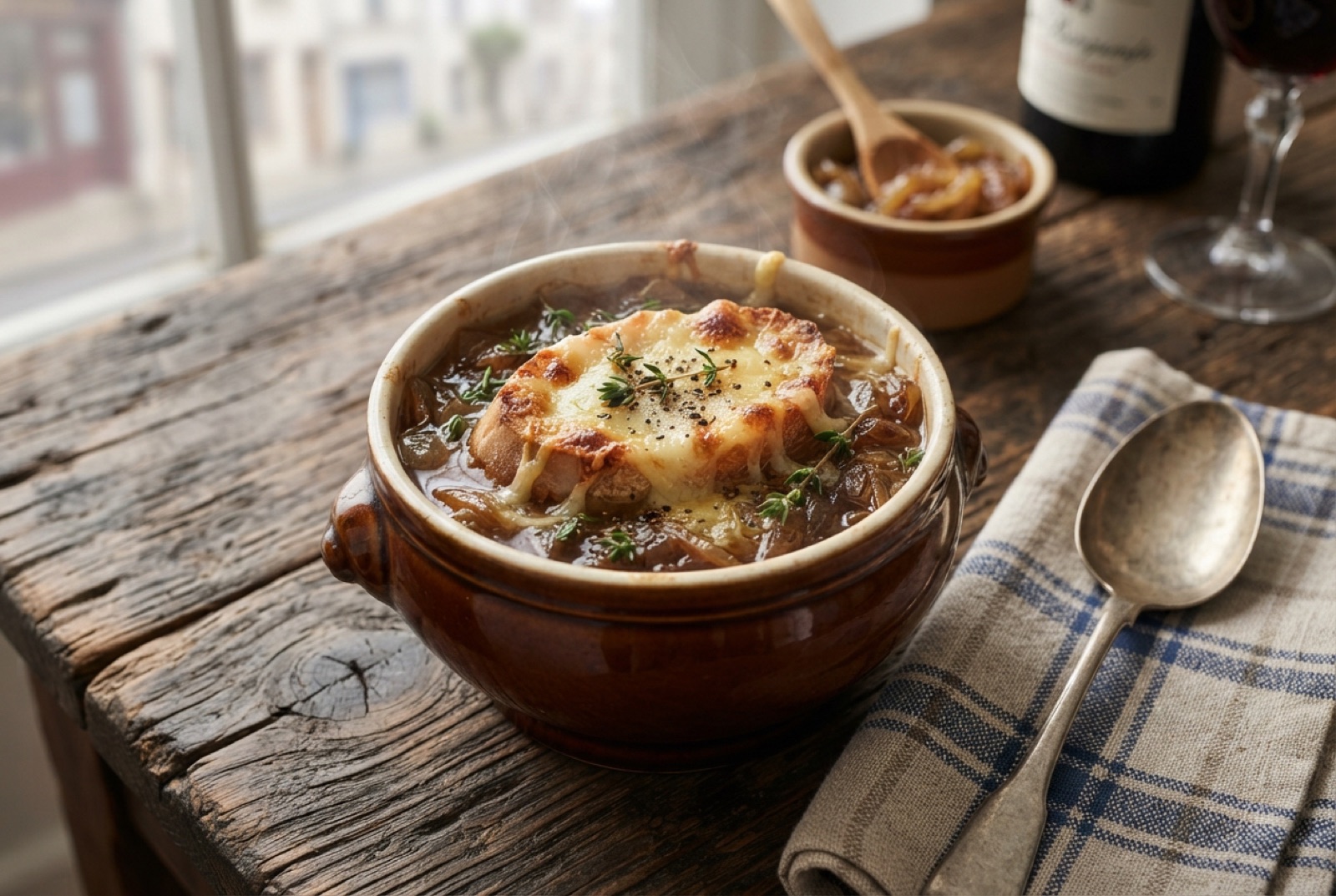
French onion soup is proof that patience is an ingredient. A kilo of sliced onions cooks down in butter for the better part of an hour until it collapses into a sweet, mahogany tangle, then simmers in beef stock with white wine, thyme and bay. The bowl goes under the broiler wearing a toasted baguette slice and a thick blanket of gruyère, which melts, bubbles and browns into the famous cheese crust you crack with a spoon. It tastes deeply savory and gently sweet at once — beefy, oniony, winey — and there is no shortcut worth taking: the caramelization is the recipe. Everything else is assembly.

- Gate
- FranceParis / Lyon
- Prep
- 15 min
- Cook
- 1 hr 30 min
- Total time
- 1 hr 45 min
- Serves
- 4
- Status
- Medium
- Nutrition / serving · estimated
- Calories 480 kcal
- Protein 20 g
- Carbs 45 g
- Fat 24 g
- Fiber 5 g
Why this recipe works.
- Honest timing — a true 45–60 minute caramelization, because that is where all the flavor comes from.
- White wine deglazing lifts every browned bit off the pot floor and into the soup.
- A dried-out crouton that holds under the cheese instead of dissolving into mush.
- Broiler-safe bowls and a thick gruyère cap for the proper cracked, browned crust.
Ingredients.
11 itemsFor the soup
For the gratinée
Equipment
- Heavy wide pot or Dutch oven
- Broiler-safe soup bowls (or a baking sheet)
- Ladle
- Sharp chef's knife
Instructions.
Start the onions
Melt 60 g of butter in a heavy wide pot over medium heat. Add 1 kg of sliced onions with a good pinch of salt and stir to coat — the pot will look absurdly full. Cook, stirring now and then, until the onions collapse, turn translucent and release their liquid, about 15 minutes.
Caramelize — slowly
Reduce the heat to medium-low and keep cooking, stirring every 3–4 minutes and scraping the pot floor, until the onions are a deep, even mahogany brown, sweet-smelling and reduced to a fraction of their volume — a genuine 45–60 minutes. Whenever the brown film on the pot floor darkens, loosen it with a tablespoon of water.
Tip This step cannot be hurried. If the onions ever smell sharp or acrid rather than sweet, the heat is too high — turn it down.
Deglaze with wine
Sprinkle the flour over the onions and stir for a minute to cook it out. Pour in the white wine and scrape up every browned bit from the pot floor, simmering until the raw alcohol smell fades and the liquid turns syrupy, 2–3 minutes.
Simmer the soup
Add the hot beef stock, thyme sprigs and bay leaf. Simmer gently, partly covered, until the flavors knit and the broth tastes rounded rather than winey, about 20 minutes. Fish out the herbs, then season with salt and black pepper — go carefully if the stock was salted.
Dry the croutons
Meanwhile, bake the baguette slices at 180°C until dried through and lightly golden at the edges, about 10 minutes — they should feel hard, like rusks. Soft bread will dissolve into the soup.
Broil the gratinée
Ladle the soup into broiler-safe bowls on a sturdy baking sheet, float two croutons on each and bury them under the grated gruyère, letting some cheese drape over the rim. Broil until the cheese is molten, bubbling and browned in spots, 3–5 minutes — watch it constantly. Rest 2 minutes before serving; the soup beneath the crust is scalding.
Tip The cheese that browns onto the bowl's rim is not a mistake — fighting a spoon through it is half the pleasure.
Tips from our kitchen.
- Slice the onions with the grain (pole to pole), about 5 mm thick — they hold some texture through the long cook instead of melting into paste.
- Do not raise the heat to speed things up. Onions caramelize evenly over medium-low; over high heat they scorch at the edges while staying raw and sharp inside, and burnt onion makes bitter soup.
- The fond — the brown film on the pot floor — is flavor, not a mess. Scrape it up each time you deglaze with a splash of water or the wine.
- Use the best beef stock you can; the soup is only two flavors, and stock is half of them. Homemade is ideal, a good low-sodium bought stock is fine.
- Dry the baguette slices fully in the oven before they go on the soup — a fresh, soft slice drinks the broth and collapses.
- Let the broiled bowls stand 2–3 minutes before serving; the soup under the crust is dangerously hot.
Substitutions.
- Gruyère → Comté, Emmental, or a mix of mozzarella and parmesan
- Comté is the closest match and often cheaper. The mozzarella-parmesan mix melts well but is milder — a budget option, not a clone.
- Beef stock → Chicken stock, or vegetable stock plus 1 tsp soy sauce
- The soup turns lighter and less classically bistro. The soy sauce trick restores some savory depth in the vegetarian version.
- Dry white wine → Dry sherry, or simply more stock with 1 tsp of vinegar
- Sherry is a common French variant and slightly nuttier. Skipping alcohol entirely works; the acid splash keeps the onions from tasting flat.
Variations.
- Gratinée lyonnaise
- The Lyon bouchon version, often enriched at the table by stirring a beaten egg yolk mixed with port into the soup under the crust.
- White wine vs. no wine
- Plenty of French home versions skip wine altogether and rely on stock and long cooking alone — leaner, more onion-forward, entirely traditional.
- Soupe à l'oignon without the gratin
- The everyday family version: same soup, served simply with toasted bread on the side instead of the broiled cheese lid.
Storage & reheating.
The soup base (without bread and cheese) keeps 4 days refrigerated and freezes well for up to 3 months — it arguably improves overnight. Reheat it on the stove until steaming, then add a freshly toasted crouton and cheese and broil just before serving. Never store or freeze the assembled gratinée; the crouton turns to sludge.
Serve with
A green salad with sharp vinaigrette and the rest of the white wine — the soup itself is rich enough to be the whole meal.
The story behind French Onion Soup Gratinée.
Onion soup is ancient, cheap-of-necessity food — onions and stale bread were what poor kitchens across Europe reliably had — and the French version grew out of exactly that thrift. The gratinée we know today, crowned with a crouton and broiled cheese, took its modern form in Paris, where it became the signature dish of the bistros around Les Halles, the city's vast central food market. The market worked through the night, and the onion soup served in the surrounding cafés at dawn fed porters coming off their shift alongside revelers ending theirs. That reputation — the restorative bowl at four in the morning — is a real and documented part of Parisian lore, and gratinée is still eaten late-night in France, including as a traditional finish to wedding celebrations.
There are also grander origin legends: one credits Louis XV, said to have improvised the soup from onions, butter and champagne at a hunting lodge, and another the exiled Polish king Stanisław Leszczyński, who supposedly fell for a version at an inn in Châlons and carried the recipe to his daughter at Versailles. Both stories are told often and verified never — enjoy them as legends, not history.
What is certain is why the dish works. Long, slow cooking converts the onions' sharpness into deep caramel sweetness — a transformation of the vegetable itself, not a browning of its surface — and beef stock supplies the savory backbone that balances it. The gratinée topping is peasant economics turned into luxury: yesterday's bread and a handful of cheese, broiled until the crust becomes the best part. Lyon, which claims every onion dish as a birthright of its bouchon taverns, makes its own soupe à l'oignon with equal pride; Paris and Lyon can share the credit. The home cook's only real obligation is honesty about time. Rushed onions make brown soup. Slow onions make gratinée.
Questions, answered.
How long does it really take to caramelize onions?
For a proper French onion soup, 45–60 minutes over medium-low heat, stirring every few minutes. Recipes promising deeply caramelized onions in 10–15 minutes are describing browned onions, which taste sharper and less sweet. The slow version converts the onions' sugars throughout, and that sweetness is the soup's foundation.
What kind of onions should I use for onion soup?
Ordinary yellow onions are the classic and best choice — they have enough sugar and enough bite to end up balanced after an hour of cooking. Sweet onions (like Vidalia) caramelize faster but can make the soup one-dimensionally sweet; red onions work but turn the broth murky. Yellow is the safe, traditional answer.
Can I make French onion soup without broiler-safe bowls?
Yes. Toast the baguette slices, pile the gruyère directly on them, and broil the cheese-topped croutons on a baking sheet until bubbling and browned, then float one on each bowl of hot soup. You lose the cheese welded dramatically to the bowl's rim, but the eating experience is nearly identical.
Is French onion soup vegetarian?
The classic version is not — it is built on beef stock, which provides the savory depth that balances the sweet onions. A vegetarian version with good vegetable stock, a splash of soy sauce for depth, and a vegetarian-rennet cheese is genuinely worth making, but it is a variation rather than the bistro original.
Why did my onion soup turn out bitter?
Almost always scorched onions: heat too high, stirring too rare, or dark fond left to burn on the pot floor. Caramelization should creep along at medium-low, and the browned film on the pot should be deglazed with liquid whenever it darkens past deep brown. Once onions burn, bitterness carries through the whole pot and cannot be simmered out.
You might also like.
All recipes →
Keep exploring France.
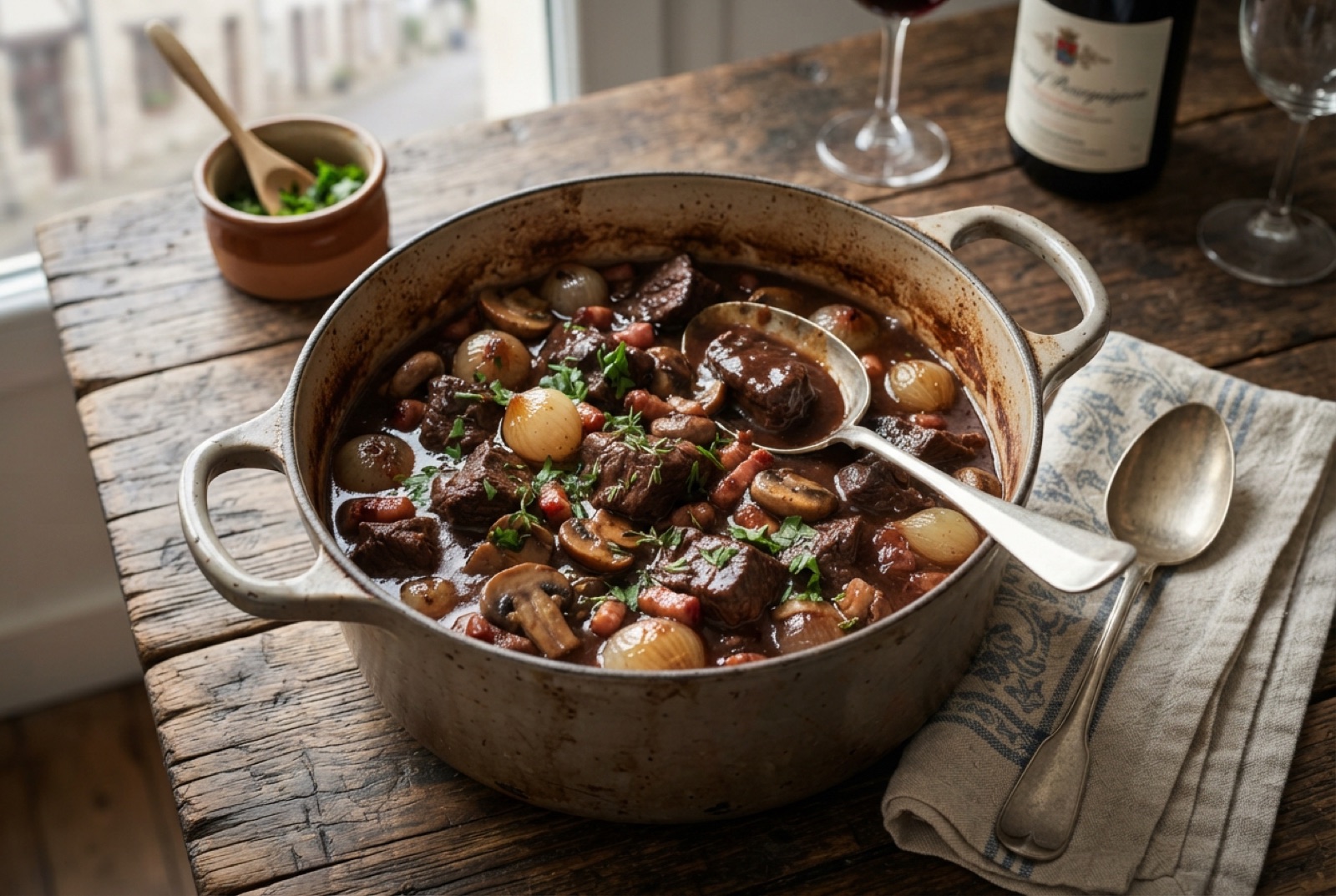
France has 9 more dishes in the atlas — Baguette and Bœuf Bourguignon, and 7 more.
Recipe by The DishRoute Kitchen · published August 18, 2026 · updated August 18, 2026