Bœuf Bourguignon.
Burgundy Beef Braised in Red Wine
Bœuf bourguignon · say it: buhf boor-gee-NYOHN
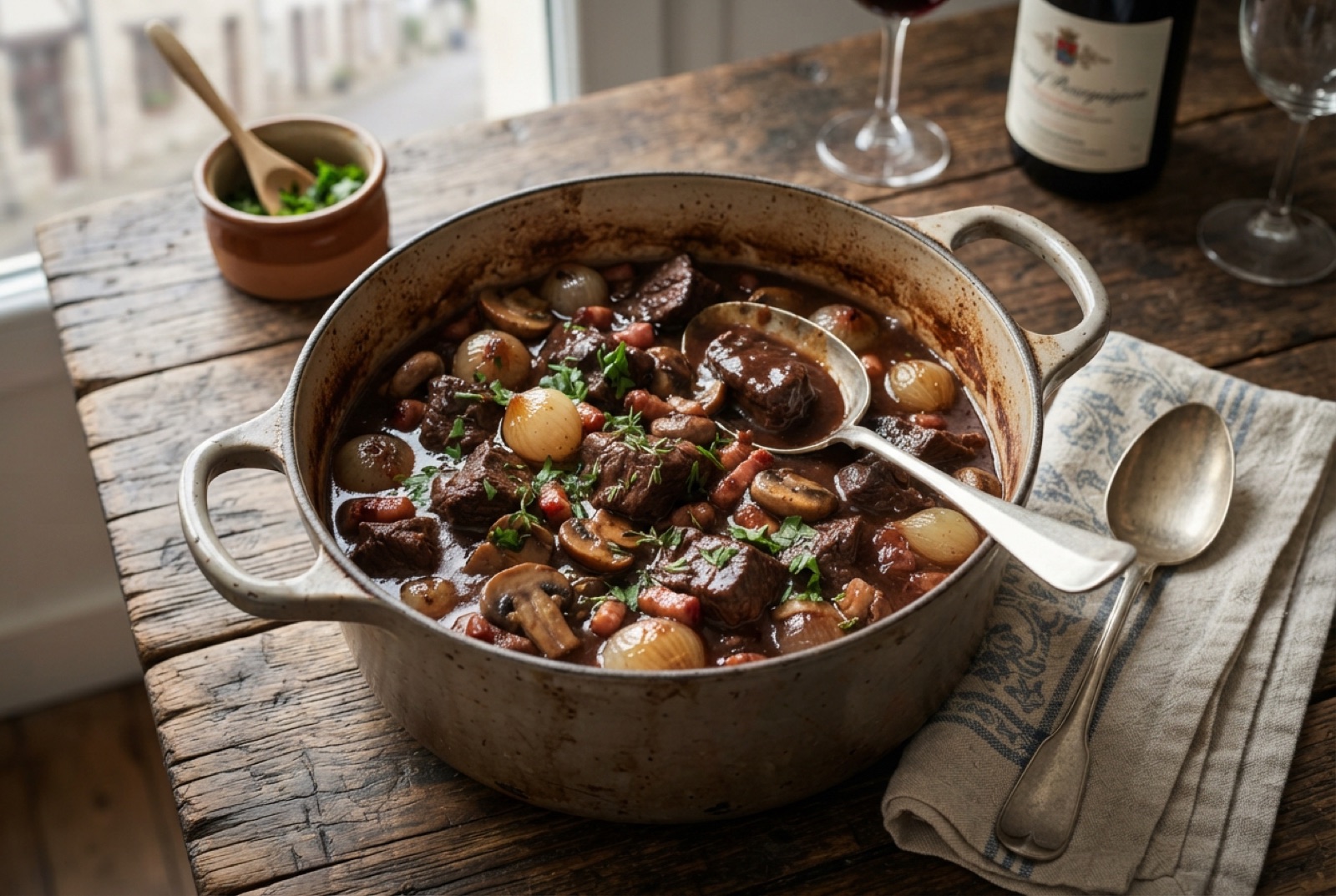
Bœuf bourguignon is a slow braise of tough, well-marbled beef in a bottle of red wine, built on the Burgundian trio of bacon, small onions and mushrooms. The finished dish tastes of wine that has lost all its sharpness — deep, faintly sweet, savoury the way good stock is savoury — with beef that gives way under a fork and a sauce thick enough to cling. It is peasant cooking in structure and restaurant cooking in result: the only expensive part is time. Cooks make it because three hours of unattended oven heat converts the cheapest cut on the counter into the best thing on the table, and because it is genuinely better on the second day.

- Gate
- FranceBurgundy
- Prep
- 40 min
- Cook
- 3 hr 20 min
- Total time
- 4 hr
- Serves
- 6
- Status
- Medium
- Nutrition / serving · estimated
- Calories 620 kcal
- Protein 49 g
- Carbs 14 g
- Fat 33 g
- Fiber 3 g
- Sugar 6 g
- Sodium 780 mg
Why this recipe works.
- The garnish is cooked separately, the way the classic demands — mushrooms browned, onions glazed — so nothing turns grey and waterlogged in the pot.
- Oven braising instead of stovetop keeps the heat even and gentle, which is the single biggest factor in tender rather than stringy beef.
- The sauce is reduced at the end rather than thickened with extra starch, so it tastes of wine and beef instead of flour.
- Written with honest wine advice: what actually matters in the bottle, and what makes no difference at all.
Ingredients.
18 itemsFor the braise
For the garnish
To finish
Equipment
- Heavy Dutch oven or cast-iron casserole with a lid
- Large frying pan for the garnish
- Slotted spoon
Instructions.
Render the lardons
Heat the olive oil in a heavy Dutch oven over medium heat and cook the lardons for 8–10 minutes, until the fat has run out and the edges are brown and crisp. Lift them out with a slotted spoon onto a plate, leaving all the fat behind.
Brown the beef in batches
Pat 1.5 kg of beef completely dry and season with salt and pepper. Sear in the bacon fat over high heat in three or four batches, without moving the cubes for the first 2 minutes, until each side has a deep mahogany crust. Transfer to the plate with the lardons.
Tip If the pan bottom starts to blacken rather than brown, lower the heat and splash in a spoonful of wine to loosen it before continuing.
Sweat the aromatics and singe the flour
Turn the heat to medium and add the chopped onion, carrots and garlic. Cook for 6–8 minutes until the onion is soft and golden at the edges, then stir in the flour and tomato paste and cook for a further 2 minutes, until the mixture smells nutty and toasted rather than of raw flour.
Deglaze with the wine
Pour in the wine a little at a time, scraping every brown patch off the base of the pot with a wooden spoon. Bring to a boil and let it bubble for 5 minutes, until the harsh alcohol smell burns off and the liquid smells of fruit rather than spirit.
Braise low and slow
Return the beef and lardons with any juices, add the hot stock, thyme and bay leaves, and top up with water if needed so the meat is just barely covered. Bring to a bare simmer, cover, and transfer to a 150°C oven for 2½–3 hours, until a cube of beef crushes against the side of the pot under light spoon pressure.
Tip Check once an hour. You want the surface trembling, never rolling — if it bubbles hard, drop the oven 10 degrees.
Glaze the onions
While the beef braises, melt half the butter in a frying pan, add the pearl onions and sugar with a splash of water, and cook over medium-low heat for 15 minutes, shaking often, until the water has gone and the onions are burnished and tender to a knife tip. Set aside.
Brown the mushrooms
In the same pan, melt the rest of the butter over high heat and add the mushrooms in one layer. Leave them undisturbed for 3 minutes, then toss and cook until they have released their water, reabsorbed it, and turned deep gold at the edges. Season lightly.
Reduce and combine
Lift the beef out of the pot with a slotted spoon and fish out the herb stalks. Boil the sauce hard in the open pot for 10–15 minutes until it darkens and coats the back of a spoon in a thin, glossy film. Slide the beef back in with the onions and mushrooms, warm through for 5 minutes and taste for salt.
Tip Drag a finger across the coated spoon — the line should hold without the sauce running back over it.
Rest and serve
Let the pot sit off the heat for 10 minutes so the sauce settles and stops scalding. Scatter with parsley and serve straight from the casserole with potatoes or noodles alongside.
Tips from our kitchen.
- Dry the beef thoroughly with paper towels before browning. Wet meat steams, and grey meat means a pale, weak sauce no amount of simmering will fix.
- Brown in batches with space between the cubes. Crowding the pan drops the temperature and you lose the crust that carries most of the flavour.
- Choose a wine you would drink a glass of — light to medium red, low tannin, no heavy oak. Never use anything sold as cooking wine; it is salted.
- Pearl onions are far easier to peel after 60 seconds in boiling water and a cold rinse; the skins slip off when you trim the root end.
- If the sauce is thin at the end, lift out the meat and boil the liquid down hard rather than adding more flour. Reduction concentrates, starch only thickens.
- Cook it a day ahead if you can. Cooling overnight lets the flavours settle and lets you lift off any set fat in one sheet.
Substitutions.
- Beef chuck → Beef shank, short rib or brisket point
- Any hard-working cut with collagen works. Avoid lean cuts such as sirloin or round — they have nothing to melt and turn dry and fibrous no matter how long you cook them.
- Red Burgundy → Any dry, low-tannin red: Gamay, Beaujolais, unoaked Pinot Noir, light Merlot
- Very tannic or oaky wines concentrate into bitterness over three hours. A modest bottle of the right style beats an expensive bottle of the wrong one.
- Bacon lardons → Pancetta cut into thick batons, or diced smoked pork belly
- French poitrine fumée is closer to pancetta than to thin breakfast bacon. If your bacon is heavily smoked, blanch it for two minutes first so the smoke does not dominate.
- Pearl onions → Small shallots, halved if large
- Frozen pearl onions are a legitimate shortcut — thaw and pat dry before glazing, or they will not colour.
Variations.
- Coq au vin
- The same braise built on chicken instead of beef, with a shorter cooking time. Same garnish, same wine logic, a lighter result.
- Bœuf à la mode
- An older cousin: a whole larded piece of beef braised in wine with a split calf's foot for extra gelatin, sliced and served with its own jellied sauce.
- Overnight marinade version
- Marinate the beef in the wine with carrots, onion and herbs for 12 hours, then drain and pat dry before browning. It deepens the colour and the wine flavour; the beef must be bone dry before it hits the pan.
Storage & reheating.
Bourguignon keeps 4 days refrigerated and improves for the first two. Cool it uncovered until steam stops, then refrigerate in the sauce; the fat sets on top and lifts off cleanly the next day. Reheat covered in a 150°C oven for 30–40 minutes, or very gently on the stove — a hard boil shreds the beef into threads. It freezes well for 3 months, though the mushrooms soften; freeze the stew and add freshly cooked mushrooms on reheating if you want them firm.
Serve with
Boiled or steamed potatoes, buttered egg noodles, or nothing but bread and the rest of the bottle.
The story behind Bœuf Bourguignon.
Burgundy has two things in abundance: Charolais cattle, a large white breed raised for beef across the region, and red wine made from Pinot Noir. Bœuf bourguignon is the obvious consequence. Long before it appeared on any restaurant menu it was farm cooking — a way to make working animals edible, since an ox that had spent years pulling a plough needed hours of wet heat before it became dinner. Wine went in because wine was there, cheaper and more reliable than clean water, and because acid and long heat between them break down connective tissue into gelatin. That gelatin is why a properly made bourguignon has a sauce with body rather than a thin brown liquid.
The dish moved up the social ladder through the codification of French cooking in the late nineteenth and early twentieth centuries, when regional home dishes were written down, standardised and given a place in professional kitchens. Auguste Escoffier published a version, and the recipe hardened into a set of expectations: beef marinated or not, but always browned; a garnish à la bourguignonne of lardons, button mushrooms and glazed pearl onions cooked separately and added near the end; the sauce strained and reduced. In the 1960s Julia Child put it in front of American home cooks as the first main-course recipe in Mastering the Art of French Cooking, and for a generation of English speakers it became shorthand for French cooking itself.
What gets argued about is the wine. Purists insist on a red Burgundy, and there is a real argument for it — Pinot Noir is relatively light in tannin, so it reduces without turning bitter or drying. But the everyday version cooked in Burgundian homes was never made with bottles anyone would cellar, and a decent unoaked Pinot, Gamay or light Merlot from anywhere gives an honest result. What ruins the dish is not the wrong appellation but a wine that is heavily oaked, very tannic or, worst of all, sold as cooking wine with salt added.
Questions, answered.
What cut of beef should I use for bœuf bourguignon?
Use a collagen-rich braising cut: chuck (shoulder) is the standard, with shank, short rib and brisket point all excellent. These cuts are full of connective tissue that melts into gelatin over long, gentle cooking, giving both tender meat and a sauce with body. Lean cuts like sirloin, fillet or round have no collagen to convert and go dry and stringy however long you braise them.
Does the wine have to be Burgundy?
No. Red Burgundy is traditional and suits the dish because Pinot Noir is low in tannin and reduces cleanly, but any dry, light-to-medium red without heavy oak works — Gamay, Beaujolais, a simple Merlot. What genuinely matters is avoiding very tannic or oak-heavy wines, which turn bitter when concentrated, and never using bottles labelled cooking wine, which contain added salt.
Why is my sauce thin and watery?
Usually too much liquid, a lid left on tight for the whole cook, or a cut too lean to release gelatin. The fix is simple: lift the meat and garnish out with a slotted spoon, then boil the sauce hard in the open pot until it reduces by a third and coats the back of a spoon. Return the meat to reheat. Reducing concentrates flavour, whereas extra flour just makes it thick and dull.
Does the alcohol cook off?
Most of it does, but not all. After three hours of simmering, only a small percentage of the original alcohol remains — enough that the dish is not suitable for anyone avoiding alcohol entirely, but far too little to have any intoxicating effect. What remains behind is the wine's acidity, colour and fruit, which is the point of using it.
Can I make bœuf bourguignon in advance?
Yes, and you should. It is better on day two, when the sauce has settled and the beef has reabsorbed some liquid. Cook it completely, cool, refrigerate up to four days, then reheat gently in a low oven. Cook the mushrooms and glazed pearl onions fresh on the day of serving if you want them to stay firm and glossy.
Can I make boeuf bourguignon in a slow cooker or pressure cooker?
Yes, but brown the beef, bacon and aromatics in a pan first — no slow cooker or pressure cooker browns properly, and skipping that step costs you most of the flavour. Slow cooker: 6–8 hours on low. Pressure cooker: about 35 minutes at high pressure with a natural release, then reduce the sauce in the open pot afterwards, since nothing evaporates under pressure.
You might also like.
All recipes →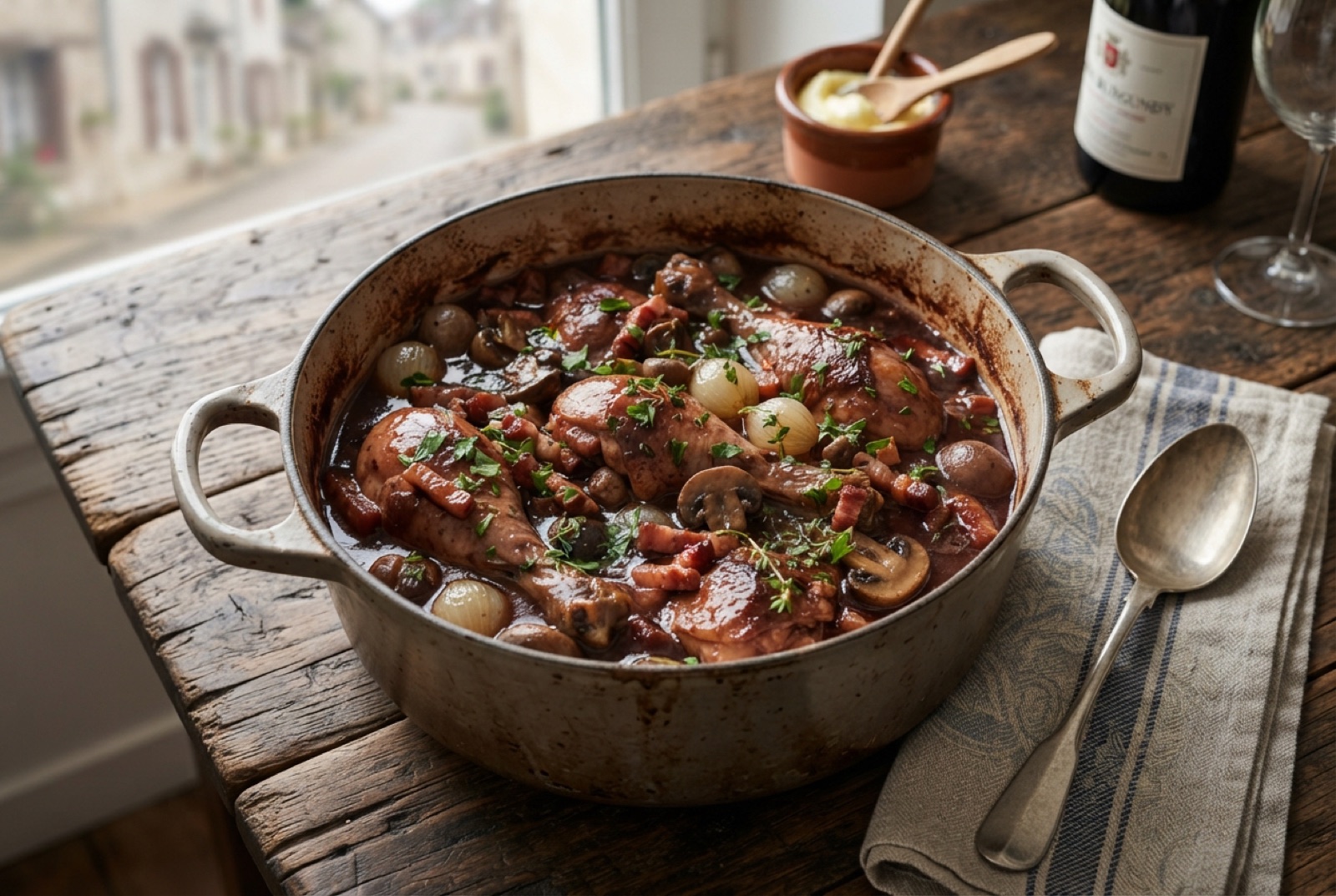
Keep exploring France.
France has 9 more dishes in the atlas — Baguette and Coq au Vin, and 7 more.
Recipe by The DishRoute Kitchen · published August 19, 2026 · updated August 19, 2026