Galaktoboureko.
Greek Semolina Custard Filo Pie
Γαλακτομπούρεκο · say it: gah-lahk-toh-BOO-reh-koh
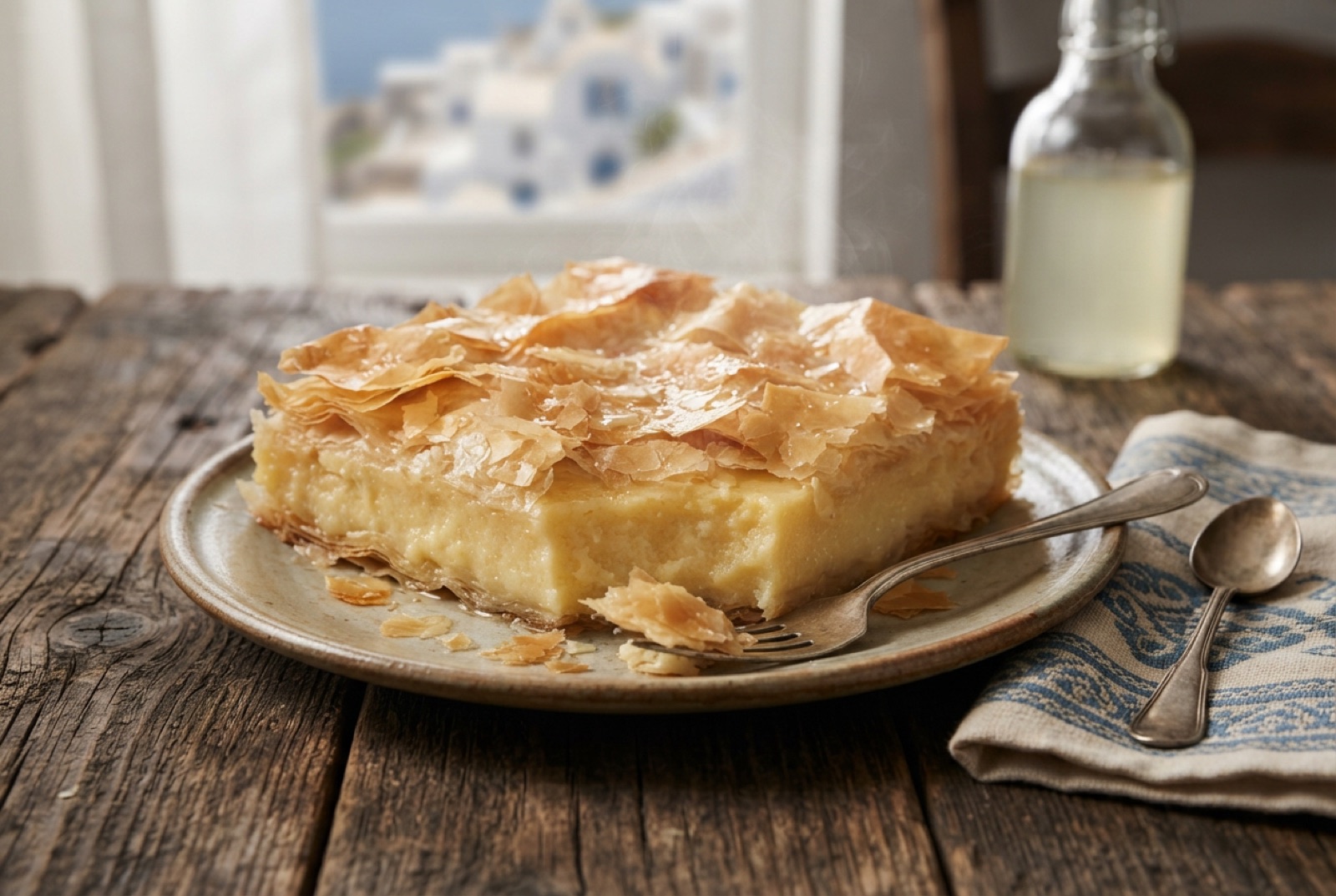
Galaktoboureko is a milk pie: a thick, pourable semolina custard sealed between layers of filo, baked until the top blisters into crisp bronze scales, then flooded with lemon syrup while it is still too hot to touch. Cut into a square and you get three textures at once — brittle pastry on top, custard that sits somewhere between pudding and set cream, and a syrup-soaked base that has gone soft and almost caramelised. It tastes of warm milk, lemon peel and butter rather than of sugar alone, which is why Greeks eat it in slabs rather than in the polite slivers baklava gets. The name is literal: gala means milk, and the pie is entirely about it.

- Gate
- Greece
- Prep
- 35 min
- Cook
- 55 min
- Total time
- 5 hr 30 min incl. 4 hr rest
- Serves
- 12
- Status
- Medium
- Nutrition / serving · estimated
- Calories 425 kcal
- Protein 8 g
- Carbs 62 g
- Fat 17 g
- Fiber 1 g
- Sugar 41 g
Why this recipe works.
- The custard is cooked properly on the stove first, so it sets into sliceable squares instead of leaking out of the pastry.
- Hot pie, cold syrup — the temperature rule explained, with the reason behind it rather than just the instruction.
- Pre-scored before baking, so the finished pie cuts cleanly instead of shattering the top into crumbs.
- Built from supermarket filo with realistic handling advice, because nobody is rolling their own for a Tuesday.
Ingredients.
13 itemsFor the custard
For the pastry
For the syrup
Equipment
- 20 x 30 cm baking tin or roasting tray
- Heavy saucepan
- Balloon whisk
- Pastry brush
- Sharp thin knife
Instructions.
Make the syrup first and chill it
Bring the granulated sugar, water, lemon peel and cinnamon stick to a boil, then simmer for 6 minutes without stirring, until it thickens just enough to coat a spoon in a thin film. Stir in the lemon juice, cool, then refrigerate until properly cold.
Tip Cold syrup is not optional. Make it before anything else so it has the full baking time to chill.
Cook the semolina custard
Heat 1 l of milk with the caster sugar, the strips of lemon zest and the salt until it steams. Fish out the zest, then rain in the semolina in a slow stream while whisking hard, and cook over medium heat for 5–6 minutes until it thickens to the texture of loose porridge and holds a brief trail from the whisk.
Tip Whisk constantly along the base of the pan — semolina catches and scorches faster than you expect.
Enrich and cool slightly
Take the pan off the heat, beat in the 80 g of butter until it disappears, then let the custard cool for 5 minutes. Pour in the beaten eggs in a thin stream, whisking without pause, until the custard is glossy and thick enough to mound on the whisk. Cover with cling film touching the surface.
Tip If the custard is still steaming hot when the eggs go in, they will set into threads. Five minutes of waiting fixes it.
Build the base
Heat the oven to 180°C. Brush the tin with melted butter and lay in six sheets of filo one at a time, brushing each with butter and letting the edges hang over the sides of the tin. Do not stretch or trim yet.
Fill and seal
Pour the custard onto the filo base and level it with a spatula. Fold the overhanging edges in over the custard, then cover with the remaining six sheets, buttering each one and tucking the edges down inside the tin like sheets on a bed. Brush the top generously.
Score and bake
Cut through the top layers only, marking 12 squares or diamonds with a thin sharp knife — stop when the blade meets custard. Bake for 45–55 minutes, until the top is deep golden with darker blistered ridges and the pie no longer wobbles as a whole when you shake the tin.
Tip If the top browns hard before the time is up, drop the oven to 165°C rather than covering it — foil steams the crispness away.
Syrup it immediately
Take the pie straight from the oven and ladle the cold syrup evenly over the whole surface, working slowly along the score lines. It should hiss and fizz as it goes in. Let the pie stand at least 4 hours before cutting through to the base.
Tip Cutting early releases custard that has not fully set and the squares slump. Four hours is the minimum, six is better.
Tips from our kitchen.
- Use fine semolina, not coarse. Coarse semolina stays gritty no matter how long you cook it, and the custard never turns silky.
- Whisk the eggs into the custard off the heat and in a thin stream, or you will get sweet scrambled egg suspended in milk.
- Score the pie all the way through the top layers before it goes in the oven — trying to cut baked filo later just crushes it.
- Keep the filo you are not using under a barely damp tea towel. It goes from flexible to shattering in about four minutes of open air.
- Torn sheets are fine. They are buried in the middle of the stack and nobody will ever know; save your best sheets for the top.
- Listen when you pour the syrup — the pie should hiss and crackle. Silence means one of the two temperatures was wrong.
Substitutions.
- Fine semolina → Fine cornmeal, or half semolina and half cornstarch
- Cornmeal gives a slightly grainier, more rustic custard; the cornstarch blend is smoother but a little more wobbly. Neither is traditional, but both set reliably.
- Filo pastry → Thicker village-style filo (horiatiko) if you can find it
- Village filo makes a chewier, sturdier pie and needs fewer sheets — around seven or eight per layer instead of twelve to fourteen.
- Butter for brushing → Half butter, half mild olive oil
- Common in Greek homes and slightly less rich. Pure olive oil works but the flavour pulls the pie savoury.
Variations.
- Orange galaktoboureko
- Swap the lemon peel in both custard and syrup for orange, and add a strip of orange zest to the milk as it heats. Softer and more floral than the classic lemon version.
- Rolled galaktoboureko
- Instead of a tray pie, roll portions of cooled custard in two filo sheets each and bake as individual logs. More surface area, more crunch, and easier to serve at a party.
- Bougatsa
- The northern Greek breakfast cousin: the same semolina custard in filo, baked in a shallow round pan, cut with a scraper and dusted with icing sugar and cinnamon instead of soaked in syrup.
Storage & reheating.
Galaktoboureko keeps 3 days at cool room temperature under a loose tent of foil. Do not refrigerate it if you can avoid it: the cold turns the syrup-soaked filo leathery and dulls the custard. If your kitchen is very warm, refrigerate but let slices come back to room temperature for 30 minutes before eating. It does not freeze — the custard weeps on thawing. Reheating is optional and best done in a 160°C oven for 8 minutes, which revives the top without melting the middle.
Serve with
Strong Greek coffee, unsweetened, to cut the syrup — and nothing else. It is a dessert that does not share the plate.
The story behind Galaktoboureko.
Galaktoboureko sits at the point where two culinary worlds overlap. The second half of its name comes from börek, the family of filled filo pastries that spread across the Ottoman world, while the first half is pure Greek — milk. That combination tells you most of what you need to know: the technique of stretching and layering paper-thin pastry is shared across Turkey, the Balkans, the Levant and Greece, but filling it with sweetened milk custard rather than nuts, cheese or meat is what makes this dish Greek. Arguments about who invented which filo sweet are old, loud and largely unwinnable, and honest cooks in every one of those countries will admit the pastry itself has no single owner.
What is not disputed is the role galaktoboureko plays in Greece today. It is zaharoplasteio food — the domain of the neighbourhood pastry shop, sold by weight from a huge blackened tray, still warm in the afternoon, wrapped in paper and string and carried home for guests. Unlike baklava, which keeps for a week and travels well, galaktoboureko is a same-day pleasure: the custard is at its best a few hours out of the oven, when the syrup has soaked the base but the top sheets are still audibly crisp. Bakers know this, which is why trays are timed to the after-lunch and early-evening rush rather than baked at dawn.
At home it is a name-day and Sunday dish, made in whatever roasting tin the family owns and cut into generous squares. Every Greek kitchen has its own small variations — some cooks scent the custard with lemon zest, others with vanilla or a strip of orange peel; some pour the syrup over cold pie, others swear by hot pie and cold syrup. That last point is the one rule nobody breaks lightly, and it is the difference between a crisp pie and a soggy one.
Questions, answered.
Why did my galaktoboureko turn out soggy?
Almost always a temperature mistake with the syrup. The pie must come out of the oven hot and the syrup must be completely cold, so the syrup is absorbed quickly into the base while the hot top layers stay crisp. Pouring warm syrup over a warm pie soaks everything evenly, which sounds appealing but produces a limp top. Make the syrup first and refrigerate it while the pie bakes.
Can I make galaktoboureko ahead of time?
You can make the custard a day ahead — press cling film onto its surface and refrigerate, then beat it smooth before assembling. The assembled, baked pie is best eaten the same day, ideally three to six hours after syruping, once the base has drunk the syrup but the top is still crisp. Assembling raw and baking the next day is not recommended, because the custard leaks moisture into the bottom filo overnight.
What is the difference between galaktoboureko and bougatsa?
Both are semolina custard in filo, but galaktoboureko is a syrup-soaked dessert baked in a deep tray, while bougatsa is a breakfast pastry from Thessaloniki and Serres, baked flat, cut with a scraper and finished with icing sugar and cinnamon rather than syrup. Bougatsa also comes in savoury versions with cheese or minced meat, which galaktoboureko never does.
Can I use puff pastry instead of filo?
You can bake a custard pie in puff pastry and it will taste pleasant, but it is a different dessert. Filo gives many thin, separate crisp layers that shatter, while puff pastry gives a smaller number of thick buttery ones that go soft under syrup. If filo is genuinely unavailable, skip the syrup entirely and treat it as a custard tart instead.
How do I stop the filo from cracking while I work?
Thaw frozen filo slowly in the refrigerator overnight rather than on the counter, and once the packet is open keep the unused sheets covered with baking paper and a slightly damp tea towel. Work quickly, brush butter in dabs rather than dragging the brush, and accept that some sheets will tear — they go in the middle of the stack where nobody sees them.
You might also like.
All recipes →
Keep exploring Greece.
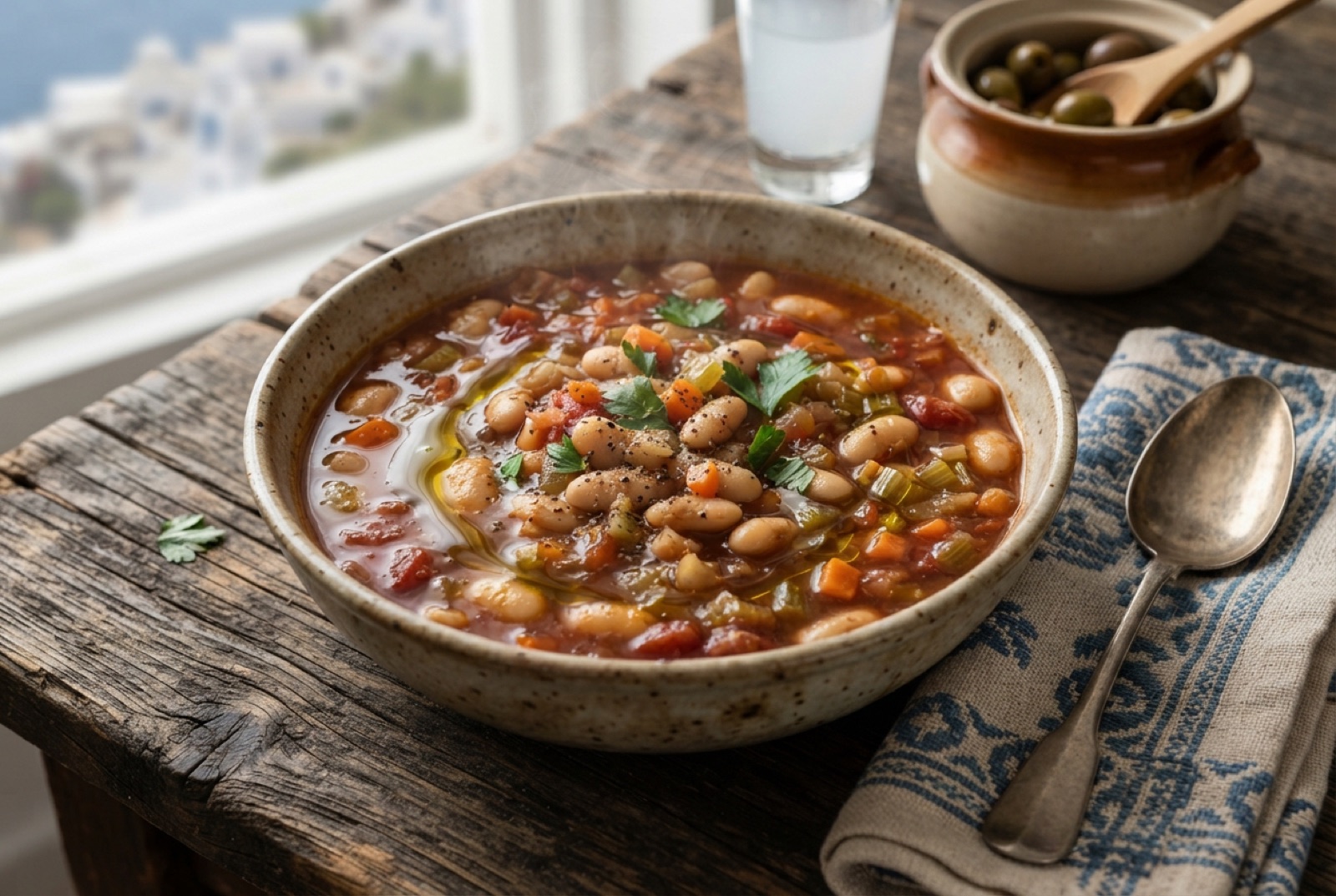
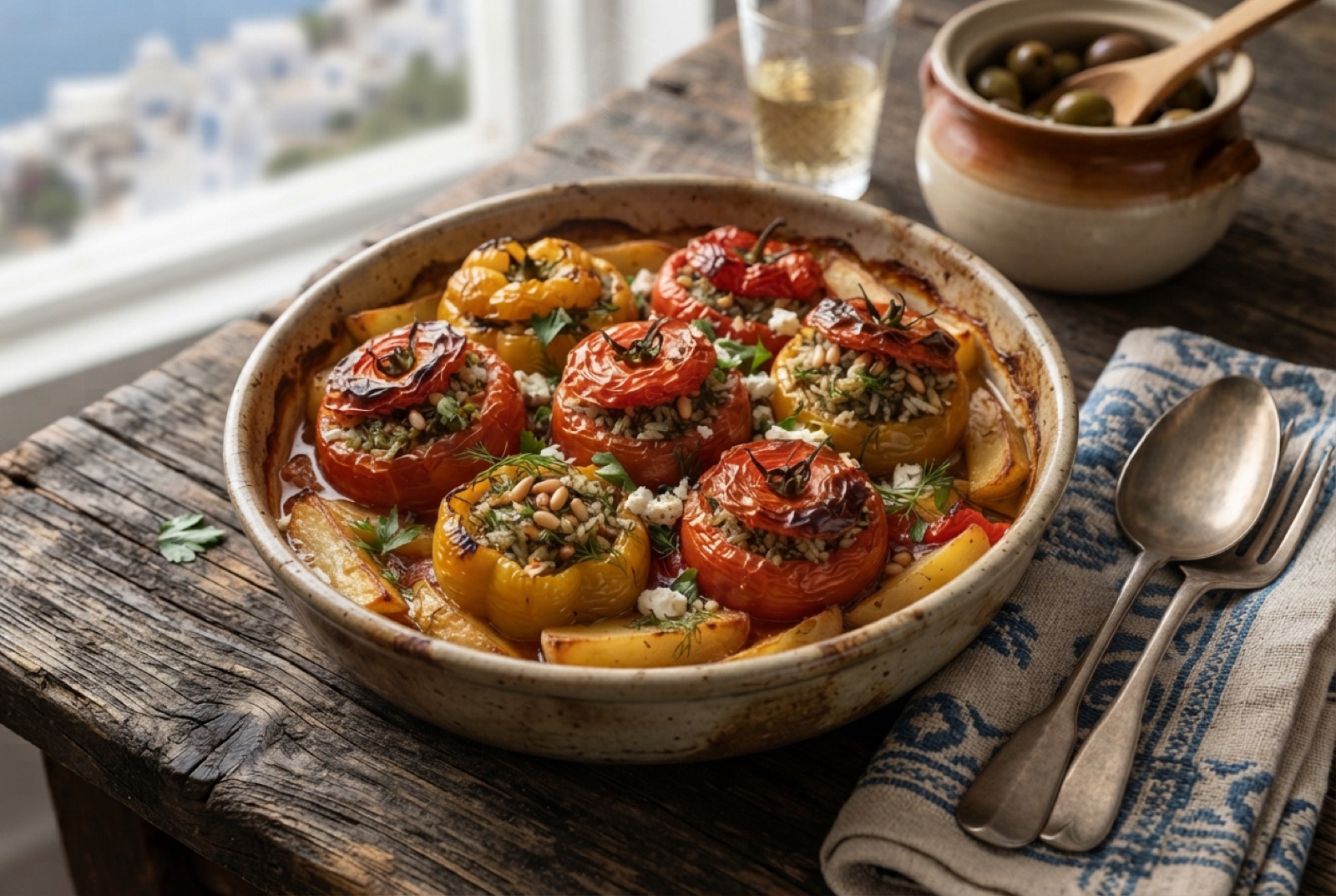
Greece has 9 more dishes in the atlas — Fasolada and Gemista, and 7 more.
Recipe by The DishRoute Kitchen · published August 19, 2026 · updated August 19, 2026