Töltött Káposzta.
Hungarian Sour Cabbage Rolls
Töltött káposzta · say it: TUR-lurt KAH-pos-taw
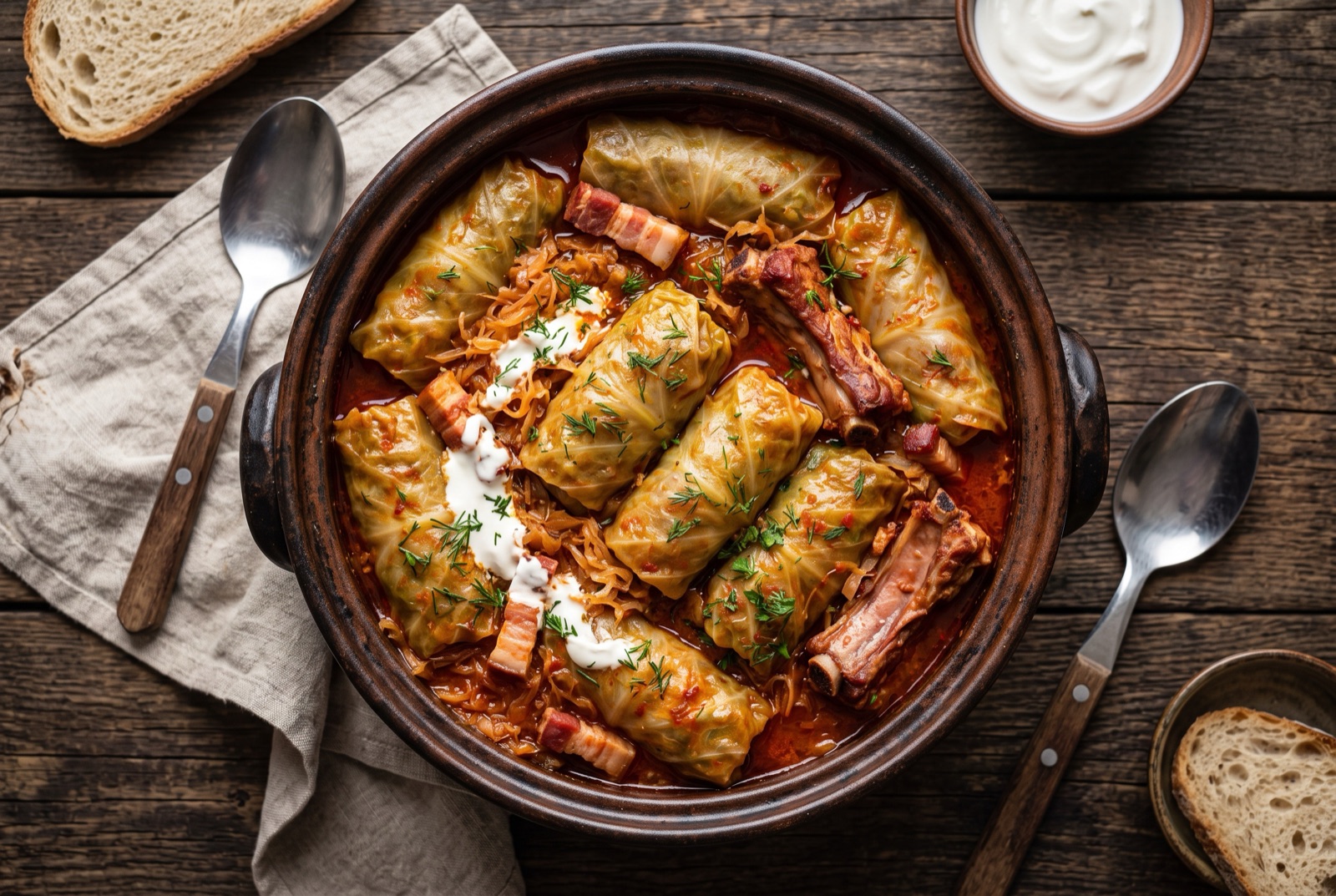
Töltött káposzta is what happens when cabbage rolls are built on sour cabbage rather than fresh. Whole heads of cabbage are brined until the leaves turn translucent and tart, then wrapped around a filling of minced pork, rice, onion and sweet paprika and packed into a pot lined with shredded sauerkraut and smoked pork ribs. Two hours of low simmering does the rest: the rolls take on smoke from the meat, the kraut softens into something jammy and savoury, and the liquid turns into a sharp red broth you will want bread for. It is sour, smoky, and considerably less heavy than it looks, because the acidity of the cabbage cuts straight through the pork fat. A spoonful of cold sour cream on top is not optional in Hungary.

- Gate
- HungaryNationwide
- Prep
- 45 min
- Cook
- 2 hr 30 min
- Total time
- 3 hr 35 min incl. 20 min rest
- Serves
- 6
- Status
- Medium
- Nutrition / serving · estimated
- Calories 590 kcal
- Protein 34 g
- Carbs 27 g
- Fat 38 g
- Fiber 6 g
- Sodium 1250 mg
Why this recipe works.
- Built on brined sour cabbage, which is what separates the Hungarian version from its milder neighbours.
- Smoked ribs go in the pot rather than the filling, so the smoke perfumes everything instead of one bite.
- Explains how to handle both whole brined heads and jarred leaves, since availability varies wildly.
- The filling is loose and only lightly packed, which keeps the rolls tender rather than dense.
Ingredients.
16 itemsFor the pot
For the filling
To serve
Equipment
- Large heavy pot or Dutch oven with a lid
- Small sharp knife for trimming the leaf ribs
- Heatproof plate to weight the rolls
Instructions.
Prepare the leaves
Separate the sour cabbage leaves and taste a scrap. If it is very salty, rinse the leaves under cold water and pat them dry. Shave the thick rib at the base of each leaf flat with a knife so it will roll without cracking, and shred any torn or small leaves to add to the kraut.
Cook the onions and build the filling
Melt the lard in a pan and cook 2 of chopped onions over medium-low heat for 10 minutes until soft and translucent. Add the garlic for 30 seconds, pull the pan off the heat, stir in the paprika until it turns deep red, then tip the mixture into a bowl and let it cool to lukewarm.
Tip Adding hot onions straight to raw pork starts cooking the meat and makes the filling greasy.
Mix the filling loosely
Combine the minced pork, rice, cooled onion mixture, egg, black pepper and a modest pinch of salt. Mix with your hands only until it just comes together — overworking gives you a springy, sausage-like texture instead of a tender one.
Roll the cabbage
Lay a leaf flat with the trimmed rib nearest you, spoon on about two tablespoons of filling in a log, fold the near edge over, tuck both sides in firmly, and roll it up. Repeat with the rest — you should get 14 to 16 rolls. The filling should be enclosed but not packed tight, so the rice has room to swell.
Layer the pot
Spread half the sauerkraut over the base of a heavy pot and lay the smoked ribs on top. Pack the rolls in seam side down in a tight single layer, add a second layer if needed, then cover with the remaining sauerkraut and the bay leaves.
Add the paprika broth
Whisk the tablespoon of paprika into the litre of water and pour it over the pot until the liquid just covers the top layer of kraut. Press an inverted heatproof plate down on top to keep everything submerged.
Simmer low and long
Bring to a bare simmer, cover, and cook over the lowest heat for 2 hours 30 minutes, checking twice that the liquid has not dropped below the rolls and topping up with hot water if it has. It is done when a roll cuts cleanly with no chalky rice and the kraut has turned soft and slightly sweet.
Tip You are listening for the occasional bubble, not a steady one. A boiling pot tears the leaves.
Rest, then serve with sour cream
Turn off the heat and let the pot stand covered for 20 minutes so the rolls firm up and lift out whole. Pull the meat from the smoked ribs and return it to the kraut, then serve two rolls per person over a bed of kraut with plenty of broth and a cold spoonful of sour cream on top.
Tips from our kitchen.
- Taste a piece of the raw sour cabbage first. If it is aggressively salty, rinse the leaves briefly in cold water and pat dry.
- Cut out the thick rib at the base of each leaf, or shave it flat, so the roll can be wrapped tightly without tearing.
- Use pork with about 20 percent fat. Very lean mince gives dry, crumbly rolls no matter how long you simmer them.
- Pack the rolls seam side down and snugly against each other, so they cannot unroll during the long simmer.
- Weigh the top layer down with an inverted heatproof plate to keep everything under the liquid.
- Make it a day ahead. The flavour genuinely improves overnight and the rolls firm up so they lift out intact.
Substitutions.
- Whole brined sour cabbage head → Jarred sour cabbage leaves, or blanched fresh cabbage leaves plus 3 tbsp sauerkraut brine
- Jarred leaves are sold by Central European and Balkan grocers and work identically. Fresh leaves make a milder, sweeter dish — adding brine or a splash of vinegar gets some of the sourness back.
- Smoked pork ribs → Smoked ham hock, smoked bacon or smoked paprika sausage
- Any properly smoked cured pork will do the job. Do not substitute unsmoked meat and try to compensate with smoked paprika — the results taste artificial.
- Minced pork → Half pork and half beef, or all minced turkey with 2 tbsp oil added
- A pork and beef mix is common in Hungarian homes. Poultry needs added fat or the filling turns dry and grainy.
Variations.
- Kolozsvári töltött káposzta
- The richest version: alternating layers of rolls, sauerkraut and smoked meat, finished with a thick blanket of sour cream and baked briefly before serving.
- Székelykáposzta
- Not stuffed at all — cubed pork stewed with sauerkraut, paprika and sour cream. Same flavours, a fraction of the work, and a weeknight standby.
- Roux-thickened pot
- Some families finish with a rántás, a pale flour-and-lard roux whisked into the cooking liquid, turning the broth into a thick sauce. Divisive, and entirely traditional.
Storage & reheating.
Refrigerate up to 4 days in the cooking liquid — it improves markedly by day two as the smoke and sourness even out. Reheat gently in a covered pot on the hob or in a low oven; a microwave dries the rolls out at the edges. It freezes very well for 3 months, again in plenty of liquid, and thaws without the filling going grainy. Do not add the sour cream before freezing; spoon it on cold at serving.
Serve with
Cold sour cream spooned over each portion, dense rye or white bread, and a shaker of hot paprika.
The story behind Töltött Káposzta.
Stuffed cabbage belongs to the whole region rather than to any one country, and the Hungarian claim is not that it invented the idea but that it insists on sour cabbage. Serbia has sarma, Poland has gołąbki, Romania has sarmale, and the Balkan and Turkish family of stuffed leaves runs back through Ottoman cooking to the dolma tradition — the word sarma itself is Turkish, from a verb meaning to wrap. Hungary sat at the meeting point of those influences for centuries, and töltött káposzta shows it: the Ottoman wrapping technique, the Central European brined cabbage, and paprika as the marker that makes it unmistakably Hungarian.
The sour cabbage is the argument. Fresh cabbage leaves, blanched and rolled, produce a mild sweet dish; brined leaves produce something sharper, funkier and much more interesting, and they hold together better through a long cook. Hungarian households traditionally bought or fermented whole heads of cabbage in autumn, which is why the dish is anchored to cold weather and to the calendar — it is standard at Christmas, on New Year, and at the end of a long night, when a bowl of it is regarded as a serious defence against a hangover.
The Kolozsvári version, named after the Transylvanian city of Cluj-Napoca, layers the rolls with extra sauerkraut and smoked meat and finishes with a heavy hand of sour cream. Székelykáposzta, confusingly, is not stuffed at all — it is the same flavour profile made as a straightforward pork and sauerkraut stew. Every family also has a fixed opinion about whether the pot gets thickened with a roux at the end, and there is no winning that discussion. What everyone agrees on is that töltött káposzta is better on the second day, which is why it is usually made in a quantity that guarantees leftovers.
Questions, answered.
Where do I buy sour cabbage leaves?
Central European, Balkan, Polish and Turkish grocers sell whole fermented cabbage heads in autumn and winter, and jarred or vacuum-packed sour leaves year round, often labelled sarma leaves or kiszona kapusta. If you cannot find any, blanch fresh cabbage leaves until pliable and add three tablespoons of sauerkraut brine or a splash of vinegar to the pot to approximate the sourness.
Why do my cabbage rolls fall apart?
Usually because they were packed loosely or the pot was boiled rather than simmered. Roll them tightly with the sides tucked in, place them seam side down, and pack them snugly so they hold each other in shape. Then keep the liquid at a bare shiver — a rolling boil agitates the pot and works the leaves loose over two hours.
Should the rice in the filling be cooked first?
No. Use raw or very briefly rinsed long-grain rice and use less than you think — about 100 grams for 700 grams of meat. It swells as it absorbs juices during the long simmer, and pre-cooked rice turns to paste. Too much raw rice is the usual cause of dense, stodgy rolls.
Can I make töltött káposzta in the oven?
Yes, and many Hungarian cooks prefer it. Assemble the pot exactly the same way, cover it tightly, and bake at 160°C for about two and a half hours. The oven heats more evenly than a hob burner, so there is less risk of the bottom layer catching, and the top can be uncovered for the final twenty minutes.
What is the difference between Hungarian töltött káposzta and Serbian sarma?
They are close cousins and both use brined sour cabbage. The Hungarian version leans harder on sweet paprika in the filling and in the pot, and is generally served with sour cream; Serbian sarma often uses more smoked meat and less paprika, and sometimes no rice at all. Regional families overlap so much that arguing about ownership is a hobby rather than a settled question.
You might also like.
All recipes →
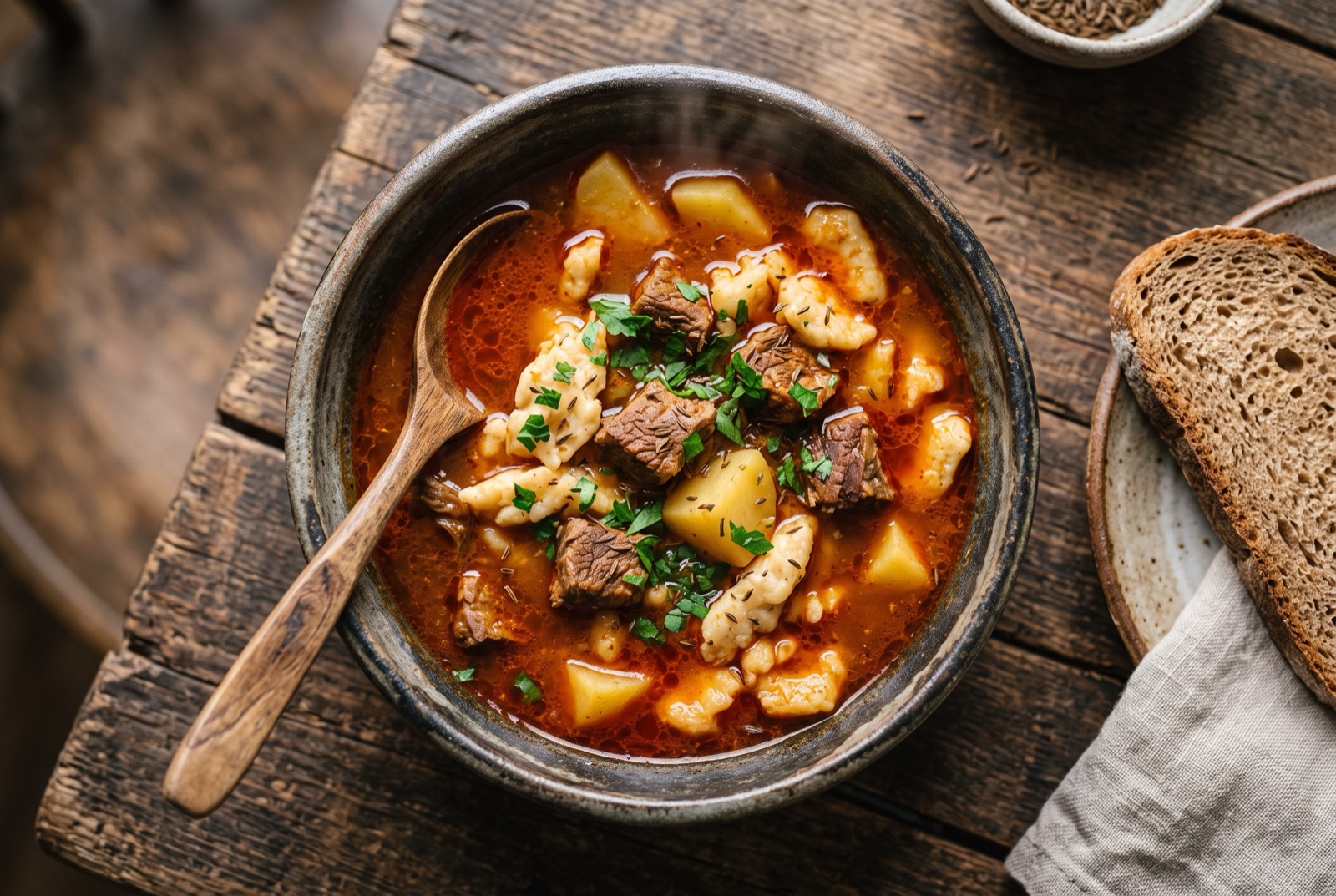
Keep exploring Hungary.
Hungary has 9 more dishes in the atlas — Dobos Torta and Gulyás, and 7 more.
Recipe by The DishRoute Kitchen · published August 20, 2026 · updated August 20, 2026