Iraqi Dolma.
Mixed Stuffed Vegetables in One Pot
دولمة عراقية · say it: DOL-ma
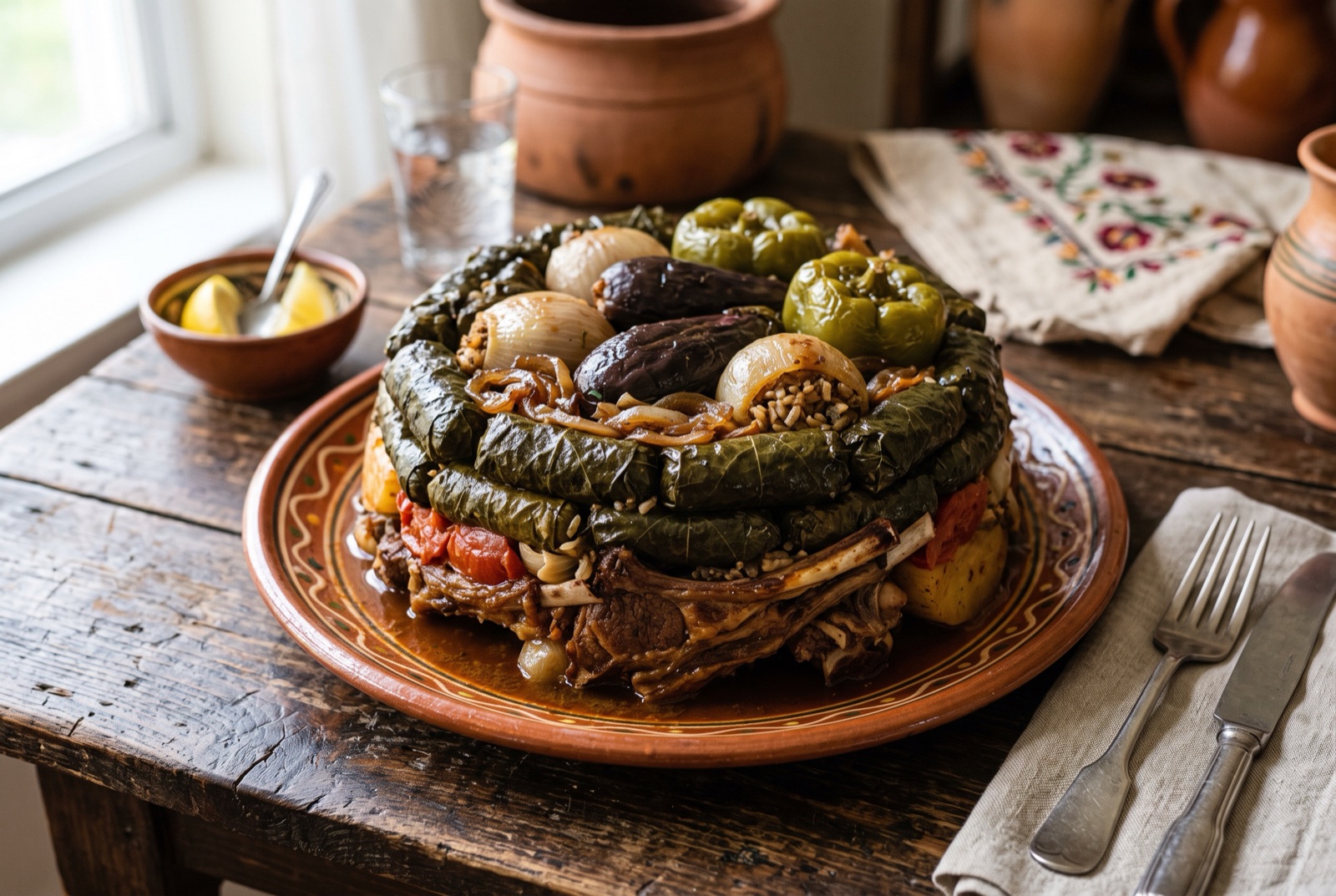
Iraqi dolma is not a plate of stuffed vine leaves — it is an entire pot of different vegetables, each hollowed or unrolled, each filled with the same rice-and-lamb mixture, then stacked in tight layers over a base of lamb ribs and simmered under a sour red broth of tomato, tamarind and pomegranate molasses. The rice cooks inside the vegetables rather than beside them, so it absorbs everything: fat from the meat, sweetness from the onion, sourness from the broth. At the table the whole pot is inverted onto a tray so it comes out as a single dome. The flavour is rich and deeply sour rather than sharp, and the texture is soft throughout, with no crunch anywhere except the caramelised ribs at the bottom.

- Gate
- IraqNationwide
- Prep
- 1 hr 15 min
- Cook
- 1 hr 50 min
- Total time
- 3 hr 20 min incl. 15 min rest
- Serves
- 6
- Status
- Takes skill
- Nutrition / serving · estimated
- Calories 610 kcal
- Protein 27 g
- Carbs 62 g
- Fat 29 g
- Fiber 7 g
- Sugar 14 g
- Sodium 920 mg
Why this recipe works.
- A single filling used across every vegetable, which is how the dish is actually made and keeps a long recipe manageable.
- A lamb-rib base layer that both prevents scorching and produces the most prized part of the pot.
- Weighted-plate technique so the layers stay packed and the pot can be inverted without collapsing.
- Sour broth balanced with both tamarind and pomegranate molasses, with quantities you can adjust before it is too late.
Ingredients.
21 itemsFor the filling
For the pot
For the broth
Equipment
- Large heavy pot with a lid
- Heatproof plate that fits inside the pot
- Apple corer or narrow spoon for hollowing vegetables
- Wide serving tray for inverting
Instructions.
Mix the filling
Combine the rinsed rice, minced lamb, chopped onion, diced tomato, parsley, tomato paste, baharat, turmeric, oil and salt in a large bowl and work it with your hands for a full minute until the rice is coated and the mixture looks uniformly red-orange rather than streaky.
Tip Taste a pinch of the raw filling for salt — the seasoning here decides the whole pot.
Prepare the vegetables
Hollow the aubergines and courgettes with a corer, leaving walls about 5 mm thick, and salt the cavities lightly for 10 minutes before blotting them dry. Cut the tops off the peppers and remove the seeds. Boil the halved onions for 5 minutes until the layers slip apart easily, then separate them into individual cups.
Roll the vine leaves
Lay each leaf vein side up, put a finger-thick line of filling near the stem end, fold the sides in and roll into a tight cigar about the width of your thumb. Keep them snug but not straining — the rice inside needs somewhere to expand.
Stuff the rest
Fill the peppers, aubergines, courgettes and onion cups no more than three-quarters full, pressing the filling in gently with a teaspoon. Leave the tops open; they will be covered by the layer above.
Line and layer the pot
Arrange the lamb ribs in a single layer across the bottom of a large heavy pot and season them. Pack the rolled vine leaves over the meat in tight rows, then build upward with the onion cups, peppers, courgettes and aubergines, wedging the smallest pieces into any gaps so nothing can shift.
Tip Pack deliberately from the outside in — a loosely filled pot will collapse when you invert it.
Weight it and add the broth
Press a heatproof plate face down onto the top layer. Whisk the passata, strained tamarind, pomegranate molasses, hot water, salt and pepper together, taste it — it should be noticeably sour and well seasoned — then pour it down the side of the pot until it reaches about two-thirds up the vegetables.
Simmer low and slow
Bring the pot to a simmer over medium heat, then drop it to the lowest setting, cover, and cook for 1 hour 45 minutes. The broth should barely move. Toward the end the pot smells sweet and sour together and the vegetables have visibly sunk as the rice absorbs liquid.
Check the rice
Lift the plate and open one stuffed pepper. The rice should be fully soft with no chalky centre. If it is still firm, pour in a cup of hot water down the side of the pot, replace the plate and lid and give it another 20 minutes on low.
Rest, then invert
Take the pot off the heat and let it stand, covered, for 15 minutes. Remove the plate, tip most of the remaining broth into a jug, set a wide tray over the pot, and flip the whole thing over in one movement. Lift the pot away, spoon the reserved broth back over the dome and serve straight from the tray.
Tips from our kitchen.
- Use short-grain or medium-grain rice rather than basmati; it swells softer and binds the filling instead of staying separate and falling out.
- Rinse the rice until the water runs clear but do not soak it — soaked rice absorbs broth too fast and bursts the vegetables from the inside.
- Salt the hollowed aubergines and courgettes for ten minutes and blot them dry, or they will release water and thin the broth.
- Pack each vegetable only about three-quarters full. Rice expands, and an overstuffed pepper splits and empties itself into the pot.
- Set a heatproof plate directly on the packed vegetables before adding liquid — it keeps everything compressed so the dome holds when you invert it.
- Taste the broth before pouring; it should be aggressively sour and well salted, because two hours of cooking and a pot of bland rice will mute it considerably.
Substitutions.
- Fresh vine leaves → Jarred vine leaves in brine, rinsed well
- Jarred leaves are already tender, so skip the blanching step entirely and handle them gently — they tear more easily than fresh.
- Lamb ribs for the base → Lamb shoulder chops, or a layer of thick potato slices for a meat-free base
- The base layer exists to protect the vegetables from direct heat as much as to add flavour, so potato alone works if you are not eating meat.
- Pomegranate molasses → Extra tamarind plus 1 tsp sugar
- Pomegranate molasses brings sweetness alongside acid; tamarind on its own is sharper, so a little sugar closes the gap.
Variations.
- Meat-free dolma
- Very common in Iraq during fasting periods: fill everything with rice, herbs, tomato, chickpeas and plenty of fried onion, and line the pot with potato slices instead of ribs.
- Chard-leaf dolma
- Swiss chard leaves used instead of, or alongside, vine leaves. They are softer and slightly bitter, and they cook faster, so they go in the upper layers.
- Kurdish yaprakh
- The northern relative, generally more tightly rolled, less sour, and often finished with a squeeze of lemon rather than a tamarind-heavy broth.
Storage & reheating.
Dolma keeps 3 days refrigerated and many Iraqis say it is better on the second day, once the sourness has settled into the rice. Store it in its broth in a covered container rather than on the serving tray, or the vegetables dry out. Reheat covered in a low oven at 150°C for 25 minutes, or in a wide pan over low heat with a few spoonfuls of water in the bottom. It freezes acceptably for a month, though vine leaves come out softer; thaw fully in the fridge before reheating so the rice does not go gluey.
Serve with
Plain yoghurt, a plate of pickles and flatbread — nothing else is needed, since the rice is already in the dish.
The story behind Iraqi Dolma.
Stuffed vegetables belong to the whole eastern Mediterranean and beyond, and arguing about who invented them is a waste of an afternoon — Greeks, Turks, Armenians, Levantines and Iranians all have serious claims and their own versions. What makes the Iraqi dish specific is not the concept but the assembly. Where a Turkish dolma might be one vegetable done well, the Iraqi version is deliberately plural: vine leaves and chard, small onions unwrapped into single layers, peppers, aubergines, courgettes, sometimes tomatoes, all in one pot, all cooked together, all tasting slightly different because of what encloses them.
The second Iraqi specific is the sourness. The cooking liquid is built on tomato with tamarind or pomegranate molasses stirred in, and it is poured over the top so it travels down through every layer as the pot cooks. The base of the pot is lined with lamb ribs or chops and often slices of potato, which do two jobs: they stop the vegetables scorching, and they turn into the best part of the dish, meat and starch sitting in reduced, concentrated broth for two hours.
Dolma is a dish that announces an occasion. It takes a morning to make properly, it is impossible to scale down convincingly, and it is one of the things Iraqi families cook when a lot of people are coming. The final gesture is theatrical and slightly nerve-racking: a wide tray is set over the mouth of the pot, the whole thing is flipped in one movement, and the pot is lifted away to reveal the stacked vegetables standing as a dome, ribs on top, broth soaking down through. Cooks who have done it a hundred times still get a second person to hold the tray.
Questions, answered.
What is the difference between Iraqi dolma and Turkish or Greek dolma?
Iraqi dolma is a whole mixed pot rather than one vegetable. Vine leaves, onions, peppers, aubergines and courgettes are all stuffed with the same filling and cooked together in layers over lamb ribs, under a sour tomato-tamarind broth, then turned out as a single dome. Greek dolmades and most Turkish versions concentrate on rolled vine leaves alone, are usually less sour, and are often served cold in olive oil.
Why did my rice come out crunchy?
Almost always too little liquid or too fast a boil. The broth needs to come roughly two-thirds of the way up the packed vegetables and the pot must stay at a bare simmer, covered, for at least ninety minutes so steam circulates. If you check at the end and the rice is still firm, add a cup of hot water down the side of the pot and give it another twenty minutes rather than raising the heat.
How do I flip the pot without it falling apart?
Let the pot sit off the heat for 15 minutes so everything settles and firms up, then remove the weighting plate and drain most of the remaining broth into a jug. Set a wide tray over the pot, hold tray and pot rims together firmly with cloths, and turn the whole thing over in one confident movement rather than tilting slowly. Lift the pot straight up, then spoon the reserved broth back over the dome.
Can I prepare dolma in advance?
Yes, and it is the sensible way to cook it. You can stuff and layer everything in the pot up to a day ahead, cover it and refrigerate without adding the broth, then pour over the hot liquid and cook when you need it. Fully cooked dolma also reheats well, so making it the day before a gathering is standard practice rather than a compromise.
Do I have to use every vegetable listed?
No. The principle is variety and a full pot, not a fixed list. Vine leaves plus two or three other vegetables makes a legitimate dolma, and cooks work with whatever is in season. What matters is that the pot is packed tightly enough that nothing shifts during cooking, so use more of what you have rather than leaving gaps.
You might also like.
All recipes →
Keep exploring Iraq.
Iraq has 9 more dishes in the atlas — Bamia and Kahi wa Geymar, and 7 more.
Recipe by The DishRoute Kitchen · published August 20, 2026 · updated August 20, 2026