Masgouf.
Iraqi Split-Grilled River Carp
مسكوف · say it: mas-GOOF
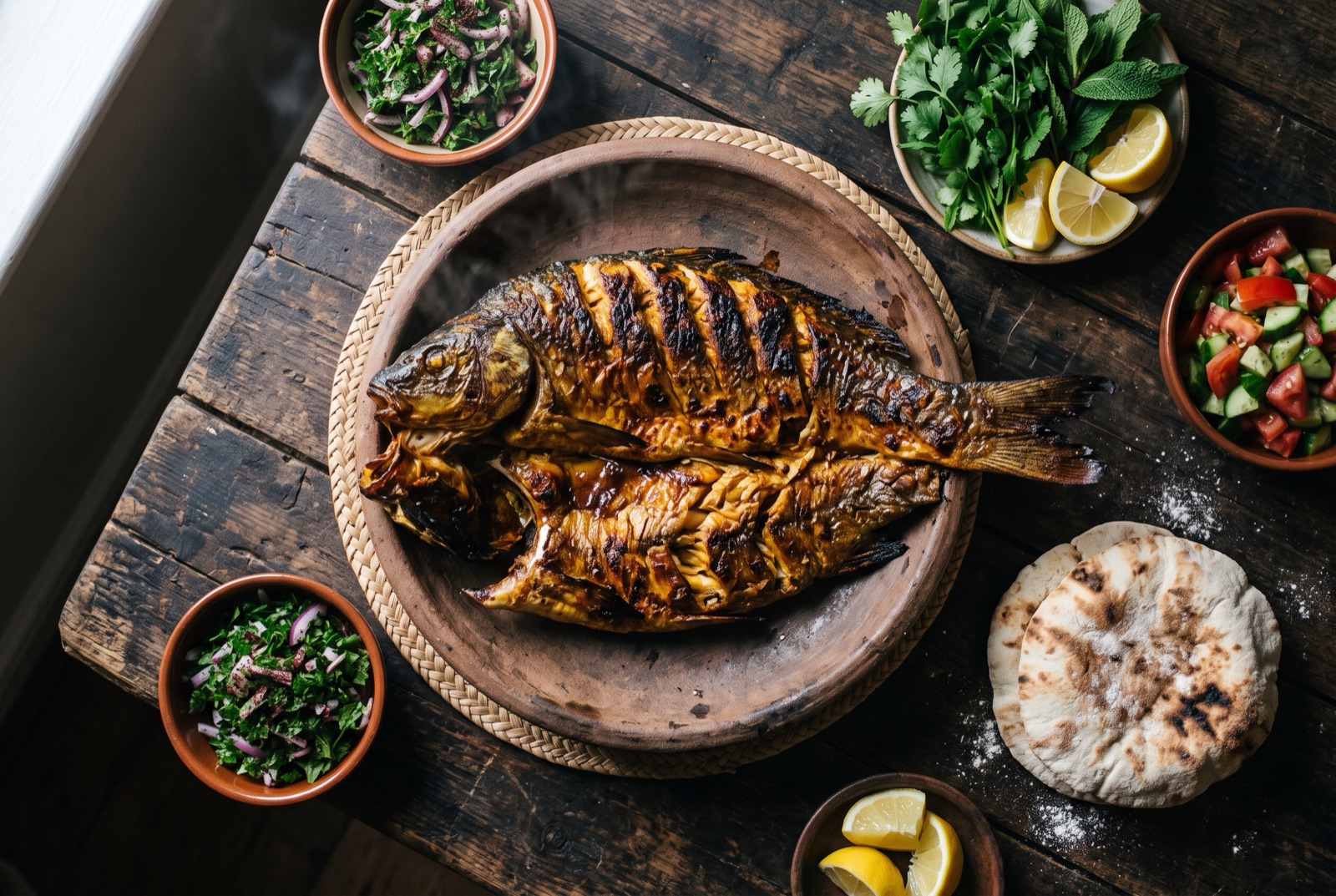
Masgouf is a whole freshwater fish — classically carp — split open down the spine so it lies flat like an open book, rubbed with a thin tamarind-and-turmeric paste, and cooked very slowly by radiant heat before being finished directly over embers. The flesh ends up dense rather than flaky, faintly sweet from the river fish itself, sour and slightly resinous from the tamarind, and heavily perfumed with smoke on the skin side. Along the Tigris it is cooked outdoors in front of a standing fire of apricot or orchard wood, the fish staked upright in a ring around the flames, and eaten with bread, raw onion and pickles rather than with rice. This version adapts the geometry to a domestic grill or oven without giving up the two things that matter: gentle heat first, hard smoke last.

- Gate
- IraqBaghdad and the Tigris
- Prep
- 30 min
- Cook
- 1 hr
- Total time
- 1 hr 30 min
- Serves
- 4
- Status
- Medium
- Nutrition / serving · estimated
- Calories 520 kcal
- Protein 46 g
- Carbs 18 g
- Fat 28 g
- Fiber 3 g
- Sugar 6 g
- Sodium 780 mg
Why this recipe works.
- Two-stage cooking — long gentle heat, then a short hard finish over the embers — which is what actually reproduces the riverbank texture on a home grill.
- A real tamarind rub rather than a generic lemon marinade, because the sourness is the point of the dish.
- Clear guidance on butterflying the fish down the back instead of the belly, the cut that defines masgouf.
- An honest oven-plus-broiler fallback for anyone without a live fire, with the trade-offs spelled out.
Ingredients.
12 itemsFor the fish
For the rub
To serve
Equipment
- Charcoal grill or fire pit (or an oven with a broiler)
- Large sharp knife or kitchen shears
- Fish basket or two large flat grill racks
- Instant-read thermometer
Instructions.
Butterfly and trim the fish
Lay the carp on its side and cut along one side of the backbone from head to tail, then open the fish out flat, leaving the belly skin joined so both halves stay connected. Trim away the dark reddish strip running down the centre of each fillet — that is where any muddy flavour concentrates — and pat the whole fish bone dry.
Tip A fishmonger will do this cut in half a minute. Ask for it butterflied down the back, not the belly.
Make the tamarind rub
Whisk the strained tamarind liquid with the oil, turmeric, baharat and crushed garlic until it looks like thin mud and coats the back of a spoon. Do not add the salt yet.
Paint the fish
Brush the rub generously over the cut flesh and into every crease, then turn the fish and coat the skin side as well. Leave it uncovered at room temperature for 20 minutes so the surface dries slightly and the turmeric stains the flesh yellow.
Build a one-sided fire
Light a chimney of charcoal and rake it all to one side of the grill, adding a few chunks of untreated fruitwood if you have them. You want a fire you can hold your hand near for four or five seconds — radiant heat, not a searing bed directly under the fish.
Cook slowly, skin side down
Clamp the fish in a fish basket or sandwich it between two racks and set it skin side down on the cool side of the grill, as far from the coals as it will sit. Cover and cook for about 45 minutes, turning the basket end to end every 15 minutes so it colours evenly. The flesh should slowly go from glassy to opaque without ever sizzling hard.
Tip If the skin is already dark at the 15-minute mark, move the fish further from the fire or damp the coals down.
Salt, then finish over the embers
Sprinkle the coarse salt over the flesh, then move the basket directly over the coals flesh side down for 4–6 minutes. Scatter soaked wood chips on the fire at this moment. You are looking for scorched edges, a hard smoky smell, and beads of fat rising on the surface — not for further cooking.
Check and rest briefly
Open the basket and press the thickest part behind the head; it should flake cleanly to the bone and read about 60°C. Slide the fish flat onto a large board or tray and let it sit for 5 minutes while you lay out the bread and vegetables.
Serve on the board
Surround the fish with the sliced onion, tomato, lemon wedges and pickles and bring the whole board to the table with warm flatbread. Everyone tears off bread, lifts fish straight from the board and builds their own bites — no plating, no cutlery.
Tips from our kitchen.
- Ask the fishmonger to butterfly the carp down the back and leave the belly skin joined — this is a hard cut to do well the first time and takes them thirty seconds.
- Dry the fish thoroughly with paper towels before rubbing it. A wet surface steams instead of taking on colour, and the skin will never blister properly.
- Keep the fish far from the flames at first. If the skin is browning within ten minutes the heat is too high, and the inside will still be raw when the outside is finished.
- Salt the flesh side only in the last twenty minutes of cooking; salting at the start pulls out moisture that the long slow phase cannot put back.
- Soak a couple of handfuls of untreated fruitwood chips and scatter them on the coals for the final flesh-down phase — that short burst is where the smoke flavour is made.
- If the fish tastes muddy to you, serve more raw onion and more lemon rather than more spice; that is exactly what the traditional accompaniments are for.
Substitutions.
- Whole carp → Whole sea bass, grey mullet, trout or tilapia, 1.5–2 kg
- Carp is traditional and holds up best to the long cook. Any firm whole fish works, but thin-fleshed fish need the slow phase cut roughly in half.
- Tamarind pulp → 2 tbsp tamarind concentrate, or 3 tbsp pomegranate molasses
- Pomegranate molasses is sweeter and darker but sits in the same sour family, and is genuinely used in some Iraqi households.
- Charcoal or wood fire → Oven at 170°C, then 5 minutes under a hot broiler
- The texture comes out right; the smoke does not. Add a pinch of smoked paprika to the rub if you are going the oven route and want a hint of it.
Variations.
- Masgouf with amba
- Served with amba, the tangy fermented mango pickle that came to Iraq through Basra trade. A spoonful on top of a bite of fish and bread is the standard riverside move.
- Tomato-topped finish
- Some cooks lay thin slices of tomato and onion across the flesh for the last stretch of cooking so they soften and scorch into the fish rather than being served raw on the side.
- Simach mahshi
- A related preparation where the butterflied fish is stuffed with fried onion, raisins, almonds and baharat before roasting, turning it from a grill dish into an oven centrepiece.
Storage & reheating.
Masgouf is at its best within minutes of coming off the fire and does not reward keeping. Leftover flesh will hold 2 days refrigerated in a covered container; pull it off the bones first, because the skin goes leathery and the frame makes it taste stronger overnight. Reheat gently in a covered pan with a splash of water, or better, use it cold in a sandwich with onion, lemon and pickle. Do not freeze cooked masgouf — the texture that the slow cook produces collapses completely on thawing.
Serve with
Flatbread, thickly sliced raw onion, tomato, lemon wedges and a dish of pickles — masgouf is eaten with bread, not with rice.
The story behind Masgouf.
Masgouf belongs to the Tigris more than to any kitchen. The riverbank restaurants of Baghdad built their entire trade on it — tanks of live carp out front, a long open fire of split orchard wood in a shallow pit, and the fish staked in a semicircle around it, skin outward, cooking for an hour or more from nothing but radiant heat. Only at the end are they laid flat on the embers, flesh side down for a few minutes, which is the moment the smoke actually gets in. The word itself points at the method rather than the fish: it describes something propped up and slow-roasted rather than grilled in the ordinary sense.
Carp is the traditional choice because it is what the river gives, and because its firm, fatty flesh survives a long slow cook without drying. That same fish is treated with suspicion in a lot of European kitchens for tasting muddy, and the Iraqi treatment answers that objection directly: the tamarind rub, the raw onion and the pickled vegetables eaten alongside are all working against any earthiness in the flesh. Eaten this way, with torn bread and a squeeze of lemon, the muddiness argument mostly evaporates.
It is also social food, not a weeknight dinner. Masgouf is ordered for a table of people, cooked to order over the better part of an hour, and brought out on a large tray with the flat fish still on its board, surrounded by flatbread, sliced onion, tomato, lemon and amba. Nobody plates it. Everybody tears bread and works inward from the edges, and the meal takes as long as it takes. Iraqis abroad tend to name it first when asked what they miss, which is a fair measure of its standing: not the most complicated dish in the country, but the one most tied to a specific riverbank and a specific afternoon.
Questions, answered.
Why is the fish cut down the back and not the belly?
Cutting along the spine and opening the fish out leaves the belly skin intact, which forms a natural hinge and holds the two halves together as one flat sheet. That shape is what allows the fish to be staked upright beside a fire without falling apart, and it also keeps the fattier belly meat protected from the direct heat so it bastes the rest as it cooks.
Can I make masgouf without a wood fire?
Yes, though you trade away the smoke. Roast the butterflied fish flesh-side up in a 170°C oven for about 45 minutes, then run it under a very hot broiler for 5 minutes to blister the surface. The flesh will be correct in texture and seasoning; for a hint of the original, add smoked paprika to the rub or finish it on a gas grill with soaked wood chips in a foil packet.
How do I stop carp from tasting muddy?
Muddiness lives mostly in the dark lateral line meat and the skin, so trim the dark strip along the centre of each fillet after butterflying and rinse the fish in cold salted water. The tamarind rub, the raw onion and the lemon served alongside are all traditional counterweights, and using a farmed carp from clean water rather than a wild river fish helps more than any technique.
How do I know when the fish is done?
The thickest part of the flesh, right behind the head, should be opaque all the way to the bone and register about 60°C on an instant-read thermometer. Visually, the flesh loses its glassy look and the surface fat starts to bead up. Because masgouf is cooked slowly, it is far more forgiving than a fast-grilled fillet, but past 65°C it starts to go dry and cottony.
What do I serve with masgouf?
Bread, raw vegetables and something sour — never rice. The Iraqi table sets out flatbread, thickly sliced onion, tomato, lemon wedges, pickled turnips or cucumbers and often amba mango pickle. Diners tear bread, take a piece of fish, add onion and pickle, and eat with their hands, which is why nothing on the table needs a knife.
You might also like.
All recipes →
Keep exploring Iraq.
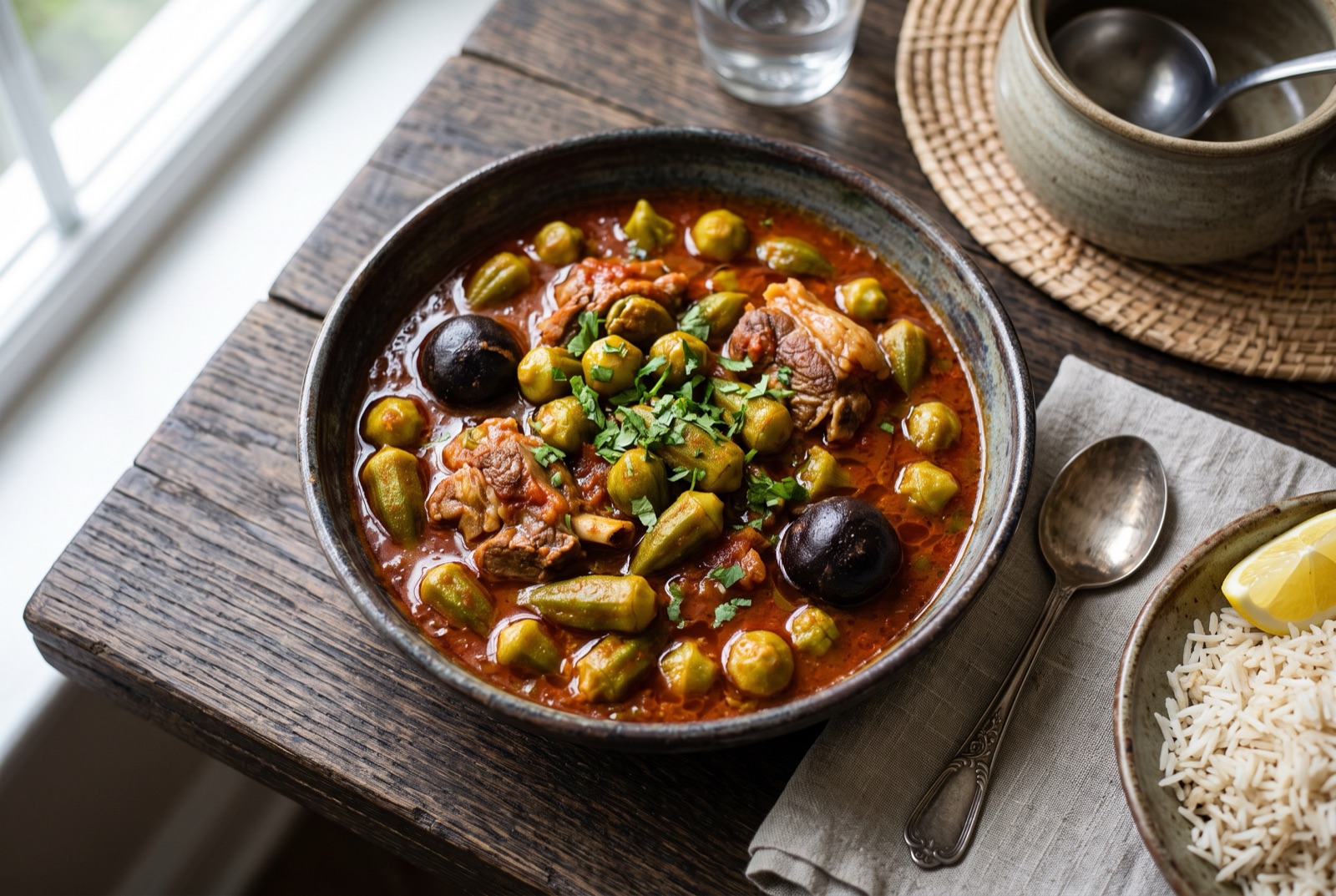
Iraq has 9 more dishes in the atlas — Bamia and Iraqi Dolma, and 7 more.
All Iraq recipes Tamarind recipes Turmeric recipes Lemon recipes mainpescatariandairy freegluten freeRecipe by The DishRoute Kitchen · published August 20, 2026 · updated August 20, 2026