Jani me Fasule.
Albanian White Bean Pot with Mint
Jani me fasule · say it: YAH-nee meh fah-SOO-leh
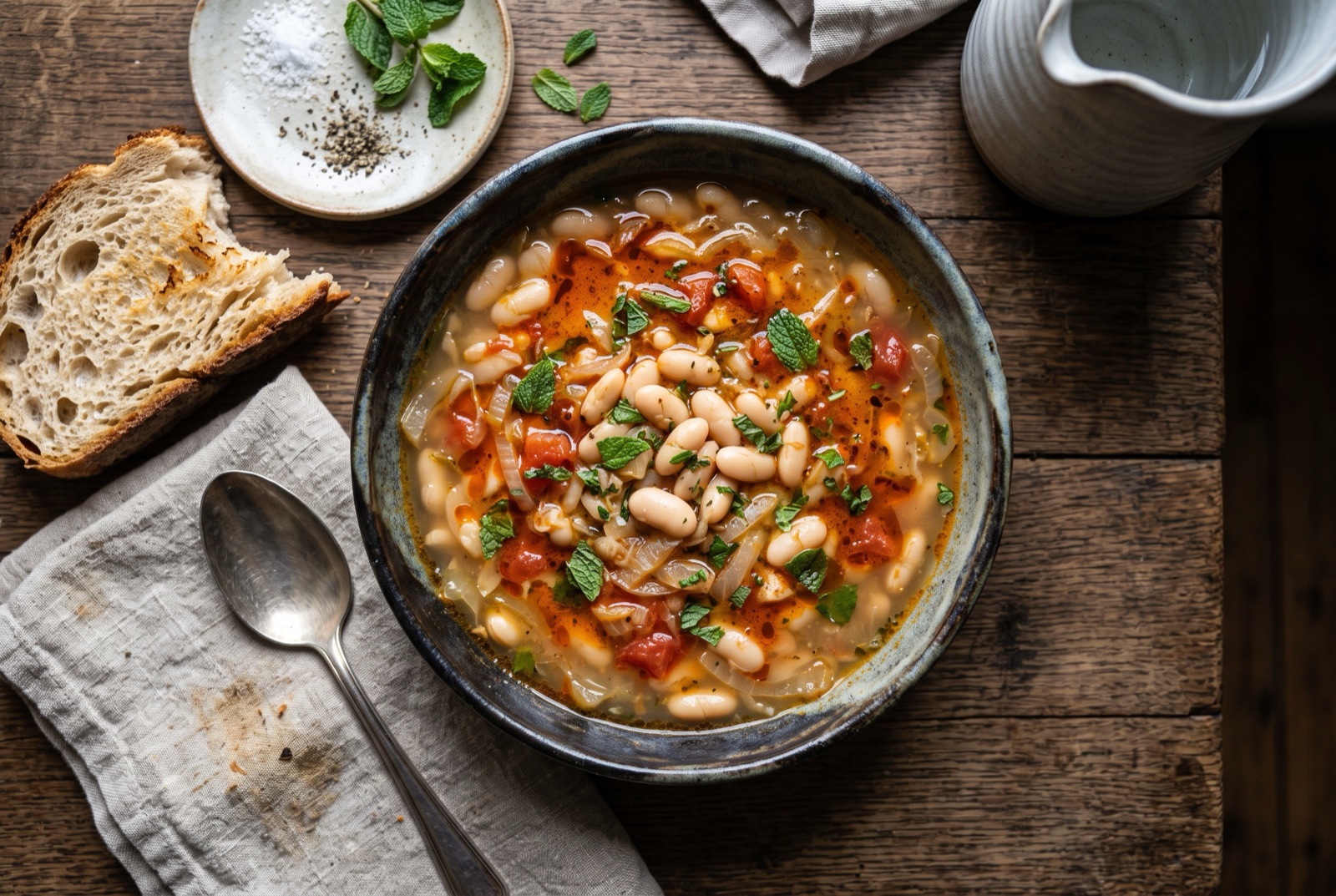
Jani me fasule is a pot of white beans cooked slowly with onion, tomato and dried mint, loosened rather than thickened, and finished by pouring over olive oil in which paprika has been briefly bloomed until it turns bright orange. It tastes clean and savoury with a definite herbal edge from the mint — nothing smoky, nothing meaty, no stock cube — and the paprika oil sitting on the surface is what makes it look and taste like more than boiled beans. Albanians eat it as a soup with bread, as a main course with pickles, and cold the next day, when it thickens and tastes better. It is vegetarian by tradition rather than by design.

- Gate
- AlbaniaNationwide
- Prep
- 15 min
- Cook
- 1 hr 40 min
- Total time
- 9 hr 55 min incl. 8 hr rest
- Serves
- 6
- Status
- Easy
- Nutrition / serving · estimated
- Calories 390 kcal
- Protein 18 g
- Carbs 50 g
- Fat 13 g
- Fiber 16 g
- Sugar 6 g
- Sodium 520 mg
Why this recipe works.
- Cooks the beans in plain water first so they go creamy, adding salt and tomato only once they are tender.
- Uses dried mint, added in two stages, which is how the herbal flavour survives an hour of simmering.
- Ends with a proper paprika oil poured over off the heat, so the paprika stays sweet instead of turning bitter.
- Naturally vegan, made from pantry ingredients, and better on the second day than the first.
Ingredients.
14 itemsFor the pot
For the paprika oil
To finish
Equipment
- Large heavy pot with a lid
- Small frying pan for the paprika oil
- Ladle
Instructions.
Boil the beans plain
Cover the drained soaked beans with 2 litres of fresh cold water, bring to the boil and skim off the foam that rises. Drop to a lazy simmer, add one bay leaf, and cook uncovered for 45–60 minutes until a bean crushes easily between your fingers.
Tip No salt yet. Salted water keeps the skins tough and the beans will take twice as long.
Sweat the aromatics
While the beans cook, warm the olive oil in a wide pan and cook the onions and carrot over medium-low heat for 12 minutes until soft, sweet and just beginning to colour. Add the garlic and one teaspoon of the dried mint and stir for a minute.
Combine and season
Tip the onion mixture into the bean pot along with the second bay leaf, then season generously with salt and pepper. Simmer together for 15 minutes so the beans absorb the seasoning.
Add the tomato
Stir in the grated tomatoes and tomato paste and simmer gently for another 25–30 minutes, uncovered, until the broth has body and tastes rounded rather than watery. Top up with hot water if it tightens too far.
Tip Some beans should have collapsed by now — that starch is what thickens the broth naturally.
Make the paprika oil
Heat the remaining olive oil in a small pan until it just shimmers, take it off the heat, and stir in the paprika and chilli flakes. It should foam, turn deep orange and smell sweet within about 15 seconds.
Tip If it smells sharp or the paprika goes brown, throw it out and start again — burnt paprika ruins the pot.
Finish and rest
Pour the paprika oil over the beans, stir in the remaining dried mint, and taste for salt once more. Let the pot stand off the heat for 10 minutes before serving, so the oil settles and the flavours pull together. Ladle into bowls and scatter with parsley.
Tips from our kitchen.
- Soak the beans overnight in plenty of cold water. Unsoaked beans cook unevenly and some will still be chalky when others have burst.
- Do not salt the beans until they are already tender — early salt slows the softening and leaves the skins tough.
- Keep the pot at a bare, lazy simmer. A rolling boil breaks the skins off and clouds the broth into a grey mush.
- Add the tomato only after the beans have softened; acid stops beans cooking any further the moment it hits them.
- Bloom the paprika in oil off the heat for no more than 20 seconds. Paprika burns almost instantly and turns acrid.
- The stew should be spoonable and slightly soupy in the pot, since it thickens noticeably as it stands.
Substitutions.
- Dried white beans → 3 tins of cannellini or butter beans, drained
- Skip the soaking and the first simmer entirely; add the beans with the tomato and cook 20 minutes so they take on the flavour.
- Dried mint → Double the quantity of fresh mint, added at the end only
- Fresh mint loses its character in a long simmer, so treat it as a finishing herb rather than a base seasoning.
- Sweet paprika → Smoked paprika, or paprika plus a little chilli
- Smoked paprika is not traditional here and pushes the dish towards a Serbian style, but it works if that is what you have.
Variations.
- Jani me mish
- Beans cooked with cubes of lamb or beef browned at the start — the celebration version, and heavier by a considerable margin.
- With hot pepper
- A whole dried or fresh hot pepper dropped into the pot for the last twenty minutes, giving a slow warmth rather than sharp heat.
- Fasule pllaqi
- The oven version: the same beans baked in a shallow dish with more tomato and oil until the top dries and browns.
Storage & reheating.
Jani me fasule keeps 4 days refrigerated and improves overnight as the beans continue to absorb the broth. Loosen it with a splash of water when reheating, since it sets almost solid in the fridge. It freezes very well for 3 months in portions; freeze it slightly looser than you want it, and refresh with a new spoon of paprika oil after reheating.
Serve with
Bread, pickled peppers or turshi, raw onion, and crumbled white cheese scattered on top of each bowl.
The story behind Jani me Fasule.
Beans are the backbone of Albanian home cooking and jani is their standard form. The word covers a broad category of simple simmered dishes — jani me fasule, jani me spinaq, jani me presh — and in each case it means vegetables cooked down in oil and water into something between a soup and a stew. Dried white beans stored through the winter, an onion, a spoon of tomato, whatever herb the household dries in summer: this was, for most Albanians through most of the twentieth century, what dinner actually looked like on a weekday. Meat was for Sundays and holidays, and the bean pot carried the rest of the week.
The defining seasoning is mint, usually dried, and it is what separates Albanian bean soup from its Balkan neighbours. Greek fasolada uses celery and lemon; Serbian and Bosnian bean pots lean on smoked meat and paprika together; the Albanian version keeps the paprika but takes the meat out and puts mint in. Some families add a hot pepper, some finish with a splash of vinegar, and in the south a little chopped tomato goes in raw at the end for freshness. Dried mint holds up to long simmering far better than fresh, which is why it is the usual choice even in households with a mint plant on the balcony.
During the years when Albania was largely closed off and food was rationed, this dish carried a particular weight — cheap, filling, made from things that could be grown and stored — and older Albanians have complicated feelings about how often they ate it. It has since been reclaimed as comfort food, and now appears on restaurant menus in Tirana as a deliberately traditional dish, served in small clay bowls to people who grew up on it. The recipe below treats it as it deserves: not as an austerity dish but as a lesson in what onions, beans and good olive oil can do with time.
Questions, answered.
Do I have to soak the beans overnight?
It helps a great deal but is not strictly required. Soaked beans cook faster and more evenly, and fewer of them burst. If you forget, use the quick method: cover the beans with water, bring to a boil for two minutes, take off the heat and leave covered for an hour, then drain and proceed. Unsoaked beans will simply need 45 to 60 minutes longer.
Why are my beans still hard after an hour?
Three usual reasons. The beans are old — dried beans more than a year old can refuse to soften no matter how long you cook them. Salt or acid was added too early, both of which toughen the skins, so hold the salt and tomato until the beans are already tender. Or the water is very hard, in which case a pinch of bicarbonate of soda in the cooking water helps.
Is jani me fasule vegan?
The traditional everyday version is, with no meat, stock or dairy — just beans, vegetables, olive oil and herbs. There is a meat version called jani me mish made with lamb or beef, and many people scatter crumbled white cheese over the bowl at the table, but the pot itself is plant-based as standard rather than as a modern adaptation.
Should it be a soup or a stew?
Somewhere in between, and Albanians disagree happily about where. The broth should be loose enough to spoon and to soak into bread, but the beans should not be swimming. Bear in mind that it thickens considerably as it cools and again overnight, so leave the pot slightly looser than the consistency you actually want to serve.
Why bloom the paprika in oil instead of adding it to the pot?
Paprika is fat-soluble, so its colour and aroma only fully release into hot oil, which is why the finishing step gives that bright orange slick on the surface. Stirring dry paprika into water-based broth gives a duller colour and a flatter taste. Do it off the heat and briefly, though, because paprika scorches within seconds and burnt paprika is unmistakably bitter.
You might also like.
All recipes →
Keep exploring Albania.
Albania has 9 more dishes in the atlas — Byrek me Spinaq and Fërgesë Tirane, and 7 more.
All Albania recipes Onion recipes Tomato recipes Paprika recipes soupmainvegetarianvegangluten freedairy freeRecipe by The DishRoute Kitchen · published August 20, 2026 · updated August 20, 2026