Kalakukko.
Rye-Crusted Fish and Pork Loaf
Kalakukko · say it: KAH-lah-KOO-koh
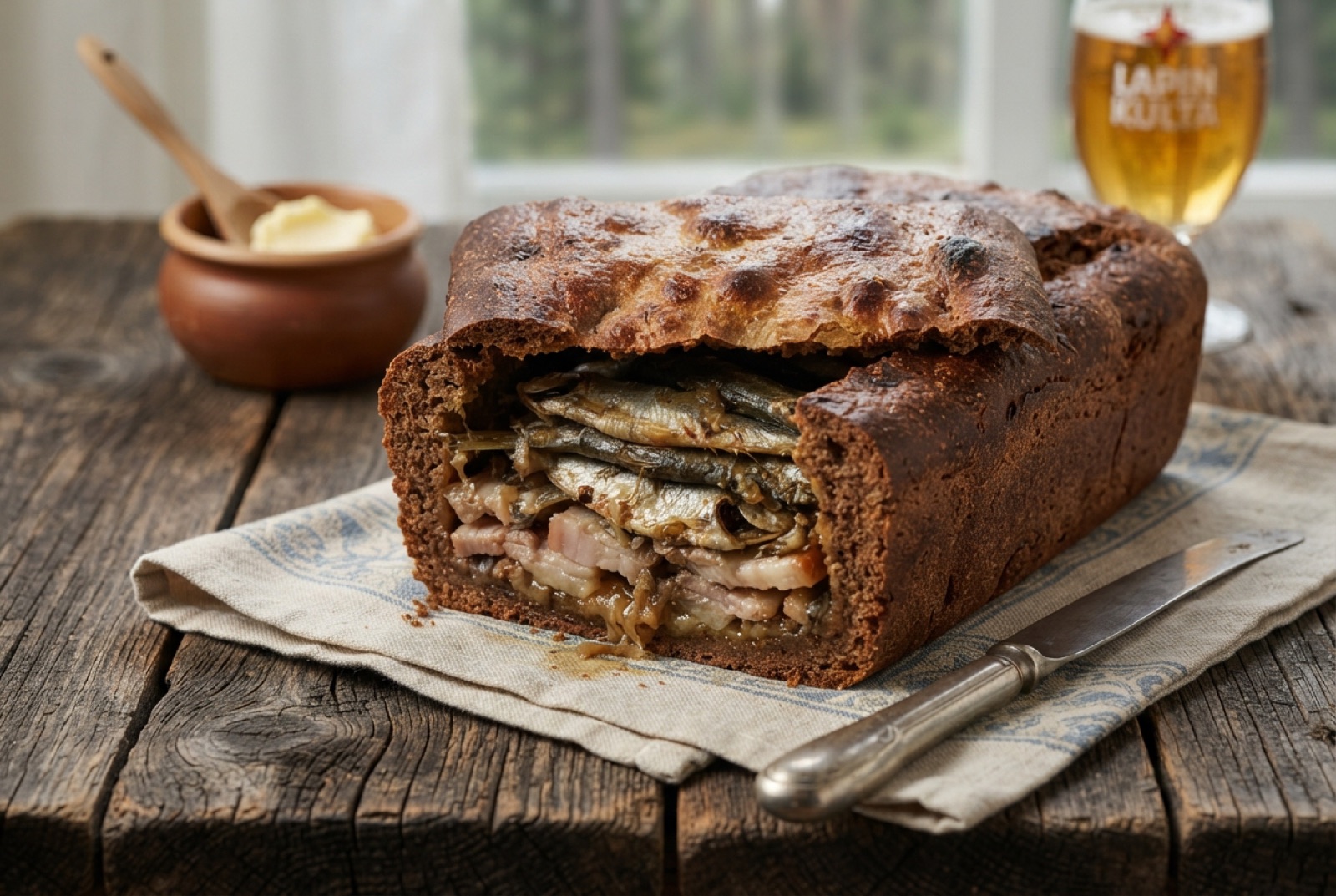
Kalakukko is a fish loaf baked inside bread — but the bread is not really there to be eaten first. A stiff rye dough is patted into a thick oval, packed with small freshwater fish and slices of fatty pork, sealed shut and baked slowly for four to five hours, during which the sealed crust turns into a pressure vessel. Inside, the fish steam in pork fat until the flesh collapses and the fine bones dissolve completely, leaving something closer to a rich, salty terrine. The crust softens from the inside, hardens on the outside, and is cut open at the table like a lid. It tastes of smoke-free wood-oven rye, salt, fish oil and pork — plain, heavy and completely singular.

- Gate
- FinlandSavonia
- Prep
- 45 min
- Cook
- 5 hr
- Total time
- 6 hr 45 min incl. 1 hr rest
- Serves
- 6
- Status
- Takes skill
- Nutrition / serving · estimated
- Calories 690 kcal
- Protein 38 g
- Carbs 58 g
- Fat 34 g
- Fiber 9 g
- Sodium 1150 mg
Why this recipe works.
- A workable home-oven version of a wood-oven dish, with the temperature curve that actually dissolves the bones.
- Explains how to seal and patch a rye crust so it does not split and leak fat halfway through the bake.
- Honest about fish substitutes: what works if vendace is unavailable, and what changes when you use them.
- Makes a loaf that feeds six and keeps for days, exactly as the dish was designed to.
Ingredients.
10 itemsFor the crust
For the filling
To finish
Equipment
- Baking tray
- Rolling pin
- Baking paper and foil
- Kitchen cloth for wrapping
Instructions.
Make the rye dough
Mix the rye flour, wheat flour and salt in a bowl, pour in the cold water and melted butter, and bring it together with your hands into a stiff, slightly tacky dough. Press and fold it against the bowl for no more than a minute — it should look smooth and feel like firm modelling clay, not elastic.
Tip Rye has almost no gluten. If you keep kneading hoping it will become stretchy, it will only become crumbly.
Shape the shell
Roll two thirds of the dough on baking paper into an oval about 1 cm thick and 30 cm long. Roll the remaining third into a slightly smaller oval for the lid. Keep both under a cloth so the surfaces do not dry and crack.
Pack the filling
Lay a third of the pork slices down the centre of the base, leaving a 4 cm border clear. Pile the whole fish on top in tight layers, salting and peppering between them, and finish with the remaining pork so the fish is completely wrapped in fat. Mound it high — the loaf settles as it bakes.
Seal it shut
Brush the clear border with water, lift the lid over the filling, and pinch the two edges together hard all the way round, then fold the sealed rim inward and smooth every seam with a wet hand until you cannot see a join. Prick nothing — the loaf must stay airtight.
Tip Spend the extra three minutes here. A leak in the first hour drains the fat and the bones will never soften.
Bake hot, then long and low
Bake at 200°C for 45 minutes until the crust is dry, firm and pale brown, then patch any cracks with spare dough, cover the loaf loosely with foil and drop the oven to 140°C. Bake for a further 4 hours; the loaf will smell of toasted rye and fish oil, and feel heavy and solid when tapped.
Butter and wrap
Brush the hot loaf all over with butter, wrap it in baking paper and then a thick kitchen cloth, and leave it for an hour. The trapped steam softens the crust from a shell into something you can actually cut.
Open at the table
Slice the top off in one piece as a lid, then spoon out the filling — it should be soft, glossy and free of any bone you can detect — onto pieces of the crust, with cold butter alongside. Cut the fat-soaked base into wedges and serve it last.
Tips from our kitchen.
- Work the rye dough cold and briefly. It has almost no gluten, so kneading achieves nothing except a crumbly, hard-to-shape mass — press it together until smooth and stop.
- Roll the shell thicker than feels sensible, around 1 cm. A thin crust cracks under five hours of internal steam and the fat runs out into the oven.
- Use small fish whole. Gutted, filleted fish falls apart into mush and misses the point, which is bones softened to nothing inside intact little bodies.
- Seal every seam by wetting the edges and pinching hard, then smooth over the joins with a wet hand. Any pinhole becomes a leak within the first hour.
- Check the loaf after 45 minutes and patch cracks immediately with a small piece of spare dough pressed on and smoothed with water.
- Butter the finished loaf while it is hot and wrap it in paper and a cloth for an hour — this is not resting, it is deliberately softening the crust so it can be cut.
Substitutions.
- Vendace (muikku) → Fresh sprats, smelt, small sardines or very small trout
- Any small oily whole fish under about 12 cm works. Larger fish need gutting and give you a fish pie rather than a true kalakukko.
- Salted pork belly → Unsmoked streaky bacon, rinsed of excess salt
- Smoked bacon will dominate everything. If it is all you have, use less and expect a distinctly smoky loaf.
- Wholegrain rye flour → 80% rye flour with 20% strong wheat flour
- The wheat makes the dough far more forgiving to shape and patch. Savonian purists would object; your first attempt will thank you.
Variations.
- Perunakukko
- The same crust filled with sliced potato and pork instead of fish — a cheaper everyday version from the same region, and a good way to practise the dough.
- Lanttukukko
- Filled with swede and pork. Sweeter and softer than the fish version, and traditionally autumn food after the root harvest.
- Coastal herring kukko
- Baltic herring fillets layered with dill in place of whole vendace. Faster to prepare and less confronting for anyone unsure about whole fish.
Storage & reheating.
A whole uncut kalakukko keeps 4–5 days refrigerated, and this durability is the reason the dish exists. Once cut, wrap the open face tightly and eat within 2 days. Reheat wrapped in foil at 150°C for 30 minutes; the crust firms again and the filling loosens. It freezes whole for up to 3 months — thaw overnight in the fridge, then reheat as above rather than in a microwave, which turns the crust to leather.
Serve with
Cold butter, a glass of piimä or cold milk, and nothing else — the loaf is the meal.
The story behind Kalakukko.
Kalakukko is the signature dish of Savonia, the lake-riddled region of eastern Finland, and Kuopio is its capital in every sense — the market hall there has sold them continuously for well over a century, and kalakukko carries EU Traditional Speciality Guaranteed status. The name literally combines fish with the word for rooster, and nobody has a convincing explanation for the second half; the various etymologies offered are guesses rather than record, so it is best treated as an unsolved piece of vocabulary rather than a story.
The logic of the dish is preservation and portability. A sealed rye crust keeps the contents from spoiling for days and travels without a container, which made kalakukko field food and forest food — something a farmhand, logger or fisherman carried out for the week and cut into as needed. The traditional filling is muikku, the tiny vendace of the Finnish lakes, used whole and ungutted apart from the largest specimens, layered with salted pork belly whose fat both bastes the fish and seals the loaf from within. Perch and small whitefish appear too, and in coastal versions Baltic herring.
The long bake is the whole technique. A wood oven was set hot to firm the crust, then allowed to fall, and the loaf sat in that dropping heat overnight, often wrapped in paper and buttered to stop the crust cracking. Five hours at a low temperature is what makes the bones disappear — the same principle as canned sardines, achieved by an entirely different route. Cutting a kalakukko is a small ceremony: the top is sliced off in one piece as a lid, the filling eaten with a spoon or scooped onto pieces of the crust with butter, and the base saved for last because it has soaked up everything.
Questions, answered.
Do the fish bones really dissolve?
Yes, provided the loaf is properly sealed and baked long enough at a low temperature. The trapped steam and fat break down the fine bones of small fish over four to five hours, exactly as the pressure canning of sardines does. If you bite bones, the bake was too short or the crust leaked and lost its steam.
Is the rye crust meant to be eaten?
Partly. The traditional way is to cut off the top as a lid and eat the softened inner crust and the fat-soaked base with the filling, often with butter. The hardest outer shell was historically treated as packaging and sometimes discarded, especially on loaves carried for days.
Can I make kalakukko with fillets instead of whole fish?
You can, and coastal versions with Baltic herring fillets exist, but the texture is different — fillets break down into a soft paste rather than staying as recognisable little fish. If you use fillets, reduce the bake to about three hours since there are no bones to soften.
Why did my loaf crack and leak?
Either the crust was rolled too thin, a seam was not sealed properly, or the oven ran too hot at the start. Patch cracks as soon as you see them with spare dough and a wet finger, and keep the temperature moderate — a hard initial blast sets the outside before the inside has stopped expanding.
What does kalakukko actually taste like?
Strongly savoury and quite fatty: sour wholegrain rye on the outside, and inside a soft, salty mixture of fish and pork somewhere between a rillette and a fish terrine. It is not delicate food, and it is traditionally eaten in small quantities with butter and cold milk to balance the richness.
You might also like.
All recipes →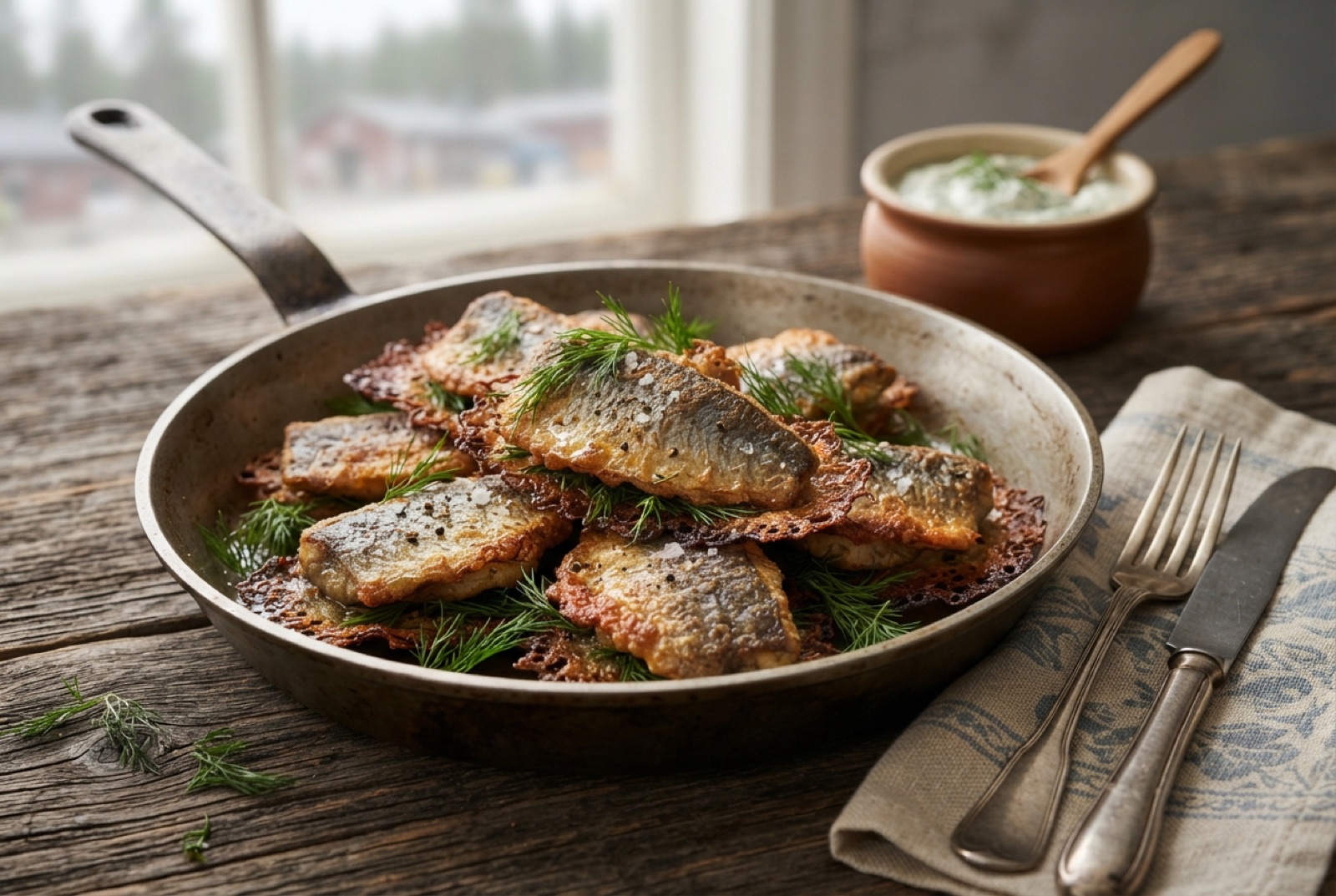
Keep exploring Finland.
Finland has 9 more dishes in the atlas — Karjalanpaisti and Karjalanpiirakka, and 7 more.
Recipe by The DishRoute Kitchen · published August 19, 2026 · updated August 19, 2026