Korvapuusti.
Finnish Cardamom Cinnamon Buns
Korvapuusti · say it: KOR-vah-POO-stee
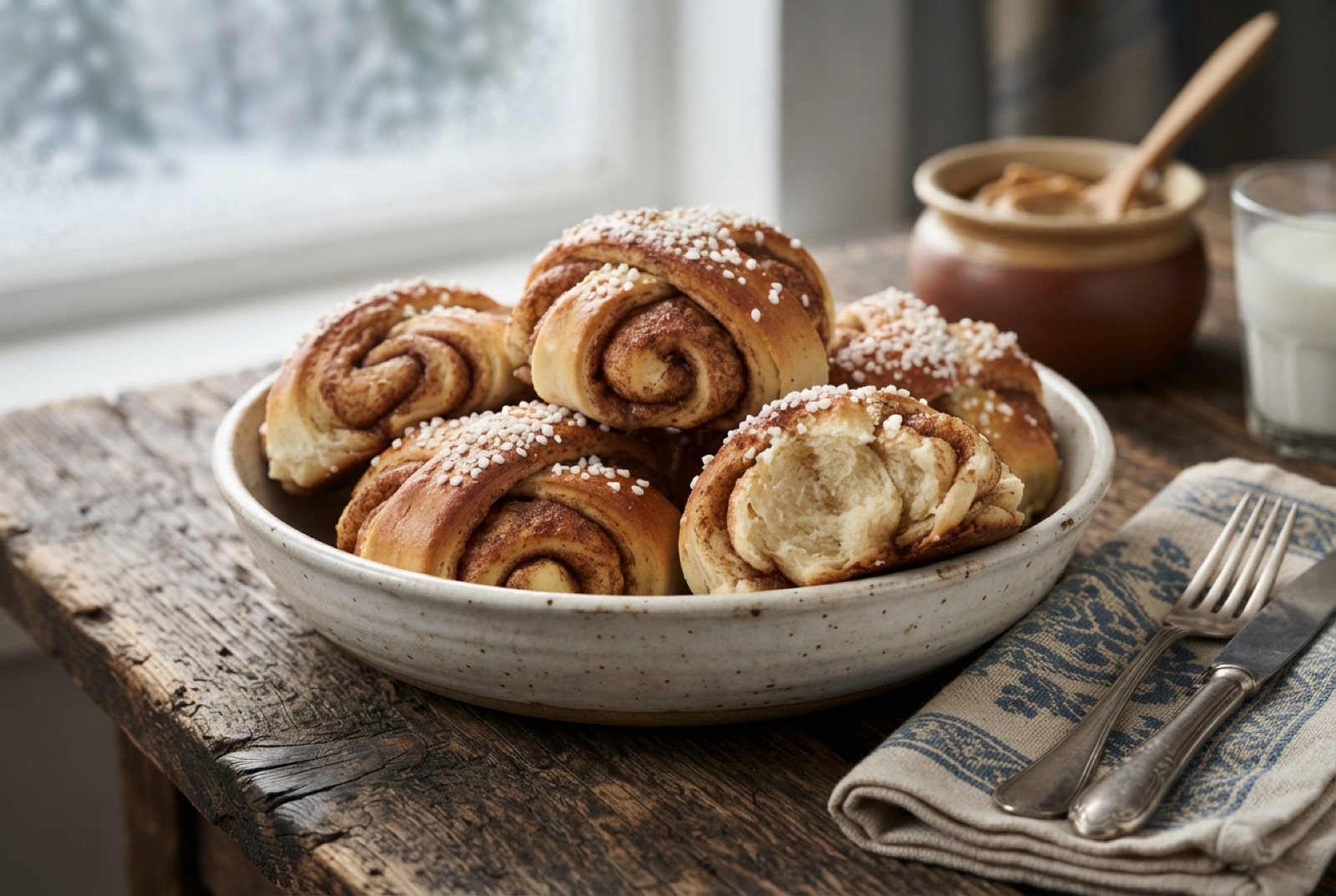
Korvapuusti are Finland's everyday cinnamon buns, and the two things that set them apart are cardamom and shape. The dough — pulla, the base of most Finnish sweet baking — carries far more crushed cardamom than a Swedish or American bun, enough that the raw dough smells sharply resinous before any cinnamon appears. The roll is cut into slanted trapezoids and each one is then pressed hard through the middle with a finger or a wooden spoon handle, which forces the cut layers to splay outward at both ends. The name means slapped ears, which is what they look like. Pearl sugar on top gives a crunch that does not dissolve, and the buns are best eaten warm, within an hour of baking.

- Gate
- FinlandNationwide
- Prep
- 30 min
- Cook
- 12 min
- Total time
- 2 hr 12 min incl. 1 hr 30 min rest
- Serves
- 12
- Status
- Medium
- Nutrition / serving · estimated
- Calories 320 kcal
- Protein 6 g
- Carbs 46 g
- Fat 13 g
- Fiber 2 g
- Sugar 20 g
Why this recipe works.
- Cardamom used at genuine Finnish strength rather than the token half-teaspoon most recipes suggest.
- The slanted cut and centre press explained step by step, which is what makes a korvapuusti rather than a generic cinnamon roll.
- Filling butter is softened, not melted, so it stays in the layers instead of running out into the tray.
- Proofing judged by how the dough behaves under a fingertip, not by a fixed number of minutes in an unknown kitchen.
Ingredients.
13 itemsFor the dough
For the filling
To finish
Equipment
- Stand mixer with dough hook or a large bowl
- Rolling pin
- Two baking trays
- Mortar and pestle for the cardamom
Instructions.
Mix the cardamom dough
Stir the yeast, sugar, salt and crushed cardamom into the warm milk, then beat in the egg. Add the flour and mix to a shaggy dough, then knead for 5 minutes until it comes together and pulls cleanly from the side of the bowl.
Tip Sieve the crushed cardamom to remove the papery husks, or they show up as bitter specks in the crumb.
Work in the butter
Add the soft butter a few pieces at a time, kneading between additions. The dough will look greasy and broken for a minute or two, then suddenly turn smooth, glossy and elastic — keep going until it does, about 8 minutes in a mixer.
First rise
Cover the bowl and leave the dough somewhere warm for 45–60 minutes, until roughly doubled and visibly domed. A finger poked into it should leave a dent that fills back slowly.
Roll and fill
Roll the dough on a floured surface into a rectangle about 40 x 50 cm and 5 mm thick. Spread the very soft butter right to the edges with a palette knife, then scatter the sugar and cinnamon evenly over the whole surface.
Roll up and cut on the slant
Roll the dough into a tight cylinder from the long side, seam underneath. Cut it into 12 trapezoids by angling the knife alternately left and right, so each piece has a wide top edge and a narrow bottom edge.
Tip A firm, tight roll is what keeps the layers distinct — a loose one unravels in the oven.
Press the ears
Set each piece on a lined tray narrow edge down, then press hard through the middle with a finger or the handle of a wooden spoon, almost to the tray, so the cut layers splay out at both ends.
Second rise
Cover the trays loosely and prove for 30 minutes, until the buns look puffed and a fingertip leaves a dent that fills only halfway back. Heat the oven to 225°C.
Glaze and bake
Brush the buns with beaten egg and scatter pearl sugar generously over the tops. Bake for 10–12 minutes, until deep golden brown with dark caramelised cinnamon at the flared edges — pale buns are underbaked and taste doughy.
Cool briefly and serve
Slide the buns onto a rack and cover with a cloth for 10 minutes so the crumb settles and stays soft. Serve warm with coffee.
Tips from our kitchen.
- Crush whole cardamom pods in a mortar and sieve out the husks. Pre-ground cardamom loses its volatile oils fast, and it is the difference between a bun that smells like Finland and one that smells vaguely sweet.
- Keep the milk at body temperature, around 37°C. Hot milk kills the yeast outright and cold milk leaves you waiting an extra hour for the first rise.
- Add the butter to the dough only after the flour is fully incorporated, in small pieces, and keep working until the dough goes from greasy to smooth and satiny.
- Spread the filling butter soft, not melted — melted butter soaks into the dough and runs out of the buns in the oven, leaving them dry.
- Cut the roll into trapezoids by alternating the angle of the knife, wide edge and narrow edge in turn, so nothing is wasted.
- Press the centre hard enough that your finger nearly reaches the tray. A timid press lets the bun spring back round and you lose the flared ears entirely.
Substitutions.
- Pearl sugar (nib sugar) → Crushed sugar cubes, or demerara sugar
- Crushed cubes are the closest match, since they hold their shape in the oven. Ordinary granulated sugar simply melts and disappears.
- Whole milk → Oat milk plus 1 extra tablespoon of butter
- Works well for a dairy-lighter dough. Skimmed milk alone gives a drier, less tender crumb.
- Fresh yeast → 7 g instant dried yeast, mixed straight into the flour
- If using instant yeast there is no need to activate it in the milk; just warm the milk to the same temperature and combine everything.
Variations.
- Voisilmäpulla
- Butter-eye buns: round buns with a deep thumbprint filled with butter, sugar and a little flour, which melts into a glossy pool during baking.
- Dallaspulla
- A slab-style version baked as one connected tray of buns and finished with a vanilla custard and pearl sugar, cut into squares after cooling.
- Laskiaispulla
- The Shrove Tuesday bun: plain cardamom pulla split and filled with whipped cream and either almond paste or jam, depending on which side of a long-running national argument you sit.
Storage & reheating.
Korvapuusti are at their best within a few hours of baking and go noticeably drier by the next day. Keep them in a paper bag or under a cloth at room temperature for up to 2 days — never in plastic or the pearl sugar dissolves and the tops turn sticky. They freeze very well for up to 3 months: freeze once completely cool, then warm from frozen at 180°C for 8–10 minutes, which brings back most of the fresh texture.
Serve with
Strong black coffee, or cold milk for anyone under about twelve. Nothing else belongs on the plate.
The story behind Korvapuusti.
Cardamom reached the Nordic countries by trade long before it reached most European kitchens, and it stuck there in a way it did not elsewhere: Finland and Sweden between them consume a strikingly disproportionate share of the world's cardamom, almost all of it in sweet yeasted dough. Finnish pulla dough — milk, butter, egg, sugar, yeast and a great deal of ground cardamom — is the foundation of an entire category of baking, plaited into loaves, filled with almond paste, or rolled with cinnamon into korvapuusti.
The buns are inseparable from the ritual of kahvi ja pulla, coffee and a bun, which structures the Finnish day more than any meal does. Finland has the highest per-capita coffee consumption in the world, and coffee is very rarely served alone — a workplace break, a visit to someone's home, a church event or a summer cottage afternoon all assume something from the pulla family on the table. Offering coffee with nothing beside it is considered slightly bare, and the correct response to being handed a korvapuusti is to accept it.
The shaping deserves explanation because it is functional as well as visual. A straight-cut spiral bun bakes with the filling spiralling inward and often leaks butter out of the base. A slanted cut and a firm press through the centre lock the layers together at the waist and open them at the ends, so the exposed edges caramelise into crisp cinnamon ridges while the compressed middle stays dense and moist. The result has more textural range than a round bun: crunchy sugar on top, caramelised flared edges, and a soft, buttery centre.
Questions, answered.
What does korvapuusti mean?
It translates roughly as slapped ears, or a box on the ear. The name comes from the shape: cutting the roll on a slant and pressing the centre down makes the cut layers flare outward at both ends, so each bun looks like a pair of protruding ears. It says nothing about how the bun tastes.
How much cardamom is right?
Considerably more than most non-Nordic recipes use — around a tablespoon of freshly crushed cardamom for 450 g of flour. The raw dough should smell distinctly of cardamom before any cinnamon is involved. Ground cardamom that has been open for months will need more, and will still taste weaker.
Why did butter leak out of my buns?
The filling butter was melted rather than softened, or the buns were not pressed firmly enough in the middle. Soft spreadable butter stays suspended in the dough layers; melted butter soaks straight through and pools in the tray, taking the sugar with it and leaving the crumb dry.
Can I make the dough the night before?
Yes. After the first rise, roll and shape the buns, place them on the tray, cover tightly and refrigerate overnight. Take them out an hour before baking so they finish proofing at room temperature — cold dough straight into the oven bakes unevenly and stays dense.
How do I know the dough has proofed enough?
Press a fingertip gently into a shaped bun: the dent should fill back slowly and only partially. If it springs back immediately the dough needs more time; if the dent stays put and the bun looks slack, it has over-proofed and will collapse in the oven. Time varies hugely with kitchen temperature.
You might also like.
All recipes →
Keep exploring Finland.
Finland has 9 more dishes in the atlas — Kalakukko and Karjalanpaisti, and 7 more.
Recipe by The DishRoute Kitchen · published August 19, 2026 · updated August 19, 2026