Leipäjuusto.
Finnish Baked Squeaky Cheese
Leipäjuusto · say it: LAY-pah-YOO-stoh
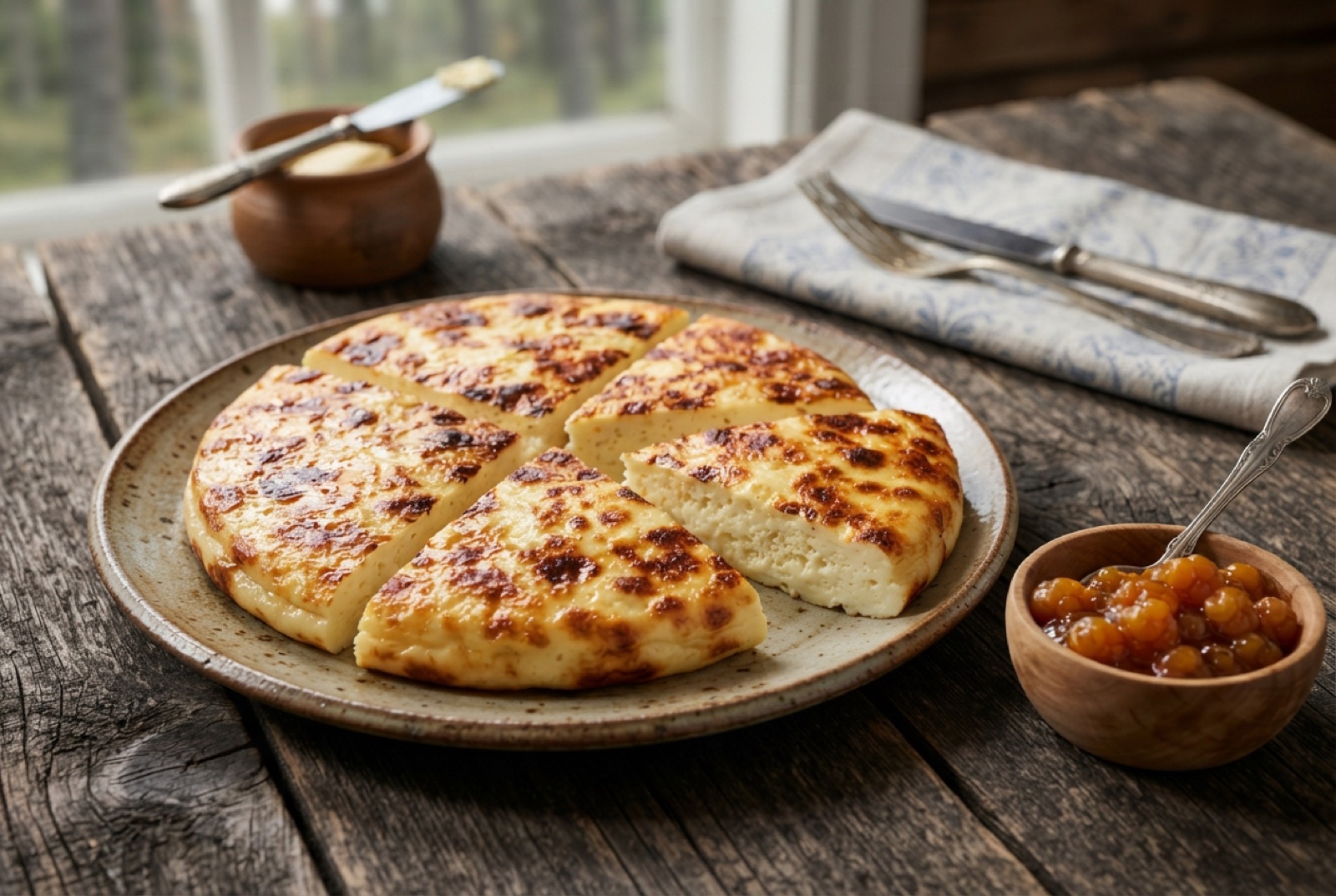
Leipäjuusto is a fresh cow's-milk cheese set with rennet, drained, pressed into a thin round and then put under a fierce grill until the surface blisters into dark leopard spots. It does not melt and it does not stretch; it holds its shape and squeaks audibly against your teeth, which is the whole reason Finns eat it. The flavour is extremely mild — clean milk, a little caramelised protein from the browning, salt — so it exists to carry other things: warm cloudberry jam, a pool of cream, or in the north, dunked whole into a cup of coffee. The name means bread cheese, because it is baked and shaped like a flatbread rather than aged like a cheese.

- Gate
- FinlandOstrobothnia and Lapland
- Prep
- 20 min
- Cook
- 35 min
- Total time
- 1 hr 25 min incl. 30 min rest
- Serves
- 6
- Status
- Medium
- Nutrition / serving · estimated
- Calories 330 kcal
- Protein 21 g
- Carbs 18 g
- Fat 19 g
- Sugar 16 g
- Sodium 560 mg
Why this recipe works.
- Real curd-setting method with a clear description of what a clean break looks like, rather than a vague instruction to wait.
- Explains the colostrum original honestly and what changes when you use ordinary whole milk.
- The grilling stage is timed by appearance, since every grill browns differently and minutes mean little here.
- Includes the coffee-cheese serving, which is the way most northern Finns actually eat it.
Ingredients.
6 itemsTo serve
Equipment
- Large heavy pot
- Thermometer
- Cheesecloth
- Round mould or 20 cm cake tin
- Grill or broiler
Instructions.
Warm the milk
Pour the milk and the cream, if using, into a heavy pot and heat slowly to 38°C, stirring now and then so the base does not scorch. Take it off the heat as soon as it reaches temperature — overheating is the main cause of a rubbery cheese.
Set the curd
Stir the rennet through the warm milk with about ten slow strokes, then stop the movement dead by holding the spoon still against the surface. Cover and leave undisturbed for 30–40 minutes.
Tip Any movement during setting breaks the forming curd and lowers your yield.
Check for a clean break
Push a knife into the curd at an angle and lift: it should split cleanly into a firm, glossy edge with clear yellowish whey filling the gap. If it smears like yoghurt, cover and give it another 10 minutes.
Cut and drain
Cut the curd into 2 cm cubes and let it settle for 10 minutes as the whey rises, then ladle everything into a cheesecloth-lined colander. Sprinkle in the salt, gather the cloth and let it drain for 15 minutes until the flow slows to a drip.
Press into a disc
Transfer the wrapped curd to a round mould or a 20 cm cake tin, flatten it to an even 2 cm thickness, and set a plate with a light weight on top. Press for 30 minutes — just enough to knit the curd together, no more.
Grill until leopard-spotted
Heat the grill to its maximum. Turn the disc out onto a baking tray, brush with melted butter, and grill close to the element for 3–5 minutes until dark brown blisters spread across the surface. Flip, brush and repeat on the other side.
Tip Stay at the oven door. The gap between beautifully spotted and burnt is about forty seconds.
Serve warm
Cut the hot cheese into wedges or thick fingers and serve immediately with warm cloudberry jam spooned over, or cube it into cups and pour hot coffee on top for kaffeeost.
Tips from our kitchen.
- Use the best whole milk you can find, and avoid ultra-pasteurised milk entirely — UHT protein will not form a proper curd no matter how much rennet you add.
- Warm the milk slowly to 38°C and hold it there. Too hot and the curd turns rubbery; too cool and it sets weakly and gives poor yield.
- Test for the clean break by pushing a knife in at an angle and lifting: the curd should split into a firm edge with clear whey running in, not smear like yoghurt.
- Press the curd only lightly, for about half an hour. Hard pressing squeezes out the moisture that makes the cheese squeak.
- Grill close to the element and watch it constantly — you want dark leopard spots across the surface in a few minutes, not an evenly beige round.
- Serve it warm. Cold leipäjuusto loses most of its squeak, and reheating is normal rather than a compromise.
Substitutions.
- Animal rennet → Vegetarian microbial rennet, at the dose given on the bottle
- Works well and makes the cheese suitable for vegetarians. The set is sometimes slightly softer, so allow a few extra minutes.
- Cloudberry jam → Lightly sweetened lingonberries, or an orange-tinged apricot or sea buckthorn preserve
- Cloudberries are expensive and rarely sold fresh outside the Nordics. What matters is tartness and a slight resinous edge rather than sweetness.
- Whole cow's milk → Whole goat milk
- Gives a sharper, tangier cheese with a slightly weaker squeak. Not traditional in Finland, but it works with the same method.
Variations.
- Kaffeeost
- Cubes of the cheese dropped into a cup and covered with hot coffee, eaten with a spoon after the coffee is drunk. Standard in northern Finland and Sweden.
- Cream-baked leipäjuusto
- The grilled round set in a dish, cream poured around it and the whole thing baked for fifteen minutes so the cheese soaks it up. Served as a warm dessert.
- Colostrum version
- The original: first-milk colostrum set by heat alone with no rennet, giving a denser, deep yellow cheese. Only possible with access to a dairy farm.
Storage & reheating.
Leipäjuusto keeps 4–5 days refrigerated, wrapped loosely so it does not sweat. It firms and loses its squeak when cold, so always reheat before serving: 5 minutes at 180°C, or a minute a side in a dry pan, restores both the texture and the sound. It freezes surprisingly well for up to 3 months — thaw in the fridge and reheat as above. Do not store it in an airtight box while still warm, or the trapped steam will make the surface slimy.
Serve with
Warm cloudberry jam, and strong black coffee — or the cheese cubed straight into the coffee.
The story behind Leipäjuusto.
Leipäjuusto belongs to Ostrobothnia, Kainuu and Lapland, and the traditional raw material was not ordinary milk but ternimaito — colostrum, the thick first milk a cow gives after calving. Colostrum is so protein-rich that it sets into a firm curd from heat alone, without rennet, and the resulting cheese is denser and yellower than the modern version. Since colostrum is available only for a few days per calving, leipäjuusto was seasonal and tied to the farming calendar, which made it a small event rather than an everyday food.
Modern leipäjuusto is made year-round from whole milk with rennet added, then finished the same way: pressed flat, and browned. That browning was originally done in front of an open fire on a wooden board propped at an angle, or in a wood oven, and the spotted pattern is the signature — Finns judge a leipäjuusto partly by the evenness of its leopard markings. In Lapland the same cheese is often made with reindeer milk, which is far richer and produces a much stronger result. The dessert use with cloudberry jam is northern too, since cloudberries grow in the bogs of Lapland and are the most prized berry in the country.
The most distinctive way to eat it is not as dessert at all. Kaffeeost — coffee cheese — means cutting the cheese into cubes, dropping them into the bottom of a cup and pouring hot coffee over them, then eating the warmed, softened cubes with a spoon once the coffee is drunk. This is standard practice in northern Finland and northern Sweden, and it surprises visitors more than almost anything else at a Finnish table. The cheese does not dissolve; it warms, softens slightly and takes on the coffee, and the squeak survives.
Questions, answered.
Why does leipäjuusto squeak?
Because it is a very fresh, unaged cheese whose protein strands are still long and elastic and have not been broken down by ripening bacteria. Those strands rub against tooth enamel and produce the squeak. The effect is strongest when the cheese is warm and fades as it ages or chills, which is why it is always served hot.
Can I use shop-bought milk?
Yes, as long as it is pasteurised rather than ultra-pasteurised or UHT. High-temperature processing denatures the proteins so thoroughly that rennet cannot form a proper curd, and you will end up with a weak, grainy mess. Standard fresh whole milk from a supermarket chiller works fine.
What does it actually taste like?
Very mild and clean, close to a warm fresh mozzarella or halloumi without the salt — sweet milk with a toasted, slightly caramelised note from the grilled surface. It has almost no sharpness or tang, which is exactly why it is served with something acidic like cloudberry or lingonberry.
Is leipäjuusto the same as bread cheese sold in the US?
It is the same tradition. Juustoleipä or bread cheese sold in parts of the American Midwest was brought by Finnish immigrants and is made the same way, though commercial versions are usually saltier and firmer. If you can buy it, you can skip straight to the grilling stage of this recipe.
Why is my cheese rubbery instead of squeaky?
Usually the milk was heated too far above 38°C, or the curd was pressed too hard or too long. Both drive out the moisture that keeps the protein structure soft and springy. Keep the temperature moderate and press only under light weight for about half an hour.
You might also like.
All recipes →

Keep exploring Finland.
Finland has 9 more dishes in the atlas — Kalakukko and Karjalanpaisti, and 7 more.
Recipe by The DishRoute Kitchen · published August 19, 2026 · updated August 19, 2026