Lángos.
Hungarian Deep-Fried Garlic Flatbread
Lángos · say it: LAHN-gohsh
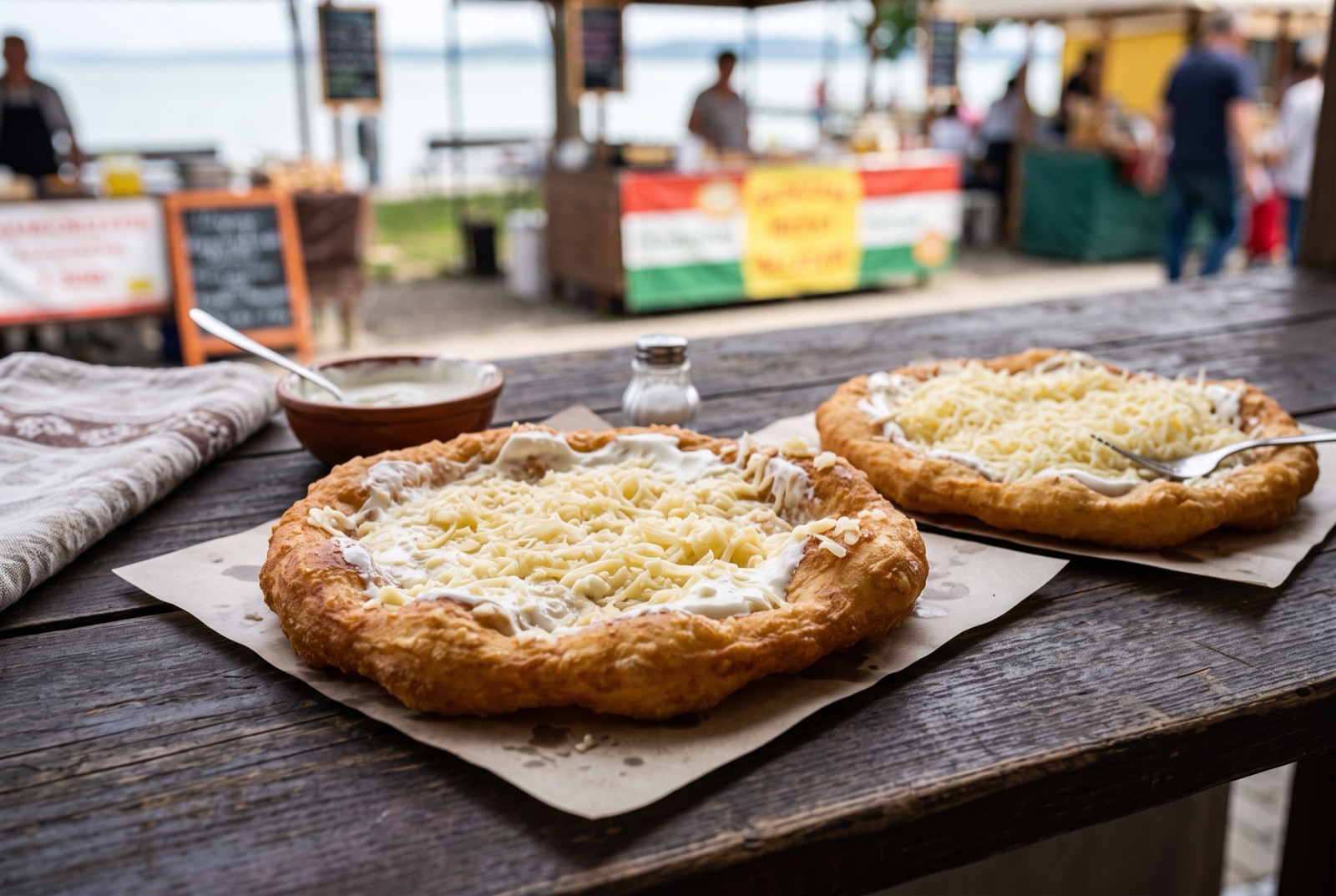
Lángos is a disc of yeasted dough, stretched thin in the middle and thicker at the rim, dropped into hot oil and fried until it puffs and blisters. Mashed potato in the dough is what makes it different from any other fried bread: it keeps the inside soft and slightly chewy rather than dry, and it stays that way as the outside crisps. The classic dressing is aggressively simple — a cut clove of garlic rubbed straight onto the hot surface, or a brush of salted garlic water, then a thick layer of sour cream and a heap of grated cheese. It is eaten standing up, with both hands, at markets, thermal baths and lakeside stalls, and it is best about ninety seconds after it leaves the fryer.

- Gate
- HungaryNationwide
- Prep
- 30 min
- Cook
- 20 min
- Total time
- 2 hr 20 min incl. 1 hr 30 min rest
- Serves
- 6
- Status
- Easy
- Nutrition / serving · estimated
- Calories 620 kcal
- Protein 19 g
- Carbs 68 g
- Fat 30 g
- Fiber 3 g
- Sodium 940 mg
Why this recipe works.
- Potato in the dough, which is what keeps the inside soft instead of turning into dry fried bread.
- Shows the stretching technique that produces a thin blistered centre and a puffed rim, not a flat disc.
- Gives the correct oil temperature and what to watch for, since this is where home lángos usually fails.
- Covers both garlic finishes — the rubbed clove and the brushed garlic water — and when each works better.
Ingredients.
12 itemsFor the dough
For frying
To finish
Equipment
- Deep heavy pan or pot for frying
- Cooking thermometer
- Slotted spoon or spider
- Wire rack
Instructions.
Start the yeast
Crumble the fresh yeast into the lukewarm milk with the sugar and leave it for 10 minutes, until the surface is foamy and smells actively of bread. If nothing happens, the yeast is dead and there is no point continuing.
Mix a deliberately sticky dough
Combine the flour, cooled mashed potato and salt, pour in the yeast milk and the oil, and mix to a soft, sticky dough. Knead for 8 to 10 minutes until it is smooth and elastic but still tacky enough to cling to your fingers — resist adding more flour.
Tip Wet hands rather than a floured surface make this dough far easier to handle.
Prove until doubled
Cover the bowl and leave it somewhere warm for about 90 minutes, until the dough has doubled and the surface is domed and bubbly. A finger pressed into it should leave a dent that fills back only slowly.
Divide and rest
Turn the dough out onto an oiled surface and divide it into 6 equal pieces with a scraper. Shape each loosely into a ball, cover with a cloth, and let them relax for 15 minutes so the gluten slackens enough to stretch.
Heat the oil
Pour the sunflower oil into a deep pan to a depth of at least 4 cm and heat it to 175°C. Test it with a scrap of dough: it should rise to the surface and start bubbling vigorously within about three seconds.
Stretch each disc by hand
Take one ball with oiled hands and stretch it into a rough disc about 18 cm across, pulling the centre thin enough to see light through and leaving the rim thicker. Work quickly and do not use a rolling pin.
Fry until blistered and gold
Lower one disc into the oil and immediately spoon hot oil over the top or press it down gently with a slotted spoon so it puffs. Fry for about 90 seconds a side, until it is deep golden with dark blisters and the thin centre has crisped. Drain on a wire rack, not on paper.
Tip A rack keeps the underside crisp. Paper traps steam and softens it within a minute.
Garlic first, then the toppings
While it is still too hot to hold comfortably, rub a cut garlic clove firmly all over the top surface and season with salt. Spread with sour cream right to the edge, heap on the grated cheese, and eat it immediately, before the base loses its crunch.
Tips from our kitchen.
- Keep the dough wet and sticky. A firm, easy-to-handle dough gives a dense lángos rather than a light one.
- Stretch each piece by hand, never with a rolling pin, which crushes the air out and stops it puffing.
- Fry at 175°C. Too cool and the dough absorbs oil and turns greasy; too hot and the outside browns while the middle stays raw.
- Press the disc down gently with a slotted spoon as it hits the oil so hot oil runs over the top and it puffs evenly.
- Rub the garlic on within seconds of it leaving the fryer. On a cooled surface the raw garlic sits harshly on top instead of melting in.
- Serve one at a time straight from the pan. Lángos stacked on a plate go soft in about four minutes and never recover.
Substitutions.
- Mashed potato in the dough → Leave it out and reduce the milk by 50 ml
- A potato-free lángos is common at commercial stalls and still good, but it is noticeably drier and stales faster. Leftover mash from the day before works perfectly.
- Sour cream and grated cheese topping → Just salt, or garlic butter, or garlic water alone
- Plain salted lángos with garlic is the older way to eat it and lets the dough speak. The cheese version is the modern default rather than the original.
- Fresh yeast → 7 g instant dried yeast
- Use it in place of 20 g fresh. Add it straight to the flour rather than proving it in milk, and expect the rise to take about the same time.
Variations.
- Sajtos-tejfölös lángos
- The default order in Hungary: garlic, a thick layer of sour cream, and a mountain of grated semi-hard cheese. Everything else is a departure from this.
- Fokhagymás lángos
- Nothing but garlic and salt. The oldest and plainest version, and the one that tells you honestly whether the dough was any good.
- Sweet lángos
- Dusted with icing sugar, or spread with jam. A minority option at stalls and firmly a children's order, but genuinely traditional.
Storage & reheating.
Lángos is a fifteen-minute food and does not keep in any meaningful sense — it goes soft within the hour and leathery by the next day. The dough, however, can be made the night before and given a slow rise in the fridge, which improves the flavour; bring it back to room temperature for an hour before shaping. Reheating a leftover lángos in a hot dry pan for a minute per side recovers some crispness, but not the puff.
Serve with
Eaten on its own, standing up, with a cold beer or a glass of buttermilk.
The story behind Lángos.
The name comes from láng, meaning flame, and points to what lángos originally was: a piece of bread dough baked in the mouth of a brick oven while it was still fiercely hot, before the loaves went in. Once the oven was ready for bread it was too late to make lángos, so it belonged to the beginning of baking day and was eaten immediately. When wood-fired ovens disappeared from Hungarian households, the dish moved into a pan of hot oil, which is where it has stayed. The fried version is now so dominant that most Hungarians have never met the baked original.
It belongs to public places rather than home kitchens. Lángos stalls cluster at markets, at thermal baths, at Lake Balaton in summer and at winter festivals, and the format is consistent enough that Hungarians judge stalls on details — whether the dough is stretched properly, whether the garlic is fresh, whether the sour cream is real. The standard order, sajtos-tejfölös, is sour cream and cheese. Beyond that, the toppings have escalated over the decades to include ham, sausage, cabbage and rather more inventive things, which older customers regard with visible suspicion.
Similar fried breads run right across the region — Serbian and Croatian mekike and pogačice, Slovak langoš, and Romanian and Balkan versions of the same idea — and lángos is not a Hungarian invention so much as the Hungarian settlement of a shared regional habit. What is specifically Hungarian is the combination that became standard: potato in the dough, raw garlic on the hot surface, and the sour cream and cheese on top. That trio is what people mean when they say lángos, and any stall that skips the garlic rub is not really making it.
Questions, answered.
Why did my lángos come out greasy?
The oil was too cool. Below about 165°C the dough soaks up fat before the surface can set, so it fries slowly and comes out heavy. Use a thermometer, aim for 175°C, and fry only one or two at a time — each piece of cold dough drops the oil temperature, so let it recover between batches.
Can I bake lángos instead of frying it?
You can, and the original was baked in a wood oven before the loaves went in, so it is not a betrayal. Bake at the highest temperature your oven reaches, ideally on a preheated stone or steel, for about 8 minutes. It will be a good flatbread but it will not have the blistered, puffed, slightly chewy texture that frying gives.
Why is there potato in the dough?
Cooked potato holds moisture and its starch interferes with gluten development, so the crumb comes out softer and stays soft longer. It is what keeps lángos tender inside while the outside crisps. Commercial stalls often skip it for consistency, but the potato version is noticeably better on a home scale.
What is the proper topping for lángos?
Garlic first — either a cut clove rubbed over the hot surface or a brush of salted garlic water — then sour cream and grated cheese, which is the standard order known as sajtos-tejfölös. Plain salted lángos with only garlic is the older version. Ham, sausage and elaborate loaded toppings are modern additions rather than tradition.
Can I make the dough in advance?
Yes, and it improves. After mixing, refrigerate the dough for up to 24 hours for a slow cold rise that develops more flavour, then take it out an hour before shaping so it comes back to room temperature. Do not shape the discs in advance, though — stretched dough left waiting deflates and will not puff in the oil.
You might also like.
All recipes →
Keep exploring Hungary.
Hungary has 9 more dishes in the atlas — Dobos Torta and Gulyás, and 7 more.
Recipe by The DishRoute Kitchen · published August 20, 2026 · updated August 20, 2026