Couscous bil Bosla.
Libyan Lamb and Pumpkin Couscous
كسكسي بالبصلة · say it: koos-KOO-see bil BOS-lah
This is the Libyan Friday plate: a mound of semolina couscous steamed over the same pot that cooks the meat, so every grain picks up tomato and hararat from the rising steam, then piled with lamb, wedges of soft pumpkin, potato and chickpeas. What makes it specifically Libyan is the crown on top — onions cooked slowly with raisins and cinnamon until they collapse into something close to jam, spooned over the middle so each mouthful swings between sweet and savoury. The couscous underneath stays loose and separate, never sticky, and the whole dish is built to be eaten from one wide tray.
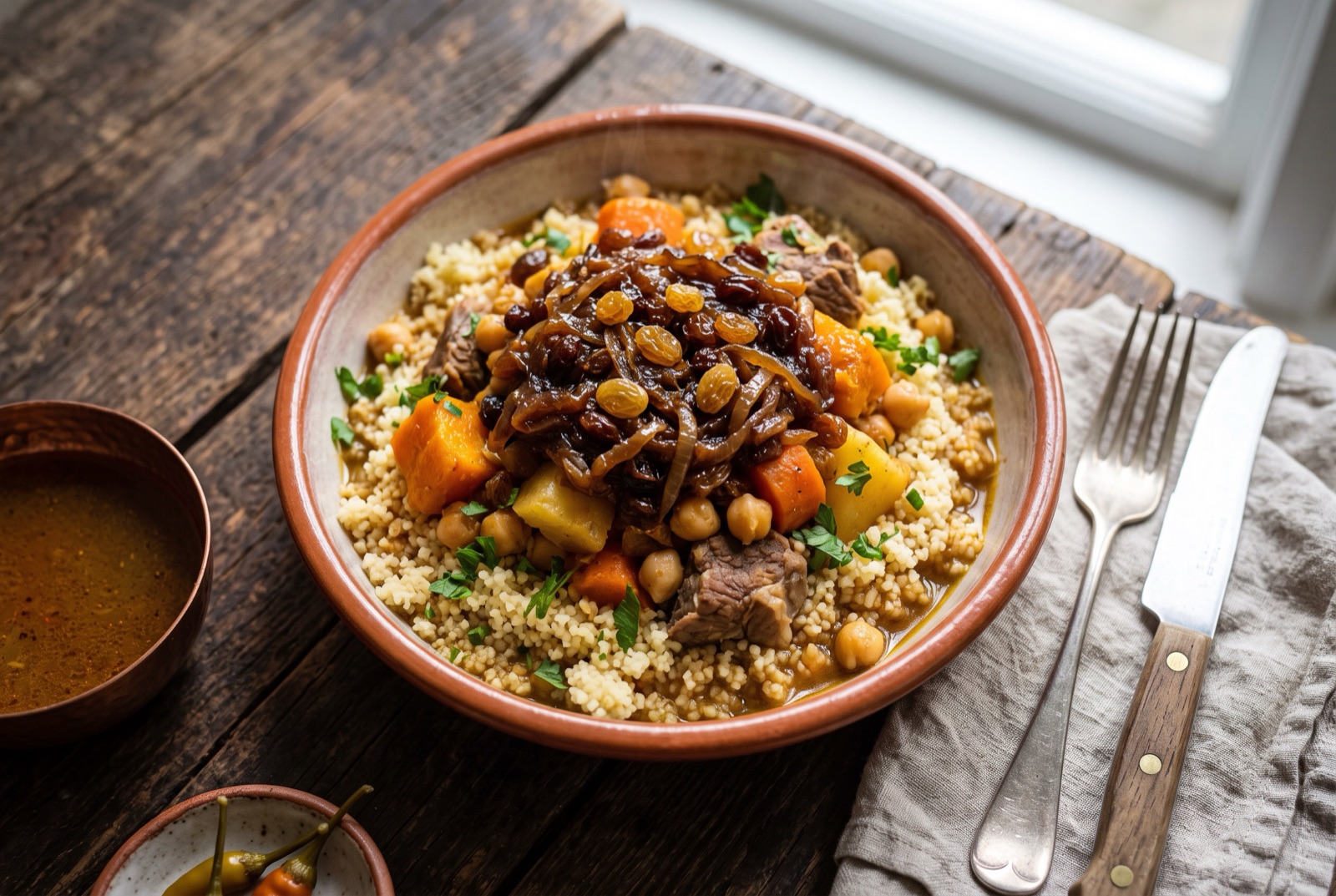

- Gate
- Libya
- Prep
- 30 min
- Cook
- 1 hr 35 min
- Total time
- 2 hr 5 min
- Serves
- 6
- Status
- Medium
- Nutrition / serving · estimated
- Calories 780 kcal
- Protein 34 g
- Carbs 98 g
- Fat 27 g
- Fiber 11 g
- Sugar 22 g
Why this recipe works.
- Steams the grain over the meat pot, the step that gives Libyan couscous its aroma and that instant packets cannot reproduce.
- Treats the sweet onion-and-raisin topping as a component with its own timing, not an afterthought stirred in at the end.
- Gives a clear rubbing-and-resting routine between steamings so the grains stay separate instead of clumping.
- Honest about the instant-couscous shortcut and what exactly you give up by taking it.
Ingredients.
19 itemsFor the grain
For the broth
For the sweet onion crown
Equipment
- Couscoussier, or a wide pot with a steamer basket
- Large shallow bowl or tray for rubbing the grain
- Wide frying pan for the onions
Instructions.
Start the broth
Brown the lamb in a little of the olive oil in the base of the couscoussier, then add the chopped onion and cook until softened. Stir in the tomato paste and fry it for 3 minutes until it darkens to brick, then add the turmeric, hararat and chilli, the 1.6 litres of water and a good pinch of salt.
Moisten the grain
Tip the couscous into a wide bowl, sprinkle over about 200 ml of the warm salted water and 2 tablespoons of olive oil, and work it through by rolling the grain between flat open palms. Leave it to swell for 10 minutes; the grains should feel damp and loose, never pasty.
Tip Rolling, not squeezing. Pressed grains fuse into lumps that survive every later step.
First steaming
Bring the broth to a simmer, set the steamer on top and seal the join with a damp cloth or foil. Pile in the couscous loosely and steam uncovered for 20 minutes from the moment steam starts rising freely through the surface of the grain.
Rub and rest
Turn the couscous back into the bowl, break it up with a fork, and rub in the remaining warm salted water and oil once it is cool enough to touch. Spread it out and let it stand for 10 minutes so the moisture distributes evenly through the grain.
Add the vegetables and steam again
Slide the potatoes and pumpkin into the simmering broth along with the chickpeas, return the couscous to the steamer and cook for another 20 minutes. The grain is done when it tastes tender with the faintest chew and no longer squeaks against the teeth.
Cook the onion crown
While the second steaming runs, cook the sliced onions in olive oil over low heat in a wide pan for 25 minutes, stirring now and then. Add the raisins, cinnamon and honey and continue until the onions are deep amber, glossy and collapsed into a soft jam that holds its shape on a spoon.
Tip If they start to catch, add a spoonful of broth from the pot rather than more oil.
Assemble the platter
Spread the couscous over a wide tray, fork through a ladle of broth so it is moist but still loose, and mound the lamb, pumpkin, potato and chickpeas over the centre. Spoon the onion crown across the middle and serve with the remaining broth in a jug alongside.
Tips from our kitchen.
- Rub the moistened grains between flat palms rather than squeezing them — squeezing compacts the semolina and makes lumps that never break up.
- Seal the join between pot and steamer with a strip of damp cloth or foil so the steam is forced up through the grain instead of escaping sideways.
- Cut the pumpkin in large wedges. Small cubes disintegrate completely before the lamb is done.
- Start the onion topping early and keep the heat low; rushed onions taste scorched rather than sweet and never reach that jam texture.
- Save a ladle of broth to moisten the couscous just before serving, and put a jug of the rest on the table for people to add their own.
Substitutions.
- Steamed couscous → Instant couscous hydrated with hot broth from the pot
- Use 500 g grain to 550 ml of the strained broth, cover for 8 minutes, then fork through with olive oil. Faster and genuinely acceptable on a weeknight, but the grains are softer and carry less of the meat aroma.
- Lamb shoulder → Chicken thighs on the bone, or diced beef chuck
- Chicken cuts the cooking time roughly in half, so add it after the broth has already simmered 25 minutes. Beef needs an extra half hour.
- Pumpkin → Butternut squash
- Butternut holds its shape slightly better and is a little sweeter. Any dense orange squash works; watery varieties collapse.
Variations.
- Couscous with dried figs
- Swap half the raisins for chopped dried figs in the onion topping, which is common in the Nafusa hill towns and gives a deeper, less sugary sweetness.
- Vegetable-only couscous
- Leave the lamb out and build the broth on chickpeas, pumpkin, potato, carrot and turnip. The sweet onion crown does even more work here, and the dish stands up perfectly well on its own.
- Couscous with camel meat
- In the Libyan south and at large gatherings, camel replaces lamb. It needs a considerably longer simmer — around three hours — but produces a leaner, slightly sweeter broth.
Storage & reheating.
Keep the broth, meat and vegetables in one container and the couscous in another, both refrigerated for up to 3 days, so the grain does not turn to porridge overnight. Reheat the couscous by steaming it again for 10 minutes or by covering it with a damp cloth in a warm oven; a microwave works but dries the edges. The onion topping keeps for a week and improves. Freeze the broth and meat for 2 months; do not freeze the couscous.
Serve with
A bowl of the reserved broth for pouring, harissa on the side, and a chopped tomato and cucumber salad to cut the sweetness.
The story behind Couscous bil Bosla.
Couscous belongs to the entire Maghreb and no single country owns it. When UNESCO recognised the knowledge and practices around couscous on its intangible heritage list in 2020, the file was submitted jointly by Algeria, Mauritania, Morocco and Tunisia — a rare piece of regional cooperation, and one that leaves Libya outside the paperwork while very much inside the tradition. Libyan households eat couscous weekly, most often on Fridays after prayers and at weddings, funerals and Eid, where it is cooked in quantities measured in kilos rather than cups.
The Libyan signature is the sweet finish. Where a Tunisian couscous might stay firmly savoury and a Moroccan one might lean on seven vegetables, the western Libyan version tips a mass of slowly cooked onion, raisins and cinnamon over the top. That sweet-savoury pairing runs through several dishes on this coast and is usually read as an Ottoman inheritance layered onto older Amazigh cooking; the honest answer is that the influences are tangled and nobody can cleanly separate them. Pumpkin is the other marker — it goes soft and slightly sweet in the broth and dissolves at the edges into the sauce.
Traditionally the grain is steamed two or three times in a couscoussier — in Libya the pot is often called a couseksi — with the cook rubbing the grains between the palms with oil and water between steamings so they separate rather than clump. Instant couscous exists and Libyan families use it on ordinary weekdays without apology, but the difference is real: steamed couscous is fluffy and slightly chewy, while instant is softer and flatter in flavour because it never sits in the meat steam. This recipe steams it, and tells you where to cut the corner if the day does not allow it.
Questions, answered.
Do I need a couscoussier to make this?
No. Any wide pot fitted with a metal steamer basket or a colander that sits above the liquid without touching it will do the job. The only requirement is that steam is forced up through the grain rather than leaking out around the rim, so seal the gap with damp cloth, dough or a strip of foil.
Why is my couscous clumping into lumps?
Either the grains were squeezed rather than rubbed, or too much water was added at once. Between steamings, sprinkle water a little at a time and work the grain by rolling it between flat open palms, which coats each grain instead of compacting them. Letting the moistened grain rest for five minutes before the next steaming also helps enormously.
Is Libyan couscous meant to be sweet?
The base is savoury and the sweetness sits on top. The onions, raisins and cinnamon form a distinct crown spooned over the centre of the platter, so each diner mixes as much or as little of it into their portion as they like. If sweet-and-savoury combinations are not to your taste, serve the topping in a separate bowl.
Can I use instant couscous from a box?
Yes, and Libyan families do on ordinary weekdays. Hydrate 500 g of it with about 550 ml of hot strained broth from the pot rather than plain water, cover for eight minutes, then fluff with a fork and a spoonful of olive oil. The texture is softer and the flavour shallower, but the meal still works.
How much broth should I put on the plate?
Enough to moisten the grain thoroughly without flooding it — roughly one small ladle per portion, worked through with a fork before the meat and vegetables go on. Libyans typically put the remaining broth on the table in a jug so each person can add more as they eat, since preferences vary a lot within one family.
You might also like.
All recipes →
Keep exploring Libya.
Libya has 9 more dishes in the atlas — Bazin and Bsisa, and 7 more.
All Libya recipes Lamb recipes Pumpkin recipes Chickpeas recipes maindairy freehalal friendlynut freeRecipe by The DishRoute Kitchen · published August 20, 2026 · updated August 20, 2026