Makaronia tou Fournou.
Cypriot Baked Pasta with Halloumi Béchamel
Μακαρόνια του φούρνου · say it: mah-kah-ROHN-yah too FOOR-noo
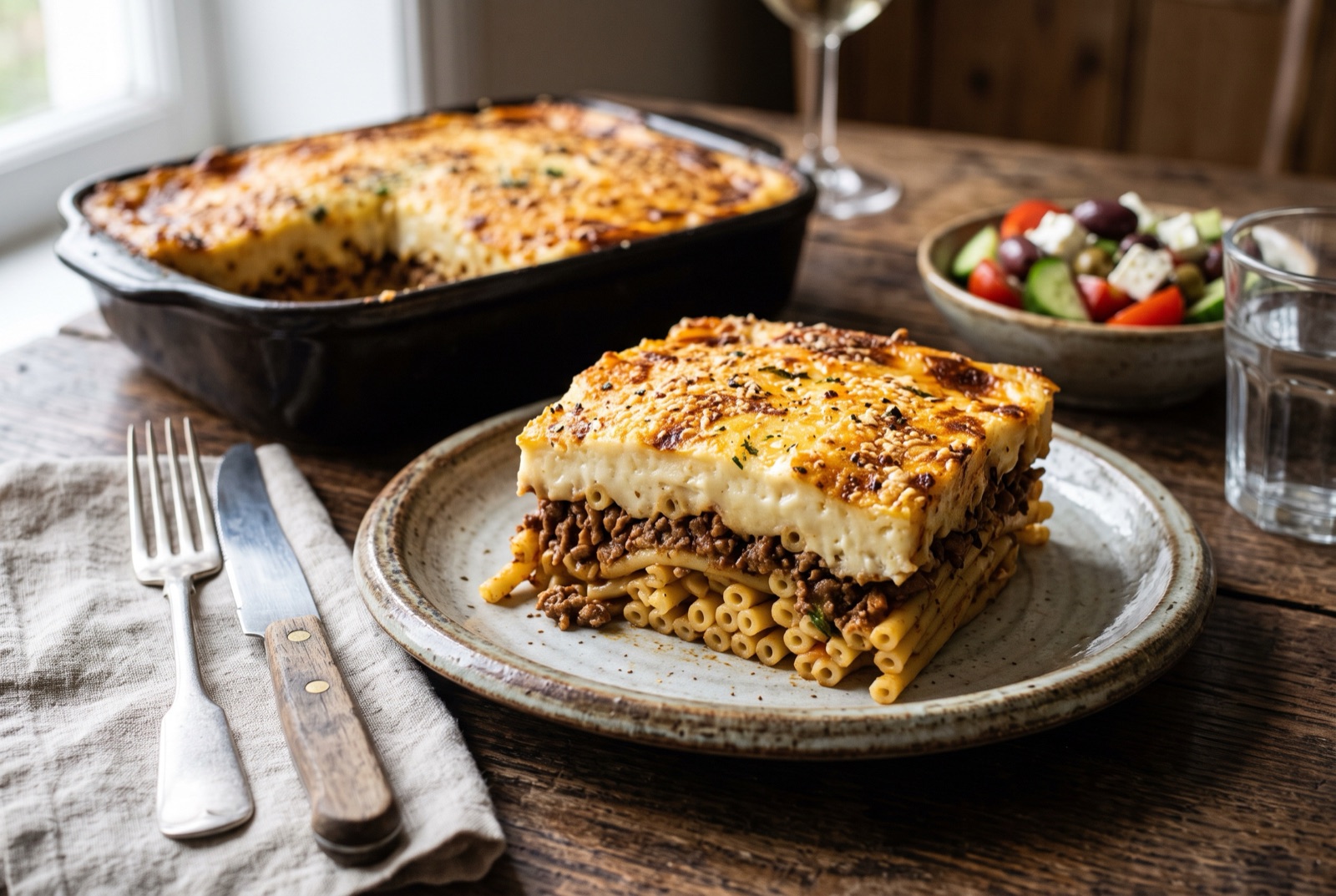
Makaronia tou fournou is a three-layer bake: long thick pasta on the bottom, a dry cinnamon-scented meat sauce through the middle, and a thick béchamel on top that puffs and browns in the oven. The Cypriot signature is in two details — dried mint stirred into the mince, and matured halloumi grated into the sauce instead of the kefalotyri a Greek pastitsio would use, which gives the top a saltier, tangier edge and a slightly chewier set. Cut properly it stands up in clean squares, with the pasta strands running the length of each slice. It is celebration food, funeral food and Sunday food, and every Cypriot household has a strong position on how thick the béchamel should be.

- Gate
- Cyprus
- Prep
- 40 min
- Cook
- 1 hr 15 min
- Total time
- 2 hr 20 min incl. 25 min rest
- Serves
- 8
- Status
- Medium
- Nutrition / serving · estimated
- Calories 680 kcal
- Protein 34 g
- Carbs 58 g
- Fat 35 g
- Fiber 3 g
Why this recipe works.
- Uses grated halloumi in the béchamel, which is the Cypriot detail that separates this from Greek pastitsio.
- Cooks the meat sauce down until genuinely dry, so the layers stay distinct instead of bleeding into each other.
- Béchamel is built thick and enriched with yolks so it slices cleanly rather than running across the plate.
- Includes the alignment step for the pasta that makes cut squares hold their shape.
Ingredients.
19 itemsFor the pasta layer
For the meat sauce
For the béchamel
Equipment
- Deep baking tray about 30 × 22 cm
- Large pot for the pasta
- Heavy saucepan for the béchamel
- Whisk
Instructions.
Make the meat sauce
Soften the onions in the olive oil over medium heat for 8 minutes until translucent and sweet-smelling, add the garlic for a minute, then raise the heat and add the mince. Break it up and cook until no pink remains and the meat has started to catch and brown on the base of the pan.
Spice it and cook it dry
Stir in the tomato paste and fry for a minute until it darkens, then add the wine, tomatoes, cinnamon, dried mint, salt and pepper. Simmer uncovered for 25 to 30 minutes, until the sauce looks dry rather than saucy and you can see fat separating at the edges. Set aside to cool slightly.
Tip If it still looks wet at 30 minutes, keep going. Excess liquid here is what makes the finished bake soggy.
Boil and dress the pasta
Cook the pasta in well-salted water for two minutes less than the packet says, so it is still noticeably firm at the centre. Drain, rinse briefly with cold water to stop the cooking, then toss with the beaten egg and the 80 g of grated halloumi while still warm.
Build the béchamel
Melt the butter, whisk in the flour and cook for 2 minutes until it smells nutty rather than of raw flour. Add the warm milk in three stages, whisking hard, and cook over medium heat for about 10 minutes until it is thick enough to mound on the spoon and hold a trail across the pan.
Enrich the sauce
Take the pan off the heat and let it cool for two minutes, then whisk in the egg yolks one at a time, followed by the 150 g of grated halloumi in handfuls, the nutmeg and a good grind of pepper. It should be glossy, thick and just pourable. Taste and season carefully — the halloumi is already salty.
Layer the tray
Butter a deep 30 × 22 cm tray. Lay half the pasta in aligned rows across the base, spread the meat sauce evenly over it, then lay the remaining pasta on top in the same direction and press down firmly with your palms so the layers compact.
Top and bake
Pour the béchamel over, working it into the corners with a spatula and smoothing the surface. Bake at 180°C for 45 to 50 minutes, until the top is deep gold with darker patches and the tray barely wobbles when you nudge it.
Rest before cutting
Leave the tray on a rack for at least 25 minutes before cutting. Run a knife down to the base in straight lines and lift each square out with a spatula — you should see three clear bands and the pasta strands running the length of the slice.
Tips from our kitchen.
- Undercook the pasta by two full minutes. It absorbs liquid from the meat sauce and béchamel in the oven and turns to mush if it starts out properly done.
- Cook the mince until the liquid has gone and you can see fat separating at the edges of the pan. A wet meat layer is the main cause of a soggy bake.
- The béchamel should hold a ribbon on the spoon for a couple of seconds. If it pours like cream it is too thin — keep cooking it.
- Take the béchamel off the heat before adding the egg yolks and halloumi, and stir the cheese in a handful at a time so it melts smoothly instead of clumping.
- Rest the tray at least 20 minutes out of the oven. Cut it hot and the layers slide apart no matter how well you made them.
- Use a deep tray, at least 6 cm. Shallow dishes give you a thin bake where the pasta layer disappears under the béchamel.
Substitutions.
- Matured halloumi → Kefalotyri, pecorino romano or a mix of parmesan and feta
- Kefalotyri is the mainland Greek choice and melts more readily. Fresh halloumi works but is milder and wetter — matured, drier halloumi grates and browns far better.
- Bucatini or thick tubular pasta → Ziti, penne rigate or thick spaghetti
- Short shapes work fine but give a crumblier slice. If you use them, press the layer down firmly before adding the meat.
- Lamb mince → Pork mince, beef mince, or a half-and-half mix
- Pork is at least as common in Cypriot homes. Beef alone is leaner, so add a tablespoon of olive oil to the pan.
Variations.
- With anari
- Some households fold fresh anari — the Cypriot whey cheese, close to ricotta — into the pasta layer along with mint. It makes a softer, creamier middle and a milder dish overall.
- Lenten makaronia
- A fasting version with no meat and no dairy: pasta layered with a tomato, onion and mushroom sauce and topped with a béchamel made from olive oil and plant milk. Common during Lent, when both meat and cheese are off the table.
- Extra-cinnamon Nicosia style
- A heavier hand with cinnamon and a whole clove or two in the meat sauce, which pushes the dish towards the sweet-savoury end. Divisive within families and worth trying at least once.
Storage & reheating.
Covered and refrigerated, it keeps 4 days and slices better cold than hot. Reheat individual squares covered at 170°C for 20 minutes, or the whole tray for 40; a microwave works but softens the browned top. It freezes well for 3 months either baked or assembled raw — if freezing unbaked, thaw fully in the fridge overnight before baking, since a frozen centre leaves you with a scorched top and cold middle.
Serve with
A sharp green salad with lemon and a spoonful of Cypriot pickled capers — the bake is rich and needs acidity beside it, not more richness.
The story behind Makaronia tou Fournou.
The dish belongs to the wider Greek pastitsio family, which itself descends from Italian baked pasta by way of the Ionian islands and the nineteenth-century Greek kitchen — the name comes from Italian pasticcio, meaning a pie or a mess, depending on the day. What Cyprus did with it is characteristic: it kept the architecture and swapped the pantry. The béchamel is bound with grated halloumi or anari rather than kefalotyri, the mince carries cinnamon more assertively, and dried mint — a herb Cypriots use far more than fresh — goes into the meat layer, giving the whole thing a cooler, greener background note that mainland versions do not have.
Pasta shape is treated as a matter of substance rather than preference. The correct pasta is a long, thick, hollow tube — the Cypriot brands are simply sold as makaronia number 2 — and it is boiled and then laid in the dish in aligned rows rather than tipped in loose. That alignment is the reason a properly made tray can be cut into architectural squares while a carelessly made one collapses into a heap. Traditionally the strands were threaded onto a long needle in some households, though few people bother now.
What makes the dish carry so much social weight is that it feeds a crowd and travels well. It appears at name-day tables, after christenings and at the meal following a funeral, and a tray of it is the standard thing to take to a neighbour who has had a baby or a bereavement. Because it holds its shape cold and reheats without suffering, it is also the classic thing to make on Saturday for a Sunday lunch with fifteen people at the table.
The one genuine difficulty is the béchamel. It has to be considerably thicker than a pouring sauce — closer to a soft custard — because it needs to set into a sliceable layer rather than soak down into the pasta. Cypriot cooks tend to enrich it with egg yolks as well as cheese, which helps it brown and hold. A runny top layer is the most common failure and the reason for the extra cooking time in the method below.
Questions, answered.
Why is my béchamel runny after baking?
It was too thin going into the oven. A béchamel for baked pasta needs to be much thicker than a sauce you would pour — it should mound slightly on a spoon and take a couple of seconds to level out. Cook the roux and milk longer, and enrich with egg yolks off the heat, which set during baking and hold the layer together.
What pasta should I use for makaronia tou fournou?
Long, thick, hollow pasta — bucatini or the Greek and Cypriot "makaronia number 2" — laid in aligned rows rather than tipped in loose. The alignment is what lets the finished bake be cut into clean squares. Short shapes like penne work but produce a crumblier slice.
Can I assemble it the day before?
Yes, and it is the usual approach for a large lunch. Assemble completely, cover and refrigerate for up to 24 hours, then bake straight from the fridge with an extra 15 minutes added. Do not freeze it half-assembled with hot components — cool the meat sauce and béchamel first or condensation waterlogs the pasta.
How is this different from Greek pastitsio?
The architecture is the same, but Cyprus uses grated halloumi rather than kefalotyri in the béchamel, adds dried mint to the meat layer, and is generally more generous with cinnamon. The result is saltier and tangier on top with a cooler herbal note through the middle.
Why did my layers slide apart when I cut it?
Almost certainly because it was cut too soon. The béchamel needs at least 20 minutes out of the oven to set, and 30 is better. A too-wet meat sauce also causes it: cook the mince until the pan is dry and the fat is visibly separating before it goes into the tray.
You might also like.
All recipes →
Keep exploring Cyprus.
Cyprus has 9 more dishes in the atlas — Afelia and Daktyla, and 7 more.
Recipe by The DishRoute Kitchen · published August 20, 2026 · updated August 20, 2026