Rendang Daging.
Malaysian Dry Coconut Beef
Rendang daging · say it: REN-dang DAH-ging
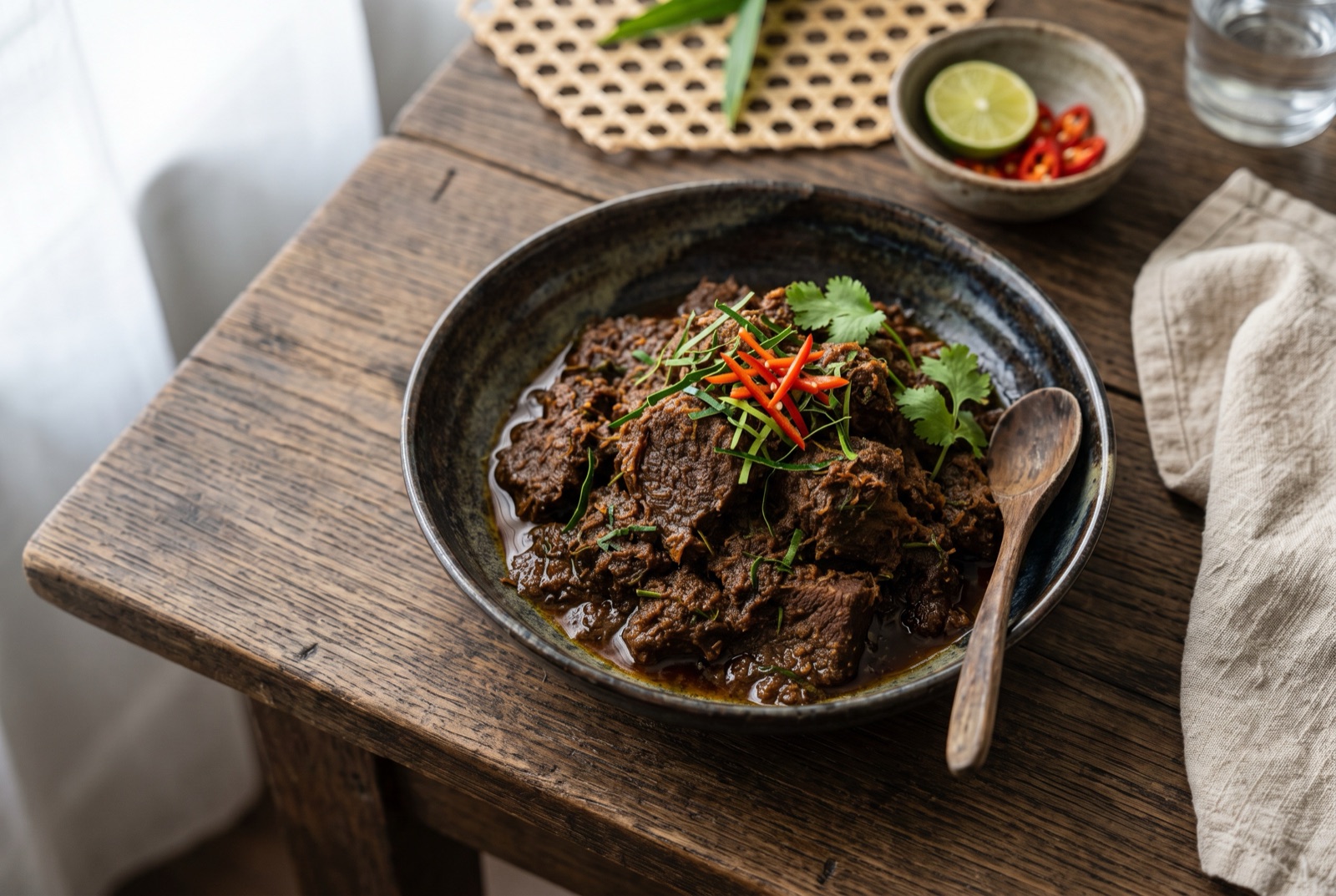
Rendang is what happens when a curry is cooked far past the point most cuisines would stop. Chunks of beef go into coconut milk with a pounded paste of chile, lemongrass, galangal and turmeric, and then simmer for three hours while the liquid evaporates, the coconut milk splits, and the meat finally fries in the spiced oil and coconut solids left behind. The result is barely a sauce at all — a dark, almost mahogany coating that clings to shreds of tender beef, sweet from palm sugar, nutty from toasted coconut, and hot in a slow way that arrives after you swallow. Malaysians eat it at Hari Raya with ketupat rice cakes, and it tastes better on day two.

- Gate
- MalaysiaNegeri Sembilan
- Prep
- 35 min
- Cook
- 3 hr
- Total time
- 3 hr 35 min
- Serves
- 6
- Status
- Takes skill
- Nutrition / serving · estimated
- Calories 620 kcal
- Protein 42 g
- Carbs 14 g
- Fat 44 g
- Fiber 4 g
- Sugar 8 g
- Sodium 620 mg
Why this recipe works.
- Kerisik made from scratch — the toasted coconut paste that gives Malaysian rendang its colour and nutty depth, with the technique explained rather than skipped.
- The three stages are named and given doneness signals, so you know when the dish moves from stewing to braising to frying.
- Uses beef shin or chuck, cuts with enough collagen to survive three hours and come out shredding rather than dry.
- Explains where Malaysian rendang differs from the Sumatran version instead of pretending they are the same dish.
Ingredients.
17 itemsFor the beef
For the rempah
For the kerisik
To cook
Equipment
- Blender or stone mortar
- Wide, heavy-bottomed pan or Dutch oven
- Wooden spoon or paddle
Instructions.
Make the kerisik
Dry-fry the grated coconut in a pan over medium-low heat, stirring without pause, for 10–12 minutes until it goes from white to sandy to a deep chestnut brown and smells like toasted nuts. Tip it hot into a blender or mortar and work it until the oil comes out and it collapses into a dark, sticky paste.
Tip It browns unevenly if you stop stirring, and the difference between chestnut and burnt is about thirty seconds.
Blend the rempah
Drain the soaked chiles and blend them with the shallots, garlic, ginger, galangal, sliced lemongrass, turmeric and ground coriander to a thick paste, using as little water as the blender will tolerate. Scrape down the sides twice; you want no fibrous shreds left.
Fry the paste
Heat 4 tablespoons of oil in a wide heavy pan and fry the rempah over medium heat for 12–15 minutes, stirring often, until it darkens, loses its raw sharpness and a thin film of oil rises to the surface.
Add beef and coconut milk
Stir the beef through the paste until every chunk is coated, then pour in the coconut milk and add the bruised lemongrass, lime leaves and turmeric leaf. Bring to a bare simmer and cook uncovered, stirring every 10 minutes or so, for about 90 minutes.
Tip Keep it at a lazy blip. A rolling boil splits the coconut milk far too early and toughens the meat.
Reduce until the oil breaks
Stir in the kerisik, sugar and tamarind water. Continue cooking uncovered for another 60–75 minutes, stirring more and more often, until the sauce turns from pale brown to dark russet, thickens around the meat and finally splits, releasing clear reddish oil at the edges of the pan.
Fry the meat in its own oil
Lower the heat and keep stirring for a final 15–20 minutes, scraping the base constantly, until the coating is dry and clinging and the beef shreds under light pressure from the spoon. Season with salt now, taste, and pull the lemongrass stalks out before serving.
Tip Ready looks almost dry: no pooled sauce, just glossy meat in dark spiced solids with a slick of oil.
Tips from our kitchen.
- Use a wide, heavy pan rather than a tall pot. Rendang is a reduction, and surface area is what lets three hours of evaporation actually happen.
- Blend the rempah with as little water as possible. Every spoon of water you add is a spoon you have to boil off again later.
- For the kerisik, keep the coconut moving over medium-low heat — it goes from golden to burnt in about thirty seconds, and burnt kerisik makes the whole pot bitter.
- The last thirty minutes need constant attention. Once the oil breaks out the beef is frying, not simmering, and the base will catch if you walk away.
- Salt at the end, not the start. The volume of liquid drops by two thirds, and rendang seasoned early ends up inedibly salty.
- Make it a day ahead. The spices settle and the meat absorbs the sauce overnight, which is why nobody in Malaysia cooks rendang on the morning of the feast.
Substitutions.
- Fresh galangal → Frozen galangal slices, or in an emergency an extra thumb of ginger
- Galangal is sharper and more piney than ginger and is not really interchangeable, but ginger gets you a good stew. Dried galangal powder is a poor third — use half a teaspoon at most.
- Kerisik (toasted coconut paste) → Desiccated coconut toasted in a dry pan, then blitzed with a tablespoon of oil
- Fresh grated coconut makes better kerisik because it releases its own oil, but frozen grated coconut works and desiccated is acceptable. Skipping it gives a thinner, paler rendang.
- Turmeric leaf → Two makrut lime leaves, shredded very fine
- Not the same aroma — turmeric leaf is grassier and less citrus — but it keeps the finished dish from tasting flat. Omitting both is fine; the rendang is still recognisably rendang.
Variations.
- Rendang tok
- The Perak royal-court version: cooked even drier and darker, with more kerisik and often a splash of tamarind, until the meat is almost candied.
- Rendang ayam
- Chicken rendang, cooked the same way but in about an hour. Use bone-in thighs and drumsticks; breast dries out long before the sauce reduces.
- Rendang daging with potato
- A common home shortcut in Malaysia: whole small potatoes added in the last 45 minutes, soaking up the spiced oil and stretching the meat further.
Storage & reheating.
Rendang keeps 5 days refrigerated and improves for at least the first three; the fat sets on top and protects it. Reheat gently in a pan with a tablespoon of water, stirring until the oil loosens again — a microwave works but tends to dry the edges. It freezes well for three months in portions. Genuinely dry rendang, cooked until almost black, keeps at cool room temperature for a day or two, which is what the technique was originally for.
Serve with
Ketupat or lemang rice cakes at festivals, or plain steamed rice and a plate of acar on an ordinary day.
The story behind Rendang Daging.
Rendang belongs to the Minangkabau people of West Sumatra, and Indonesia and Malaysia have been politely disagreeing about it ever since. The honest position is that it is a shared dish with a shared origin: Minangkabau traders and migrants settled Negeri Sembilan on the Malay peninsula centuries ago and brought the technique with them, where it met local tastes and slowly diverged. Neither country invented it separately, and neither owns it now.
What did diverge is the cooking. Sumatran rendang is generally taken further and drier — cooked until it is almost black and will keep for weeks without refrigeration, which was the original point in a hot climate before iceboxes. Malaysian rendang is usually stopped earlier and left a little wetter, sweeter, and softer in colour, and most Malaysian cooks finish it with kerisik: fresh coconut dry-fried until dark brown, then pounded until the oil comes out and it turns into a coarse, greasy paste. Kerisik does two jobs at once — it thickens and it adds a toasted, almost caramel note that plain coconut milk cannot give. Turmeric leaf, shredded fine, is the other common Malaysian signature.
Rendang is festival food. It appears at Hari Raya Aidilfitri after the fasting month, at weddings, and at kenduri — the communal feasts thrown for births, house moves and returning pilgrims — where it is cooked in a cauldron over wood by whoever in the family has the arm for it, because for the last hour someone has to keep the wooden paddle moving or the bottom scorches. That labour is not incidental; a rendang that has not been stirred through the breaking of the coconut milk is a curry, and Malaysians will tell you the difference immediately.
Questions, answered.
What is the difference between rendang and curry?
Time and liquid. A curry is served in its sauce; rendang is cooked until the sauce has gone. Once the coconut milk reduces past the point of emulsion it splits, releasing oil, and the meat then fries in that oil with the spice paste and coconut solids. That frying stage is what creates rendang's dark colour and concentrated flavour, and a wet, saucy version is properly called kalio — a legitimate halfway dish, but not rendang.
What is kerisik and do I have to make it?
Kerisik is grated coconut dry-fried until deep brown and then pounded or blended until the oil is released and it becomes a dark, oily paste. It thickens the rendang and adds a toasted, nutty depth. It is close to essential in the Malaysian style — without it the dish is paler and thinner. Desiccated coconut toasted and blitzed with a little oil is a workable shortcut.
Which cut of beef should I use?
Shin, chuck, brisket or short rib — anything with connective tissue that turns to gelatin over long cooking. Three hours will destroy lean cuts like rump or sirloin, leaving dry fibres in an oily sauce. Cut the meat into large chunks of about 4 cm; smaller pieces shred apart before the sauce has reduced.
Why did my rendang burn on the bottom?
Because the final stage is frying, not simmering. Once the coconut milk breaks and the oil separates there is little water left to protect the base, so the pan needs a lower flame and near-constant stirring for the last half hour. A heavy-bottomed pan helps enormously; a thin one will scorch no matter how carefully you watch it.
Can I make rendang in a pressure cooker or slow cooker?
Partly. Both are good at tenderising the beef but bad at the reduction, because neither lets moisture escape. The workable method is to pressure-cook the meat in the paste and coconut milk for about 30 minutes, then transfer everything to a wide pan and reduce it uncovered until the oil separates. You cannot skip the open-pan stage and still get rendang.
You might also like.
All recipes →
Keep exploring Malaysia.
Malaysia has 9 more dishes in the atlas — Acar Awak and Asam Laksa, and 7 more.
All Malaysia recipes Beef chuck recipes Coconut milk recipes Coconut recipes maindairy freegluten freehalal friendlyRecipe by The DishRoute Kitchen · published August 20, 2026 · updated August 20, 2026